Toronto mayor Rob Ford’s problems include living in a “American-style suburban McMansion”?

The mayor of Toronto is getting all kinds of attention – and at least one person thinks one of his problems is “American-style suburban McMansion”:

Also from the Gawkerverse: this Ken Layne piece about Rob Ford’s essential un-Canadianness, which wrongly asserts that “when he sits around his American-style suburban McMansion, he literally sits around his American-style suburban McMansion.” Rob Ford’s house is suburban, but it’s actually a pretty modest place.

Americans are known for their big houses. It shouldn’t be a surprise that this is something Canadians pick up on since most Canadians live quite close to the U.S.-Canada border. Indeed, there are plenty of stories regarding McMansions in the Chicago metropolitan region and Chicago and Toronto are often compared to each other. But, which part of the insinuation is worse:

1. That a Canadian acts like an American?

2. That owning a McMansion is a bad thing anyway (whether one lives in Canada, the United States, Australia, and other places with McMansions)?

3. That sprawl/suburbs are bad?

This also reminds me of the documentary Radiant City that involves Canadian suburbanites outside of Calgary but utilizes a number of American opponents to McMansions and seems to be most interested in tackling American-style sprawl. A side note: it is a film that includes a mock musical about mowing lawns.

The crazy house you get when put together the McMansions of Google 3D warehouse

One group combined the various McMansion designs they found on Google 3D warehouse – and the result is not pretty:

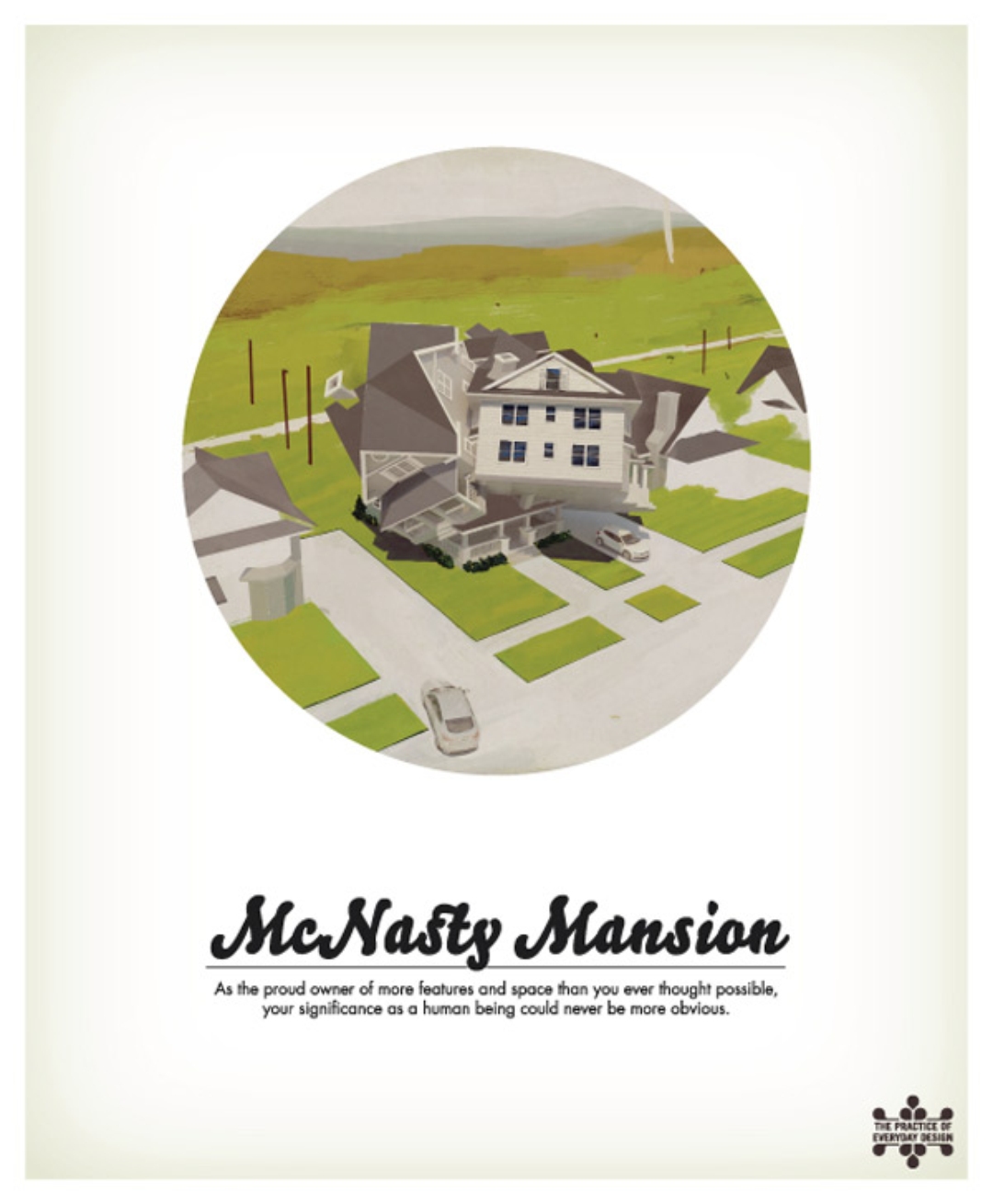
Two-year-old Canadian design office The Practice of Everyday Design searched Google 3D Warehouse (an open-source library of model files) for the most popular suburban home typologies. After culling the top examples, they fused them all together and 3D-printed the mess. They call it “Nasty McMansion,” and you can buy one! We suggest hanging it on a string and dangling it from the ceiling in your office, as a warning.

Think of it as a kind of Ringstrasse for suburban mansions. Write TOPED:

“The McNasty Mansion offers a new and more exciting typology of homes, formed off the same principals of the McMansion: more rooms than one can fill, enough mixed styles to ensure complete architectural confusion, and enough faux finishes and cheap materials to keep cost down but dimensions huge.

I’m not sure how exactly they put this image together but it looks like it was done in such a way to maximize the bizarreness. For example, that front door on the left that tilts down toward the ground would be quite difficult for the average McMansion owner to access. Wouldn’t you get a similar result even if you combined more pleasing designs? And how exactly does their 3D design incorporate “faux finishes and cheap materials” versus the real things? But, if the goal was to create a “McNasty” design that creates a startling visual, the goal was met.

Just curious: what is the general level of architectural design on Google 3D warehouse?

Don’t confuse community-building “little free libraries” for bird McMansions

Don’t make the mistake of confusing a “little free library” with an oversized birdhouse in your neighbor’s front lawn:

Zooming by in your car, you might mistake them for bird McMansions…

Based on a map on the Little Free Library website and chatter among local “stewards” — people who erect the boxes and maintain them — we’d say the Kansas City area has at least 20 little libraries so far, typically about the size of a recycling bin.

The idea germinated in a small Wisconsin town in 2009, when Todd Bol built a diminutive one-room schoolhouse out of an old garage door as a tribute to his late mom, a teacher. He stocked it with books and put it on a post outside…

“This is just a way to build community, and people can put in books that they love or just want to get rid of,” says Theiss, who’s an actual librarian. She works at Rockhurst University.

Several things are interesting here:

1. People with these libraries still believe in the power of books. How many people in the U.S. would agree?

2. From this article, it sounds like many of these small libraries are in fairly well-off suburban-type neighborhoods. The irony is that such neighborhoods are supposed to have community but need these small book outposts to bring community.

3. While these small libraries may have benefits, does this suggest people don’t want to spend the time to travel to the library? Perhaps this is more about convenience than community?

I’ll be curious to see if this is just a fad or something longer lasting.

New York City seeing a rise in super-rich mansions (not McMansions)

Curbed highlights a Gizmodo story about “McMansions” in New York City – and both get it wrong as these new homes are far beyond McMansions:

But developers may be reaching a breaking point in Manhattan, where warehouses are being bought to build $100 million single-family homes.

A handful of real estate stories this week question whether NYC is reaching peak development. First off, we have a mind-boggling report about the rise of single-family “palaces” in Manhattan. According to the New York Times, the super-rich are buying up warehouses, parking garages, and other commercial buildings to turn them into gigantic McMansion-style homes (including what will soon become the largest single-family home in the city). According to one broker, the new “benchmark” price is going to be $100 million, as opposed to the almost austere $50 million buyers expected to pay a few years ago.

It’s one thing to get rid of warehouses and garages—but another set of trend pieces alert us of a more problematic trend: The disappearance of gas stations in the city. As developers strive to find new plots of land that can be rebuilt from the ground up, they’re buying up gas stations left and right. We’ve covered at least one of these developments before, but according to the NYT and the Village Voice, it’s becoming a problem for cab drivers who can’t always find a station in time.

Note: the New York Times article cited above which starts with the story of a new 40,000 square foot home does not use the term McMansion. Calling them McMansions is just wrong; these are unusually large and expensive homes that go far beyond the typical, mass-produced, large suburban home.

More on these new homes from the New York Times:

“The town-house buyer doesn’t want a multi-unit condominium that is mass-produced,” said Wendy Maitland, a senior managing director of sales at Town Residential, who just closed a deal on a town house at 45 East 74th Street for $26 million. “This is an entirely private home, built for the lifestyle of someone who has multiple staff, a private driver. These people do not need a doorman, and they aren’t sharing amenities.”

Such buyers don’t exactly need a discount, but the value of private homes compared with condominiums is a draw anyway. “There is a gap in the marketplace — mansions are an area that is undervalued,” said Louis Buckworth, a broker at the Corcoran Group. He recently represented the British real estate magnate Christian Candy in buying a $35 million 30-foot-wide mansion for his family on the Upper East Side. (“Mansion” is typically defined as a town house at least 25 feet wide.) Mr. Candy’s new home, at 17,000 square feet, cost less than $2,100 a square foot. Meanwhile, “an 11,000-square-foot apartment at One57,” said Mr. Buckworth, referring to the glass tower in Midtown that Extell Development is building, “sold for $10,000 a square foot, making what we paid a joke.”

McMansion owners may want similar things – privacy, more space – but these homes are a step above.

Interestingly, even with their size and price, they tend to compare favorably to expensive homes in other global cities:

And for many buyers — especially foreigners who see real estate as more affordable in New York than in cities like London or Hong Kong — the numbers are eye-catching. Mr. Candy, for example, just sold a $250 million apartment in London and a $400 million home in Monaco, Mr. Buckworth said. “So as a foreigner, you say to yourself: ‘I can spend £20 million for an average-size flat in London, or get a mansion in prime Manhattan.’ And you can see why these numbers aren’t going to be particularly scary.”

So instead of pitching the story on Curbed and Gizmodo as the excesses of the American wealthy in New York City, this could be told as a story of relative value for big homes in a major global city. Same data, different contexts and narratives. Just bringing up the word McMansion implies selfish owners out to live in ostentatious homes.

Homebuyers don’t want “the same old McMansion”

Here some evidence that “the same old McMansion” is outdated and needs some new features:

New home buyers are coming back, but they don’t want the same old McMansion. They want a house they can use.

That means a “great room” where everyone can gather – and a spalike bathroom to escape from the crowd.

But usefulness also extends to lots of storage space for big-box buys. It means “drop-off zones” for recharging smartphones and pet-friendly “puppy showers.” It means a home office actually designed for work and media centers made for play. It means big closets and little nooks…

According to experts, today’s home buyers are much more budget conscious, a natural consequence of the recession. They demand more value per square foot. They’re not interested in rooms they will rarely use such as a formal dining room. Most of all, home buyers want a house that “works” for them.

“McMansions put a huge percentage (of square footage) into hallways and formal spaces that are used infrequently,” Lake said. “It adds up to a lot of square footage. We’re building homes with 1,000 less square feet but every room feels bigger because the house isn’t so cut up.”

As the article notes toward the end, these are not necessarily smaller homes. In fact, my interpretation here is that these are McMansions with different features. What counts for luxury today versus twenty years ago has changed: buyers want to see how to use their space rather than simply have large spaces, they want luxurious bathrooms, and they want exciting kitchens and great rooms. I’m guessing builders don’t mind these changes too much – they can work against the McMansion image (customize the luxury items!) and still sell expensive homes at high prices.

The question in the long run is whether these interior design changes are enough to stop these homes from acquiring the McMansion label.

One way to avoid teardown McMansions nearby: just buy all the properties yourself

Mark Zuckerberg has a way to avoid annoying teardown McMansions next door:

Facebook chief and founder Mark Zuckerberg bought four homes adjacent to his own tony Palo Alto house to prevent a developer from building a McMansion capitalizing on being next to the creator of Facebook.

Zuckerberg paid more than $30 million for the four properties next door and behind his home, and is now leasing them back to the owners, according to the San Jose Mercury News.

The 29-year-old billionaire reportedly bought the houses to prevent a developer from building a McMansion and marketing it as “being next door to Mark Zuckerberg,” according to an unnamed source.

According to public records, the home behind Zuckerberg’s was sold last December to a legal entity affiliated with Iconiq Capital, a San Francisco company that handles Zuckerberg’s finances. Last month, two more properties behind his home and one next door were also bought by associated entities of Iconiq. One of the properties sold for $14 million.

The irony of this is that defeating teardown McMansions requires having more money than the possible property owners. Have less money and residents can often have a fight on their hands.

Another issue: who would pay more money for a home just because it is next to Mark Zuckerberg? Rather than offering opportunities to spy on Zuckerberg, I wonder if this is more of a halo effect for the neighborhood: it’s such a good neighborhood that one of the world’s best-known people live here.

Bankrate.com asks “What is a McMansion?”

Bankrate.com defines financial terms and recently look at the term McMansion:

The Bankrate.com financial term of the day is: “McMansion”

“McMansion” is a disparaging term used to describe homes that are oversized and opulent, but also without a whole lot of uniqueness. McMansions are loosely defined as houses between 5,000 and 10,000 square feet with soaring, grandiose entryways and multicar garages, often shoehorned onto relatively small lots.

McMansions are giant homes that have sprouted up in the suburbs the way fast-food restaurants have — hence the name.

Three features of this definition stand out: (1) marking the term as a disparaging one – it is rarely used positively and can be used effectively when criticizing others; (2) it highlights their mass-produced nature (not very unique, sprouted up); and (3) sets some square footage limits so that McMansions are larger than most American homes but don’t run into mansion territory. Several other parts of the definition, including common design features and small lots, may be common but are not part of all McMansions. However, the video is disappointing. I was hoping for some classic images of McMansions…

I also wonder if this is Bankrate’s definition of a McMansion as Americans see them or as a financial publisher? Here is a little bit about Bankrate.com:

We at Bankrate, Inc. have over three decades’ experience in financial publishing. Bankrate was born in 1976 as “Bank Rate Monitor,” a print publisher for the banking industry…

Today, Bankrate, Inc. is the Web’s leading aggregator of financial rate information, offering an unparalleled depth and breadth of rate data and financial content. Bankrate continually surveys approximately 4,800 financial institutions in all 50 states in order to provide clear, objective, and unbiased rates to consumers. Our flagship Web site, Bankrate.com, provides free rate information to consumers on more than 300 financial products, including mortgages, credit cards, new and used automobile loans, money market accounts, certificates of deposit, checking and ATM fees, home equity loans and online banking fees.

In addition to rate data, we publish original and objective personal finance stories to help consumers make informed financial decisions.

What exactly does Bankrate think about McMansions?


Older adults like bigger things, like McMansions; younger adults like smaller things, like skinny jeans

Here is an example of tying consumption of things like McMansions or skinny jeans to certain generations:

If there’s one thing today’s young people know it’s this: size doesn’t matter.

From watching movies on cell phone screens to driving micro-cars like the Honda Fit, less is more with this generation.

Known as millennials, people born in the years just before and after 2000, believe in small carbon footprints and short attention spans. They don’t watch television episodes, they watch YouTube clips. Even email is too cumbersome for them. Millennials prefer to communicate with more instantaneous social media like Facebook chat and text-messages.

Compare this with people from Gen X and older and you see how wide the size-gap has become.

We Gen X’ers wore baggy jeans, flannel shirts and puffy hair. Many (too many) of us have oversized televisions and drive Hummers as big as tanks. We live in McMansions and super-size our lunches while today’s younger people wear skinny jeans, live in small apartments, and eat more salad.

We had record and compact disc collections with gigantic stereo speakers. They have iPod Nanos and ear buds.

The conclusion of the argument is that doing more with less is probably better on a crowded planet. Comparing the consumption of a McMansion to a tiny house (a comparison made a few paragraphs later) is one way to measure things: one house is bigger than the other and requires more resources. But, how do you compare a McMansion to an iPhone? The McMansion might require more resources (though all that goes into making an iPhone is more hidden) but can’t the consumption of an iPhone still be a problem (if younger adults are spending hours and hours with the device – and at least some are)? Plus, if you consume smaller objects, theoretically you might do it more often and collect a lot of stuff in the long run, even if it is more in the form of digital files. And then skinny jeans versus baggy clothes? Is this more about aesthetics rather than the size of consumption objects?

All that said, making sweeping claims about consumption patterns across generations can be difficult. We might be on safer ground by arguing that younger generations today are buying different kinds of products (digital, in particular) and may not be valuing “traditional” American consumption (cars, bigger houses).

Claim: New Jersey McMansions being built in well-connected places

If McMansions are on a comeback, one observer in New Jersey suggests the state’s new McMansions tend to be built to certain places:

The National Home Builders Association survey found growing interest in them, but Rutgers trend watcher James Hughes says not in New Jersey – with a few exceptions.

“In well-placed communities with rail access to New York city, some McMansions are being added.”

He says a large baby boom generation may be vacating their McMansion, but the pool of buyers for them is shrinking.

Hughes is hinting at a few things that influence McMansion placement:

1. Places connected to New York City by train may be likely to have more money, tied to their jobs in the city. These communities may be desirable because they offer options to driving as well as the possibility of more established suburbs.

2. Younger generations aren’t as interested in McMansions so there is less demand for such homes.

These may be actual reasons but the first one is also a bit paradoxical. New Urbanists as well as those interested in transit-oriented development have tended to emphasize that suburbs with mass transit nodes can be home to denser housing. What happens if McMansions and other big housing options come to dominate such suburbs and end up pricing out many suburbanites?

Advantageously framing a teardown McMansions debate

A story on Burbank, California residents opposing teardown McMansions illustrates one way to frame the debate:

Put a six bedroom, five bath, mansion, next to a 1940’s three bed, one bath.  Sound a little mismatched?

A group of Burbank residents think so, and they’re urging Burbank officials to regulate “McMansions” from defacing the character of their neighborhoods…

Her dutch colonial home has been carefully remodeled to stay in line with the character of the neighborhood.

Right across the street from her, a historic house was demolished, oak trees were uprooted, all to make way for three huge six bedroom mansions, two sit empty for months at a time and are up for rent.

Here is what is emphasized in this framing: the lives of long-time residents of an established neighborhood are being disturbed by outsiders constructing big homes that serve their personal interests rather than those of the community. Modest homes next to gargantuan homes. A quaint neighborhood character versus a super-sized, garish character. This is a common rhetorical technique utilized by those opposed to teardown McMansions. (This argument may also include financial pitches as older residents have a hard time keeping up with increased property taxes.)

The counterarguments can include:

(1) Individual property owners should be able to do what they want with their property. This includes the rights of current property owners to cash out on their once-modest homes and for new owners to be able to use their resources to build the kind of home they desire.

(2) Neighborhoods are going to change over time. Suburban residents can be guilty of trying to “freeze” their neighborhoods in time, preserving the features they liked when they moved in. (This isn’t just limited to teardown situations. See NIMBY.) However, this limits the “natural” change that might take place in neighborhoods as new residents move in and social conditions change.

Even this article mainly provides the viewpoint of those opposed to McMansions, it also hints at the common divide in teardown discussions: the rights of owners in a neighborhood to preserve what is there versus the rights of individuals and outsiders to change features of the neighborhood. However, this framing as presented here can be quite effective as it suggests outsiders threaten good neighborhoods.

See an earlier post on Burbank and McMansions here.