Old Navy map of Chicago emphasizes trendy, whiter areas while ignoring other areas

A shirt recently on sale at Old Navy made some interesting choices in displaying Chicago neighborhoods:

Freeman, 35, who does freelance writing on comedy for the Tribune, tweeted out a picture of the T-shirt on Thursday. He was out looking for pajamas for his young children last Saturday and saw the T-shirt at the Old Navy in Oak Park.

“May have found the worst Chicago map ever — on a shirt at Old Navy,” Freeman tweeted. “Wicker Park has its own listing but #2, #13 and #14 sum up the entire south and west sides.”

Indeed, every neighborhood from Galewood to Little Village to Lawndale to Austin and the Island is part of the “Far West Side,” according to the map. Englewood, West Englewood, Gresham, Marquette Park, Brighton Park and a host of other neighborhoods are part of the “Southwest Side.”…

A spokesman for the city department in charge of official maps pointed out that Old Navy has a presence in Chicago, which might excuse a mistaken T-shirt.

A few quick thoughts:

1. I wonder if this reflects what a suburbanite or a tourist might know. Most of the smaller areas are closer to the Loop and Lake Michigan. The O’Hare and Midway Area neighborhoods are named after the one location in each place that an outsider might ever visit.

2. Another possible defense for the neighborhoods listed: it would be harder to fit all 77 official community areas and 178 official neighborhoods on a shirt.

3. It would be interesting to know how well Chicagoans know all the community areas and neighborhoods.

4. How many of these shirts could Old Navy sell? Several thousand? Perhaps the company should know better but the map may have had more exposure through the media reports about it than through actual sales.
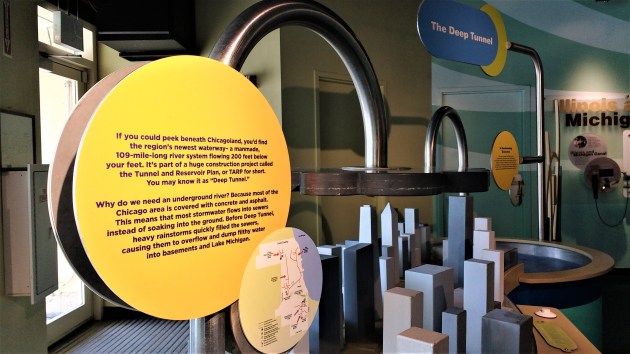
Teaching kids about Chicago’s Deep Tunnel project

Kids should know about one of the largest civil engineering projects in the world: the Deep Tunnel project in and around Chicago.

DeepTunnelNotebaertNatureMuseum

This is from the Riverworks exhibit at the Peggy Notebaert Nature Museum in Chicago. While some of the pieces of the exhibit failed to work the day we visited, I think I could see the purpose of the The Deep Tunnel exhibit: the floodwaters would be diverted away from the city.

The concept may appear simple and explainable to kids but the execution in real life is not. The exhibit suggests the flooding the past is now alleviated by Deep Tunnel. Yet, the problems are likely to go on in a region that continues to expand and change. Remediating water and flooding issues is a very difficult task compared to altering development at the beginning.

It is interesting to think how else this engineering feat could be presented to children. I could imagine a scaled model that kids could walk through to help give them a sense of the size of the sewers needed as well as the size of some of the water reservoirs. Deep Tunnel is not intended for minor amounts of water; this is supposed to help protect millions of people on a fairly regular basis. Communicating the sheer size could fascinate kids. Or, perhaps some sort of computer game where kids play the role of an engineer or expert as they make choices about where to divert water. Come to think of it, where is this version of Simcity or Roller Coaster Tycoon – “Infrastructure Builder” or “Sewer Wars” or something catchier.

Fox Valley Mall “near Naperville” Part 2 – development requirements

A store at Fox Valley Mall prefers to say they are “near Naperville” rather than the actual location in Aurora. How did this shopping center end up across the street from Naperville?

The Urban Investment and Development Corporation (UIDC) started purchasing property for a shopping center in 1966. At this point, Naperville was expanding to the south and southwest at a rapid rate but was nowhere near the size it is today. Similarly, Aurora had an established downtown but there was not a whole lot of development in this area. To help guide its growth, Naperville had developed regulations, particularly in residential subdivisions, to help ensure quality development.

In 1972, UIDC annexed the land they had purchased to Naperville. According to local officials in both communities, the developer chose Aurora in part because of fewer development regulations. Fallout from this choice ensued. Aurora and Naperville signed a boundary agreement to help limit such situations where a developer could play the two communities off of each other. The 1975 Naperville mayoral race included discussion of the loss of the mall. Additionally, the construction of the mall and the loss of status and sales tax money to Aurora helped spur Naperville leaders toward improving the community’s downtown. After the mall opened, Naperville was able to capture some status and money through the opening of stores on the east side of Route 59.

In sum, the developer of the Fox Valley Mall chose to locate in Aurora for some advantages in the early 1970s. Given the path of the two communities since then, I wonder if that developer would choose differently today. On one hand, a Naperville address would convey a certain status. On the other hand, locating just across the street might be the perfect solution: the developers could get benefits from Aurora while always claiming to be “near Naperville.”

Fox Valley Mall “near Naperville” Part 1 – status

I recently heard a radio ad for a store located at Fox Valley Mall which was said to be “near Naperville.” The mall is officially located in Aurora so why would a store there claim to be in the next suburb over? One word: status.

In this particular location, Aurora and Naperville are separated by Illinois Route 59. On the east side, containing a number of stores just across the street from the mall, is Naperville. On the west side, including the mall plus additional stores, is Aurora. Aurora is the bigger community – roughly 200,000 people – but Naperville is the wealthier, higher status community. Some of the figures: Naperville has a median household income of over $110,000 and 4.9% of residents are in poverty. In contrast, Aurora has a median household income of almost $64,000 and 14.0% of residents are in poverty. The communities also differ in race and ethnicity: Aurora is significantly less white (over 30%) and more Latino (35% more) and Black (5% more).

So, when a store says they are “near Naperville,” what are they trying to hint at? They want to associate their store and the shopping experience with a wealthier community rather than Aurora. They want people to think of an upscale and safe place, rather than the diversity of incomes and races/ethnicities of Aurora. Ultimately, they want shoppers to come and spend money like they have Naperville resources.

If it is the case that the store wants to associate with Naperville, why is it located in Aurora? The bigger question: why is the mall in Aurora? To be answered tomorrow.

Determining the complicated boundaries of the Chicago suburbs

Prompted by the discovery of Green Oaks, Illinois earlier this week, I went searching for a list of all of the Chicago suburbs. Instead, I found a discussion about where exactly the Chicago suburbs end. Here is an expert talking about this very issue in summer 2018:

The best definition of where the “suburbs” are, according to Ellis, is probably the boundaries of the Chicago-Naperville-Joliet Metropolitan Statistical Area

But calling everything inside those boundaries “the suburbs” is probably too simple…

So, Ellis said, the suburbs end to the west at the Fox River, to the south along the Lincoln Highway, and stretch along the train lines as far south as Michigan City, IN and as far north as Kenosha, WI.

The second map probably also conforms to cultural understandings in the region about what is really a suburb. There are places that could be within the far-flung orbit of Chicago but do not think of themselves or are not regarded by others as true suburbs.

This is an issue for many metropolitan regions, particular due to two changes:

1. Suburban areas keep developing further from the central city.

2. More people commute suburb to suburb rather than into the central city on a regular basis.

With more housing available further from the city as well as the presence of jobs in far-flung job centers, more residents can be part of a metropolitan region even if they rarely make a trip into the big city or do direct business with the big city.

See the new skyscrapers soon to be added to Chicago’s skyline

Curbed Chicago takes a quick look at eleven skyscrapers, seven proposed or approved and four under construction, that could alter the iconic skyline of Chicago:

Vista Tower.
Studio Gang

Vista Tower

Status: Under Construction

Currently rising along the south bank of the Chicago River’s main branch, the 1,198-foot Vista Tower is posed to become the city’s third tallest building. It’s angular design from Chicago architect firm Studio Gang is made up of three stacks of undulating geometric frustums wrapped in alternating bands of shaded of glass.

Work progressed quickly after Vista broke ground in 2016 and recently reached the halfway mark. Delivery of its 406 luxury condos, a 192-room five-star hotel, and impressive amenities is expected in 2020…

Golub & Co./CIM Group

Tribune Tower East

Status: Proposed

At 1,422 feet, this proposed addition to Chicago’s neo-gothic Tribune Tower is gunning for the title of Chicago’s second tallest building. Slated to replace a parking lot just east of its historic neighbor, the yet-to-be-named skyscraper will contain a 200-key luxury hotel, 439 rental apartments, 125 condominiums, and 430 parking spaces.

The design from hometown architecture firm of Adrian Smith + Gordon Gill is quite slender by Chicago standards—partly due to a protected view corridor requiring Tribune Tower to remain visible from the Ogden Slip to the east.

A skyline is important to the status of a city, particularly for one like Chicago that takes pride in a history of important architectural works (particularly in the Loop as it transformed from a commodity based economy to a finance center) and consistently works to assert its importance as a global city. These new buildings will add more glass as well as more height to the skyline. It will take some time for all of them to become accepted and recognized parts of the a skyline for a long time that was fairly set (roughly from the early 1970s to the early 2000s with the three tallest buildings).

It would be interesting to consider how Chicago compares to other cities in the approval and construction rate of skyscrapers. Even on this list, the majority of the tall structures are not yet under construction. Chicago always seems to have some supertall buildings in the works (see this earlier post) but many do not come to fruition. Is this common in all major cities? Does Chicago have more proposals than normal or a lower ratio of completed buildings?

Photo reminders that railroads ran into the heart of Chicago into the mid-1900s

Chicago’s Loop today is associated with gleaming skyscrapers and the finance and banking industries. Here are some great photos that provide a reminder that Chicago’s rise and wealth depended on railroads that ran right to the center of the city: the south bank of the Chicago River as well at the lakefront (which is now Grant Park).

Historically, railroads helped make Chicago what it is. As detailed in Nature’s Metropolis, Chicago became the center for gathering commodities and goods from the fertile Midwest (corn, cattle, etc.) as well as distributing other goods back to the growing Midwest. This thriving trade helped prompt other businesses and industries to form, such as the development of commodity futures.

These railroads still matter tremendously in the Chicago region, even if they are less visible. There are still railyards in Chicago (such as near Midway Airport), just outside the city (such as near O’Hare Airport), and other ones a long ways away (such as the intermodal facilities in Joliet or New Rochelle which facilitate transferring materials between trains and trucks). The trains may block traffic but they help ensure Chicago remains a transportation center.

Chicago neighborhoods lead the way in percentage and absolute numbers of millennials

Chicago continues to be a draw for young adults:

According to U.S. Census population estimates, 73 percent of West Loop residents (6,800 people) are millennials. California-based apartment search website RENTCafe.com analyzed the data, ranking ZIP codes in the country’s 30 largest U.S. cities. And the West Loop — ZIP code 60661 — is home to a higher percentage of people born between 1977 and 1996 than any other in the country, according to their analysis.

But the trendy downtown-adjacent neighborhood doesn’t come close to several other Chicago areas in terms of sheer numbers. Lakeview, Logan Square, Irving Park, Lincoln Park, Chicago Lawn, Pilsen and Lincoln Square — each home to more than 30,000 millennials — all rank among the top 20 ZIP codes in the nation with the largest millennial population, according to RENTCafe.

While the emphasis in the rest of the article is on the excitement in such neighborhoods, I want to hold the data up to two larger trends.

These figures may suggest Chicago continues to draw young adults from throughout the Midwest. From an area roughly from Detroit to Omaha, Minneapolis to St. Louis, Chicago pulls in a lot of residents to the leading city in the middle of the country. This is happening even as the US population continues to shift to the South and West.

Furthermore, these high percentages of millennials may seem out of place considering Chicago’s population loss in recent years. On one hand, the city as a whole is struggling to retain residents. On the other hand, a good number of millennials want to move to and live in Chicago. The long-term trick may be for the city to figure how to keep these millennials in the city even as millennials on the whole might prefer the suburbs later in life.

Even with all of its issues, Chicago is still a desirable place to live, particularly for millennials. These neighborhoods with younger adults could prove very important to helping the city retain its status as a leading global city.

Conditions right for Pittsburgh to be a “house-flipping hotspot”

Pittsburgh is home to a lot of profitable house flipping activity:

Today, old industrial cities such as Pittsburgh, Buffalo and Cleveland are among those offering the greatest returns. They have struggled to recover from the recession, but now are beginning to attract tech firms, such as Google-parent Alphabet Inc, Uber Technologies Inc, and Amazon.com Inc.

The influx of new workers is boosting demand for urban homes in areas that have some of the oldest housing stock in the nation and not much new construction, creating richer opportunities for flippers than in Las Vegas or Miami at the height of the housing boom more than a decade ago…

In Pittsburgh, home flippers made a gross profit of 162.7 percent on average during the second quarter of this year, while in Buffalo, the average gross return came in at 107.5 percent, according to ATTOM data. Nationally, the average house-flipper earned a 44.3 percent gross return on investment this year, compared with the 35.3 percent during the boom…

“Pittsburgh’s housing market was under-invested in for 40 or 50 years,” said Aaron Terrazas, senior economist at real estate listing firm Zillow. “The housing stock in the urban core of these cities requires substantial investments to update these older homes and bring them up to modern living standards.”

There are plenty of Rust Belt cities that would want in on this action. Do you think political and business leaders in places like Syracuse or Milwaukee or Lansing wouln’t salivate over the prospect?

But, it sounds like Pittsburgh could be a unique place. Certain conditions were in place:

  1. An influx of tech workers. Pittsburgh has a university and research base that not all Rust Belt cities can draw on. Everyone wants part of the tech industry but how many cities, particularly struggling ones, can attract significant numbers of tech employees?
  2. Relatively cheap homes. Many Rust Belt cities have this.
  3. An attractive urban core. In addition to jobs, a vibrant city or neighborhood scene could go a long way to attracting new workers and residents.
  4. While the article mentions concerns about residents being priced out of their own neighborhoods, I assume leaders in Pittsburgh are at least okay with the house flipping activity if not outright encouraging it. A “favorable business climate” could signal to developers and investors that the city wants redevelopment and is okay with seeking profits. This does not even account for the moves local leaders may have made to encourage the growth of the tech industry.

In other words, if the conditions change in Pittsburgh – such as there are fewer cheaper houses to make money on – it is not guaranteed that house flippers will simply move on to the next Rust Belt city with cheap housing.

When considering redevelopment projects, balancing concerns of neighbors and “market demand”

A recent meeting in Naperville about redevelopment plans for 5th Avenue involved interested parties with two different perspectives. These two views are extremely common in debates about development and redevelopment. The Daily Herald encapsulates the issue in two sentences toward the end of the article:

Resident Sandee Whited said she thinks Ryan Companies is “ignoring what we want” in terms of building height.

McDonald said the company is listening to residents’ wishes but balancing them with market demand.

When opposing redevelopment, the argument of neighbors often revolves around this idea: the new structure or land use is out of tune with the surrounding properties. People bought single-family homes because they liked the residential character (single-family homes, lots, quieter, safer, etc.). Multi-family housing or a larger structure disrupts this character. In this Naperville case, concerns about the larger structure include changes to traffic and light.

When promoting redevelopment, developers and local leaders will argue – not always explicitly – that growth is good. Here, it is phrased in terms of “market demand.” In other words, there are possible businesses and residents who would be willing to pay good money to be located in the structure. Naperville is a desirable place to locate: certain businesses could generate a lot of money with a location near the train station and downtown while residents would enjoy the high quality of life, the status of the community, and the access to the train station. The new development will generate profits for the developers and perhaps more tax revenues and an increased status for the city.

Balancing these two perspectives is not easy. At times, neighbors might be able to rally the whole community with the implied threat that a single development could change what is possible in the community and more single-family homes will be under threat. This claim is a little harder to make in Naperville given its downtown and size but the city does have relatively few tall structures near single-family homes. The developers and the city may be able to convince the community that this redevelopment project is a good asset for everyone, even if a few neighbors are inconvenienced.