Chicago neighborhoods lead the way in percentage and absolute numbers of millennials

Chicago continues to be a draw for young adults:

According to U.S. Census population estimates, 73 percent of West Loop residents (6,800 people) are millennials. California-based apartment search website RENTCafe.com analyzed the data, ranking ZIP codes in the country’s 30 largest U.S. cities. And the West Loop — ZIP code 60661 — is home to a higher percentage of people born between 1977 and 1996 than any other in the country, according to their analysis.

But the trendy downtown-adjacent neighborhood doesn’t come close to several other Chicago areas in terms of sheer numbers. Lakeview, Logan Square, Irving Park, Lincoln Park, Chicago Lawn, Pilsen and Lincoln Square — each home to more than 30,000 millennials — all rank among the top 20 ZIP codes in the nation with the largest millennial population, according to RENTCafe.

While the emphasis in the rest of the article is on the excitement in such neighborhoods, I want to hold the data up to two larger trends.

These figures may suggest Chicago continues to draw young adults from throughout the Midwest. From an area roughly from Detroit to Omaha, Minneapolis to St. Louis, Chicago pulls in a lot of residents to the leading city in the middle of the country. This is happening even as the US population continues to shift to the South and West.

Furthermore, these high percentages of millennials may seem out of place considering Chicago’s population loss in recent years. On one hand, the city as a whole is struggling to retain residents. On the other hand, a good number of millennials want to move to and live in Chicago. The long-term trick may be for the city to figure how to keep these millennials in the city even as millennials on the whole might prefer the suburbs later in life.

Even with all of its issues, Chicago is still a desirable place to live, particularly for millennials. These neighborhoods with younger adults could prove very important to helping the city retain its status as a leading global city.

Conditions right for Pittsburgh to be a “house-flipping hotspot”

Pittsburgh is home to a lot of profitable house flipping activity:

Today, old industrial cities such as Pittsburgh, Buffalo and Cleveland are among those offering the greatest returns. They have struggled to recover from the recession, but now are beginning to attract tech firms, such as Google-parent Alphabet Inc, Uber Technologies Inc, and Amazon.com Inc.

The influx of new workers is boosting demand for urban homes in areas that have some of the oldest housing stock in the nation and not much new construction, creating richer opportunities for flippers than in Las Vegas or Miami at the height of the housing boom more than a decade ago…

In Pittsburgh, home flippers made a gross profit of 162.7 percent on average during the second quarter of this year, while in Buffalo, the average gross return came in at 107.5 percent, according to ATTOM data. Nationally, the average house-flipper earned a 44.3 percent gross return on investment this year, compared with the 35.3 percent during the boom…

“Pittsburgh’s housing market was under-invested in for 40 or 50 years,” said Aaron Terrazas, senior economist at real estate listing firm Zillow. “The housing stock in the urban core of these cities requires substantial investments to update these older homes and bring them up to modern living standards.”

There are plenty of Rust Belt cities that would want in on this action. Do you think political and business leaders in places like Syracuse or Milwaukee or Lansing wouln’t salivate over the prospect?

But, it sounds like Pittsburgh could be a unique place. Certain conditions were in place:

  1. An influx of tech workers. Pittsburgh has a university and research base that not all Rust Belt cities can draw on. Everyone wants part of the tech industry but how many cities, particularly struggling ones, can attract significant numbers of tech employees?
  2. Relatively cheap homes. Many Rust Belt cities have this.
  3. An attractive urban core. In addition to jobs, a vibrant city or neighborhood scene could go a long way to attracting new workers and residents.
  4. While the article mentions concerns about residents being priced out of their own neighborhoods, I assume leaders in Pittsburgh are at least okay with the house flipping activity if not outright encouraging it. A “favorable business climate” could signal to developers and investors that the city wants redevelopment and is okay with seeking profits. This does not even account for the moves local leaders may have made to encourage the growth of the tech industry.

In other words, if the conditions change in Pittsburgh – such as there are fewer cheaper houses to make money on – it is not guaranteed that house flippers will simply move on to the next Rust Belt city with cheap housing.

When considering redevelopment projects, balancing concerns of neighbors and “market demand”

A recent meeting in Naperville about redevelopment plans for 5th Avenue involved interested parties with two different perspectives. These two views are extremely common in debates about development and redevelopment. The Daily Herald encapsulates the issue in two sentences toward the end of the article:

Resident Sandee Whited said she thinks Ryan Companies is “ignoring what we want” in terms of building height.

McDonald said the company is listening to residents’ wishes but balancing them with market demand.

When opposing redevelopment, the argument of neighbors often revolves around this idea: the new structure or land use is out of tune with the surrounding properties. People bought single-family homes because they liked the residential character (single-family homes, lots, quieter, safer, etc.). Multi-family housing or a larger structure disrupts this character. In this Naperville case, concerns about the larger structure include changes to traffic and light.

When promoting redevelopment, developers and local leaders will argue – not always explicitly – that growth is good. Here, it is phrased in terms of “market demand.” In other words, there are possible businesses and residents who would be willing to pay good money to be located in the structure. Naperville is a desirable place to locate: certain businesses could generate a lot of money with a location near the train station and downtown while residents would enjoy the high quality of life, the status of the community, and the access to the train station. The new development will generate profits for the developers and perhaps more tax revenues and an increased status for the city.

Balancing these two perspectives is not easy. At times, neighbors might be able to rally the whole community with the implied threat that a single development could change what is possible in the community and more single-family homes will be under threat. This claim is a little harder to make in Naperville given its downtown and size but the city does have relatively few tall structures near single-family homes. The developers and the city may be able to convince the community that this redevelopment project is a good asset for everyone, even if a few neighbors are inconvenienced.


“One Naperville” sticker, more diverse suburb

While recently at a rest stop in Indiana, I saw a minivan with an Illinois license plate and this sticker on the back:

No automatic alt text available.

Given the uniqueness of the sticker and my scholarly interest in Naperville, I almost snapped a picture of the vehicle but did not feel so inclined with its passengers standing not too far away. Instead, I found the image on the Internet. I do not know if there are ongoing “One Naperville” efforts but I found an event from September 11, 2016 commemorating 9/11 put on by the Naperville Interfaith Leadership Alliance. The similarities in style to the “Coexist” bumper stickers are due to the makers of this sticker (see bottom right). The peacemonger.org people are the same ones behind the original “Coexist” design.

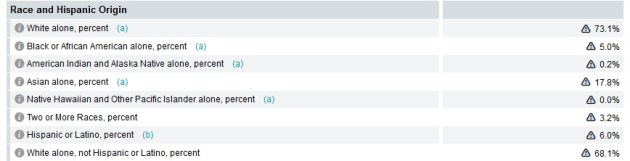
Naperville is known for a number of features including its wealth, its high ranking in a number of listings of quality places (examples here, here, and here), its fast-growing population at the end of the twentieth century, its vibrant downtown, its office space along I-88, and, more recently, its diversity. According to QuickFacts from the U.S. Census Bureau:

NapervilleQuickFacts

That this large and wealthy suburb is only 68.1% white alone is notable. The diversity is noticeable in different retail establishments, those using the city’s Riverwalk, the local government naming liaisons to minority groups, and the presence of different religious groups (including mosques).

However, Naperville was not always this way.

What it costs to maintain dozens of pieces of public art in Naperville

Naperville’s Riverwalk and downtown features dozens of works of art. However, it takes resources to keep that art nice and to keep adding new pieces:

In 2016, the city started to set aside about $50,000 a year for maintenance of public art from its food and beverage tax revenue, which is pooled into a fund named for the activities it supports — Special Events and Cultural Amenities.

Since its founding in 1996, Century Walk has installed works at 48 locations, some of which involve several pieces by large numbers of artists, and others that involve intricate or large-scale works by individual talents…

Others on the council agree, but some say there should be a stronger focus on planning for the future of Naperville’s outdoor art, setting aside money for maintenance or requiring future projects to come with some sort of endowment for their long-term care. Century Walk Chairman Brand Bobosky, for his part, wants the city’s maintenance fund increased and coupled with money for new art creation, to the tune of $200,000 a year…

In the past three years, Mondero has repaired the broken tiles on the bench damaged by skateboards, rebuilt a wall called “Man’s Search for Knowledge Through the Ages” that was damaged by a vehicle, repainted two murals, bolted the arm of a sculpted man to hold it in place and cleaned several plaques.

Not all suburbs would be willing to (1) initiate public art in the first place and then (2) invest city resources into it. Yet, Naperville clearly sees it as part of the package it offers to residents and visitors: come to the Riverwalk, enjoy the vibrant suburban downtown, and take in the public art that often commemorates the suburb’s past. The art is not exactly edgy; Naperville is not going after street art or modern art (see the example of the Bart Simpson image that popped up a few years ago). The art that Naperville does have is intended to help tell the community’s story and present interesting visual displays for visitors.

Whether the public art can come first and help create a vibrant suburban area is debatable. Plenty of suburban communities want mixed-use areas that bring in visitors and generate revenue and art is often viewed as part of that package. But, it is unlikely that public art alone could create such a setting. The suburb would already need a confluence of enough residents, resources to apply to such an area, and a good plan for development or redevelopment.

Naperville to add 6,600 seat indoor concert venue

While a new development in the northwest corner of Naperville seems to be primarily about ice hockey, the facility could also accommodate sizable concerts:

Extra landscaping to block sound will be negotiated into a plan for an ice rink and entertainment venue soon to be developed in Naperville.

CityGate Centre North will be a 209,589-square-foot facility with two NHL-regulation-sized ice rinks and seating for up to 4,600 for hockey games or 6,600 for concerts…

Ken Witkowski, senior vice president of Calamos Real Estate LLC and a former law enforcement official, said CityGate Centre North plans to be largely dedicated to hockey and ice skating uses with several local clubs and a semipro team. But owners are keeping their concert options open and Witkowski said they also could plan up to two concerts, expos or other entertainment events a month.

He said the concrete outer walls of the $60.2 million arena will absorb sound created inside, and security on site will “maintain proper decorum.”

Does a facility like this give Naperville a new edge in the competitive suburban entertainment scene? This would help fill a gap in the west suburban entertainment scene: a decent-sized concert venue. The northwest suburbs have the Sears Center and Allstate Arena. Gymnasiums on college campuses throughout the metropolitan region can host concerts. This sized facility would fit between larger (think United Center, Allstate Arena) and smaller venues (think theaters). It would also be in a wealthy community where plenty of nearby residents could pony up money for tickets.

At the same time, it is a little funny that a suburban concert venue will be constructed next to a retirement community, warehouses, and a nice hotel. There are a jumble of uses just off Route 59 north of I-88 and they are not necessarily all compatible.

It will also be interesting to see how much the concert potential affects the design of the facility. Could this accommodate high-tech shows? Could the hottest new acts be headed to Naperville, Illinois?


Chicago mayor Rahm Emanuel now rolling out affordable housing ideas

The Chicago Tribune summarizes the recent efforts of Chicago mayor Rahm Emanuel to promote affordable housing in the city:

The Tribune’s Jeff Coen and Gregory Pratt recently reported on Mayor Rahm Emanuel’s stumbles as he’s tried to tackle the tricky issue of affordable housing. They discovered that in gentrifying neighborhoods where affordable housing is most needed, fees paid by developers to fund housing at below-market rates get diverted elsewhere. In many cases, that money shows up on the South Side, where housing needs are great, but where affordable housing isn’t as acute of a problem as it is on the North Side.

They also found that the amount of affordable housing being built in the city is falling short of City Hall’s projections. In 2015, when City Hall strengthened the city’s affordable housing ordinance, Emanuel’s team predicted the creation of 1,200 new housing units by 2020. But as of the end of the first quarter in 2018, a Tribune analysis showed that the ordinance revamp had yielded only 194 affordable housing units, or a five-year pace of 431 units.

With a re-election campaign underway, the mayor’s been spitting out housing initiatives with dizzying speed — by our count, six measures within a span of a week that, one way or another, aim to make housing more affordable. Among them:

  • The creation of a housing department that brainstorms long-term remedies to the city’s lack of affordable housing;
  • The establishment of a $30 million fund to funnel low-cost financing to developers buying apartment buildings in gentrifying neighborhoods, with the catch that the developers have to set aside at least 20 percent of the units as affordable housing for at least 15 years;
  • The expansion of the city’s transit-oriented development program to four heavily used CTA bus lines. The city’s TOD program currently encourages high-density housing and retail near train stations. Apartment builders in TOD areas must provide affordable housing. That requisite would apply to TOD projects near bus lines along Western Avenue, Ashland Avenue, Chicago Avenue and 79th Street.

Four quick thoughts:

  1. Chicago does not get as much attention regarding affordable housing as cities like San Francisco, Seattle, and New York City. Yet, the city has major affordable housing needs stretching back decades. Luxury condos may be common in the Loop, River North, and along the city’s lakeshore but numerous other neighborhoods need good and cheap housing. The list of city residents waiting for public housing is very lengthy.
  2. This lack of attention paid to Chicago compared to those other cities also hints at the relative nature of affordable housing. Chicago may be cheap compared to San Francisco but that does not mean that the city is relatively expensive compared to other big cities in the Midwest or the South.
  3. Perhaps just as important as how many affordable housing units are created is where the affordable housing units are located. If most of the units end up in wealthier and whiter neighborhoods, will this have a significant impact on worse-off neighborhoods?
  4. The Tribune mentions the looming reelection Emanuel faces: are these affordable housing ideas simply campaign fodder or is there going to be a sustained effort over time?

No, the Milwaukee Bucks’ new arena will not solve residential segregation in Milwaukee

The CEO of the Milwaukee Bucks says their new arena may or may not help the city:

Perhaps no NBA city is in greater need of a melting-pot meeting point than Milwaukee…

Feigin told the Wisconsin State Journal in 2016 that Milwaukee was “the most segregated, racist place I’ve ever experienced.” While he didn’t want to revisit those comments this week, Feigin said the new arena could help transform the city’s downtown.

“I don’t think this (arena) is a solution for racial harmony,” he said. “But Milwaukee doesn’t have a centralized meeting place. There are no parks in the middle of the city. By building this plaza, you’ve kind of orchestrated a meeting place.

“There are certainly obstacles and certainly a long way to go, but our message is this is a wonderful city. We are an organization that will speak out about injustice, and we are also an organization that is focused on how we can solve problems.”

It sounds like the Bucks CEO hopes the stadium becomes a cosmopolitan canopy site where people of different backgrounds can gather together and find common ground around the city’s basketball team. I am generally skeptical of claims that sports teams can help revive cities or heal cities. See this earlier post about whether the Cleveland Cavaliers winning an NBA championship would revive the fortunes of Cleveland. For an arena, will a few hours of watching basketball help fans truly cross race and class boundaries? A general civic pride might develop but I would guess many sports fans can compartmentalize their love for a winning team and their relationships, abstract or otherwise, with the other.

Even with concerns, Nashville will likely push for more growth

Nashville is growing and reactions are mixed:

The Nashville region population grew 45% from 2000 to 2017, reaching about 1.9 million, according to the U.S. Census Bureau. Ms. Ervin represents both sides of the city’s extraordinary growth: a transplant who was attracted to a booming urban hub, and a resident increasingly concerned that unbridled development may threaten the Tennessee capital’s charm…

Nashville’s thriving health-care, financial and tourism sectors have drawn national attention. In April, the U.S. Bureau of Labor Statistics reported the city had an unemployment rate of 2.7%—lower than any other major metro area in the U.S. From 2010 to 2016, Tennessee’s large urban areas, led by Nashville, accounted for 57% of all employment growth in the state, according to the Brookings Institution…

With urbanization comes pressure on local government to improve housing affordability, workforce education and public transit, Mr. Briley said…

The government has been working to manage growth, such as preserving green space and establishing a special fund to build low-income housing in the city, which spent $10 million last year, Mr. Briley said.

Generally, population growth is good in the United States. It is seen as a positive sign for business and the status of the city. It means that the city will be taken more seriously by outsiders, whether that includes businesses considering moving, sports teams wondering where to locate, or where government money should be spent. Nashville is now the 24th largest city in the United States and moving up that list – with established cities like Detroit and Boston in sight – means something.

At the same time, significant growth does inevitable change cities and communities. At the least, it pits longer-term residents versus newer residents who can be perceived as jumping on the bandwagon. Growth can transform a lot of neighborhoods and open space as demand for housing and other land uses increases. It can lead to questions about how to bridge the gap between being a smaller big city and a big city. Some will perceive that they are being left behind as the city now tries to chase bigger dreams.

Two final thoughts:

  1. Even with concerns expressed by some, very few leaders will ever try to limit growth. Whatever problems arise with changes due to growth will be seen as secondary to the goal of growing in population, business, popularity, and capital.
  2. It is too bad this story does not include more about the suburbs and the whole region. The city of Nashville is growing but what about the suburbs? As noted above, a recent vote over mass transit in the region pitted city and suburban voters against each other.

True for Chicago and elsewhere: “cities don’t just crop up in random places”

At Instapundit, Gail Heriot explains how Chicago came to be:

FATHER JACQUES MARQUETTE AND LOUIS JOLLIET: On this day in 1673, a 35-year-old Jesuit priest and a 27-year-old fur trader began their exploration of Lake Michigan and the Mississippi River, leaving from St. Ignace at the north end of Lake Michigan. From there, they went up the Fox River and then overland (carrying their canoes) to the Wisconsin River, which took them to the Mississippi River. Out of fear of running into the Spanish, they turned back at the Arkansas River. By then, they had confirmed that the Mississippi does indeed run to the Gulf of Mexico.

The route back was different. And this becomes important to the history of the country and especially of the City of Chicago: Friendly Native Americans told them that if they go up the Illinois River and the Des Plaines, rather than the Wisconsin, it would make the trip easier. That’s because the portage distance from the Mississippi watershed and the Great Lakes watershed was shortest there. The Chicago River, which dumped into Lake Michigan was only a short distance away.

If you’ve ever wondered why Chicago grew into a major city so quickly, this is why: Location, location, location.  In the modern world it’s easy to miss how much topographical issues like that mattered (and in different ways continue to matter).  But cities don’t just crop up in random places.

The locations of major population centers may seem fairly obvious now: a large population has been there for a long time and the city by its own large inertia continues to draw more people. This may be particularly true for cities outside of North America where there may be centuries or millennia of accumulated settlement.

Yet, looking at the founding of major cities in the United States often shows that there are located at places that provided major transportation advantages for people of that time. Even though this might be less obvious now since we do not think much about sea travel and shipping, a number of major coastal cities have protected ports. Inland, many cities are located on key bodies of water, primarily rivers. Even more recently, communities developed around railroad junctions and highway intersections where a lot of traffic converged.
Perhaps in a “perfect world,” major cities would be spread out at fairly even intervals. But, development does not typically work this way: it often follows earlier transportation links or patterns of development.