“Tom Brady, sociologist of religion”

A new documentary series looks at how sports fosters belonging and Tom Brady is one of the people behind it:

The theory, as you might guess from the title, is that sports, broadly constructed, are a kind of religion. As Chopra intones during the introduction, with images of stadiums and religious pilgrimages rolling by, sports “have believers, priests, and gods. They have rituals, miracles, and sacrifices. Sports unite us. They are a calling.”…

In parsing “the religion of sports,” Chopra and his star-powered co-producers are trying to understand a resilient form of meaning making and community formation in the United States. It seems a little silly to group Chopra and co. with social theorists like Alexis de Tocqueville and contemporary scholars who worry that America’s community structures are fraying. But, incredibly, that’s the project they’ve created: a sort of jock’s guide to civil society. While the series can, at times, come across as a rosy-eyed passion project, its central insight—that sports can be understood as a way that people find belonging—reveals a rich theme for artists who seek to grapple with the strong sense of cultural division and isolation experienced today by Americans of different ethnic, class, and political backgrounds…

Chopra takes this literally: “Sports is an actual faith. It’s not even metaphor. It’s real. You practice these things,” he said. This is debatable—Chopra is looking at religion purely as a matter of practice, while discounting the importance  of belief. Sports are not about the metaphysical nature of the universe; they provide no guidebook for the self or community in navigating life.

But, to embrace Chopra’s interpretation of “religion” for a moment, it’s curious to consider the ways in which sports participation has not followed the same trend line as other communal activities. According to organizations like Pew, traditional religious affiliation is steadily declining in the United States; participation in civil-society groups like bowling clubs or parent-teacher organizations has gone down significantly as well. As Americans have pulled away from these kinds of community institutions, their love of sports has stayed relatively constant: According to Gallup, the percentage of Americans who call themselves “sports fans” has hovered around 60 percent for at least the last 15 years.

This sounds like a Durkheimian exploration of a functional religion, another area of social life that has some similar characteristics to religion. Sports involve rituals, collective effervescence, totems, and beliefs. This could range from sports (earlier posts involving the World Cup and the belief of some American sports fans that supernatural forces are involved) to following Apple (earlier post here).

I hope, however, this documentary series doesn’t fall into two common traps with this comparison:

  1. Sports are the magic elixir that can bring everyone together. (In contrast, many argue today that religion divides people.) Being a fan alongside another fan may bring individuals together for a moment but does it really make the world a better place? Does racism really disappear? Are cities healed? My answer: no and see these earlier posts on the effect of the Cleveland Cavaliers, the ability of soccer teams to bring about urban revival, and the Chicago Cubs winning the World Series. .
  2. Putting sports fandom and religion side by side suggests that it doesn’t matter ultimately what people believe; it is simply that common beliefs bring people together. Not all beliefs at the same level. Do sports really dictate how most people make major decisions in their life? Do sports provide ultimate meaning? (They may serve this role for a small number of people but religion is still going pretty strong throughout the world.)

The documentary series will reveal how much it gets right about the sociology of sport and religion…


How white evangelicals define themselves – and what is missing

Yesterday, I highlighted a sociological argument about who white evangelicals are. Recently, evangelical leaders came together to provide their own definition for evangelicals. This included input from sociologists, theologians, historians, and others. Here is the four part definition:

The Bible is the highest authority for what I believe.

It is very important for me personally to encourage non-Christians to trust Jesus Christ as their Savior.

Jesus Christ’s death on the cross is the only sacrifice that could remove the penalty of my sin.

Only those who trust in Jesus Christ alone as their Savior receive God’s free gift of eternal salvation.

This is a theological definition. With a few well-worded survey questions, evangelicals can be separated from other religious and Protestant groups.

From a sociological perspective, what does this definition miss? At least a few things:

  1. Social/cultural context. Theological beliefs alone cannot capture the cultural dimensions of being evangelicals. If we define culture as “patterns of meaning-making” (a definition preferred by sociologists of culture), making sense of those four theological views and putting them into practice is a whole additional ballgame to consider. What is it like to worship in an evangelical setting? How are evangelicals encouraged to live their day-to-day lives? What kinds of media do they consume? What institutions do they celebrate and contribute to? And so on.
    It is not enough to cite a particular religious history for the group that could be dated back to 1600s American Protestants or 1700s-1800s British Protestants. Those theological paths were also significantly influenced by social events including the Enlightenment, evolution and the rise of science, industrialization, urbanization, and the rise of the western democratic state.
    In other words, others can hold similar theological views – particularly black Protestants – but they do not share the same social dimensions with white evangelicals.
  2. Engagement with race. As has been explored in the last two decades, particularly in still-relevant Divided By Faith, American evangelicalism has a sordid history with race. While some evangelicals have fought for the rights of non-whites, many have not. When white evangelicals today are asked about race, they tend to stick to color-blind approaches (“we don’t see race”), argue that talking about race issues makes it worse, and that evangelicals should be united in Christ. The argument in Divided By Faith is that evangelicals have an individualistic approach to all of life – including theology – and can’t see structural issues like racism. If evangelicals do try to address race (or other less popular issues), some evangelicals exercise their individual abilities to join new churches or groups.
  3. Politics. This has probably received the most public attention since the 1970s as evangelicals emerged as a recognizable group, had their first President (a Baptist and Democrat), and formed their own political groups (The Moral Majority, etc.). Evangelicals do tend to vote a certain way – with Republicans – and have coalesced around certain moral issues (like abortion) while saying little about others that are clearly Biblical concerns (like poverty and immigration, as just two examples).
    A recent plenary session at a sociology of religion meeting I was at noted a more recent trend: evangelicals (and other religious groups) as a whole are not really voting with religious convictions in mind. It is all about party identification.
  4. Forming their own institutions. Once the modern-fundamentalist split occurred around the turn of the 20th century, evangelicals created a whole new set of institutions: TV and radio stations, colleges, magazines, parachurch ministries (think Focus on the Family), publishing houses, celebrities (from Billy Graham to Tim Tebow), movies, and more. And perhaps the most notable institutions are non-denominational churches as well as the suburban megachurch.
  5. Limited interaction, engagement, and work with Christians around the world, let alone other Christian groups in the United States. The evangelical tendencies toward drawing boundaries based on theology (as well as cultural characteristics) can make it difficult to work with others.
  6. Where did the fundamentalists go? They were subsumed under the evangelical umbrella after World War II. Few Christian groups choose to use this name given its connotations today but it can sometimes be hard to determine the fundamentalists (who typically advocate more separation with the world) and evangelicals (who typically advocate more engagement with the world). Insiders can tell you clear differences between Bob Jones and Wheaton College but outsiders may not be able to (and may not care to).

All this said, it is not as simple as defining a religious group solely by their theology. To their credit, LifeWay and others acknowledge that this four point scale only gets at evangelical belief. As sociologists of religion often note, religiosity includes belief, belonging, and behavior. Perhaps evangelicals themselves want to primarily emphasize theological positions but this does not fully capture who they are nor is it the way that those outside the group will regard them.


Explaining white evangelicals: American Evangelicalism, Embattled and Thriving

With all the talk of white evangelicals in the postmortem of the 2016 election, it is useful to return to a 1998 sociological book about this group: Christian Smith’s American Evangelicalism: Embattled and Thriving. Here is one way we can understand white evangelicals from a sociological perspective:

1. Smith adopts the subcultural theory to explain the group’s success and current standing. This has two dimensions:

“The subcultural identity theory of religious persistence is this: Religion survives and can thrive in pluralistic, modern society by embedding itself in subcultures that offer satisfying morally orienting collective identities which provide adherents meaning and belonging.” (118)

“And the subcultural identity theory of religious strength is this: In a pluralistic society, those religious groups will be relatively stronger which better possess and employ the cultural tools needed to create both clear distinction from and significant engagement and tension with other relevant outgroups, short of becoming genuinely countercultural.” (118-119)

In this perspective, pluralism can actually help religious groups by fostering a sense of shared identity compared to the broader society and also providing opportunities for engagement with others.

2. The vitality of the group often depends on drawing strong distinctions between the group and the outside world.

“The evangelical tradition’s entire history, theology, and self-identity presupposes and reflects strong cultural boundaries with nonevangelicals; a zealous burden to convert and transform the world outside of itself; and a keen perception of external threats and crises seen as menacing what it views to be true, good, and valuable.” (121)

3. Evangelicals want to engage social issues but are ultimately limited in what they can accomplish because of their approach.

“the only truly effective way to change the world is one-individual-at-a-time through the influence of interpersonal relationships.”(187)

“they routinely offer one-dimensional analyses and solutions for multidimensional social issues and problems.” (189)

4. When it comes to political action, evangelicals support government intervention in some areas (like abortion, gay rights, and prayer in schools) but not in other areas. This leads to an unresolvable tension.

“By this we mean, in short, that many evangelicals think that Christian morality should be the primary authority for American culture and society and simultaneously think that everyone should be free to live as they see fit, even if that means rejecting Christianity.” (210)

5. Thus, the problems with evangelicalism come from within.

“Evangelicalism’s problems, in other words, are largely subculturally indigenous, difficulties of their own tradition’s making.”(217)

While the data for this book came from the culture wars era (comprehensive surveys and interviews conducted in the mid 1990s with ordinary evangelicals), a lot of this still rings true today.

A follow-up post tomorrow will contrast Smith’s understanding (as well as other sociological emphases) compared to how white evangelicals understand themselves.

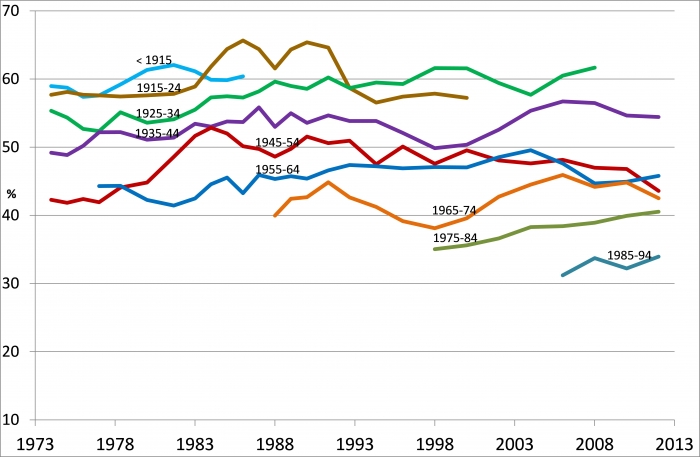
Claim: US undergoing secularization, just at a slower pace

Two sociologists argue that the United States is not that unusual regarding secularization trends in the industrialized world:

Most research that compares American religion with religion elsewhere emphasizes the high levels of participation in the United States, and treats those high levels as strong evidence that America is exceptional.

If we look at the trends, though, it appears that the US isn’t a counter-example to the idea that modernization causes problems for religion. On the contrary, religious change in the United States is very similar to what we see elsewhere: long-term decline produced mainly by generational replacement.

This process operates slowly, and it can be counteracted in the short term by short-lived revivals, but it is very difficult to reverse…

Figure 2 – Attendance monthly or more often by decade of birth, United States, 1973-2014

Voas Fig 2

Chaves has been making this argument for a few years now.

Two quick thoughts:

  1. As they note at the end, the interesting question then to ask is why the United States has been slower to follow the secularization trend than other nations. This is not a small question and at least several suggestions have already been made by researchers including World Wars in Europe and the rise of the welfare state.
  2. Researchers are in a unique position if they argue any trend is inevitable. Voas and Chaves may be shown correct if religiosity continues to decline in new generations but it could be decades before the conclusive evidence arises. Additionally, societal patterns can change – even if such changes seem improbable at one time. If a researcher is correct in calling out a trend, they can appear prophetic but if they are wrong, their status may be diminished.

Berger on four benefits of religious pluralism

In First Things, Peter Berger discusses the benefits of religious pluralism for religious faith:

“First benefit: It becomes more difficult to take a religious tradition for granted. Acts of decision become necessary”…

“Second benefit: Freedom is a great gift, and pluralism opens up new areas of freedom,” according to Berger…

“Third benefit: If pluralism is combined with religious freedom, all religious institutions become in fact voluntary associations”…

“Fourth benefit: Pluralism influences individual believers and religious communities to distinguish between the core of their faith and less central elements,” according to “The Good of Religious Pluralism.”

This would be a more specific version of two arguments made by sociologists of religion in recent years:

  1. Some have argued that religion, as a whole, has positive effects on society as religious people tend to vote more, participate in more religious and civic activities, and give to others. In this argument, religion itself is made better – such as agreeing to basics about the faith rather than fighting over less essential elements – and this would presumably then help the broader society by having religious groups that are softer around the edges.
  2. Competition between religious groups – made possible in the United States by freedom of religion as well as the separation of church and state – actually enhances religious life as groups compete for adherents. Berger’s argument is specifically about a kind of pluralism where religious groups can peacefully interact and enhance each other. It would be interesting to then hear him discuss places where religion is pervasive but pluralism is either tenuous (competition still happens but it is violent or state-sponsored) or nonexistent.

Some NJ suburbanites not happy with Orthodox influx

The New Jersey suburb of Toms River is up in arms regarding numerous Orthodox families moving in:

These days, though, most homeowners draw the blinds, retreating from brushes with a fast-growing Orthodox Jewish community that’s trying to turn a swath of suburban luxury 10 miles (16 kilometers) from Atlantic beaches into an insular enclave. The rub, a township inquiry found, is “highly annoying, suspicious and creepy” tactics used by some real-estate agents…

“It’s like an invasion,” said Thomas Kelaher, Toms River’s three-term mayor, who’s fielded complaints from the North Dover section since mid-2015. “It’s the old throwback to the 1960s, when blockbusting happened in Philadelphia and Chicago with the African-American community — ‘I want to buy your house. You’ll be sorry if you don’t.’ It scares the hell out of people.”

The upset has its roots in adjacent Lakewood, home to yeshivas including Beth Medrash Govoha, among the world’s biggest centers for Talmudic study. Scholars typically marry young and start large families that maintain strict gender roles and limit interaction with secular society…

The opposition, he said, has nothing to do with dislike of Jews, but with a fear that Toms River will become like Lakewood’s more tattered sections, with cars parked on lawns, overgrown landscaping, trash piled at curbs and residents crowding single-family homes.

As the article notes, this sounds similar to the tactics employed against different racial and ethnic groups in the first half of the 20th century: fear, worries about changing the character of the community and providing new social services, enforcing zoning laws, pushy slash creepy real estate agents, the potential for declining property values. Yet, this story hints that residential segregation is alive and well. Even though Americans regularly talk about the geographic mobility everyone can access, it doesn’t quite work this way as existing residents can be resistant to change and different racial and ethnic groups tend to cluster not just in cities but also in suburbs.

The case for saving Chicago’s old churches

Here is an argument for why the broader public should work to preserve dozens of older churches throughout Chicago:

The protection of religious structures presents a unique set of problems. A particularly formidable roadblock is the city’s inability to step in to designate threatened religious buildings as a landmark. The city has powers allowing it to move forward with landmark designations for non-religious buildings in spite of owner consent, however, a 1987 revision to the Landmark Ordinance states that “no building that is owned by a religious organization…shall be designated a historical landmark without the consent of its owner.” And without protections, many of these buildings are left to deteriorate and ultimately face demolition…

Chicago’s Catholic churches are among the most prominent visual connections to the city’s past and the ethnic communities that once dominated the neighborhoods. They provide clues to what ethnic communities make up Chicago’s diverse population through the languages engraved on facades, the style of buildings, and the saints for whom they were named…

For most Chicagoans, the interiors of sacred places remain a mystery, but Seidel’s anecdote indicates that people still care a great deal about the buildings in their neighborhoods, even when they might not necessarily understand or fully appreciate the Latin, Polish, Hebrew, or Greek spoken inside.

And this is the exact point that preservationists believe to be the most important. Even if the number of people attending religious services drops, that doesn’t necessarily mean that the general populace fails to recognize great architecture or stop using religious structures as spatial identifiers. It doesn’t mean that many of these struggling South Side neighborhoods don’t deserve to have culturally significant structures.

This comes after the archdiocese of Chicago announced it would close dozens of churches. This is interesting because historically it has been Protestant groups who have been happy to step away from their churches in big cities. Particularly after white flight, many of those Protestant churches were sold to other religious groups, converted to other uses, or demolished over recent decades. But, many Catholic churches stayed because of a commitment Catholics had to the building and neighborhoods as well as providing worship spaces to new waves of immigrants. The archdiocese suggests this is no longer tenable:

In his announcement, Blase indicated that the church is faced with a perfect storm: a shortage of priests joining the seminary, declining mass attendance, and the deferral of maintenance bills for churches that are in need of attention. All of these issues combined has put a squeeze on archdiocese resources and will force many parishes to either close or consolidate. And with the looming closure of potentially dozens of churches, there is now a threat of demolition for some of the city’s most important cultural and architectural icons.

But, I would guess it may be hard to mobilize many neighborhoods (and the necessary resources) to save old churches from religious groups that few attend or adhere to in those places. How many Americans are willing to sacrifice something to save old buildings for the sake of keeping them around? The argument laid out above is a typical one from preservationists: losing the buildings means losing a physical part of the place’s heritage. But, where are the resources to preserve these buildings if market forces – both in the economy and in American religion where attendees can choose among hundreds of options – are suggesting they are not worth much?

Opposition to a proposed mosque in suburban Palos Park

A group wants to convert a former church into a mosque in Palos Park and has encountered opposition:

An anonymous flier circulated in mailboxes and online this month decried plans to open a mosque and community center at the site of a former church in this southwest suburb, roughly a mile from the home of 72-year-old Omar Najib, who intends to pray there.

The Muslim American Society bought the property at 12300 S. 80th Ave. in December and plans to do minor maintenance at the site, with no opening day scheduled yet. The leaflet titled “Save Palos” accused the house of worship of threatening to erode housing values and congest traffic…

Opposition to new mosques has become “almost a given” in the Chicago area as well as throughout the country, a brand of Islamophobia often shrouded in concerns over zoning or urban planning, said Ibrahim Hooper, spokesman for the Council on American-Islamic Relations, based in Washington, D.C.

Residents in Bayonne, N.J., rallied last month against plans for a Muslim community center there, bearing signs that read “Stop the Mosque” and “If the Mosque Comes the Mayor Go’s” (sic). Around the same time, members of a Christian group spoke out against a mosque scheduled to open this spring at the site of a former South Milwaukee, Wis., church. In late November, tempers also flared at a forum over an Islamic center proposed in Fredericksburg, Va.

Even as mosques and other non-Christian religious buildings have become more common in the Chicago suburbs, they still occasionally encounter opposition. See earlier posts about mosques and opposition here, here, here, and here. That there are national discussions about Muslims and ongoing conflict with Muslim groups only adds to typical NIMBY concerns from suburbanites.

One hurdle that new religious groups can encounter are local governments which may or may not support their groups. The end of this particular article suggests the mayor of Palos Park “immediately condemned the anonymous leaflet as cowardly.” Yet, would the local government feel the same way if a vocal and sizable portion of the community rallied against the new mosque and community center?

Can Americans elect a non-Christian president?

On President’s Day, Pew Research highlighted the religious faith of America’s presidents:

With the exception of Democrat Bernie Sanders (who is Jewish), all of the presidential hopefuls are Christians and most are Protestants.

In addition, all of the current presidential candidates have spoken openly about the importance of faith in their lives (again, with the exception of Sanders, who describes himself as “not particularly religious”). Our recent survey shows that many Americans care about their leaders’ faith. For instance, half of all American adults say that it’s important for a president to share their religious beliefs. And more people now say there is “too little” religious discussion by their political leaders (40%) than say there is “too much” (27%).

Historically, about a quarter of the presidents – including some of the nation’s most famous leaders, like George Washington, James Madison and Franklin Roosevelt – were members of the Episcopal Church, the American successor to the Church of England.

The next largest group of presidents were affiliated with the Presbyterian Church, which has roots in Scotland. Andrew Jackson, Woodrow Wilson and Ronald Reagan, all of whom had Scots-Irish ancestry, were among the commanders in chief who belonged to the denomination.

Protestants have dominated the office yet just two denominations – Episcopalians and Presbyterians – have supplied nearly half (19 out of 43) of the presidents. Arguably, Americans might not care exactly what denomination or particular doctrinal beliefs a president has as long as they identify as a Christian. This may be part of American civil religion where particularities are not encouraged but a general Christian faith is helpful.

In a continuing trend, a sizable number of Americans say they are unwilling to vote for atheists for president though more younger voters are open to it:

As the 2016 presidential election field takes shape, more than nine in 10 Americans say they would vote for a qualified presidential candidate who is Catholic, a woman, black, Hispanic or Jewish. Less than half of Americans would vote for a candidate who is a socialist…

Among religious identities, while the large majority of Americans would vote for a Catholic or Jewish presidential candidate, smaller majorities say they would vote for a candidate who is Mormon (81%), an evangelical Christian (73%), Muslim (60%) or an atheist (58%)…

At least two-thirds of adults younger than 30 say they are willing to vote for a candidate with any of the characteristics included in the survey.

How this influences the 2016 election remains to be seen.

Berger on the religious pluralism of cities

Peter Berger describes some of his own experiences seeing religiosity break into city life and sums up with these thoughts:

Years later I took a course at the New School of Social Research under Albert Salomon entitled “Balzac as a Sociologist”. I sensed that Balzac’s novels conveyed the same experience of Paris, all its secrets hidden behind closed doors. What could be going on behind this particular door: a religious cult (Balzac was curious about esoteric cults), a great crime, an orgy, or a political conspiracy?  During my student days I roamed endlessly through New York; since I was already obsessed with religion (as a friend of mine once put it, rather pejoratively, “once a godder, always a godder”), I visited every sort of religious space—not only regular Christian churches and different synagogues, but any manner of what for me were esoterica: a brand-new Zen center, the Anthroposophical Society and its cultic offspring, the so-called Christian Community (where one could attend a quasi-Gnostic ceremony in 20th-century America), a Mormon church, Pentecostal storefronts in Puerto Rican East Harlem (about which I wrote my M.A. thesis, my hands “dirty with research”), and the Baha’i (about which faith I wrote my doctoral dissertation). I could go on. But enough. I will observe that mystery is always, minimally, akin to the core of religious experience which Rudolf Otto (in my opinion the greatest 20th-century scholar of religion) called the mysterium tremendum. Thus it should not be a surprise that cities have typically been places of religious innovation (Pentecostalism, the biggest religious explosion of our time, mainly flourishes in the intensely pluralistic mega-cities of the Global South).

While cities are often regarded as centers of secularization and financial markets, they often contain a remarkable amount of religious activity. Two books I have read recently attest to this. In How the Other Half Worships, sociologist and photographer Camilo José Vergara looks at a number of urban churches primarily through images with some explanation of the experiences had within the diverse church buildings. While Vergara roams far and wide in poorer neighborhoods, sociologist Katie Day examines the dozens of religious congregations along Germantown Avenue in Philadelphia in Faith on the Avenue: Religion on a City Street. Both books hint at the lively religious life of urban residents and organizations even as other aspects of cities receive much more attention from scholars.