Rising property values and “passive income, which is the real American dream”

Why do so many homeowners care about protecting their property values? While recently reading about social class and Hollywood, I found this observation:

Photo by Karolina Grabowska on Pexels.com

That passive income, which is the real American dream, is no longer something that the actual artists—not just actors but writers and directors and everyone else who ever made a dime off of residuals—involved in the entertainment business get to enjoy.

The context here involves the actors and others involved with long-popular television shows that could reap the financial benefits for decades.

Isn’t this passive income also what American homeowners in the early 21st century expect when they purchase a residence? Scholars have noted the shift to Americans viewing their homes as a positive investment. Instead of needing a home for shelter and enjoying that residence while there, homes and residences are now supposed to make money for their owners. In this arrangement, property owners are not expected to be completely passive; they should maintain their property or possibly even improve it. In return, their property values go up and they can cash out in the future. A loss is very undesirable and even staying roughly at the same value over time is not much help given expenses. A nice profit requires a decent uptick in value. Such a profit can help owners climb the economic ladder, have a comfortable retirement, and pass along wealth and advantages to children and family.

This can help explain why so many homeowners fight against perceived threats to their property values. People want to change the use of land or alter the neighborhood in ways that might limit the rise of property values. It is a threat to passive income. (Whether those changes to the neighborhood and/or community actually lower property values is another story.)


Going off the grid in a suburban setting

What issues might arise if a suburbanites want to take their residence off the grid?

Photo by Vivint Solar on Pexels.com

Many off-gridders have glanced at their water bills and decided they’d rather use the water that falls from the sky for free, but some states make rainwater collection systems very difficult to install in your home, or have strict limits on how much rainwater can be harvested and how it can be used (for example, Colorado only allows certain properties to collect 110 gallons, which can only be used outdoors). For waste management, installing a septic system in a crowded urban neighborhood will be nearly impossible, and many states have extremely strict regulations surrounding the installation of composting toilets (not to mention extremely strict regulations about what you can do with all that waste once you’ve collected it).

Additionally, local municipalities might have laws that supersede or enhance statewide restrictions, and Home Owner Associations (HOAs) may have rules that prevent you from making the changes necessary to your home. These rules can beprettycomprehensive, too—some HOAs don’t allow clotheslines for drying clothes, for example, and can even forbid solar panels for aesthetic reasons. Condominium boards may also resist some of your off-grid choices. Bottom line: before you do anything, check the local laws and regulations that might apply to you.

Finally, while installing solar panels on your property is more or less legal in every state (and many states encourage it), not all states or local municipalities will allow you to actually disconnect from the power grid. If you feel it’s important to literally be off-grid, you’ll need to do some digging before you assume anything; and in multi-family structures like condominiums it might even be physically impossible to accomplish. Of course, the flip side to remaining connected is that in many cases you can sell excess electricity back to the grid—and if your solar rig fails at halftime during the Super Bowl, you’ll still have power…

Of course, if you’re going to grow your own food in the city, you’ll need enough space for that, too. It’s not impossible to find city homes with yards or large outdoor spaces where you might be able to grow your apocalypse garden (and even raise chickens!), but those houses will obviously be more expensive. And your property deed or local regulations might limit your ability to have “livestock” of any kind on your property (and your neighbors may or may not be excited about those chickens).

Three things strike me after reading this:

  1. Suburban life is ruled by a series of local regulations. Suburbs on the whole might have similar guidelines and expectations compared to other kinds of places but local control can lead to oddities.
  2. The ability to live in one’s own residence is connected to community regulations and a social contract with surrounding residents. This leads to two questions: can a resident go off the grid and should a resident go off the grid? What would the neighbors think?
  3. I wonder how many suburbs are prepared for this possibility. Even if regulations make it more difficult to go off the grid, what would happen in communities if someone really wanted to pursue this and they had the resources and means to pull it off?

The problem of summer (and many other) days: too many fun things to do

As summer winds down and school starts up again, I am reminded of something I experience every summer and throughout much of the year: there are more fun things to do each day than I am able to do. Here is an incomplete list of activities I want more time for each day:

Photo by Tran on Pexels.com

-Reading

-Watching interesting TV shows and movies

-Seeing more of family and friends

-Playing board games

-Enjoying the outdoors

-Playing and listening to music

-Advancing writing/research projects

I do not often feel bad about not being able to do all this. Rather, I am excited to get to the next day(s) and to continue these activities. I cannot keep up with everything I want to do but with steady progress there is much to enjoy.

(As a side note, the conversations in recent years about a glut of content in television and online hint at a bigger glut: life offers a lot of possible experiences. For example, I read regularly but there is not enough time to get to everything I want to read, should read, and need to read to keep up with my field and interests.)

The bland interiors that pushes viewers to choose gaudy McMansions instead

A review of a renovation TV show suggests it is more fun to see McMansion than bland interiors:

Photo by Rachel Claire on Pexels.com

But like any good home design show, the real main character is not the couple doing the renovations, but the end results. For the two years that I’ve watched this program, I’ve tried to dial down what one might call this aesthetic, which is both specific and generic—like every other high-end Airbnb listing on the market, or an antiseptic boutique hotel that prides itself on design. But it wasn’t until halfway through this season when one of the McGee’s clients hit the nail on the head. “It’s upscale-looking,” a woman says of her newly-renovated basement, which is divided into three clear “zones” meant to delineate what kinds of leisure activities should occur there and why. It’s not quite upscale, but suggestive of it instead, a different kind of new money aesthetic. But if given the choice between Studio McGee’s all-white fantasia and a giant McMansion fit for a Real Housewife of New Jersey, I’d take gold restroom fixtures and Travertine tile any day. At the very least, it’s fun.

What is the look inferior to glitzy McMansions?

What this translates to is large architectural gestures that convey wealth—vaulted ceilings in the kitchen and the living room, a “wine room” with built-in bookshelves that meet the ceiling, and other flourishes that speak to the vast amounts of money this couple must have to maintain their bonus home. It’s not that any of these design choices are anywhere close to hideous, per se—Studio McGee’s signature look is quieter than the Property Brothers, but more sophisticated that Chip and Joanna Gaines’s farmhouse chic. Staged as they are, though, the spaces designed by Studio McGee lack any discernible personality. Children get giant bedrooms with queen-size beds; every kitchen has an enormous island, whether or not the space actually needs it. (While most kitchens could use an island, not every space needs one. Understanding this difference is crucial.)

Is the primary offense that the bland yet wealthy interiors required a lot of money to implement but have no personality? McMansions are often criticized for their blandness; they are big boxes with large rooms that people can fill in many different ways.

It could be that the “fun” of the loud McMansion is that it shows up better on TV and with its particular cast of characters. The show under review is meant to show off a particular aesthetic of its designers while the Real Housewives of New Jersey has a different purpose. The loud McMansion on TV might be fun in the way that McMansion Hell is fun: you make fun of the McMansion and its dwellers. Which home viewers might want to live in might be a different story.

I missed the urban scooter revolution

On a recent trip to Los Angeles, I saw a part of urban life I primarily read about: the proliferation of electric scooters.

The scooters were all over the place. There were more scooter users in the bike lanes than bicycles. Scooters of multiple services zoomed by. They could be parked anywhere.

They make a lot of sense in a place with good weather, limited mass transit, and a good number of visitors. (On the other hand, they do not make as much sense right next to the large vehicles Americans often drive.)

One additional thought: are these scooters doing what the Segway was supposed to do or could have done?

A Brooklyn church pursuing a Jane Jacobs-inspired development

A plan is underway for a New York City church to work with a developer to construct a sizable development:

Photo by Pixabay on Pexels.com

A. R. Bernard, pastor of the largest evangelical church in New York City, has been working on a plan for more than 10 years. Now the proposal to build a $1.2 billion urban village and revitalize the struggling neighborhood around his church is progressing through the city’s approval process and closer to reality. The Christian Cultural Center (CCC) hopes developers could break ground in Brooklyn next year…

On 10.5 acres of church land, the proposed village would include thousands of units of affordable housing, a trade school, a supermarket, a performing arts center, 24/7 childcare for night-shift workers, senior living facilities, and other amenities designed to revitalize the East New York neighborhood…

“I’m a big Jane Jacobs fan, when it comes to understanding the urban landscape. And community means amenities are within a 1,000-foot walking distance,” Bernard said, referring to the urban planner who is famous for saving lower Manhattan from a highway and for her ideas on smaller-scale urban development focused on street life. “She was a genius. Absolute genius.” He sees this plan as a counter to the influence of the infamous urban planner and Jacobs nemesis Robert Moses, who had a history of dividing communities economically, including in this part of Brooklyn…

The church hopes this village can be a model for other cities and it could be scaled up or down, Bernard thinks. But he added that a church must be large enough, like CCC, to pull such a plan off.

As my research on religious congregations and zoning issues in the New York City region found, it is not necessarily easy for congregations to make significant changes to property. Lots of actors can express concerns.

But, some congregations have the resources and community presence to pursue projects like this and it might be difficult for others to propose and pull off the same plan. Affordable housing is needed all over and it sounds like the other parts of the project would also provide helpful facilities and services.

It would also be interesting to see how the congregation might serve as a physical and social anchor of a sizable new development as it matures.

Is it about the home or the location of the home?

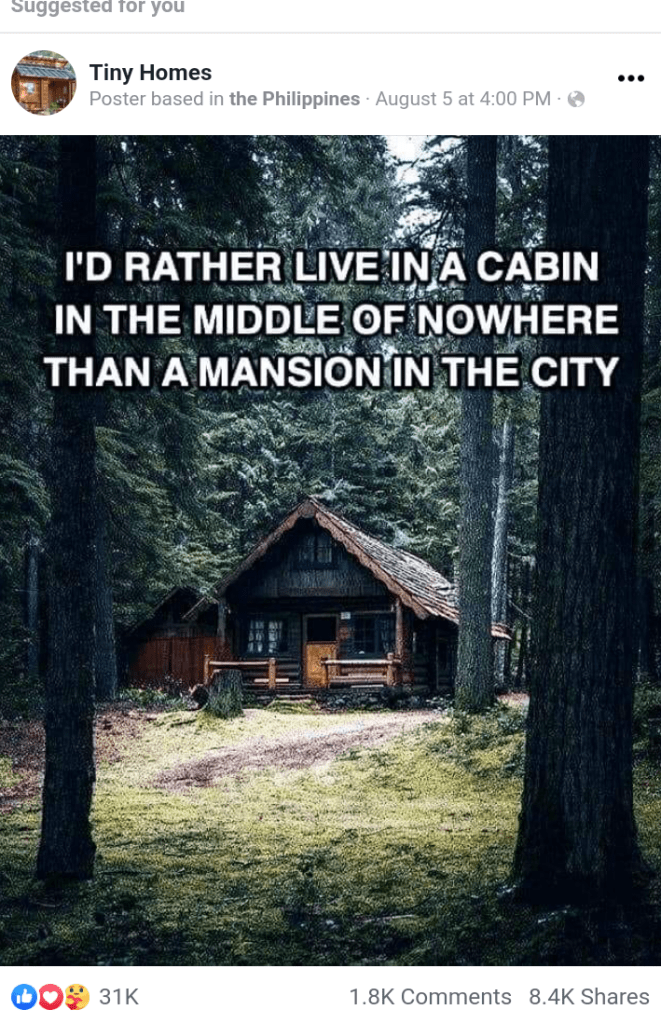
I recently saw this:

I think this is promoting living in the country as the person making the statement would be okay with a cabin rather than a mansion. The cabin looks like it is in decent shape, but it is no mansion.

However, this gets at a question I wonder about a lot: what exactly is it that motivates many people to select where they live? Here are several of the major factors:

-How many resources they have? What can they afford?

-What kind of neighborhood or community do they want to live in?

-Proximity to work.

-Quality of schools.

-Proximity to family.

-Preferences for kind and style of residence.

If you choose to live in a cabin in the country, you are elevating some of these factors as more important than others. But, is the choice primarily about the country and nature, the relative lack of people, the different kind of house, or something else? Reducing it to a binary choice of cabin/country versus city/mansion is simple but the decision might be much more complicated.

Robot vacuum as mapper and research tool for homes

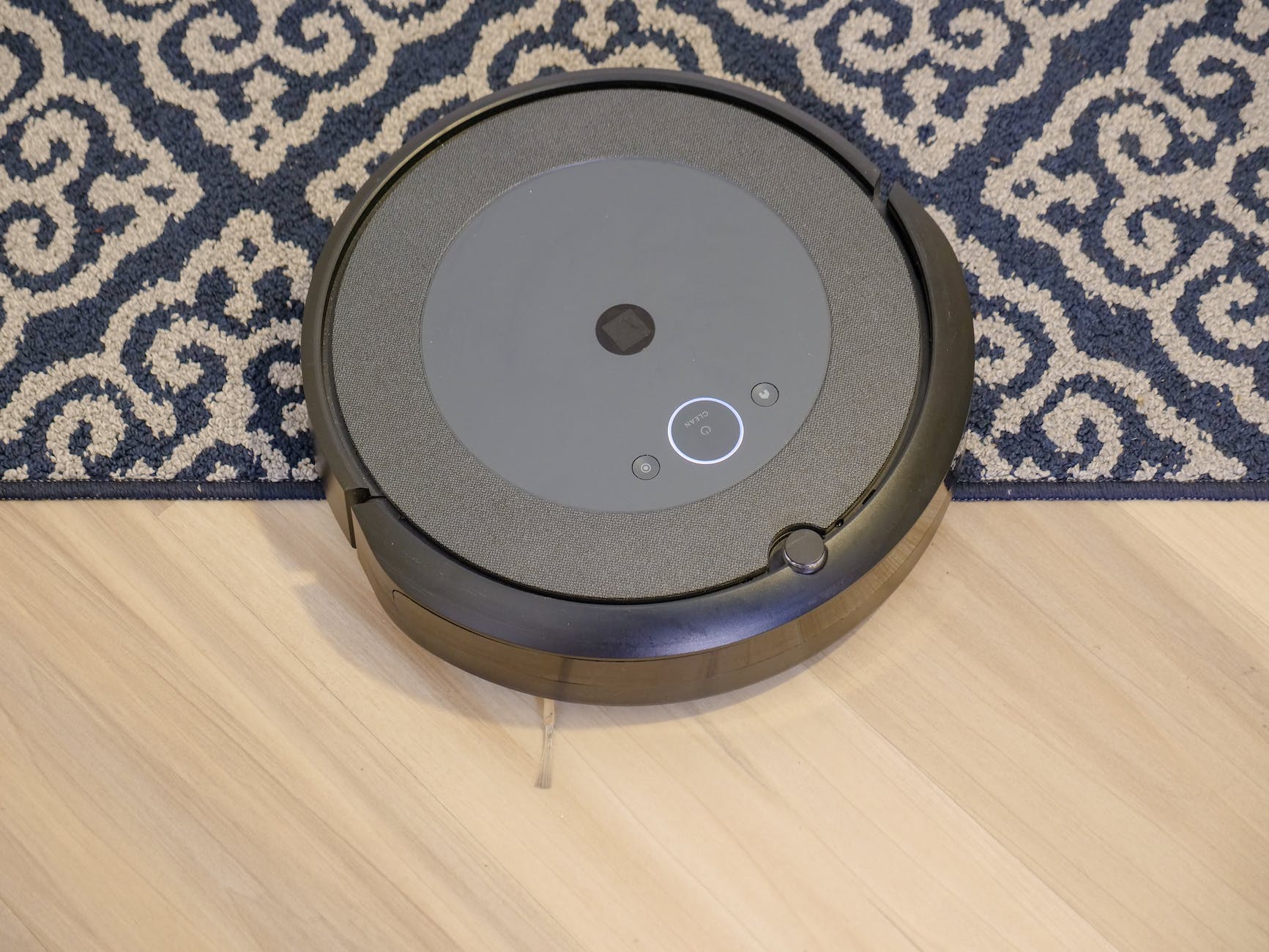
The Roomba may also be a cartography tool to map homes:

Photo by Kindel Media on Pexels.com

The company announced a $1.7 billion deal on Friday for iRobot Corp., the maker of the Roomba vacuum cleaner. And yes, Amazon will make money from selling those gadgets. But the real value resides in those robots’ ability to map your house. As ever with Amazon, it’s all about the data

The Bedford, Mass.-based company’s most recent products include a technology it calls Smart Maps, though customers can opt out of sharing the data. Amazon said in a statement that protecting customer data is “incredibly important.”

Slightly more terrifying, the maps also represent a wealth of data for marketers. The size of your house is a pretty good proxy for your wealth. A floor covered in toys means you likely have kids. A household without much furniture is a household to which you can try to sell more furniture. This is all useful intel for a company such as Amazon which, you may have noticed, is in the business of selling stuff…

Amazon would not be alone in wanting to map your home. Apple Inc. also unveiled a tool in June for the next release of iOS, its mobile operating system, that uses the laser scanner on the latest iPhones to build 3-D models that it’s dubbed “RoomPlan”.

While I can imagine the commercial potential of this mapping (beyond retailers, this can be very useful for real estate businesses as well), I am also interested in the research potential. Such mapping could reveal how residents use space, floor plans, and people and pets moving through areas. Rather than relying on people’s reports on their interior activity or direct observations of this, the Roomba can be the research “eyes.” Equip it with a camera, microphone, and other sensors and it could collect all sorts of information (all agreed to by the research participants, of course). A vacuum and research device, all in one.

Urban high-rises under construction, Los Angeles edition

In cities across the United States, the development and construction of downtown high-rises is ongoing. This was one of my views of Los Angeles this weekend:

Who is funding such development? Who will purchase the spaces in these new buildings? How does it all fit within a metropolitan landscape marked by uneven development and residential segregation? Located near L.A. Live, Crypto.com Arena, and downtown Los Angeles, this is desirable property.

Does a “medium sized suburb” have 20,000 residents?

I recently saw a headline comparing a group of people to the population size of a suburb:

Photo by Ingo Joseph on Pexels.com

Nearly 20,000 Cook County residents holding revoked FOID cards — enough to populate a medium-sized suburb

More population comparisons from later in the story:

Arthur Jackson, first deputy chief of police for the Cook County Sheriff’s Police Department, told legislators over the years, 33,000 Cook County residents’ firearm owner’s identification cards have been revoked because of violent felony convictions, domestic violence charges or serious mental health issues.

That’s more than the entire population of Highland Park in Lake County.

Of that total, “nearly 20,000” have not turned in their cards — more than the population of north suburban Deerfield.

“Medium” is between “small” and “large.” The smallest suburbs can be just a few hundred or a few thousand people while the largest suburbs can have several hundred thousand residents. Is nearly 20,000 in the middle?

The comparisons to specific suburbs might be more helpful, particularly if people know something about Highland Park or Deerfield. They can picture these communities and then make the connection to the number of people with revoked FOID cards.

Other comparisons that might be better: the number of people in a basketball arena, the number of students at a college, the number of people at a concert.

I am not sure that a “medium-sized suburb” is clear enough to help people understand the number at question here.