Finding the world’s “coolest neighborhoods” and considering their “nowness”

One publication just released a ranking of the coolest neighborhoods in the world:

Photo by Willian Justen de Vasconcellos on Pexels.com

If you’re daydreaming about the most exciting local spots in your next city-break destination, global listing guide, Time Out has you covered with its latest roundup of the “world’s coolest” neighborhoods.

Topping the 2025 rankings is a corner of Tokyo that Time Out calls a “bibliophile nirvana.” Jimbōchō is home to some 130 vintage book stores — Time Out highlights Isseido Booksellers and Kitazawa Bookstore as great starting points for a day of bookish exploring — as well as its coffee-shop culture and delicious curry houses.

Time Out’s annual list is compiled from nominations made by its global network of editors and writers. The selections are then ranked against criteria including culture, community, livability, food and drink and what Time Out describes as “that hard-to-define sense of ‘nowness.’”

A Chicago neighborhood is a little bit down the list:

Rounding out the top five is the highest ranking US spot — Avondale in Chicago, highlighted for its wine bars, wellness studios and music venues. The neighborhood is also praised for its quirky small business scene, which includes retro bowling alley Avondale Bowl and antique mall-themed bar Consignment Lounge. Jeff Wilson, managing partner at Avondale Bowl, told CNN Travel that “seeing many of Avondale’s local, small businesses be included in a list with so many other communities around the globe really shows how many amazing things are happening right around us.”

I have multiple questions after reading about these rankings:

  1. Rankings of places often have to account for a lot of communities. Here, we could start with the many cities in the world. And then each city has numerous neighborhoods, depending on how their size is defined. There are a lot of neighborhoods to choose from.
  2. How long does “nowness” last? What is the half-life for a cool neighborhood? There is something unique about the neighborhoods at the top of list. The activity and meanings present in these neighborhoods might continue at a similar rate over time yet the neighborhood might become less cool to those experiencing the neighborhood.
  3. This list seems geared toward seeking out places to visit. But what these visitors might find attractive could differ from people who live there. Visitors want to find something unique, experience something new. How does this relate to the supply of local housing or job opportunities? Does being identified on such a list lead to more tourists, which then might alter the day-to-day life in the neighborhood? To play off the idea of Chicago as “a city of neighborhoods,” could a traveler be a connoisseur of novel neighborhood experiences?

Currently “a hodgepodge” approach toward e-bikes and e-scooters across suburbs

The Illinois Secretary of State suggests suburban communities have taken a variety of approaches to e-bikes and e-scooters:

Photo by Hazal zeynep on Pexels.com

“Several municipalities, particularly in the suburbs have adopted their own rules regarding e-bikes,” Secretary of State Alexi Giannoulias told us. “Right now, it’s a hodgepodge or local ordinances and regulations, depending on where you live. That inconsistency is problematic because it makes roads less safe for all of us.”

Suburbs like local control, the ability to set their own local rules and ordinances. In this situation, some have responded to the number of e-bikes and e-scooters with regulations and others have not.

Here are some possible future pathways regarding e-bike and e-scooter regulation, ranked from what I think is most unlikely to happen to what I think is most likely:

  1. Suburbs work together to have common rules. They decide the common suburban experience is threatened, whether it could be the safety of riders or difficulties drivers face encountering these vehicles. It would make sense for suburbs sharing borders to have the same rules as it is not always obvious when you are crossing from one suburban community to another. But since suburbs tend not to work together, I do not think this is likely to happen. What might get them to work together? A far-fetched scenario: the city of Chicago says any suburbanites riding e-bikes or e-scooters in the city has to pay an extra tax so suburban communities fight back by saying they allow residents to ride freely in their suburb .`
  2. State laws are passed that then take precedence over local regulations. As noted in the editorial, the state can change the classifications for e-bikes and e-scooters. Or perhaps they could adjust roadway rules. A coalition of state lawmakers can come together to address this pressing issue facing suburban and other kinds of communities. This could happen if the political will is there.
  3. Suburbs continue to make their own regulations if they want. Perhaps they lobby hard to keep local control or political movement at the state level does not take place. Slowly, more suburbs adopt regulations and it all becomes less of “a hodge-podge” in a few years as consensus emerges about how best to regulate these vehicles.

Birkenstock has 9 US stores. Here is how many are in the suburbs.

Birkenstock announced the opening of their newest US store in Naperville:

Photo by Bruno Silva on Pexels.com

Birkenstock is continuing its U.S. retail expansion with its first Midwestern store in the Chicago suburb of Naperville, Ill.

According to the German footwear brand, the new store is located at 20 W. Jefferson Avenue and offers Birkenstock’s full footwear collection for men, woman and kids, along with the Care Essentials line of premium, all-natural foot care products.

David Kahan, president of Birkenstock Americas, told FN that the company decided to open this location after hosting a pop-up at local retailer Naperville Running Company a few years ago.

“[The pop-up] gave us our first glimpse into just how special the local community is,” Kahan said. “The passion and dedication of our fans, particularly around the post-run sport world was truly inspiring. It highlighted the opportunity to connect in a bigger way throughout the year, and we’re excited to return with a dedicated space to share the full Birkenstock collection with Naperville.”

Naperville has a vibrant suburban downtown with a mix of national and local stores and restaurants. It is also a wealthy suburb.

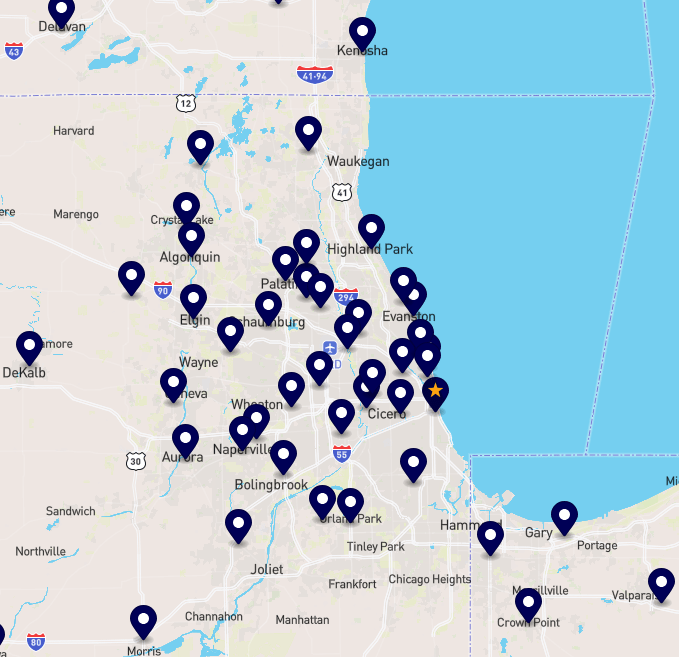
According to the Birkenstock store locator, they have many resellers: nearly 4,700 locations. But they operate only 9 of their own stores. Here are these locations and their urban/suburban status:

  1. Naperville, IL – suburban (outside Chicago)
  2. Nashville, TN – urban
  3. Sevierville, TN – suburban (smaller suburb outside Knoxville)
  4. New York, NY – urban (Soho neighborhood)
  5. Brooklyn, NY – urban
  6. Deer Park, NY – suburban (outside New York City)
  7. Larkspur, CA – suburban (outside San Francisco)
  8. Venice, CA – suburban (outside Los Angeles)
  9. Glendale, AZ – suburban (outside Phoenix)

From this list, six of the nine locations are suburban. Birkenstock stores are in the suburbs of the country’s three largest metropolitan areas – New York, LA, Chicago – and are also outside several other sizable cities – Phoenix, San Francisco, and Phoenix. Can we expect new locations outside Dallas, Miami, Washington, D.C., Atlanta, and Philadelphia soon (the remaining top 10 metropolitan areas by population)?

Additionally, Birkenstock has stores in two cities: two locations in New York City and one in Nashville.

Residents from all over the United States can access Birkenstock products online or through thousands of retailers. But the company has picked these largely suburban locations to put a company store and that tells us something about their intended market and their brand.

Criticizing cities and ICE activity in complex suburbia

President Donald Trump often criticizes American big cities, particularly Chicago as he has mentioned the city multiple times in his first and second term. Just yesterday in the Arizona service for Charlie Kirk, Trump highlighted Chicago:

Photo by cottonbro studio on Pexels.com

Trump told mourners that one of the last things the slain conservative activist and Illinois native said to him was, “Please, sir. Save Chicago.” Trump then launched into a familiar refrain, saying, “We’re going to save Chicago from horrible crime.”

One of the Trump administration’s actions regarding Chicago includes recent ICE activity. While all the details are hard to come by, it appears however that this activity has not just affected people living in Chicago; there has been ICE activity in numerous suburbs. An ICE facility in Broadview. ICE agents approaching people in numerous suburbs, as far as 40 miles out from the city.

These actions hint at the complexity of the Chicago region and suburbs across the United States. Even as some Americans have long associated cities with racial and ethnic diversity, this diversity has increased in suburbs in recent decades. The American suburbs are full of people of different racial and ethnic groups as well as large numbers of recent immigrants to the United States.

So when Trump says Chicago has problems, does he mean just the city or is the whole region in question?Again, from the Kirk service:

Trump later took aim at Gov. JB Pritzker, declaring, “You have an incompetent governor who thinks it’s OK when 11 people get murdered over the weekend. … He says he’s got crime [under control]. No, they don’t have it under control, but we’ll have it under control very quickly.”

Both the city of Chicago and its suburbs have the same governor. Only one of the Chicago collar counties in Illinois voted for Trump in 2024: McHenry County. (There are portions of the greater Chicago area in southeastern Wisconsin and northwestern Indiana but they may not be part of the same conversation.) Are the problems some see in Chicago also ones they see present in suburbs?

When music accompanists do not get to see what they are accompanying

I have played piano in a number of situations – for church services, weddings, funerals, musicals, choirs, marching band shows, and instrumental soloists – where I do not get to see what the audience sees. This can happen because I am focused on my own playing and there is not much time to look. I need to make sure the music sounds good, my fingers are where they should be, and the pages are flipped when needed. But it also regularly happens because of where the piano is located; where the instrument is situated makes it difficult or impossible to see the action. Whole musicals have occurred where I can hear the lines, singing, and movement but I am facing another direction to watch the director who is facing the action on the stage.

Photo by Pixabay on Pexels.com

This is an interesting position to be in: to be part of the event or performance without seeing all of it. The audience takes it all in. For them the music and all that happens in front of them are all one thing. To the participants, they each have a role to play. The musical accompaniment is not the main focus. It “supports or complements.

This is analogous to numerous situations in life. There are times when each of us are main actors in what is going on around us. We can make choices that have immediate consequences and drive the story forward. But this does not happen all the time. Often we are playing a part in an organization or a group or a situation. Our participation matters – the situation is different depending who is or is not present, who is doing something and who is not – but does not depend on us.

In the musical situations when providing accompaniment I described above, does this mean I have missed these events? I may not have seen the bride walk in or the formation the band makes on the field or observed the way people leave a funeral service. I do not know everything that happened in the front. But I was there and playing a part that contributed to the whole.

Mortgage fraud rates very low – but on the rise?

With cases of mortgage fraud in the news, one source says it is rare:

Photo by Leeloo The First on Pexels.com

About 1 in 116 mortgage applications contained fraud in the second quarter of 2025, according to Cotality’s National Mortgage Application Fraud Risk Index.

The data shows the two riskiest investments for mortgage fraud are investment properties and multiunit properties.

This is less than 1%.

But the same source says mortgage fraud is on the rise:

“The increase in the fraud risk can partly be attributed to the volatility starting to be seen in the real estate market,” Matt Seguin, senior principal of mortgage fraud solutions, said in the Cotality report. “Interest rate cuts haven’t come at the rate expected over the last year, so purchase transactions, which, historically speaking, have higher fraud risk, continue to represent almost 70% of the applications seen by Cotality.”

Cotality analyzed data in six categories of mortgage fraud: identity, transaction, property, income, occupancy, and undisclosed real estate. The research found that every category except occupancy saw an increase in the second quarter.

The largest year-over-year increases were in undisclosed real estate debt and transaction fraud risk. Undisclosed real estate debt rose 12% this year, compared with a 5.9% decline year over year in 2024. Transaction fraud risk increased 6.2% this year, following a 4.9% increase last year.

Rare and relatively small increases in the last year.

Perhaps the problem of mortgage fraud would sound more serious if this 1 in 116 mortgages was connected to the cumulative money involved. Each mortgage is connected to a good amount of money. Add all the fraud up and how much money are we talking about? Is it enough money for financial institutions or the general public to pay attention to?

Another way to think about this would be to compare fraud rates here with fraud rates with other financial instruments. How about credit card debt? Auto loans? Home equity loans? And so on. Mortgage fraud is low but perhaps it is even lower than in other areas or higher than others.

Regardless of the numbers, absolute or otherwise, fraud is still fraud. But whether it is perceived as a social problem might take more than just reporting the numbers or putting them in context.

The percent of income Cook County residents pay to own their home

How much does it cost to be a homeowner in Cook County?

Photo by Ricky Esquivel on Pexels.com

Homeownership expenses — including typical monthly mortgage payments, homeowners and mortgage insurance and property taxes — accounted for 29.2% of the average income earned by a Cook County resident as of the middle of this year, up from the 23.2% historical average based on data collected between 2005 to 2025, according to ATTOM, a national property data provider.

That is lower than the 33.7% national average and slightly higher than the 28% typically recommended by mortgage lenders, the data shows.

For the average Chicago resident, 42% of their mortgage payment is for expenses such as property taxes and insurance, marking it the fourth-highest share in major markets across the country, according to Andy Walden, head of mortgage and housing market research for Intercontinental Exchange, a data and financial technology firm. This is in large part, he said, because of property taxes.

This particular article suggests these costs are high for those who want to start a family; they may be able to purchase a home but there is not much left over after that point. The figures above help provide context for the 29.2% homeownership cost:

  1. This is higher than the average in the past. Homeowners in Cook County are now paying more per month than previously.
  2. The figure it higher than the 28% lenders might recommend.
  3. But the Cook County percentage is lower than the national percentage.
  4. And out of that overall percentage, Chicagoans tend to pay more for property taxes and insurance.

And a little more context: the homeownership rate in Cook County is about 62.5%.

All interesting information. Owning a home takes resources for purchasing it and maintaining it. The same lending practices that make it possible to get a mortgage for 30 years also mean costs for that long. But could the issue be something different: the costs of having children? How have those costs changed over time?

The Chicago area is often regarded as having a medium cost of living. Big cities in the Northeast and West cost more, places in the South and Midwest cost less. People living in these different contexts adjust. With the relative costs of living, how much does it differ to raise children in each place?

Homeownership is one of the biggest financial investments that a person or household will make. How many Americans now experience or believe that pursuing homeownership, a vital part of the American Dream, impedes their ability to pursue having kids?

“A board-game sociopath” and social interactions

Perhaps you have played games with someone like this:

Photo by DS stories on Pexels.com

Within the confines of the rules, there’s not much I won’t stoop to, and not only in games where lying is the point, as it is in Werewolf. If we are playing Settlers of Catan, where players trade resources and build settlements, I will manipulate you to try to get the best possible deal, and I will downplay how well I’m doing so I seem unthreatening until I swoop in and win in one massive turn. If we’re playing some kind of war game, say, Risk or Root, I will lock in on the person most likely to keep me from winning and work to convince everyone they’re a bigger threat than I am. I don’t always lie—that would be too predictable. A mix of heartfelt honesty and bald-faced lies keeps my opponents on their toes. All for the glory of winning at moving little plastic pieces around a cardboard surface.

This gets at the competitive nature of games: there are winners and losers. Some games might have reputations for pitting people against each other – ask people about family histories of playing Monopoly or Risk – and others might be gentler. Even cooperative games have collective winners.

Games are also social:

Of course, how you behave in a game can still affect how people see you outside of it. If you’re a poor sport, or if you go too far with the playful deceptions and actually start bending the rules, that could degrade your real-life relationships. But people can usually tell what’s all in good fun. Even if you’re backstabbing, deceiving, and betraying one another, “our brains are very smart,” Kowert said. “We know what’s real and what’s not.” For instance, in a game, “I’ll throw my husband under the bus so quick,” she said. “And I wouldn’t do that in real life.”

Both Tilton and Kowert emphasized that the main thing games teach their players is social skills. Tilton has used Werewolf in the classroom to teach small-group communication. Because the fantasy scenarios of games don’t really translate to real life, what’s most likely to carry over is the practice you get at reading people and communicating with them.

Throughout games, players interact. Sometimes those interactions are directly about the game, with some games encouraging more of this than others, and other times the interactions are about other aspects of life. Gaming groups can involve long-time friends and also help new people meet each other.

If some people are board game sociopaths, how many others are glue people that help the group stick together? Or people who help other players along? Or players who care less about the outcome and enjoy the process? Could a group of people only devoted to winning continue over time?

In the bigger picture, games and leisure activities offer humans opportunities to build relationships and practice interactions that take place in other settings. Can you handle winning and losing a board game? Can players develop skills in negotiating? Can they learn how to have small talk? Yes, they are “just games” and the consequences of winning and losing are usually small but they can be learning opportunities for other areas of life.

(Some?) suburbanites go apple picking

What kind of suburbanite goes apple picking in the fall? One former apple orchard resident has an idea:

Photo by Tom Swinnen on Pexels.com

I grew up on a 64-acre apple orchard in rural Ohio. To reveal my origin story to a new acquaintance is inevitably to watch their pupils dilate as they picture bucolic scenes of fruit-laden trees, decorative cornstalks, tractor-pulled hayrides, and caramel-doused apples plunked onto sticks. Orchards, I’ve come to see, are like catnip to the imaginations of boho-chic suburbanites, TikTokking wanderlusters, and harried parents on the edge of a nervous breakdown. If apple pie enjoys symbolic stature as the wholesome, patriotic dessert of America, the orchard is its hallowed birthplace and cradle—a mythical agricultural space that conjures bygone days of bliss and childhood innocence.

As a suburbanite, I am not a frequent visitor to apple orchards. What I know largely comes from advertisements for orchards and conversations with others who visit orchards. From what I can gather, the orchards are now less about apples and more about entertainment and being a mini theme park. Food options. Corn mazes. Activities for kids. Various pricing levels. Yes, some apple picking options or apple purchasing options before leaving.

Does this appeal to “boho-chic suburbanites”? Does that include people who want a controlled and cheap setting for fun with their kids, an interesting setting for selfies and family pictures, a way to fulfill some vision of what fall is supposed to look like, or some connection to an agricultural past that some have a long connection to?

I am sure there are a few good academic papers that could be written about apple orchards in 2025 as sites of consumption, social interactions, late-stage capitalism, and modern connections to nature.

Suburban disillusionment and Rules for Radicals

In the Prologue to the 1971 book Rules for Radicals, Saul Alinsky describes the disillusionment some young people in the United States felt:

Photo by u00d6merhan Datlar on Pexels.com

Today’s generation is desperately trying to make some sense out of their lives and out of the world. Most of them are products of the middle class. They have rejected their materialistic backgrounds, the goal of a well-paid job, suburban home, automobile, country club membership, first-class travel, status, security, and everything that meant success to their parents. They have had it. They watched it lead their parents to tranquilizers, alcohol, long-term endurance marriages, or divorces, high blood pressure, ulcers, frustration, and the disillusionment of “the good life.” (xiv)

By this point, the American suburbs of the postwar era had existed for roughly two decades. The growing communities outside major cities had typically catered to middle-class white residents who sought a particular vision of the good life with a home, some space, and opportunities for their children to succeed (plus multiple reasons for leaving cities).

But Alinsky is hinting at how some who lived in these suburbs or grew up in him did not find them to be the good life. Their experiences suggested the suburbs were found wanting. The answers the suburbs supposedly had did not materialize or they were not the right answers. The suburban life could not address particular and/or difficult social issues.

On the other hand, many Americans continued to move to the suburbs even as some suburbanites were disillusioned. The percentage of Americans living in suburbs continued for multiple decades after Alinsky wrote the book. How many young adults rejected this suburban way of life and turned to something else? The percentage might have been small compared to the mass of suburbanites, even as Alinsky’s work proved influential.