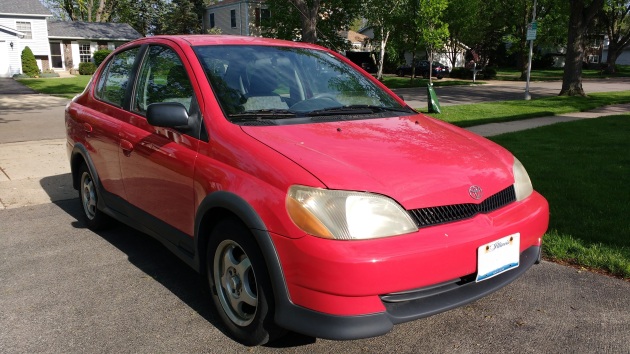
We bought a Toyota Echo for $6,600 in December 2006; sold it for $1,500 eleven and a half years later

Our family recently bid adieu to our 2000 Toyota Echo with its manual locks, manual windows, cassette deck plus CD player, and over 163,000 miles.

ToyotaEchoMay18.jpg

Despite its features that were outdated even when we bought it, it served us well:

-No major repair issues.

-30+ MPG. Not quite the Geo Prizm or small Honda Civics but good for commuting.

-Obtaining decent all-season tires provided much better traction in winter and handling.

-Decent size inside, particularly for headroom.

-Low insurance costs plus some resale value twelve years later.

There are not too many of these early Echoes left; this probably has less to do with their reliability and more to do with their limited sales in the first place.

Fighting smog not by reducing driving but by insisting on more efficient cars

Smog and air pollution due to vehicles is a familiar sight in many large cities. Yet, Crabgrass Crucible suggests the fight against smog in Los Angeles did not target driving itself but rather automakers:

The ban on fuel oil easily found favor among antismog activists. After all, like the steps with which smog control had begun, it mostly targeted the basin’s industrial zones. Harder to swallow in Los Angeles’s “citizen consumer” politics of this era, even for antismog activists, were solutions that might curtail the mobility associated with cars. Consonant with national trends noted by automobile historian Thomas McCarthy, there was a widespread reluctance to question orthodoxies of road building and suburban development. Even the “militant” activists at the 1954 Pasadena Assembly only went so far as a call to “electrify busses.” By the 1960s, as motor vehicles were estimated to cause nearly 55 percent of smog, there were suggestions for the development of an electric car. Yet Los Angeles smog battlers of all stripes raised surprisingly few questions about freeway building. For many years, Haagen-Smit himself argued that because fast and steady-running traffic burned gasoline more efficiently, freeways were smog remedies. So powerful and prevalent were the presumed rights of Angelenos to drive anywhere, to be propelled, lit, heated, and otherwise convenienced by fossil fuels, that public mass transit or other alternatives hardly seemed worth mentioning.

Once pollution controllers turned their sights to cars, they aimed not so much at Los Angeles roads or driving habits or developers as at the distant plants where automobiles were made. Probing back up the chain of production for smog’s roots, local regulators and politicians established a new way of acting on behalf of citizen consumers. Rather than pitting the residential suburbs of the basin against their industrial counterparts, in an inspired switch, they opened season on a far-flung industrial foe: the “motor city” of Detroit. The APCD’s confrontations with Detroit car makers had begun during the Larson era, but quietly, through exchanges of letters and visits that went little publicized. In 1958, after the nation’s chief auto makers had repeatedly shrugged off Angeleno officials’ insistence on cleaner-burning engines, the Los Angeles City Council went public with its frustration. It threw down the gauntlet: within three years, all automobiles sold within the city limits had to meet tough smog-reducing exhaust standards. Because its deadline had passed, a 1960 burst of antismog activism converged on Sacramento to push through the California Motor Vehicle Control Act. The battle was hard-fought and intense, but the state of California thereby wound up setting pollution-fighting terms for its vast car market. (232-233)

This helps put us where we are today: when the Trump administration signals interest in eliminating national MPG standards for automakers, California leads the way in fighting back.

Ultimately, this is an interesting accommodation in the environmentalist movement. Cars are significant generators of air pollution. Additionally, cars do not just produce air pollution; they require an entire infrastructure that uses a lot of resources in its own right (building and maintaining roads, trucking, using more land for development). Yet, this passage suggests that because cars and the lifestyle that goes with them are so sacred, particularly in a region heavily dependent on mobility by individual cars, the best solution is to look for a car that pollutes less. This leaves many communities and regions in the United States waiting for a more efficient car rather than expending energy and resources toward reducing car use overall. And the problem may just keep going if self-driving cars actually lengthen commutes.

More Prii at which location: Whole Foods on a weekend or an arboretum on Earth Day weekend?

A recent experience at the Morton Arboretum led me to this question regarding where I was more likely to see Toyota Prii:

-The parking lot for Whole Foods on a weekend

-At the arboretum on Earth Day weekend

Since certain lifestyle and consumption choices are tied to other lifestyle patterns (for example: TV shows), connecting Prius owners to these two places may not be that surprising. One study had this to say about small car owners:

Small Car: Prius, Honda Civic, Smart Car
According to a study by researchers at UC Davis, “What type of vehicle do people drive?
The role of attitude and lifestyle in influencing vehicle type choice,” small car drivers are more pro-environmental and prefer higher density neighborhoods than drivers of others types of cars. This isn’t surprising; if you live in a big city, it’s simply easier to park with a small car and if you’re concerned about the environment, you’ll want something that’s more fuel-efficient. Small car drivers, unlike other categories of drivers, don’t necessarily see their cars as a ticket to freedom. They aren’t workaholics or status seekers who try to display wealth. They want to lessen their impact on the earth and have a reliable car—and find a parking spot.

When considering the number of Prii at the arboretum, there were also a large number of vans and SUVs, vehicles less friendly toward the environment. Can a driver claim to be an environmentalist while also driving a large vehicle? Is a Prius a special badge of honor?

True for Chicago and elsewhere: “cities don’t just crop up in random places”

At Instapundit, Gail Heriot explains how Chicago came to be:

FATHER JACQUES MARQUETTE AND LOUIS JOLLIET: On this day in 1673, a 35-year-old Jesuit priest and a 27-year-old fur trader began their exploration of Lake Michigan and the Mississippi River, leaving from St. Ignace at the north end of Lake Michigan. From there, they went up the Fox River and then overland (carrying their canoes) to the Wisconsin River, which took them to the Mississippi River. Out of fear of running into the Spanish, they turned back at the Arkansas River. By then, they had confirmed that the Mississippi does indeed run to the Gulf of Mexico.

The route back was different. And this becomes important to the history of the country and especially of the City of Chicago: Friendly Native Americans told them that if they go up the Illinois River and the Des Plaines, rather than the Wisconsin, it would make the trip easier. That’s because the portage distance from the Mississippi watershed and the Great Lakes watershed was shortest there. The Chicago River, which dumped into Lake Michigan was only a short distance away.

If you’ve ever wondered why Chicago grew into a major city so quickly, this is why: Location, location, location.  In the modern world it’s easy to miss how much topographical issues like that mattered (and in different ways continue to matter).  But cities don’t just crop up in random places.

The locations of major population centers may seem fairly obvious now: a large population has been there for a long time and the city by its own large inertia continues to draw more people. This may be particularly true for cities outside of North America where there may be centuries or millennia of accumulated settlement.

Yet, looking at the founding of major cities in the United States often shows that there are located at places that provided major transportation advantages for people of that time. Even though this might be less obvious now since we do not think much about sea travel and shipping, a number of major coastal cities have protected ports. Inland, many cities are located on key bodies of water, primarily rivers. Even more recently, communities developed around railroad junctions and highway intersections where a lot of traffic converged.
Perhaps in a “perfect world,” major cities would be spread out at fairly even intervals. But, development does not typically work this way: it often follows earlier transportation links or patterns of development.

Explaining why traffic deaths are up 46% since 2009

In 2016, 5,987 American pedestrians were killed. Why so many?

Distraction behind the wheel, texting while walking and even marijuana legalization have all been tagged as potential culprits in past research.

In addition, a new study released Tuesday by the Insurance Institute for Highway Safety shows an 81% increase in single-vehicle pedestrian fatalities involving SUVs between 2009 and 2016, based on federal records…

The USA Today Network is investigating the phenomenon of rising pedestrian fatalities, an urban problem primarily plaguing either cities with high poverty rates or warm-weather spots such as Florida and Arizona. Our analysis so far has found that African Americans are killed at a disproportionate rate compared with their population nationwide.

Nationally, more pedestrians die in collisions when they are jaywalking along busy arterial roads. More of those fatalities also occur at night and involve males. Many of these crashes also involve alcohol, though federal safety researchers say that does not explain the increase. In 2016, pedestrians accounted for 16% of traffic deaths; in 2007, that figure was just 11%, according to NHTSA.

I am a little surprised to see that increased driving is not cited here. While driving dipped during the economic crisis, it is up to record levels in recent years.

While the emphasis here is on the upward trend in recent years, the numbers overall are a reminder of the consequences of such a strong emphasis on driving in American society. Roadways are built primarily for cars. Even when there is infrastructure for pedestrians and other non motor vehicles, it can be daunting to not be a car. Countering this could require extensive marketing campaigns; this article discusses efforts in several large cities. But, a significant change in favor of non-vehicles would truly require not just publicity but redesign and the reshaping of lifestyles.


Could Americans be convinced to use buses by new technology?

Technological advances to buses might make them more attractive…or they might not. Here are the five new features:

Electrification

Autonomy

Minibus/trackless train

Seamless payment

Accessbility

Two things stand out to me from the argument:

  1. Newer technology tends to make things more attractive in society. This does appear to be a general pattern though I am not sure technology alone could overcome misgivings wealthier Americans have about buses.
  2. The shifts described here tend to reduce some of the features that might be less attractive about buses: they would not be as large and they would be less tied to particular routes. This makes them less like traditional buses and more like large vans that have flexibility.

One aspect of mass transit to which I’m surprised there is not more discussion of in this argument is whether these smaller and more flexible buses would be faster for users. If so, this could be a tremendous plus. One of the promises of self-driving vehicles is that traffic flow could be better coordinated and would not be affected by drivers slowing things down.

Testing play streets in Los Angeles

The city of Los Angeles, known for its highways and roads, is trying to turn some of its streets into areas for fun and community activity:

There are roughly 7,500 miles of streets in Los Angeles, and Fickett Street is only one of them. But in this predominantly Latino neighborhood where parks are scarce, residents and activists have begun a design intervention to reclaim streets for civic life, kibitzing and play. From London to Los Angeles, the play street concept, known as “playing out” in England, has become an international movement of sorts, especially in low-income communities that lack green space and other amenities.

The efforts in Boyle Heights, a 6 ½-mile area bisected by six freeways, is a collaboration between Union de Vecinos, a group of neighborhood leaders, and the Kounkuey Design Initiative, or KDI, a nonprofit public interest design firm that helps underserved communities realize ideas for productive public spaces.

The Los Angeles Department of Transportation has invested $300,000 on 15 KDI-designed pilot play streets this year in Boyle Heights and Koreatown, another heavily trafficked neighborhood. Seleta Reynolds, the general manager of the LADOT, first became aware of the concept while visiting Copenhagen…

On a recent Sunday, Kounkuey unveiled its “playground in a box.” Shade structures stretched across Fickett Street, affixed to loquat trees and no-parking signs, and the plastic “wobbles” created by KDI doubled as Tilt-a-Whirls, BarcaLoungers, and formidable hurdles for teenage skateboarders. Nine-year-old Amanda Alvarado built a McMansion. “Ava, lookit!” she exclaimed to her 4-year-old sidekick in pink pom-pom slippers.

This is a clever idea for two reasons. First, it transforms what is typically a thoroughfare for cars into a space for community life. Many American neighborhoods and communities are full of roads and planning that emphasizes the efficiency of getting vehicles from Point A to Point B. Even if the effort is temporary, the transformation can be a powerful symbol. Second, it does not require long-term investments into new spaces or architecture. The road already exists. Bringing in the equipment takes some work but it is portable and can also be used elsewhere.

At the same time, this seems like an incomplete concept. It feels like a small band-aid for larger issues. As the article goes on to talk about, in a neighborhood bisected by highways, lacking green space, and pushing back against gentrification, couldn’t more be done? How about permanent parks?

City vs. suburbs in Nashville transit vote

An ambitious transit plan in the Nashville metropolitan area was roundly defeated by voters:

Had it passed, Let’s Move Nashville—the boldest municipal transit plan in recent memory—would have launched five light-rail lines, one downtown tunnel, four bus rapid transit lines, four new crosstown buses, and more than a dozen transit centers around the city. Depending on how you do the math, the scheme would have cost $5.4 billion or more like $9 billion, funded by a raft of boosted local taxes. More than 44,000 voters across Metro Nashville’s Davidson County came out in favor of the referendum, with more than 79,000 voting against it…

That’s a simplified version of the city’s politics, of course; while the vote fell broadly along urbanite versus suburbanite lines, a map reflecting the vote tally, and not just the vote result, would look more purplish. But not all that purplish. In the end, a vision for transforming transit in Nashville could not transform the politics of the city.

“There were a host of reasons [the proposal failed], like the cost ($9 billion), the scale (20 plus miles of light rail), the funding source (sales tax increase) and the financing structure (a decade of interest-only payments),” writes Emily Evans, managing director for healthcare policy for Hedgeye Potomac Research, in an email. Evans previously worked as a municipal financial analyst and served on the Nashville City Council for nine years.

A complicated plan like this has a lot of moving parts that voters could either support or vote against. At the same time, it can be a difficult sell for those outside the city core or in the suburbs to support mass transit plans that (1) they feel are not as necessary since they are able to drive where they need to go and (2) that might bring new people to their neighborhoods. When given a choice and their own personal resources, many Americans would prefer not to use mass transit, particularly if they would have to pay more for something they do not perceive helping them.

I would suggest this gets back to larger issues of whether regions really want to work together. Can cities and suburbs both thrive due to joint projects and shared resources? Or, is this a zero-sum game where resources can taken from one area and given to another in the same region is seen as a loss? The voters of Nashville remain to be convinced that mass transit is a big enough boon for themselves, let alone everyone.

Supercommuters up 15.4%, or 0.4 million, between 2005 and 2016

A small and rising number of Americans commute more than ninety minutes a day:

While super commuters still represent a small share of the overall workforce, their long commutes have become increasingly common over the past decade. In 2005, there were about 3.1 million super commuters, roughly 2.4 percent of all commuters. By 2016, that share had increased by 15.9 percent to 2.8 percent of all commuters, or about 4 million workers. In some parts of the country the problem is much worse; in Stockton, where James lives, 10 percent of commuters travel more than 90 minutes to work each day.

The rising number of super commuters underscores a general trend towards longer commutes. The share of commuters traveling 24 minutes or less to work each day has decreased to 55 percent of all commuters in 2016 from 59 percent in 2005. Meanwhile, the share of commuters traveling 25 minutes or more has increased to 45 percent in 2016, compared to 41 percent in 2005. The share of commuters traveling an hour or more to work each day increased 16.1 percent to 9.2 percent in 2016 from 7.9 percent in 2005.

I understand that this article is geared around showing differences in commuting over time. And the data can back that up: supercommuting is up and more Americans have longer commutes.

At the same time, this may be overselling the data:

  1. The changes over 11 years are relatively small. The article talks about percentage changes but the absolute numbers are small. This is the difference between supercommuting is up 15% versus saying it is up 0.4 million.
  2. Given that this data is based on samples of the US population, is a 4% change statistically significant? Is an increase from 2.4 million supercommuters to 2.8 supercommuters substantively significant?
  3. What are the trends between 2005 and 2016? Both of these measurement points are with a more robust economy. Driving was down after the housing bubble burst – was supercommuting affected by this? Is the trend line steady in an upward direction over the last 11 years or is it up and down?

From a broader view, this is not that much change. (There may still be shock value in reminding the public that 2.8% of all commuters are really willing to go far each day.)

Pneumatic road tubes to count traffic, check speed

Here are the secrets of “those weird black tubes in the road”:

Here’s a good description of the actual operation of the tube setup from the U.S. Department of Transportation:

“Pneumatic road tube sensors send a burst of air pressure along a rubber tube when a vehicle’s tires pass over the tube. The pressure pulse closes an air switch, producing an electrical signal that is transmitted to a counter or analysis software. The pneumatic road tube sensor is portable, using lead-acid, gel, or other rechargeable batteries as a power source.”…

A single pneumatic road tube is most commonly used to simply count the number of cars on the road, as well as time the gaps between individual vehicles.

If two pneumatic road tubes are set up spaced slightly apart, the counter can track the number of axles a vehicle has to better determine each individual vehicle’s class, the direction of traffic and the speed at which vehicles are moving.

A relatively simple device to figure out how many vehicles are on the road. These traffic counts are then very helpful for additional decisions like traffic control, widening or adding to roads, and even thinking about new roadways.