A growing number of US suburbs contain a majority of renters

A new analysis suggests the number of suburbs with a majority of renters is increasing:

Photo by Marlene Leppu00e4nen on Pexels.com

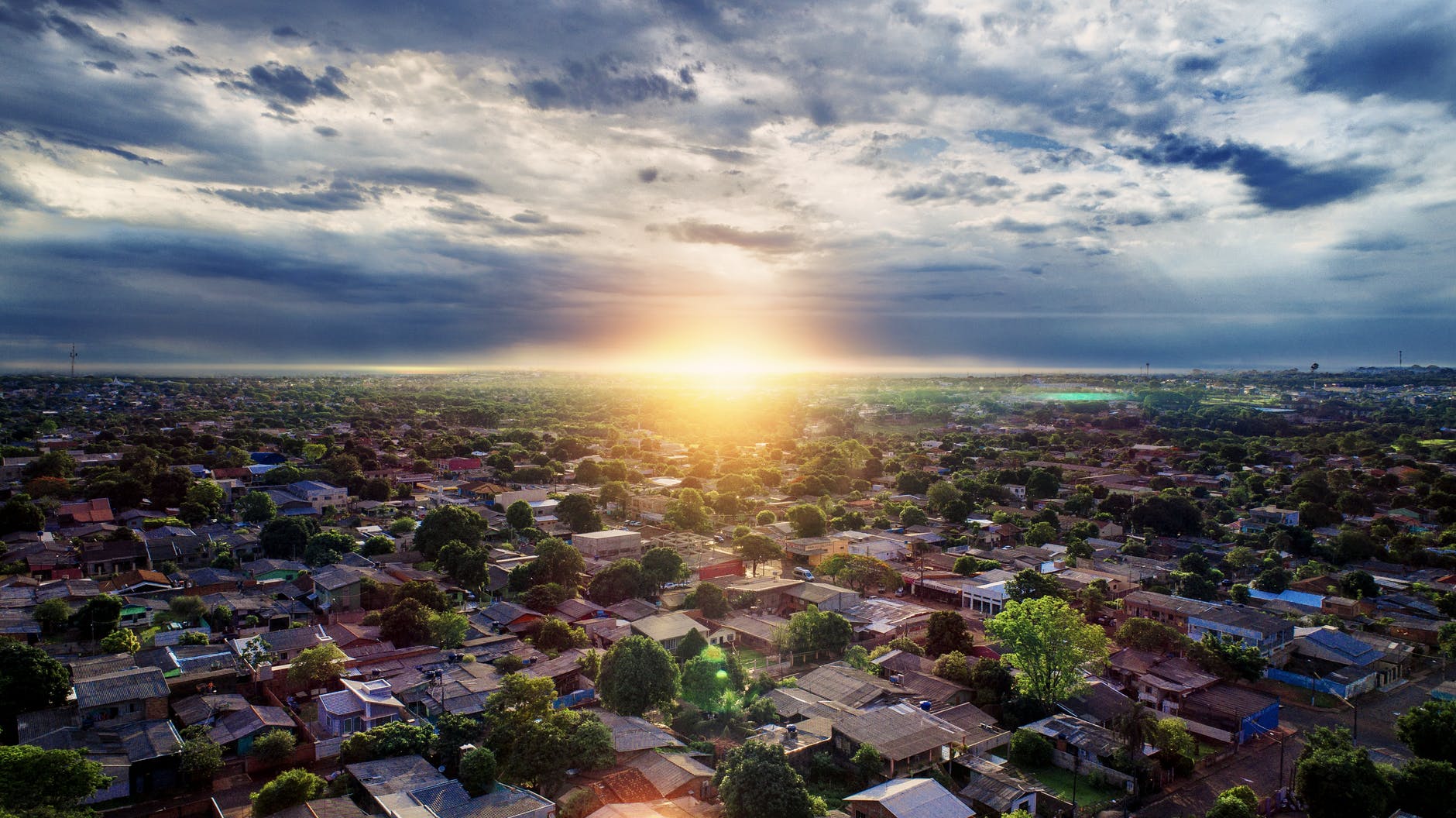
Renters now make up the majority of residents in more than 100 suburbs around the U.S., according to a new analysis of Census Bureau data from Rent Cafe. Another 57 suburbs are on their way to becoming predominately renter territory over the next five years, the apartment search website also found…

Overall, roughly a quarter of the more than 1,100 suburbs near the nation’s 50 largest metro areas are renter-dominated, according to Rent Cafe. Some 21 million people rented their homes in the suburbs as of 2019, up from 17 million a decade ago.

Millennials and members of Generation Z account for most suburban renters, Census data show. Rent Cafe notes that 55% of suburban renters are younger than 45, with median household earnings of around $50,000.

Meanwhile, the pandemic is expected to further fuel the shift away from suburban homeownership in favor of renting. Remote work opportunities have generated more interest in suburban areas within striking distance of cities.

If this is indeed the case, it would be interesting to know if these suburbs share characteristics. Do they tend to be close to the city or further out? Do they have particular hosing stocks compared to other suburbs? Are middle-class and up suburbs still devoted to residents owning single-family homes as a status marker?

My guess is that a majority of suburban residents would still say that they desire to home at some point. But, if more suburbanites are now renters, is the pathway to homeownership in their own community or other suburbs much more restrictive? This is part of the larger affordable housing conversation; people need any decent housing to live in but because many Americans aspire to own a home, having affordable ownership options is important as well.

An interesting middle path in some communities could be having significant numbers of single-family homes with long-term renters. The appearance and status of homes is maintained while renting adjusting for current conditions. On the other hand, many have argued that renters do not care for their properties or communities in the same way and communities may not like this trend.

The United States does not produce new big cities; it produces more edge cities, boomburbs, and suburbs

Two recent posts – a plan for a new multi-million person American city and the fastest-growing American communities are all suburbs – plus the construction of many new cities around the world led to this idea: the United States produces far more suburbs than big cities.

This was not always the case. The urbanization of the United States was quite rapid and gave rise to numerous big cities by the mid-twentieth century. In the early 1900s, the United States was less than 30% urban and less than one hundred years later was 80% urban. See this table from a 2002 US Census publication:

Before this, certain cities boomed. Chicago went from a small community in the 1830s to the second largest city in the United States in 1890. Numerous Sunbelt cities exploded in population, whether Atlanta or Phoenix or Las Vegas.

But, the United States now has relatively few new big cities. For decades, numerous small suburbs have truly expanded. One of the most noteworthy, thank to journalist Joel Garreau’s work Edge Cities, is Tysons Corner, Virginia. Once a rural intersection, the construction of a shopping mall and the arrival of thousands of square feet or retail and office space created a new kind of suburban community: one dominated by business rather than residents. While Tysons Corner has plans for additional residential units, it is a convergence of business and office activity at the intersections of several major roads outside Washington, D.C. Instead of new big cities, Americans get office parks and retail in the suburbs that rivals that of smaller big cities.

Another alternative to new big cities are suburbs that boom in population. I have detailed the population growth of Naperville, Illinois which grew from roughly 12,000 residents in 1960 to nearly 150,000 today. Boomburbs, analyzed by Robert Lang and Jennifer LeFurgy, are suburbs with multiple consecutive decades of double-digit growth. Some of these suburbs have grown to multiple hundreds of thousands of residents, including places like Henderson, Nevada or Mesa, Arizona. While some of these suburbs now have populations rivaling smaller big cities, they are more suburban in nature with sprawling landscapes and dependence on cars.

More broadly, where other places around the world have focused some development attention and resources on new cities, the United States has continued to fund and pursue suburbs. There are multiple reasons Americans love suburbs – I highlight the top seven – but this is still an interesting choice given how new cities might have non-linear benefits in certain areas that could help people and the country meet new challenges.

The ten fastest growing American communities are all suburbs, all in South or West

Growth in the United States continues to occur in suburbs in two regions of the country:

Photo by Ingo Joseph on Pexels.com

The 2020 Census listed Meridian as one of the 10 fastest-growing large cities in the country. All the cities on the list grew at rates of more than 44 percent. They are all in the South and the West. And they are all suburbs…

Meridian and the nine other cities represent a trend, according to U.S. Census Bureau officials. As the country’s biggest cities grow and become increasingly unaffordable to many, their suburbs have ballooned, taking on their own identities…

The Phoenix and Dallas-Fort Worth metro areas have had suburbs on this list every decade, he said. “Sizable amounts of empty land for construction of housing” encourages this population growth, and that land is more commonly available in the West and South. Now, people are often going farther and farther from city centers to search for empty lots, especially in cities that have been growing for the past half-century, Perry said…

Meridian and suburbs like it, Perry said, are “a reminder that there are still some pockets of rapid population growth in certain areas of the country,” despite the past 10 years being the second slowest growing decade for the U.S. population. What the Census data makes clear is that many suburbs are taking on a life of their own.

This is a continuation of several longer trends. The population growth in the United States has generally shifted to the South and West and away from the Northeast and Midwest. Certain suburban communities continue to grow rapidly, driven by expanding metropolitan areas, a quest for cheaper land, and the celebration of sprawl and single-family homes. Many big cities are still growing but they are no longer the fastest-growing places.

At the same time, these ongoing patterns might be surprising for several reasons. First, the suburbs have endured critiques for decades yet the same pattern seems to keep repeating: small towns outside hot metro areas balloon in size and population over the course of several decades. As the article notes, this can bring a lot of change that is not universally liked by the residents there before sprawl or even some of the residents who join the sprawl. The rapidly-growing suburbs are no longer places like Naperville but the descriptions of what is happening are very similar. What have Americans learned in the seven-plus decades of postwar suburban growth?

Second, are these growth patterns sustainable in areas with water and other environmental concerns? Communities in the West are reconsidering growth amid water shortages. Is the land converted to subdivisions stable and have good drainage? Does the emphasis on driving contribute to smog and the use of land that was once more open?

Third, population increases are often accompanied by a gain in status. Larger communities are better-known, have more business activity, and become destinations. Will these rapidly-growing suburbs suddenly be put on the map (also suggesting that other places decrease in status)?

Put together, will there be cheap enough open land outside attractive cities for explosive suburban growth? Or, because there will always be some suburban land somewhere cheaper than properties in the most expensive markets, think New York City, Los Angeles, and San Francisco, there might always be a market for sprawl.

McMansion as a symbol of a lot of something and more

A ranking of every Weezer song includes using the term “McMansion” for the second-worst song on the list:

Photo by freestocks.org on Pexels.com

204. “Beverly Hills,” Make Believe

To this day, Weezer’s highest charting single – which makes sense, as it’s about as close to the lowest common denominator as the band has ever sunk. A lumbering monument to the pursuit of wealth and luxury, “Beverly Hills” matches its vapidity of message with a McMansion’s worth of painful musical ideas: the clumsy half-rapping of the verses, the annoying “gimme, gimme” rejoinder of the chorus, the talkbox solo of the bridge. Even louder than the caveman thud of Pat Wilson’s opening drum salvo was the sound of dyed-in-the-wool diehards stampeding for the exit, finally ready to accept that the glorydays of Pinkerton weren’t coming back.

The most obvious use of the word here is to suggest the song has a lot of bad ideas. McMansions are criticized for their size and their poor architectural ideas.

But, there could be more here in this paragraph. A few quick ideas:

  1. Beverly Hills is a wealthy neighborhood with a lot of big houses. Are some of them McMansions? McMansions are connected to displays of wealth and excessive consumption.
  2. The reference to “the lowest common denominator” could be linked to the critique that McMansions are vapid and mass produced. They are not real mansions; they are attempts to mimic higher quality construction and more architecturally pure mansions.

All together, the use of the term McMansion here does not refer directly to the actual homes. Rather, it highlights how familiar the term is in order for its use in a music review to highlight abstract ideas.

Sustaining McMansion purchases with low interest rates

If architecutural critiques of McMansions do not dissuade potential buyers, enticing interest rates might prove persuasive. One Southern California mortgage broker explains:

Photo by Andrea Piacquadio on Pexels.com

Maybe you, too, can afford a Southern California McMansion. How about paying just interest, not principal, at a rock bottom 1.875% mortgage rate for the first three years?

For a $1.5 million loan on a $2 million home, your house payment is locked down at $2,344. Assuming monthly property taxes of $2,083 (1.25% annual property tax rate) and $250 for monthly homeowners’ insurance, your total house payment is $4,677…

If rate and payment uncertainty gives you too much heartburn, you can find longer interest-only lock terms of five, seven or 10 years in the 2% to 3% interest rate range on 30-year mortgages.

Even 30-year jumbo fixed rates are super cheap. I’ve found rates as low as 2.375% for Inland Empire properties, where jumbos start at $548,250. In Los Angeles and Orange counties, where jumbos start at $822,375, rates are as low as 2.625%.

Why buy a McMansion? Because it is relatively cheap due to low interest rates. As the commentary notes, renting a McMansion could be significantly more costly than buying. Since Americans like large houses and this is an expensive real estate market, a large McMansion at reasonable rates may look like a good deal.

At the same time, the idea of even cheaper interest rates for just three years should cause some pause. What happens if interest rates go up? This sort of approach sounds like some of the mortgage options of the 2000s that helped lead to difficulties for some in keeping up with their mortgage.

Another way that McMansions could continue to be an attractive financial option in the future is if their relative value drops compares to other homes. If fewer people want such a home, this might depress values to a point where others who value space or like other McMansion features might be able to get a bargain.

The difficulties of defining religion, COVID-19 religious exemptions edition

With people seeking religious exemptions to COVID-19 vaccine mandates, the question of how to define religion arises.

Photo by Rodolfo Clix on Pexels.com

Exemption requests are testing the boundaries of the federal Civil Rights Act of 1964, which requires employers to provide reasonable accommodations for employees who object to work requirements based on religious beliefs that are “sincerely held.”

To the benefit of objectors like Holmes, the provision defines “religion” broadly. The Equal Employment Opportunity Commission has specified that religious objections do not have to be recognized by an organized religion and can be beliefs that are new, uncommon or “seem illogical or unreasonable to others.”

They cannot, however, be based only on social or political beliefs. That means employers must try to distinguish between primarily political objections from people who may happen to be religious and objections that are actually religious at their core.

For many skeptics, resistance tends to be based not on formal teachings from an established faith leader but an ad hoc blend of online conspiracies and misinformation, conservative media and conversations with like-minded friends and family members.

This would not be a surprise to sociologists of religion and others who analyze religion in the United States. On the one hand, American religiosity has formal patterns. There are established religious traditions, denominations, and congregations. Christianity has been a dominant religious form and so its beliefs and practices are widespread. The First Amendment rights to free exercise of religion and no state religion have provided room for religious groups to develop and grow.

On the other hand, for at least a few decades, American religion has been marked by a willingness by many to decide what their own religion will be comprised of. This ranges from people who attend a congregation but do not necessarily agree with important doctrines or practices to those who create a highly individualized faith that draws on multiple traditions. From the “Sheilaism” of the 1980s discussed in Habits of the Heart to those today who would say they are spiritual but not religious,

This then means that a definition of religion is difficult. Is it as simply as saying that someone “would know religion when they see it?” If the law needs precision in order to make decisions, this definition and its interpretation will be very important to deciding who has a viable religious exemption and who does not.

Water shortage hits the Colorado River and the agreement governing water distribution dates back to 1922

Updating infrastructure to meet new challenges is an issue in numerous areas, including in securing water. The current case of the Colorado River illustrates how updating is needed:

The 1922 compact overestimated how much water was in the river system to begin with. And now there’s even less. On top of that, the rules about divvying up the water – whether you’re a city, an irrigation district, or a rancher – essentially operate like dibs or calling shotgun in a car.

The phrase that people like to use in the West is “first in time, first in right.” The water users who arrived first in these places where the water is used and claim the water when they got there, hold the most senior water rights, and their water rights remain senior no matter who comes after them. Those senior water rights trump junior water rights even to this day, with an exception: The law says that if you don’t use those senior water rights to their full extent every year that they could be confiscated and given to somebody with more junior water rights…

Why has the frontier mindset survived to 2021 in the way we think about and legislate water?

Part of it is cultural. The culture of the West survives. In the north, in the mountains, it’s a culture of rugged individualism, and in the south, it is still a bit individualistic and conservative. The rights to the water track to the history of the place, not to how it has evolved in more modern times. [These] cities didn’t exist in the mid-1800s, so they have very junior water rights now, even though that’s where most of the people are. So literally the largest volume of water goes to the people in places with the deepest historical roots.

Future battles about access to water will be fierce, particularly in places where less water is available than in the past.

Will this slow growth in states where growth has been a feature of life for decades? This could affect communities, metropolitan areas, states, and a whole region.

Does this help break the obsession Americans have with green grass lawns? The drought in California half a decade ago could have been just a taste of the future.

Does this become a major issue in elections? How exactly does a water distribution renegotiation occur, particularly if elected officials have little direct influence?

What would a more collectivist mindset to water look like in the United States compared to a more individualistic approach or one rooted in history in the area? I could imagine a quick switch of systems would be difficult but phasing in changes over time might be possible.

Facebook and powerful actors

The Wall Street Journal reports on the ways powerful people interact with the platform differently compared to regular users:

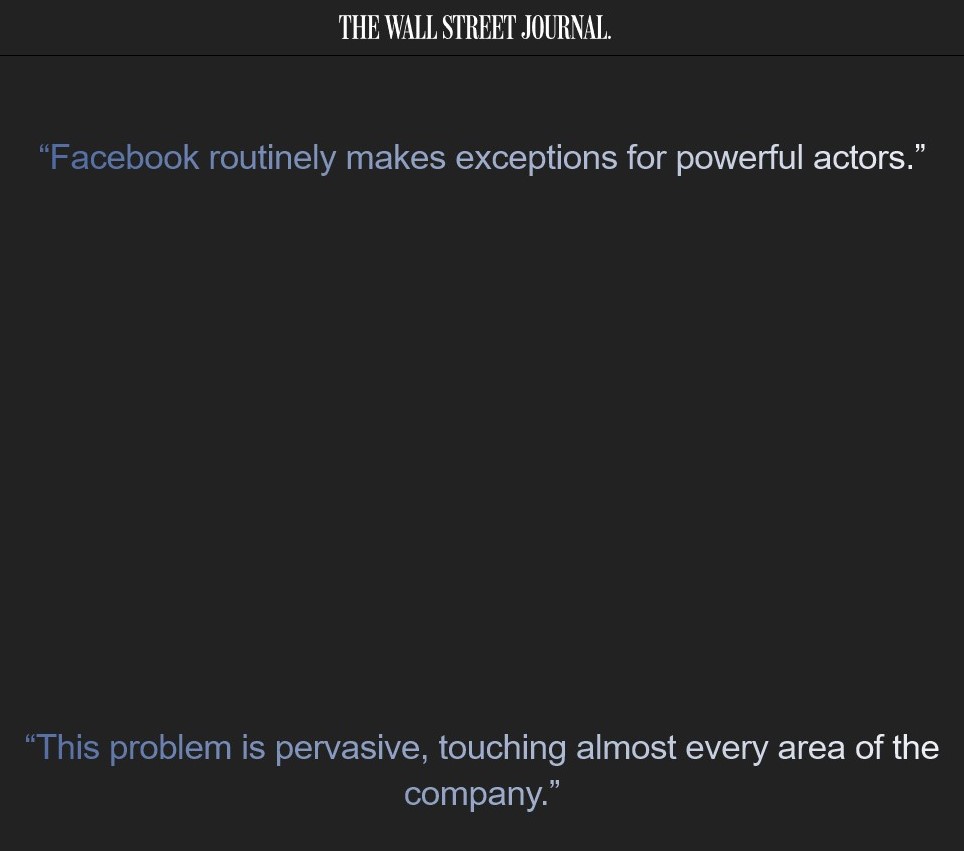
The program, known as “cross check” or “XCheck,” was initially intended as a quality-control measure for actions taken against high-profile accounts, including celebrities, politicians and journalists. Today, it shields millions of VIP users from the company’s normal enforcement process, the documents show. Some users are “whitelisted”—rendered immune from enforcement actions—while others are allowed to post rule-violating material pending Facebook employee reviews that often never come.

At times, the documents show, XCheck has protected public figures whose posts contain harassment or incitement to violence, violations that would typically lead to sanctions for regular users. In 2019, it allowed international soccer star Neymar to show nude photos of a woman, who had accused him of rape, to tens of millions of his fans before the content was removed by Facebook. Whitelisted accounts shared inflammatory claims that Facebook’s fact checkers deemed false, including that vaccines are deadly, that Hillary Clinton had covered up “pedophile rings,” and that then-President Donald Trump had called all refugees seeking asylum “animals,” according to the documents.

A 2019 internal review of Facebook’s whitelisting practices, marked attorney-client privileged, found favoritism to those users to be both widespread and “not publicly defensible.”

“We are not actually doing what we say we do publicly,” said the confidential review. It called the company’s actions “a breach of trust” and added: “Unlike the rest of our community, these people can violate our standards without any consequences.”

This will likely get a lot of attention for the different approach to different kinds of users. That elite members are treated differently could get interesting in an era with an increased focus on inequality and the influence of social media.

I am also interested in hearing more about how much Facebook and other social media platforms rely on powerful and influential people. Celebrities, whether in politics, entertainment, sports, the arts, or other spheres, are important figures in society. Elite figures may not be like regular users in that they attract a lot of views and promote engagement among other users. Social media platforms want users to engage with content and elites may provide just that.

Going further, social media platforms have power users. For example, a small percent of Twitter users are highly engaged. Social media use and content generation is even across different users. Should those who generate more content and engagement operate under a different set of rules? Is having provocative users or people who push the boundaries (or even get away with breaking the rules) good for business?

This makes me wonder if there would be a market for a social media platform that puts users on a more level playing field. If we know that certain resources, statuses, and social markers lead to differential treatment, might an online platform be able to even things out?

The Sopranos prequel highlights the path from Newark neighborhood to suburban McMansion

The Sopranos’ McMansion is a key part of the original show. The new prequel movie might help explain how the family ended up in a New Jersey McMansion:

Photo by Dhyamis Kleber on Pexels.com

By the 1990s, the mob was operating out of detached villas with swimming pools in upstate New Jersey, but if you want to learn precisely why the adult Tony Soprano lives in a gilded McMansion rather than a clapboard house with a stoop in Newark like his mother’s, The Many Saints Of Newark has the answer.

As Harold’s fortunes rise, black families move onto the same streets as Italians, causing much angst to the latter, including Tony’s parents, Johnny Boy and Livia Soprano. It makes Tony’s racism that much more obvious when, 30 years later, his daughter, Meadow, brings home her mixed-race college boyfriend. “I think there was talk, back in the day, about ‘Were black people getting short shrift on The Sopranos?’” says Odom Jr. “Was our story being told? I think David had a desire this time to look at an arc that really didn’t get explored the first time, at how the two communities intertwined and where they butted up against each other.”

This sounds like a white flight story line: as the population of Newark changed, as more Black residents moved into what were exclusively white neighborhoods, white residents moved out. This happened in numerous cities across the United States (as my own research on religious groups in the Chicago area adds to). In The Sopranos, Tony and cronies make money off housing programs in the city.

At the same time, this narrative could say more about a general move to the suburbs and less about the specific move to the suburban McMansion at the heart of the show. Tony Soprano presumably used his wealth to purchase a big home in a quiet subdivision to hide his work and give his family an opportunity at a more normal suburban life. But, did he go straight from Newark to the suburban McMansion? Did his journey include a more modest suburban starter home or a suburban apartment (as it did for other characters on The Sopranos)? Did a young adult Tony Soprano make his moves from a suburban split-level or anonymous apartment off a major suburban road?

The housing path of Tony Soprano is not an inconsequential part of the story that is being developed here; it highlights his family history, his success, and his goals in life. If I see The Many Saints of Newark, I will be keeping an eye on the residences depicted within the film.

The capacity of a big box store with COVID distancing guidelines

Big box stores are ubiquitous in the United States today. From Walmart to Costco to Home Depot and more, they line major roadways and attract many shoppers. Outside of briefly considering how many people could fit into one of the buildings during Black Friday shopping or when seeing an empty building serve as a COVID-19 vaccine site, I do not regularly contemplate the capacity of the structures.

Photo by Alexander Isreb on Pexels.com

Yet, in a recent trip to a nearby Target, I saw a sign stating how many people could be in the store given COVID-19 distancing guidelines. The number: 672 people. If that is the crowd allowed during COVID-19, the capacity during regular times must be quite a bit higher. Here are some numbers for Walmart stores in April 2020 when they imposed restrictions:

Starting Saturday, Walmart stores will allow no more than five customers for each 1,000 square feet of space. The restrictions will keep the stores at roughly 20% of their capacity, the company said. The average Walmart store is about 180,000 square feet. About 900 shoppers would be permitted in a store that size under the new restrictions.

From these numbers, the regular capacity for a 180,000 square foot store would be about 4,500 customers. The name big box store does not then solely refer to square footage; at full capacity a single store could hold more people than a small town or more than many full high school buildings.

Even during COVID-19, a large number of people are allowed in the building. I have been to big box stores during COVID but I do not think the stores were ever close to the reduced capacity. This does not mean I was not close to other customers; big box stores are set up like suburban subdivisions where foot traffic is funneled to main arteries (primary roads) and different sections have their own aisles (side streets). Still, there was a lot of room to operate in buildings that sometimes can seem to stretch out to the horizon.