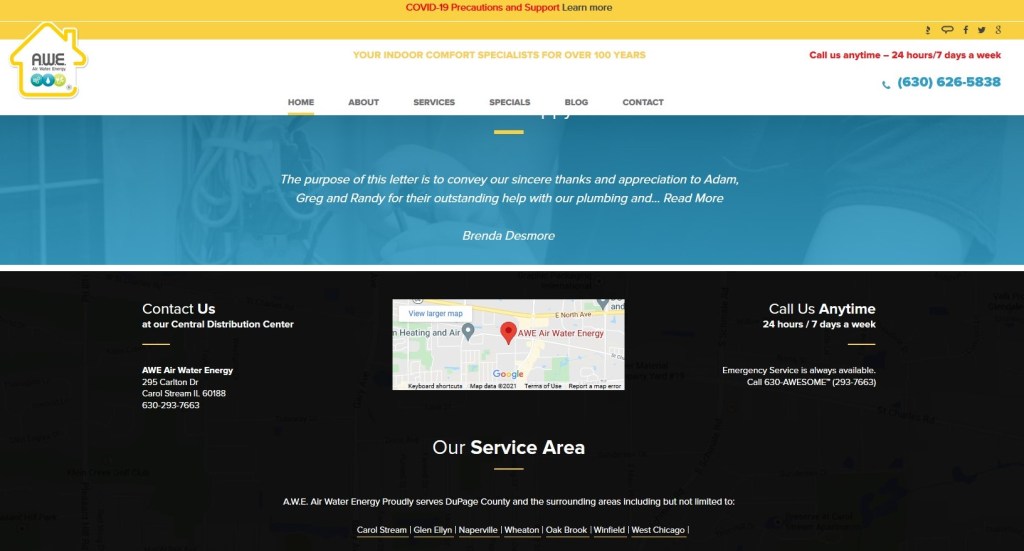
Certain numbers stick out in advertising. The Empire carpet jingle, 1-877-CARS-FOR-KIDS, and one local company I saw recently:
The phone number 630-293-7663 – or 630-AWESOME – works in two ways. First, it fits with the company name A.W.E. which stands for Air, Water, and Energy. Second, what company would not want to be known as awesome? Whether fitting the definition for inspiring awe or remarkable, this number will get remembered. All it needs now is a jingle that sticks in your head…
If you too want to make cool words out of phone numbers, here is a phone number to word generator.
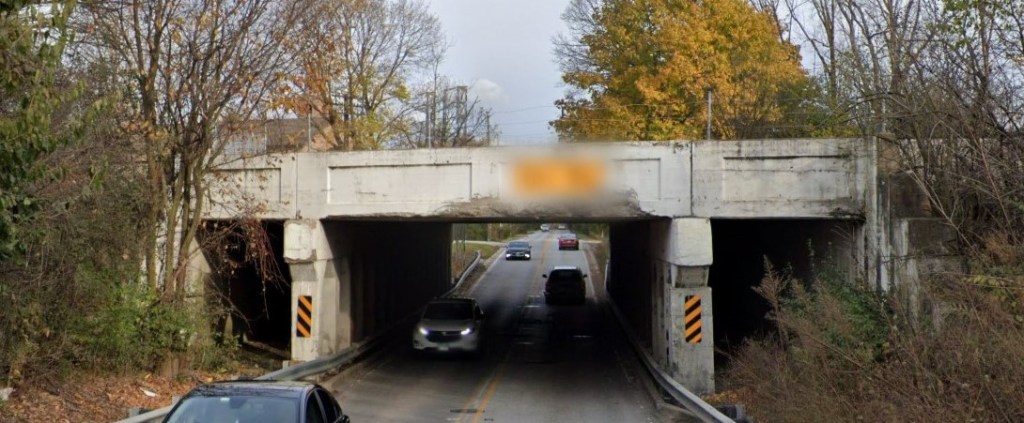
That factory still operates as Chicago Heights Steel, and the cobblestone portion of Main Street is mostly a driveway leading to it. But just past the factory is a secret passageway of sorts, an ancient viaduct just wide enough to allow one vehicle to pass under the old Elgin, Joliet & Eastern railroad tracks…
There are areas, though, where there are no ways around it, and if you get stopped, you just have to abide. I’ve lived in those areas, but I don’t anymore. The main train line by me is above grade and it’s great. The old Illinois Central tracks, which include what’s now known as the Metra Electric District commuter line, traverse the area atop a big berm as unobstructed motorists cruise underneath through a series of viaducts from Sauk Trail all the way into the heart of Chicago.
According to Metra, the grade separation was a direct result of Chicago hosting the 1893 World’s Columbian Exhibition — city leaders didn’t want messy train deaths to tarnish the event’s image. In the years after those initial express trains from downtown to Jackson Park for the World’s Fair, commuter trains made their way to the suburbs, with Flossmoor getting service in 1900 and Matteson by 1912. The raised platforms, tracks and viaducts followed with the entire line being above grade by the 1920s…
Viaducts are harder to come by these days than they were in the golden age of railroads, and I only know of a few that have been constructed in my lifetime. Despite the hassles that can come along with them, motorists, and likely train engineers too, are happy we have the ones that are here.
Even as railroad lines help put many suburban communities on the map and still provide access to big cities, many local residents just see them as a hassle for the traffic and noise they create. With the automobile dominating suburban travel, trains are nuisance when they block vehicle flow.
I am familiar with numerous railroad viaducts in suburban communities in addition to the ones mentioned above in the south suburbs of Chicago. They were ahead of their time as they allowed access under the railroad tracks, sometimes even before cars were around. Local leaders and officials they foresaw the problems that might arise between ground-level traffic and trains and therefore separated the two flows to let each move on their own. This helps avoid safety issues that still plague communities today.
At the same time, not all of these viaducts have been treated well. As the article notes elsewhere, they can have drainage issues. Their original size is often an issue as today’s vehicles and/or traffic flow is larger, meaning that old viaducts need to be expanded. Letting one car through at a time is better than nothing but many communities would benefit from two lanes each way being able to go under the tracks. Foresight in infrastructure is helpful but it needs consistent attention to keep up with repairs and expanded suburban populations.
Local school boards around the country are increasingly becoming cauldrons of anger and political division, boiling with disputes over such issues as COVID-19 mask rules, the treatment of transgender students and how to teach the history of racism and slavery in America.
Meetings that were once orderly, even boring, have turned ugly. School board elections that were once uncontested have drawn slates of candidates galvanized by one issue or another…
School boards are typically composed of former educators and parents whose job, at least until recently, mostly consisted of ironing out budgets, discussing the lunch menu or hiring superintendents.
But online meetings during the pandemic made it easier for parents to tune in. And the crisis gave new gravity to school board decisions. Parents worried their children were falling behind because of remote learning or clashed over how serious the health risks were.
This preference for local input and control is not just limited to suburbs: from the beginning, Americans have generally liked the idea of decentralized power. In the realm of education, there is input from the federal government, state government, and local bodies and districts. Local citizens retain some ability to provide their opinion on local education and to serve on local governments that control budgets and other aspects of local education.
Because of this system, people can work through different channels to address issues they are concerned about. Perhaps they can pressure the national Department of Education. They might seek to influence state boards. They can run for local boards and show up at meetings to voice their opinions. All could be useful in terms of promoting particular educational paths or policies. At the same time, I would guess there is an immediate satisfaction at showing up at local meetings, seeing real people in your community that shape schools, and advocating for change. These are not distant bureaucrats grinding out policy decisions; these are local elected residents who meet at regular times.
In the current moment, decisions made by local school boards help to differentiate different communities from each other. One district might be open to teaching something where another says no. Money may be allocated one way in a particular community while it is not a budget line in another. Board members may claim to represent one part of a community and not others. Local schools are not just about education; they symbolize local priorities and concerns. They help address or reinforce racial, ethnic, class, and gender boundaries in and across communities. Schools are both a part of the status of a community and contribute to that status.
In this article, it sounds like many of the school board battles are proxy fights over national issues. Whether this serves individual communities and their residents well remains to be seen.
Such gangbusters growth is unlikely to continue, with the pandemic easing. But the rush to the country that underpins it is less an anomaly than a speeding up of a long-tern trend, as more people – notably millennials yearning to become homeowners – look to adopt quasi-rural lifestyles. Being priced out of urban living is one driving factor; interest in healthier and more sustainable diets, including homegrown vegetables and home-harvested eggs, is another. Whatever is motivating them, Tractor Supply sees an opportunity in these “ruralpolitans” – and the COVID-driven shift toward remote work will help sustain their numbers.
Lawton, who became CEO in early 2020 after two years as the No. 2 at Macy’s, says millennials’ willingness to move farther from city centers is a “game changer”: “We seeing a new kind of shopper in our stores,” he tells Fortune. Now Tractor Supply is adapting to cater to both its established customer base and these younger space-seekers, following a strategic road map with the folksy title “Life Out Here.”…
The fast-growing cohort that Tractor Supply is cultivating, she says, are “beginning to learn how to garden. They have this passion for poultry.” Call them the “country suburban” customers.
The company is strategic about where it meets these customers. Its stores are almost all located in mid-size or small towns – communities that are often too small to support a Home Depot, Petco, or Walmart.
The economic impact of COVID-19 has hit some businesses very hard while others, like Tractor Supply, have found opportunities. From the sound of this article, they had locations in numerous places that received new residents during COVID-19 and had the right mix of products and service that appealed to them.
I wonder about the class dynamics of all of this. How do the new “ruralpolitans” who want to raise chickens or have a small farm and have moved from the city compare to the other shoppers at Tractor Supply or to long-term residents in the community?
Another question to ask is whether these newer residents with these interests in food and farming are in it for the long haul or not. On one hand, if remote work is more viable than ever, perhaps people will stay in smaller communities outside cities and pursue this. On the other hand, if companies ask more workers to return or if small-scale agriculture and animal husbandry is not appealing in the long run, this may be more of a flash in the pan. Industry-wide shifts in agriculture could have an impact as well.
Finally, the move to a more rural life has implications for private lives and community life. Many Americans say they like the idea of living in a small town but this is different than actually living in one. What is the tipping point where an influx of new residents changes the character of the community (or is change somewhat inevitable)? How involved will these new residents be in local organizations, religious congregations, local government, and in local social affairs?
For a network focused on single-family homes, the term McMansion is rarely uttered on HGTV. Here is one example I ran into a few weeks back on My Lottery Dream Home:
On the top left of the image, you can faintly see some of the narration over the image: “Willow Park Way that almost looked like a McMansion.”
Almost a McMansion. The exterior here has some interesting features that might place it in McMansion territory: multiple roof lines, interesting window placement, a large house, in a sprawling Texas community.
Even as the couple did not select this home at the end, it is interesting the term was applied to this home and not the others which also could have been viewed as McMansions. Present a large suburban home with a front meant to impress yet some questionable architectural choices and McMansions may just come to mind.
At the same time, this episode was set in suburban Texas where housing tastes are different than in more sophisticated markets. In my comparison of the use of the word McMansion in the New York and Dallas regions, there was more openness in Dallas to such homes and what they represent. Surely, some McMansion dwellers and afficionados watch HGTV and they might be in markets where McMansions are not so disliked.
I will keep checking for more mentions of McMansions on HGTV. As I do, I am much more likely to hear terms like mid-century modern or country farmhouse much more than the term McMansion.
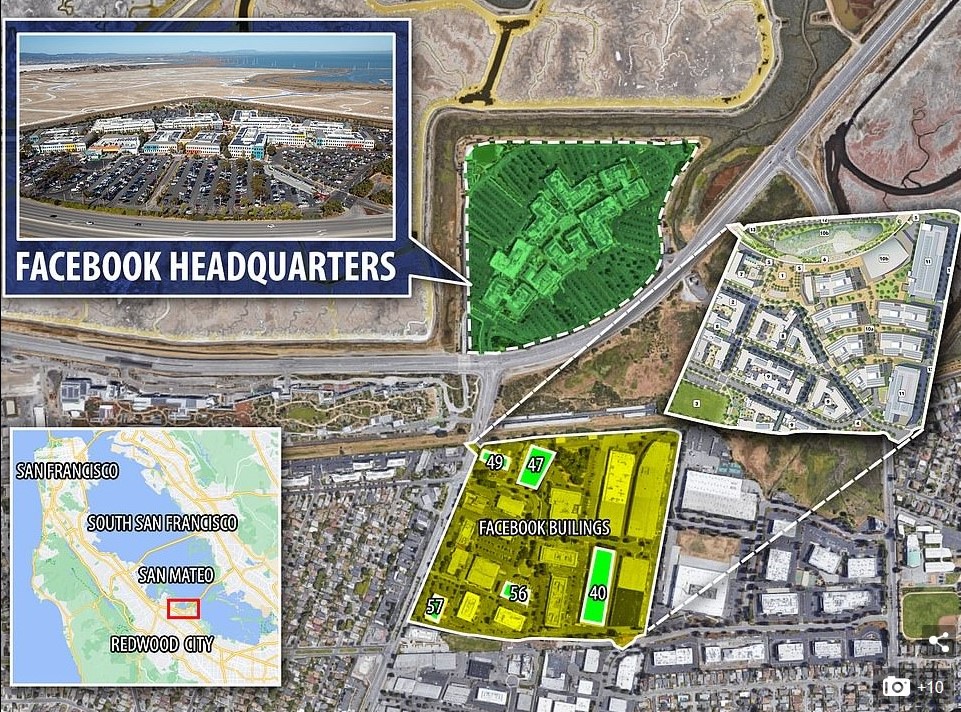
The most recent plans, which were updated in May, show the development will be built where a single-use industrial and warehouse complex currently stands…
It will feature 1,729 apartments, including about 320 that will be affordable housing and up to 120 units designated for senior housing…
The plans for the new city also feature a supermarket, pharmacy, cafes and restaurants and a 193-room hotel.
The 200,000 square feet of planned retail space will be built around a 1.5-acre town square.
Separate to the town square will be a four-acre public park, a two-acre elevated park similar to New York City’s High Line and other public open spaces.
In addition to the housing and retail spaces, Facebook also plans to have 1.25 million square feet of new office, meeting and conference room space for the social media company.
There are multiple interesting elements of this proposal:
This has numerous benefits for Facebook. It will have new office space built to its specifications. It will have some housing space for workers. It worked with the municipality to make changes.
All of this happening in the aftermath of COVID-19 where it is not entirely clear how many workers will return to the office. Adding this amount of office space suggests Facebook thinks it – or some other firm – can use the space.
This kind of mixed-use development is popular in many places. For example, New Urbanists promote such developments for their numerous advantages. Is Facebook explicitly building on this line of reasoning or does it have other reasons for this kind of development?
Once the land is developed in this way, what role will Facebook play moving forward in overseeing the space? This will be an ongoing tension between the company, residents, and the municipality.
This is an expensive area in which to develop land. Facebook has the resources to pull this off when others could not. In the long run, will this viewed as a net gain for the larger community or is it best for the company?
Since the project is under review by Menlo Park, it will be interesting to see how this continues to play out.
President Joe Biden promised jobs and better access to education in an appeal that may resonate with suburban swing voters during a historic trip to McHenry County College.
“America is back,” Biden said Wednesday, promising to fund transportation through an infrastructure package that faces opposition in Congress…
During his remarks, the president touted the infrastructure program and the American Families Plan, which includes checks of up to $300 for eligible families starting this month.
“That’s good for families and is good for the economy and it will create more jobs,” said Biden, who repeated the word “jobs” several times during his speech.
Infrastructure often refers to physical structures operating in the background of society. Electricity, gas pipelines, power plants, roadways and mass transit lines. I would guess many people do not think about these much until there is a problem or it becomes very visible. As a recent example, I drove down a highway that had a pipeline pass over the roadway. While I know that pipelines are essential, I do not think about them much until I hear about them on the news (the recent pipeline ransomware, the Keystone Pipeline, etc.).
The Biden administration is pushing to include more human capital elements in its infrastructure plan. In terms of the essential pieces for society to function, jobs, health care, and other benefits are indeed important. Particularly in the era of the knowledge economy and more attention paid to inequality, including a more human element to infrastructure would hold some appeal.
At the same time, I wonder if the goals of the Biden administration fall more into the category of human rights. Should people have a right to a job, which provides income and worthwhile activity? Should there be a right to good affordable housing? A right to Internet access?
Perhaps the political calculation is that moving toward a conversation of human rights is a bridge too far. Americans have resisted the right to housing or public housing. But, call it infrastructure and housing is not guaranteed but rather an important foundation for society. On the other hand, electric lines and gas lines are essential for everyday living yet are they a right? Is the difference that infrastructure might require a cost while rights are supposed to be free or really cheap?
Given the current public conversations, this may be the way societies are headed: people should have more rights. Universal basic income might be the next area where this occurs: jobs are not enough and people should be able to have a guaranteed income source to have a decent life.
For now, American political leaders will debate exactly what infrastructure means. At the least, there will be acknowledgement that numerous building blocks of social life must be in place for desired outcomes.
Today we write instead about the humble sidewalk. It’s prosaic. Unromantic. Mundane.
But to patrons of two-footed transportation – and to wheelchair users, kids on scooters and people consigned to canes or crutches – the humdrum sidewalk is either a safe glide path or a menacing minefield .It’s as crucial to its users as vast roadways are to motor vehicles. The difference is that drivers and passengers in the vehicles are better protected than is the postal carrier who each day risks tumbling onto your concrete.
We’re thinking about cracked sidewalks in part because of Chicagoland’s snowstorms last winter. If you’re the beneficiary of a Snow Samaritan – one of those thoughtful neighbors who helpfully pushes her snowblower down the whole block – imagine how she feels when her machine trips on a sidewalk that’s broken, caved low or heaved up by freeze-thaw cycles. When that happens once too often, she has to cue the costly repair.
So on behalf of all those who encounter your sidewalk, step outside and inspect. And if it’s damaged, call or email whoever oversees public works in your neighborhood – the ward superintendent, the village manager, the city council member, the local street department foreman.
This is the practical argument to make for sidewalks: safety and costs. Cracks and other sidewalk problems make it more difficult to navigate. I know this from my own experience walking, running, and biking. I am able to effectively move around sidewalk issues but not everyone can. These negative sidewalk experiences can then add additional costs, whether from addressing injuries from falls or damaged bicycles and other vehicles.
But, the practical argument may not be convincing or elegant enough. It strikes me as a very Midwestern way to address the problem. An additional way to make this pitch might be to appeal to what sidewalks make possible. The most famous part of The Death and Life of American Cities by Jane Jacobs is the opening section which speaks to all the possibilities available because of thriving sidewalks. Repairing sidewalks is not just about safety or costs; it is about opening space for people to go back and forth and others to utilize. With the right mix of surrounding uses, the sidewalk then becomes a public space that enriches the neighborhood.
Put all of these arguments together and the humble sidewalk is pretty important. In communities dominated by cars, sidewalks offer an alternative path for transportation and sociability.
The results reflect years of investment by the Chinese government in smart cities. Hundreds of Chinese cities have pilot programs, and by some estimates, China has half of the world’s smart cities. The spread of edge computing, cameras, and sensors using 5G wireless connections is expected to accelerate use of smart-city and surveillance technology.
Given both the rapid urbanization of China plus the adoption of smart cities, this will create an interesting mix. Will this lead to more global cities in China? Different forms of urban life compared to those elsewhere in the world? New innovations that build on the smart city platform?
The first rung on the homeownership ladder has long been an affordable “starter home.” These houses, with their smaller footprints and selling prices, allowed young homeowners to build wealth and upsize as they started their families…
Supply of “entry-level housing”—which Freddie Mac defines as homes under 1,400 square feet—is at a five-decade low.
Surging prices and stiff competition mean there aren’t enough smaller, more affordable starter homes to go around in many regions. The pandemic and subsequent recession, along with the student debt crisis and delayed family formation, contributed to frustration and despair among younger house hunters…
Lately, data from the National Association of Home Builders shows new construction is again giving priority to higher square footage for single-family homes, a trend likely spurred by the widespread shift to working from home and house hunters’ need for more space.
I wonder about the role of local governments. How many urban neighborhoods and suburban communities allow for or encourage the construction of smaller homes. It might take some extra work for a community to work with a developer who is willing to construct smaller and cheaper homes. At the same time, some of the existing members of the community might not be happy about the change as smaller homes are often interpreted as dragging down values and the character of the community. At the least, wealthier communities are unlikely to encourage such homes unless they are at a higher price point – and then it is no longer a starter home.







 Legally Sociable