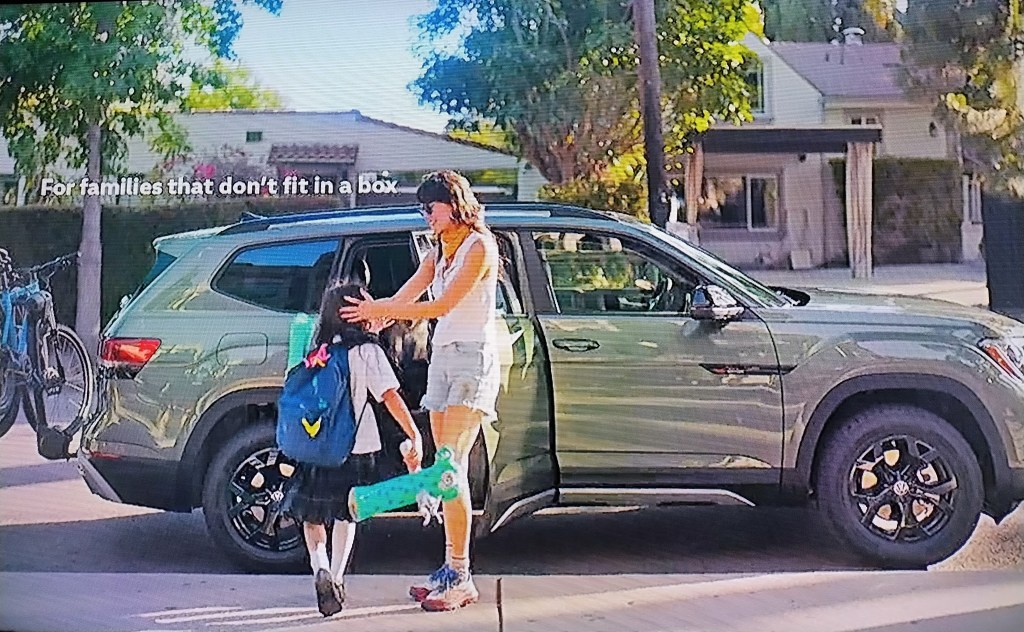
A new Volkswagen TV commercial features the song “Little Boxes” sung by Malvina Reynolds. This song originally critiqued the sprawling mass suburbs of the postwar United States but now is used – and in a remixed version! – to sell an SUV:
Four thoughts related to this advertising campaign:
The song was protesting conformity in sprawl. Does buying a particular SUV counter conformity and sprawl?
The tagline above – “For families that don’t fit in a box” – seems to suggest that people who own this vehicle are doing things outside the box. This vehicle allows you to escape the normal suburban life. Can this happen when almost everyone has an SUV already?
The song said houses were boxes; are SUVs boxes? This particular model might be less boxy than some others but it still looks like a box. Are SUVs cool boxes where as suburban ranches houses were considered by some to be uncool boxes?
If the primary target of this campaign is suburbanites, then a song critiquing suburbia is being used to sell products suburbanites. We have come full circle: do what you can to sell SUVs to suburbanites!
Between 1925 and 1990, the rate of suburbanization differed by Protestant denomination. Some denominations were already more likely to be in the suburbs (their suburban presence predated mass suburbanization), some moved to the suburbs in increasing numbers, and some hardly moved at all. The general pattern among these groups was an increasing percentage of their churches in suburban locations, a process that was underway by the 1930s and 1940s and continued after World War II…
In this study, churches were influenced by settlement patterns in the Chicago region and the presence of numerous churches already existing in suburban communities. In addition, the racial and ethnic identity of some denominations helped dictate their choices for new suburban locations.
This article built on important work by multiple scholars about white flight in the Chicago area. Mark Mulder in Shades of White Flightlooked at how The Christian Reformed Church and The Reformed Church in America churches, both Dutch Reformed denominations, moved to the suburbs. Irving Cutler in The Jews of Chicago examined how Jews moved to suburban communities. Eileen McMahon in What Parish Are You From?analyzed how one Catholic parish responded to changing neighborhood populations, including moving to the suburbs.
As the story is told of American suburbanization, particularly after World War Two, the story should include the role religious institutions and adherents played in supporting white flight. I say more about the ways this played out with evangelicals in Sanctifying Suburbia.
Pope Leo XIV grew up in Dolton, Illinois, a suburb just south of the city of Chicago. Is this a story not just of the first American pope but a pope who grew up in the changing American suburbs? Over the years, what happened in his suburban community that had its first white settlers in the 1830s? First from the Encyclopedia of Chicago:
The mixture of railroads and the Little Calumet River proved to be a good site for industry. Dolton grew as a center for truck farming and manufacturing. It has produced bakery equipment, brass castings, shipping containers, cement, furniture, agricultural equipment, steel tanks, and chemicals. This diverse activity attracted an ethnically varied workforce. In the 1960s the Calumet Expressway (now the Bishop Ford Freeway) improved automobile and truck access to Chicago by two interchanges serving Dolton. In recent years large numbers of African Americans have moved to Dolton. The 2000 census reported a population of 25,614 with 14 percent white, 82 percent black, and 3 percent Hispanic.
According to a table on this page, Dolton was 99.9% white in 1960, 58.1% white in 1990, and 14.3% white in 2000. According to the Census Bureau, Dolton is now 4.9% white.
This is the story of how one small town became trapped in a downward spiral that poverty experts say follows a well-worn pattern of deindustrialization that leads to a disenfranchised economic class. Communities of color inherit a legacy of decline and then lack the resources, both financial and political, needed to turn things around.
The focus is Dolton, but it just as easily could be Riverdale, Harvey, Dixmoor, Posen, Calumet City or other nearby suburbs that once were powered by steel and other industry but over time slowly coalesced into a broad swath of economic distress. In other parts of Illinois, such as North Chicago to the north or Maywood to the west, the details change but the problems are often much the same.
It was no one single thing, but a cascade of events that changed the fortunes of Dolton and its neighbors. The decline of manufacturing led to a loss of job and pay opportunities, which in turn fed a wave of white flight as longtime residents left and were replaced by African-American city dwellers lured by better, yet not too expensive, housing.
But luring new investment to now majority black communities proved a challenge and housing values began to fall, taking down with them the tax revenues needed to keep up public services. Next came widespread foreclosures and an invasion of real estate scavengers who bought houses on the cheap, transforming a community of homeowners with a deep financial stake in their town into one of renters with looser bonds.
All the while, the political fabric vital to turning things around continued to fray. Government stumbled amid patronage and gridlock, rendering even more challenging the task of drawing needed new investment.
His parents had been living in a 1,200-square-foot brick house on East 141st Place in Dolton. They bought it new in 1949, paying a $42 monthly mortgage.
His father Louis Prevost was superintendent of the south suburban schools in District 169. News clippings from 1945 show he served as a Navy lieutenant in the Mediterranean in WWII. He had graduated from the old Central Y.M.C.A. College in 1943 while living in Hyde Park.
The new pope’s mother, Mildred Martinez Prevost, studied library science at DePaul University. Her death notice, in 1990, said she and her husband started the St. Mary’s library in the basement of the old school building and mentions jobs she had in the libraries at Holy Name Cathedral, Von Steuben High School on the North Side and at Mendel from 1969 to 1975.
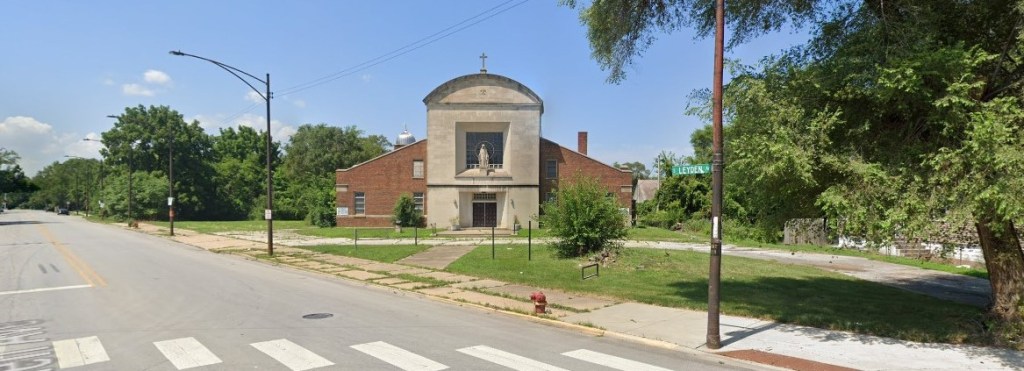
The Prevosts attended a Catholic parish – St. Mary of the Assumption – just inside the southern borders of Chicago and next to the suburbs of Dolton and Riverdale. Here is what the property looked like as of July 2024:
Like St. Mary’s, other Catholic institutions that helped shape the future cardinal are long gone, closed over the past several decades as the Catholic population around where he grew up and elsewhere plummeted. Among those bygone institutions:
• Mendel College Prep High School, where Prevost and his mother worked.
• St. Augustine Seminary High School in Michigan.
• Tolentine College in Olympia Fields, the suburb where he briefly lived.
• Mount Carmel Elementary School in Chicago Heights, where his father was principal.
Several of these communities mentioned – Olympia Fields, Chicago Heights – experienced racial change similar to that of Dolton.
If white Catholic residents indeed left Dolton and other communities on the South Side of Chicago and its southern suburbs and American suburbia became more complex, where did they move to? How did this shape the ministry of Pope Leo XIV?
The new research, published in the scientific journal Nature Cities, built on previous work using satellite measurements to paint a detailed picture of rising and falling land. It also closely examined the connection between changes in land elevation and changes in groundwater, using data from individual monitoring wells.
Water pumped from wells isn’t something that people think about often. “You just turn on your tap, do what you need to do, and you go on your way,” said Leonard Ohenhen, a researcher at Columbia University’s Lamont-Doherty Earth Observatory and lead author of the study.
But extracting more water than can be replenished “can have a direct relationship with what happens on the surface,” he said. “You can cause the ground to sink significantly.”…
Other factors also influence land elevation. For example, a vast expanse of bedrock beneath parts of the country, pressed downward by enormous glaciers during the last ice age, is slowly rebounding back into place. But over time it creates a sort of see-saw effect that today is adding 1 to 2 millimeters per year to subsidence rates in much of the northern United States.
If pumping water from directly underground leads to this issue, what could happen next? Here are a few ideas that come to mind:
Getting water from further away. At least then if it is pumped out of the ground it does not affect cities and metropolitan regions – the issue is pushed off elsewhere.
Somehow pumping something back into the ground to refill what was depleted.
Factoring in sinking ground at initial construction. This would lead to boosting the elevation of new sites in anticipation of what might happen in the future.
Or not much might happen until one city experiences dire effects from this sinking. Imagine a whole neighborhood or an important development sinks to a point where the land becomes unusable. Would that prompt urgent action?
Nineteen people were killed in Chicago last month, which is the fewest murders the Windy City has experienced during any April since 1962. In Baltimore, there were just five murders in April—the lowest number in any month since 1970. Three other major cities—Los Angeles, Philadelphia, and Detroit—recorded their fewest first-quarter homicides since the 1960s.
Criminologists tend to speak in caveats, with warning of reversion to the mean and admonitions to wait for better data, but even they must admit: These are some eye-catching numbers. “It’s really encouraging,” said John Roman, a crime researcher at the University of Chicago’s National Opinion Research Center. “It’s worth taking a moment and noting that we are approaching the numbers in most crime statistics we haven’t seen since the 1960s. In these cities, if you’re under 55, this is probably the safest moment you’ve ever lived in. That’s great, and it should be celebrated.”
The early 2025 crime decline builds off numbers from 2023 and 2024 and appears to include not just homicide but also robberies, rapes, burglaries, and auto theft. In many respects, we are returning to a pre-COVID world of public safety, with profound implications for residents of neighborhoods tormented by gun violence, the police who are supposed to solve the problem, and the politicians who love to campaign on the issue.
For decades, many Americans have associated big cities with crime. This can be in comparison to the settings in which they live – and a slight majority of the country is suburban – and can persist despite fluctuations in the actual crime rate.
But this is also connected to long-standing anti-urban sentiments. In a country that idealizes small-town life and where many love the suburbs, cities can look unappealing. Any reports on crime – whether crime is up or down – could feed into this broader narrative.
This goes beyond politicians trying to make political points by playing up particular issues cities face. How about the media and how it reports crime? How about the ways Americans perceive safety? How about police? And so on. There are facts about crime and perceptions about crime. For a long time, Americans have connected crime to cities. It might take a long downturn in crime for that connection to be broken.
“As advertised, your on-site, outdoor, retail business use of Property is strictly prohibited and must immediately cease,” the May 16 letter read. Small, at-home businesses are allowed under the village’s House Occupation Code. The catch is they must operate indoors.
Yamamoto has been appealing for about a year, hoping to work with the village to update the zoning code and allow for the farm. He even submitted three separate proposals. The first aimed to tweak the code so that residents can apply for special use permits for agrotourism. The second changed “agrotourism” to “agricultural experiences” and limited what could be sold and the number of people who were allowed on the property. The last proposed a change in the village’s definition of “agricultural activities” — which are already allowed — to include on-site sales…
“The Village’s Zoning Board of Appeals was particularly concerned that under these various proposals, similar outdoor commercial operations could be allowed to occur on every residential single-family property in the Village,” Paul wrote.
But Little Ducky still has support in the community. Several residents showed up to Yamamoto’s first proposal hearing in August 2024, and many more wrote letters. In all, 133 written comments were submitted, with 129 in support and four in opposition. Of those who spoke in person, 16 supported the farm, while three opposed it…
Yamamoto isn’t giving up. He’s already submitted two more applications and has been waiting for a response since February. In the meantime, he and his wife are picking and delivering tulips themselves.
The catch in this case seems to be that indoor businesses are allowed – imagine something involving a home office or a service that can be provided in a home – versus an outdoor operation. That outdoor business could create noise or be unsightly or disrupt the character of a single-family home neighborhood. Residents might be willing to put up with loud power equipment to keep their landscaping looking good (or not) but an outdoor business is a threat.
It will be interesting to see if support from local residents could shift the outcome. Could a one-time variation in the zoning be granted? Or the zoning guidelines changed to allow clearly-defined agricultural uses?
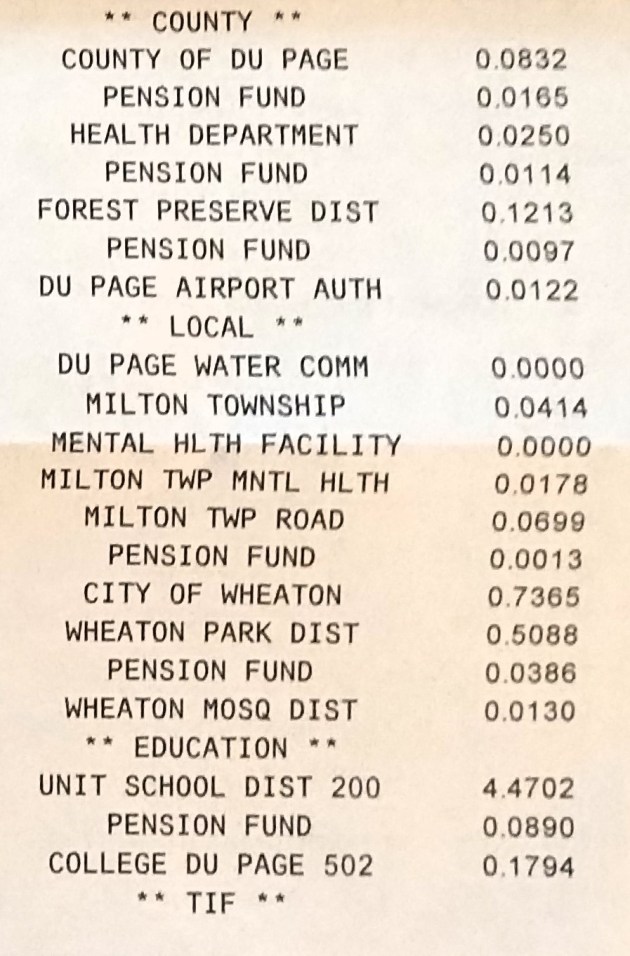
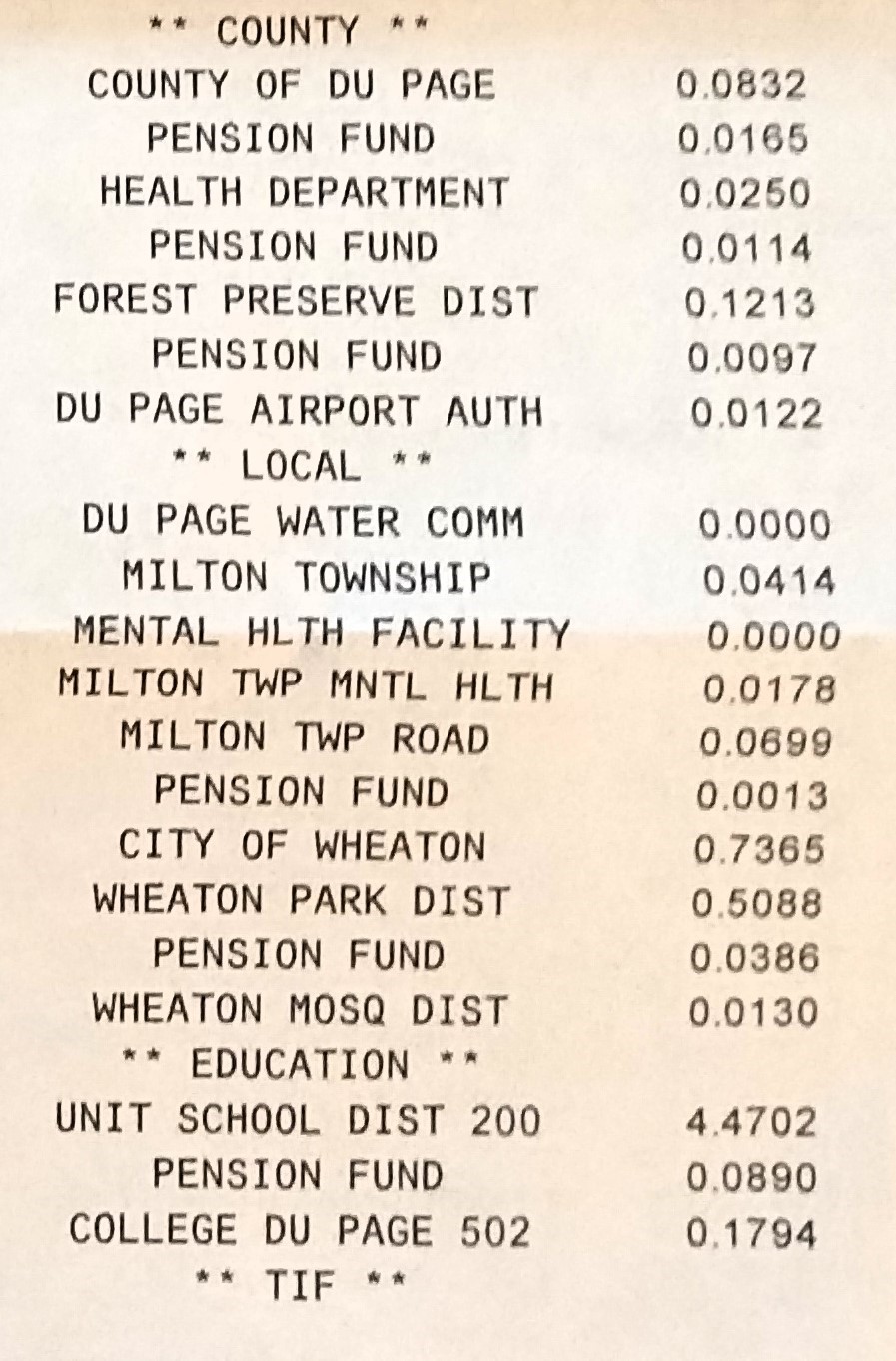
In thinking about recently receiving property tax bills in our county, I wondered what suburbanites would be willing to give up in order to lower their taxes. Here are some thoughts about each of the taxing bodies that receive monies:
-the county: how many people could name exactly what the county provides? Some roads, some medical and social services, some other things. Perhaps some people would rather pay a municipality or a state to do the same things?
-pension funds: I’m guessing taxpayers have little choice here.
-DuPage Airport Authority: how many average residents see the benefits of having a private airport within the county? Perhaps this helps some businesses?
-water commission: getting water is necessary.
-Milton Township with four lines: does the work the township does be carried out by the county or municipalities?
-City of Wheaton: lots of local services, including roads. What would residents want the city to do less of?
-Park District: not everyone participates and facilities and programs can be costly. But is the alternative all private options?
-mosquito district: who likes mosquitos?
-K-12 school district: the tax costs are high but what suburbanites want lower quality schools (which then they often associate with property values)? Or how many people want less money for the next generation?
-Community College district: with the costs of college these days, would people be willing to have a smaller community college or no community college option?
Consider these all together and the tax money goes towards schools, roads, public health, and more. Perhaps the argument could be made that these same services could be provided more efficiently or at better scales. This might save some money but does not necessarily address the long-term issues of rising costs and the need to update and maintain vital infrastructure. And if voters restrict one source of funding – such as limiting property taxes in California – then governments will seek revenues elsewhere.
Is it possible to consider all of these taxes at once rather than considering them one a time through referendums or each body making decisions that are best for them?
Even though the measure failed in Bensenville, at least 163 communities around the state have recently enacted local grocery taxes.
Gov. JB Pritzker signed a bill last year repealing the state’s 1% grocery tax, saying it hit poorer families harder. But the bill also allowed municipalities, which depend on the revenue, to implement their own tax. Bensenville put the proposal on the ballot to get voters’ input, but local officials are not required to do so. In many municipalities, local governing bodies are casting the deciding vote…
The state suspended the grocery tax for fiscal year 2022 to help fight rising inflation, but municipal leaders say losing the stream of revenue permanently forces them to consider cutting services, raising sales or property taxes, or implementing a local grocery tax. If they approve a local grocery tax by Oct. 1, it would take effect on Jan. 1, 2026, when the state tax expires…
Illinois residents already pay the highest combined state and local taxes in the nation, at more than $13,000 annually, according to a recent report by WalletHub. Food prices rose 3% in the past year as of March, and the federal government forecasts them to rise another 3.5% this year…
“If local governments believe it is necessary to tax milk, bread, eggs, etc. to fund local services/local government, then they should be responsible and accountable for that decision to local taxpayers,” Illinois Department of Revenue spokeswoman Maura Kownacki told the Tribune. “The state should not be imposing a regressive, statewide sales tax on groceries especially during a time when inflation is hitting the pocketbooks of Illinois families.”
The cynical take would be that in a state with high taxes the Illinois governor wanted to paint the state in a good light by dropping the tax. Municipalities have limited options for filling the budget hole so they quickly move to adopt a local tax. The grocery shopper notices no change in taxes while the politicians debate who was more responsible.
I get the reaction from communities. They want a balanced budget each year and don’t want to have to cut services or acquire debt. Getting money from groceries is dependable money as people need to buy food.
At the same time, adding local taxes and fees can make residents angry. They already see the amount the federal and state governments take in each paycheck. Why do local governments charge for car registration and ask for more money for schools and keep coming up with new revenue ideas?
I wonder if this is also part of the larger issue of limited growth in Illinois. If communities were growing – adding residents, businesses, energy, status – this can cover up revenue issues. New growth leads to growing budgets with new tax money coming in. But if many communities in Illinois are growing slowly or not growing at all, this means stagnant budgets. Or worse, communities have to spend more to maintain older infrastructure that supported growth decades ago.
It may just be a grocery tax but the issues could be much larger.
As I have embarked on new projects over the years, there is often a period of acquiring books and other sources. This often includes purchasing at least some of them as I find it very helpful to have them on hand in physical form to read and reference.
As referenced in the title of this post, here are three themes regarding this process:
I enjoy finding, receiving, and reading the books. This is all fun. I like books, I like doing research. The books have a practical end – they are there to help complete my writing – but I also enjoy knowing them and having them.
Finding books can be time-consuming. Almost all books can be had. I have done a few projects where a few books are very hard to find, let alone get one’s hands on. You may need to consult multiple websites and search engines to try to find certain texts. (WorldCat can be helpful here as it can display how many libraries own items.)
And almost all books can be had for a price. If one is working with a budget or does not want to spend more money, this complicates the search. And how long can one wait to see if there is a cheaper price.
In some ways, the process is common across projects. Budget time and money to find and acquire books and then enjoy having and using them. At the same time, the particulars of finding and using books can vary quite a bit within and across projects.
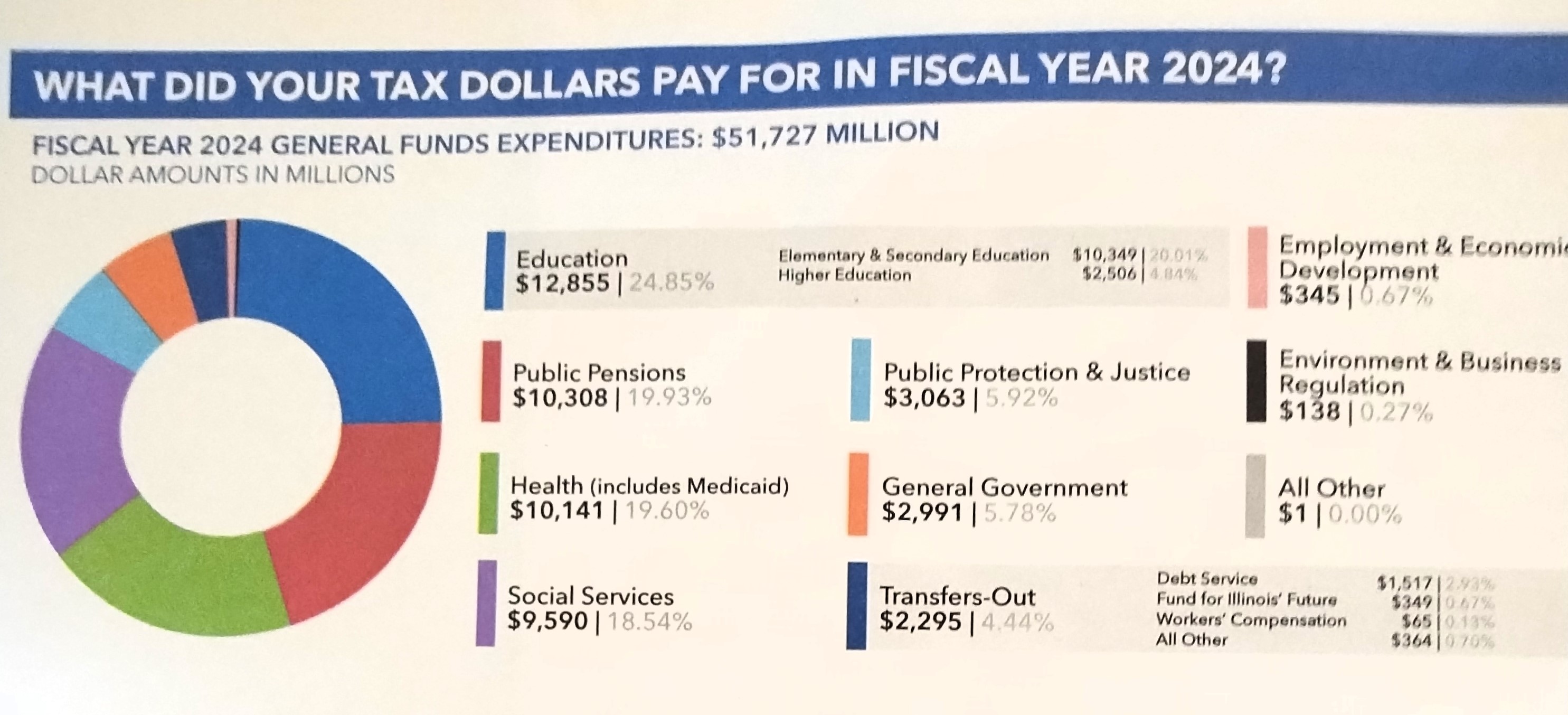
I recently received the breakdowns of where tax dollars for the State of Illinois and DuPage County went in 2024:
In both cases, education leads the way. For state expenditures, education accounts for 24.8% of spending. At the local level, education accounts for 69.4% of the total rate.
The large portions going to education are supported by multiple interests of residents:
Education is often pitched as for children, the next generation, and the future. If we do not spend on education today, how will the children succeed and/or do better than the previous generation?
The quality of local schools is often tied to housing prices and the status of communities. To not spend locally on schools might provide short-term savings but reduce the desirability of properties and communities in the long-term.
The bulk of education costs is in salaries for teachers and staff. Without quality educators, how can schools be successful?
Some might complain about the tax burden – and Illinois does have high property taxes – but it is hard to argue against spending on education. It could be more effective to reign in spending by targeting other areas where there is duplication of local services (such as townships).







 Legally Sociable