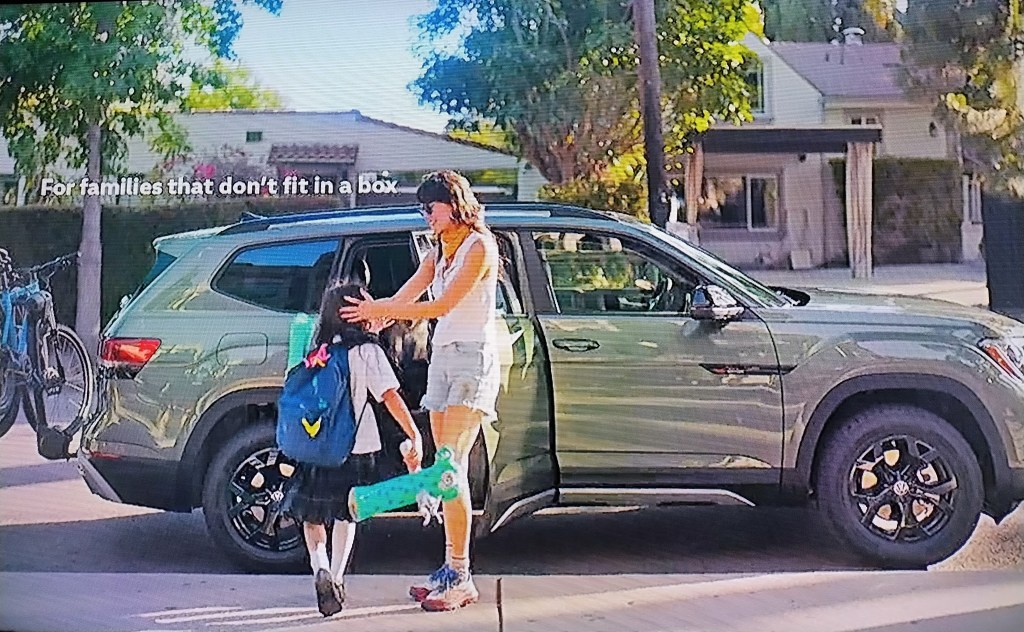
“Little Boxes” song critiquing suburbia now used to sell SUVs to suburbanites

A new Volkswagen TV commercial features the song “Little Boxes” sung by Malvina Reynolds. This song originally critiqued the sprawling mass suburbs of the postwar United States but now is used – and in a remixed version! – to sell an SUV:

Four thoughts related to this advertising campaign:

  1. The song was protesting conformity in sprawl. Does buying a particular SUV counter conformity and sprawl?
  2. The tagline above – “For families that don’t fit in a box” – seems to suggest that people who own this vehicle are doing things outside the box. This vehicle allows you to escape the normal suburban life. Can this happen when almost everyone has an SUV already?
  3. The song said houses were boxes; are SUVs boxes? This particular model might be less boxy than some others but it still looks like a box. Are SUVs cool boxes where as suburban ranches houses were considered by some to be uncool boxes?
  4. If the primary target of this campaign is suburbanites, then a song critiquing suburbia is being used to sell products suburbanites. We have come full circle: do what you can to sell SUVs to suburbanites!

How Walmart describes itself

Most companies and organizations have an idea of who they are and what they do. With a recent branding effort, Walmart described themselves this way:

Photo by Luis Zambrano on Pexels.com

Walmart is excited to announce a comprehensive brand refresh that reflects its evolution as a people-led, tech-powered omnichannel retailer. From its humble beginnings in Bentonville, Arkansas, in 1951, Walmart has grown into a global leader dedicated to helping people save money and live better.

This is the opening paragraph of a press release that has more details. But this first section has a lot of ideas. Walmart is:

  1. people-led
  2. tech-powered
  3. omnichannel
  4. from humble beginnings
  5. global leader
  6. helps people save money
  7. helps people live better

There is a lot here. Probably too much for a slogan or advertising campaign. And how many line up with how the public sees Walmart?

When I think of Walmart throughout most of my life, I think of #6 above. It has pitched as the place for low prices. When they first arrived in the Chicago suburbs, I found that their CDs were much cheaper than the music stores in the area. Compared to other big box stores or grocery stores selling the same or similar items, Walmart often has lower prices.

What does it mean to be “people-led”? As opposed to AI led or driven by numbers? Is “global leader” referring to revenues or practices or name recognition?

The last one might be most interesting. Is the American good life partly dependent on Walmart? If Walmart was not around, would American lives be better or worse? Would this alternate universe just remove Walmart locations or all Walmart is connected to (supply chains, approach to retail, the growth of Bentonville, etc.)? If lots of Americans think Walmart does help them save money and given the role of money and wealth in American life, many might answer “yes” to this.

Why aren’t there more cars and vehicles that serve as moving billboards?

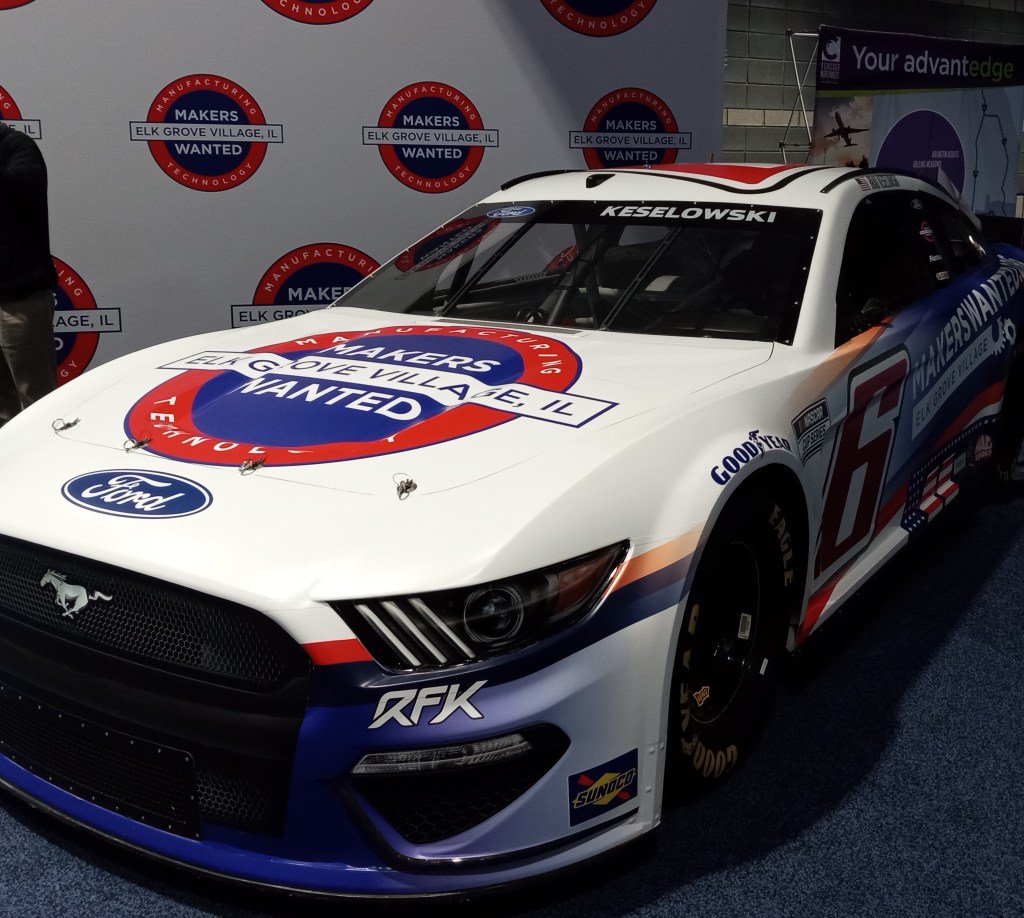
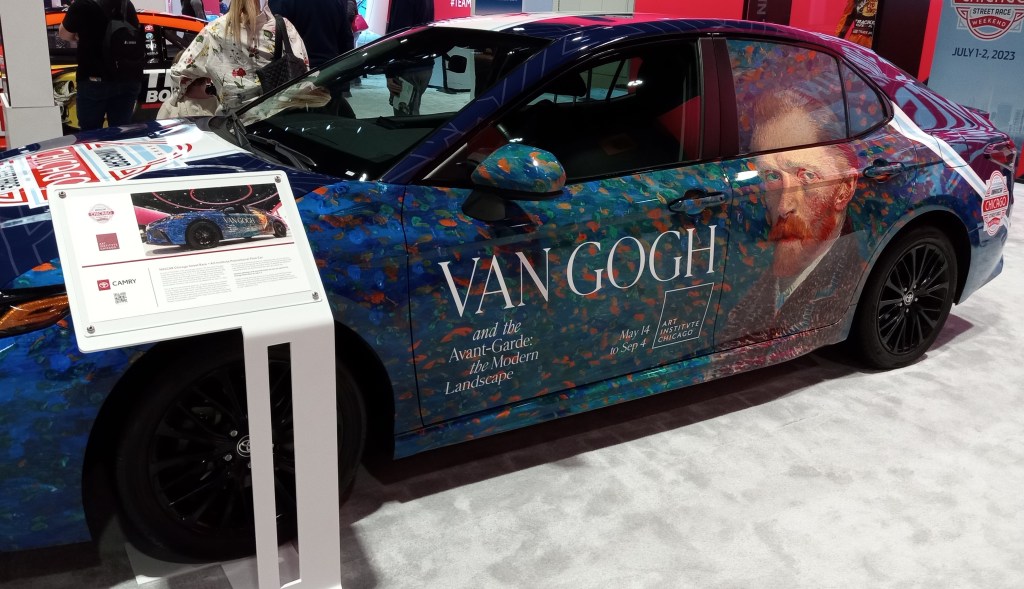
At the Chicago Auto Show, I noticed two unique cars that advertised something: an art show and a suburb.

The first car is not unique in its context. Every Nascar vehicle is covered in sponsorships. This one is unusual in that a suburb, Elk Grove Village, is continuing a marketing campaign that included sponsoring college bowl games.

But, why not have cars and trucks driving around the Chicago region with the same branding? It probably does not cost much to put decals or magnets or paint jobs on vehicles and then have a bunch of vehicles advertising “Makers Wanted.” This might be particularly helpful in a region with hundreds of suburbs and where there is a perceived need among some suburbs that they need to stand out for particular reasons.

The second car is a more unusual advertisement: an art exhibit at a world-class art museum. The Art Institute does not advertise broadly in mass media. But, what if there were a lot of Van Gogh vehicles driving along local roads? (There would need to be allowances for the “Van Go” jokes.”) Van Gogh and his works are widely known and some people might even want a Van Gogh painting on their vehicle for aesthetic reasons.

Even with all the colorful paint jobs at the Auto Show this year (lots of bright blue and yellow), this could be an opportunity for someone or some place to exploit without having to pay too much.

Two communities and two different approaches in advertising to baseball viewers

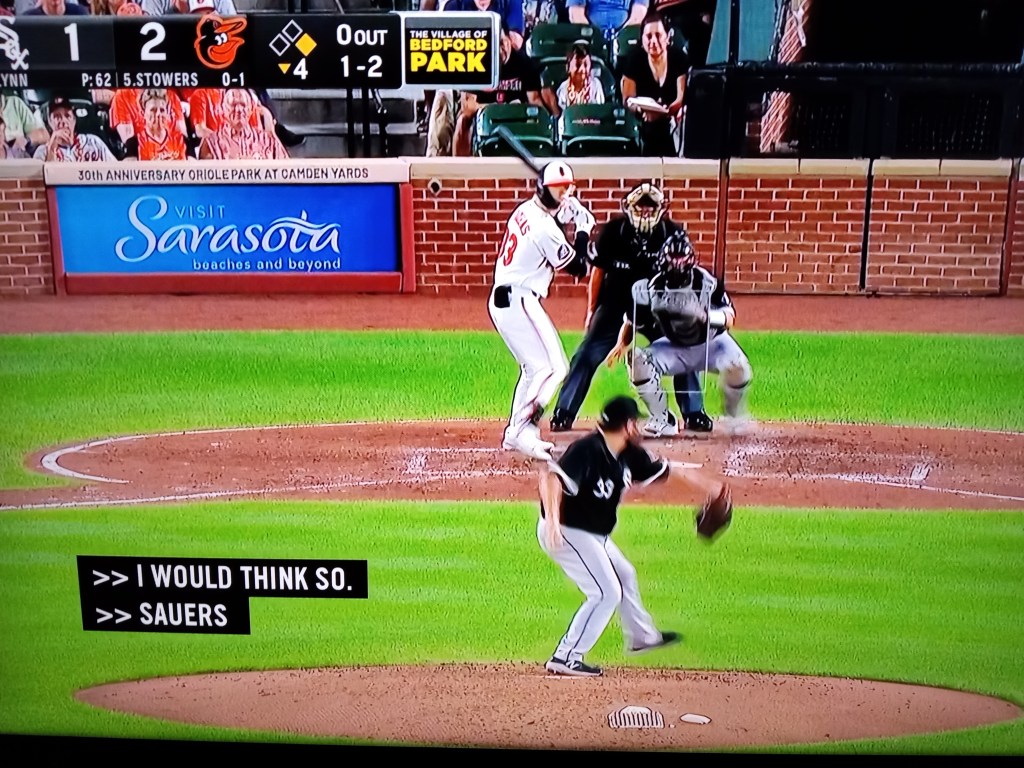
What is the most effective way for a community to reach viewers of a baseball game? Here are two contrasting approaches on last night’s White Sox broadcast:

The Village of Bedford Park is not unknown to media consumers in the Chicago region; they advertise the advantages they provide for businesses, including plenty of water. The suburb has less than 1,000 residents but wants your business.

In this ad, there is little communicated about the Village outside of its name. Name recognition has some value; the Chicago area has hundreds of suburbs and knowing this small suburb could be consequential.

Contrast this approach with that of Sarasota. A bigger community of over 50,000 residents, the suburb emphasizes “beaches and beyond.” This could be aimed at tourists, visitors who bring in money to hotels, property owners, restaurants, stores, and more, or people who might want to relocate to a land of beaches.

This approach is more common when communities advertise. Including the name, a tagline or motto, and some sort of image – here Sarasota in a particular script and with a flowing tee – aims for name recognition and some knowledge about the community.

Are either of these approaches effective for baseball fans watching the game? Do they decide to take their business to Bedford Park or visit Sarasota? Many communities now advertise and engage in branding in similar ways but it would still be interesting to hear officials in both of these communities discuss the merits and return on investment of these marketing approaches.

How effective are religious and political billboards?

On a recent long drive, I noticed two additional types of billboards compared to the typical ones selling good and/or services: religious billboards and political billboards. These do not comprise a majority of billboards in my observations – or even a significant minority – but there were at least a few. Such efforts raise several questions for me:

Photo by Taras Makarenko on Pexels.com
  1. Do religious and political billboards reach a large audience compared to other forms of media advertising? Compared to some other forms of advertising, the audience along the road might be more known: traffic counts are known and drivers who use a particular road or go through a particular location are a particular group. This may be more targeted advertising with a known number of daily viewers.
  2. Do people seeing religious or political billboards respond to them similarly or differently compared to commercial billboards? The medium of a billboard requires a fairly simple message as people go by them at a high speed. An image or two and limited text are possible. People are used to commercial appeals. So, does anything change if a Bible verse is on a sign? I know there is a religious marketplace in the United States but does a billboard encourage more religiosity? Or, does an image of a politician and a short statement catch people’s attention? Are these just like other billboards, or, because religion and politics can be personal and contentious, do they provoke more engagement or more turning away?
  3. My bigger question about billboards and all forms of advertising: how much does it influence behavior? I saw these billboards, they caused me to think a little and I am blogging about the concept here, and any other ongoing influence is hard to ascertain. In my lifetime, I have seen thousands of billboards, just as I have likely seen hundreds of thousands of advertisements in other forms. I know they influence people but it is hard to connect the dots between billboards and change.

I will keep looking for and reading more unusual billboards. At the least, they help break up a long drive.

Chicago starts new round of advertising battle with Texas

Chicago and Illinois have been part of advertising campaigns from other states – Texas, Florida, and Wisconsin – in recent years. Several weeks ago, a Chicago group countered with a full page ad in the Dallas Morning News:

World Business Chicago, the city’s public-private economic development arm, purchased the print ad, which opens with “Dear Texas” before jumping into reasons companies should consider moving north. It cites the Midwest city’s startup ecosystem, attraction of tech and engineering graduates and a top-ranked logistics and transportation sector as strengths.

Then it hones in on what it perceives as Texas’ new weakness.

“In Chicago, we believe in every person’s right to vote, protecting reproductive rights and science to fight COVID-19,″ the ad states.

“We believe that the values of the city you are doing business in matters more than ever before,” World Business Chicago CEO Michael Fassnacht told Bloomberg News Friday.

So goes on the ongoing battle between different cities and states in the United States with sizable differences. Certain locations stand out as outliers for the two sides; places like California, New York City, and Chicago for liberals and Texas, Florida, and other Southern locations for conservatives. Certain places do have sizable differences in culture and character but are they as easy to reduce to stereotype as their opponents often do? Many Americans live in more in between spaces – such as suburbs – compared to the ideal type locations often discussed.

The real question in all of this is whether such marketing campaigns work. Would a business or resident in Texas or Dallas see this ad and then make a move to Chicago? What factors prompt people and organizations to move? Multiple features of Chicago mentioned in the article could matter: human capital, a central location, a particular culture, certain regulations. Texas’ new abortion restrictions seem to have fired up many and some companies have announced plans to help their employees in Texas. At the same time, moving is not an easy task. Texas, like most places, has its own appealing factors.

Ultimately, is such marketing more about dunking on the opponent? I would be interested in checking back in with World Business Chicago to see how the advertising worked out.

Call [area code]-AWESOME for your needs

Certain numbers stick out in advertising. The Empire carpet jingle, 1-877-CARS-FOR-KIDS, and one local company I saw recently:

The phone number 630-293-7663 – or 630-AWESOME – works in two ways. First, it fits with the company name A.W.E. which stands for Air, Water, and Energy. Second, what company would not want to be known as awesome? Whether fitting the definition for inspiring awe or remarkable, this number will get remembered. All it needs now is a jingle that sticks in your head…

If you too want to make cool words out of phone numbers, here is a phone number to word generator.

Selling Schaumburg, Illinois

Schaumburg, Illinois, nearly 30 miles northwest of downtown Chicago, is a prototypical edge city. Home to Woodfield Mall, hundreds of thousands of square feet of office space, and over 70,000 residents plus located at the convergence of I-290, I-90, and IL-390, journalist Joel Garreau mentioned Schaumburg in his 1991 book Edge City: Life on the New Frontier. When I heard Schaumburg advertising on the radio, I wondered: is this an aggressive or a desperate move in these particular times? Where does Schaumburg fit among other Chicago suburbs also trying to get their name out there (examples here and here)? A few thoughts on this.

https://www.villageofschaumburg.com/

-Woodfield Shopping Mall is one of the largest in the United States. Even with numerous shopping malls struggling plus the problems of brick and mortar retailers, Woodfield will probably survive due to its size, location, and status. It may need to transform significantly – can it still support hundreds of stores? – but it is likely in good shape compared to numerous other Chicago area malls that are exploring new paths (other examples here, here, and here).

-Office space may be hard to fill. Schaumburg is not in a city; other suburban office parks have become less desirable in recent years with firms looking to appeal to young workers. Add the complications of COVID-19 when more workers are not going to the office. At the same time, many workers going to Schaumburg are doing so via car and they may be coming from relatively well-off suburban areas.

Growth is important to American communities. Like many edge cities, Schaumburg experienced explosive growth early in its history: it had 986 residents in 1960, in 1980 had over 53,000 residents, and peaked in 2000 at over 75,000 residents. Where does it go from here? Population loss and/or the loss of businesses would not be a good image for the community as it tries to chart a bright future.

Compared to other Chicago suburbs, Schaumburg is likely in good shape. At the same time, the growth and status of the past and present does not have to continue amid new social pressures and internal decisions. If Schaumburg is advertising in order to attract businesses, perhaps this hints at broader issues across suburbs: can they all succeed in what may be a challenging several year period?

Local TV market ad celebrities, Bob Rohrman edition

For decades, American television viewers have been treated to (or subjected to, depending on one’s point of view) recurring characters in local television ads. In the Chicago region, Bob Rohrman was a mainstay:

Of all the Chicago auto dealers who ever graced the small screen as their own TV pitchman, few were as delightfully campy as Bob Rohrman.

Rohrman’s low-budget commercials radiated good humor and bad production, featuring his mustachioed and bespectacled face peering out from a variety of goofy costumes, a uniquely awkward delivery and flubbed lines that often devolved into a joyous cackle.

The spots were punctuated by a cheesy cartoon lion and the tag line: “There’s only one Bob ROHRRRR-man!”

Somehow it all worked, turning the Bob Rohrman Auto Group into one of the largest family-owned dealership groups in the Midwest, and its spokesman/founder into something of a Chicago celebrity.

In the era of cable and satellite television, streaming options, declining network television and local radio, and targeted commercials on particular platforms, we may be at the end of local advertising like this. All the advertising then becomes more corporate, slick, tied to national or multinational corporations. And we lose a few public characters who few people may have actually met but who many could recognize.

We purchased a vehicle from a Rohrman dealership several years ago. At no point, did I think about the commercials in that process. But, given the number of Rohrman commercials I have seen and heard over the years, who knows if it influenced me. (I can safely say that other auto pitchmen or dealers, including Max Madsen or the Webb boys, did not lead me to visit their lots.)

When a billboard with a basketball player slowed down Chicago traffic

Along one of the most congested stretches of highway in the United States, a mural of NBA player Dennis Rodman led to even more traffic in early 1996:

In March 1996, men’s clothier Bigsby & Kruthers painted an image of Rodman on the side of a building just off the Kennedy Expressway. The 32-foot-high mural stared eastbound traffic in the eye, causing gapers delays in both directions that snarled traffic as badly as road construction.

An operations manager for a traffic-data company said the larger-than-life image added 20 to 30 minutes to morning commutes on the Kennedy and the Edens Expressway. And that was before Rodman’s hair was even on it.

“The 75-foot-wide advertisement included a color image of Michael Jordan looking down on traffic,” a March 26, 1996, Tribune story read. “But it’s the oversize Rodman who has taken the rush out of rush hour. His power glower is punctuated with three earrings and a nose ring; his arms are crossed, and his natty suit has the sleeves ripped out to reveal his collection of tattoos. He is even leaning forward, as if he just might want to butt heads.”

Standing just before the North Avenue exit, the painting was wider and taller than billboard laws normally would have allowed. But because the building was being used as a Bigsby & Kruthers warehouse, the advertising was not limited in size.

While most of the mural was black and white, the hair was in color — and changed as Rodman’s dye did, only adding to the traffic headaches.

Alas, the mural didn’t last. Bigsby & Kruthers covered it up a little more than two weeks after it first appeared in response to the concern of traffic officials.

A few quick thoughts:

  1. Cities have regular spots that come up on traffic reports and the Kennedy is typically on the list in Chicago (“from O’Hare to downtown”). These spots can be on the list for a variety of reasons: a chokepoint for traffic, an odd curve or different road design (such as narrowing of lanes), and/or regular accidents. Billboards probably are not common contributors to this.
  2. At the same time, certain billboards or advertisements can be become part of the urban highway experience. As commuters travel regular routes, they get used to seeing particular signs. New signs can also garner attention if they are a significant change or unusual. The other sports one that comes to mind from the Chicago region involved a series of Brian Urlacher balding treatment billboards along I-294 that popped up several years ago. I’m not sure if it caused any delays but it certainly caught people’s eyes as one of the city’s most recognizable recent sports stars suddenly had hair.
  3. The particular Rodman billboard came as part of a perfect storm. Take a regularly congested stretch of highway plus an incredible basketball team that set the record that year for most wins in a season plus a truly unique player on the billboard (and not one who fit the typical Chicago image). The billboard did not last long but it left a mark.