McMansions as short-term rentals, fake images of downtown Chicago, and news about housing

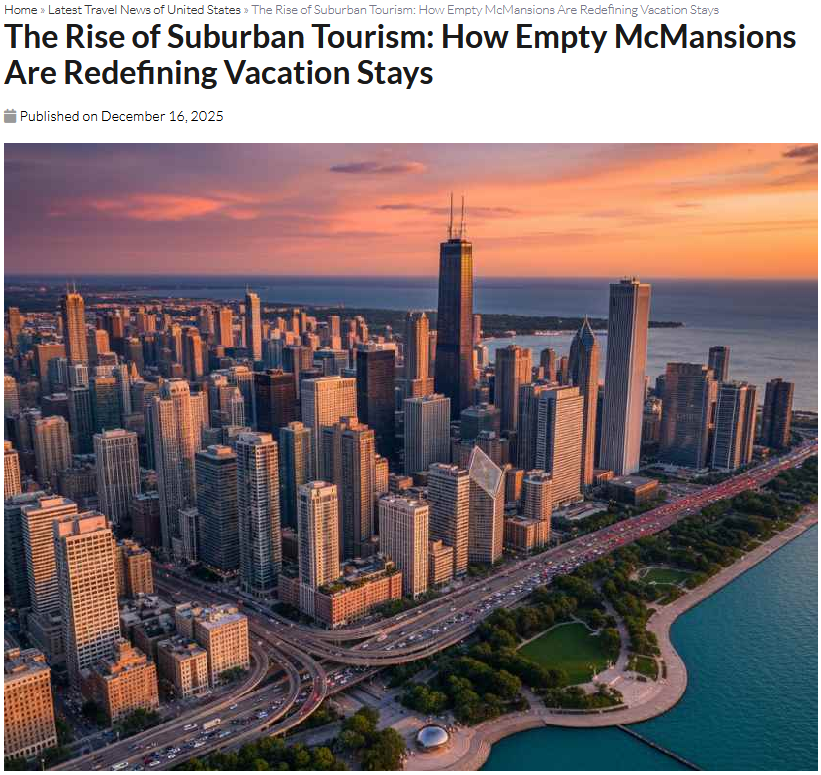
I search regularly for interesting news about McMansions. I recently ran across a headline that seemed plausible: “The Rise of Suburban Tourism: How Empty McMansions Are Redefining Vacation Stays.” But the headline was paired with a particular picture:

Image at link

I am familiar with the Chicago skyline and lakefront. This image is…interesting. It has elements of the Chicago lakefront. A big body of water. Some iconic buildings. The Bean. Jean Baptiste Pointe du Sable Lake Shore Drive and parks along the water.

But it is also clearly wrong. The buildings are not where they should be. The lakefront is not in the right pattern. The Bean is not located on a pedestal next to the water. The local highway does not empty onto the lakefront road in that manner. And so on.

So is the McMansion story true? The summary/conclusion:

Empty McMansions in the suburbs of the United States are reshaping tourism patterns, with many tourists now seeking more dynamic urban destinations. However, these empty homes also present new opportunities for suburban areas to adjust and offer new experiences for visitors. Through creative uses of space, a focus on sustainable tourism, and rebranding efforts, suburban regions can continue to evolve as attractive destinations for a new generation of travelers.

Are more McMansions being rented out? Is this changing tourism patterns in metropolitan regions? is there any evidence of this happening? There is little in the story to provide evidence for the argument.

I will keep my eyes open for similar news but the fake image of Chicago does not inspire confidence.

How many data centers does the United States have, want, and need?

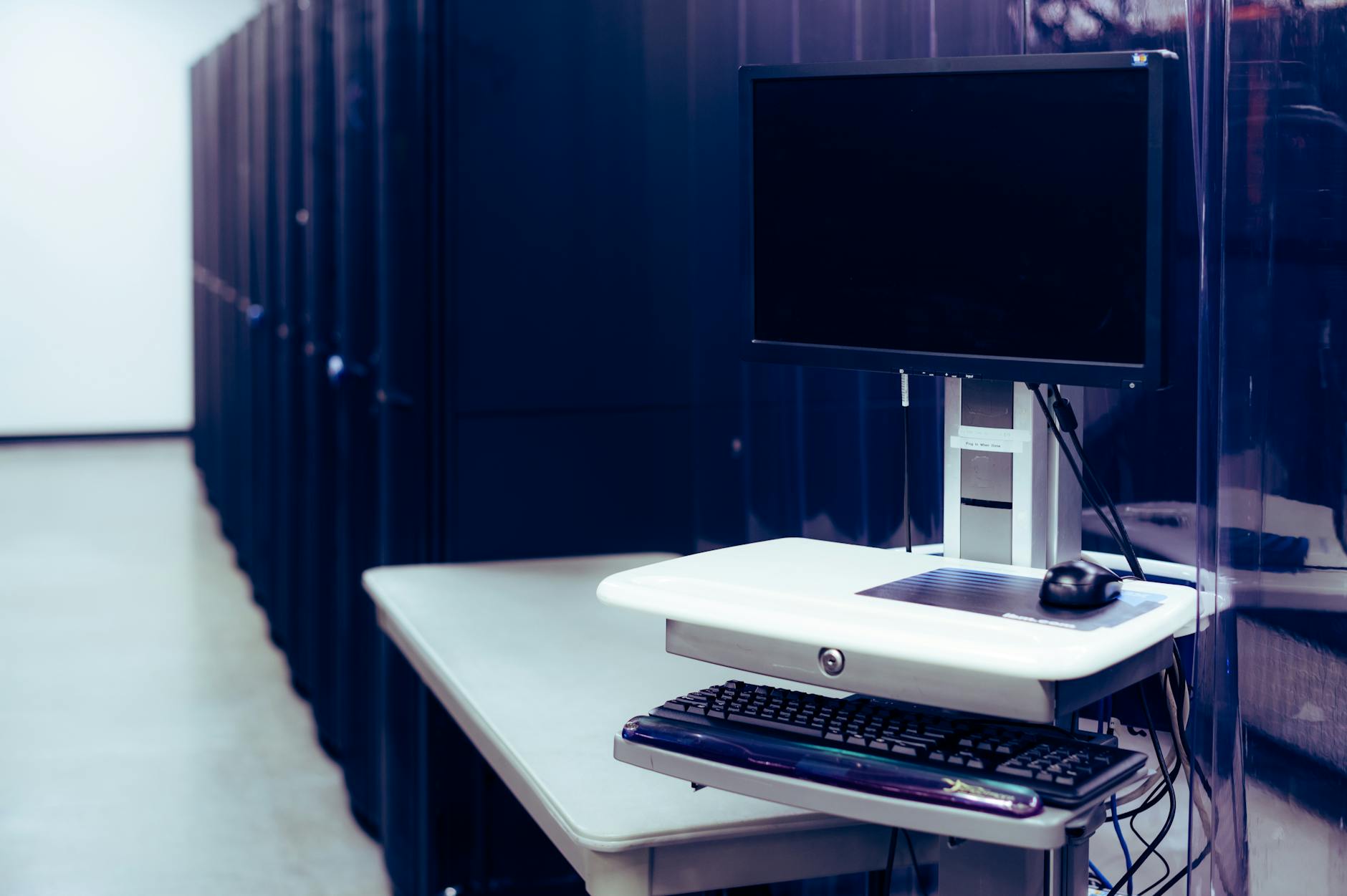
Datacentermap.com says there are 4,287 data centers in the United States.

Photo by Brett Sayles on Pexels.com

How do they know how many data centers are in the country? Their explanation:

Our data originates from multiple sources, primarily:

  • Operators: Data center operators and service providers use Data Center Map as a marketing tool, to promote their data centers, networks and services to potential clients. They have direct access to add and update listings.
  • External sources: We monitor multiple external databases, to identify missing or changed listings. They are automatically queued for manual review.
  • Manual sourcing: We manually identify operators that we are missing and manually add them to our database.
  • End-users: End-users send us tips and requests, about missing or outdated listings, that we manually handle…

As there are no regulatory requirements to register data centers in a central database, there are no complete resources available. All databases are based on voluntary data submissions and/or collecting data from providers or other sources.

How many data centers are needed for the United States? From what I have read, data centers are under construction in order to meet the current and future needs of AI technology. The future needs might be hard to forecast. Within a few years, what newer tech and AI products will be considered essential?

How many data centers are wanted? I am thinking of two possible scenarios. First, tech companies might want a certain number of data centers to meet needs and have extra capacity. But, they can only build so many and they can meet needs and maybe only a little more.. Second, communities and residents may not want some of these data centers. While this opposition often occurs community by community, this could add up to limit the number of data centers throughout the country.

It will be interesting to see where this number ends up. And if the number keeps going up, how many people living around them or driving by them will know and/or care they are there?

Local histories online and thrown into the AI training process

Arcadia Publishing is presenting its authors of local histories the opportunity to join or opt out of their texts being part of AI processes:

Photo by Olena Bohovyk on Pexels.com

Such hyperlocal histories are a crucial resource, a way for particular communities to preserve and chronicle their cultures, as well as a means for marketing their regions to tourists and chance visitors. But their audiences are consequentially limited, so Arcadia does not usually approach its authors with hundreds of dollars on offer. In its email to Brown, the publishing house even pointed out that these opportunities for author compensation “could be very limited in the future,” pointing to summertime court verdicts that recognized the A.I. training process as fair use—even with copyright material. Arcadia was offering its authors a favor, while making clear it didn’t have to, and pointing out that this could be their only chance…

Arcadia is hardly the only book publisher to ink such opaque contracts with the A.I. overlords, despite the spirited objections and lawsuits brought by various authors. University and scholarly presses—which have been confronting the fallout from the Trump administration’s mass grant cancellations, higher printing and shipping costs from tariffs, and industry headwinds—are providing the model. Taylor & Francis, an academic publisher based in the United Kingdom, signed a $10 million deal with Microsoft last year to share a portion of its catalog for A.I. training, in exchange for annual payments from the tech giant through 2027. Authors were reportedly given no notice and their royalties were measly in turn; Bloomberg quoted one anonymous Taylor & Francis author who claimed to earn only $97 for ceding their book to the training maw. (A T&F spokesman told Bloomberg that the payments were “in accordance with the licensing terms and royalty statement periods in their contracts,” while parent company Informa declared in a press release that “the agreement protects intellectual property rights.”) Wiley, an over-200-year-old academic publishing house, has already struck multiple A.I. deals for licensing and product integration, offering up its works to inform the output of Perplexity’s LLM and Amazon Web Services’ chatbot.

For the publishers, the arrangements were lucrative. For the authors, the payouts were much less so. In July, Johns Hopkins University Press gave the authors of its 3,000-title catalog an Aug. 31 deadline to opt out of having their works become A.I. training fodder in a new tech partnership. If they opted in, they would receive a little under $100 per work. Like Arcadia, Hopkins Press did not disclose the A.I. company involved or the money it was hoping to earn. It did press the urgency of signing now while writers still had some agency, and reminded them who here really has the power. “In your contract, you provide us with the rights to go ahead with this kind of licensing,” Barbara Kline Pope, executive director of Hopkins Press, wrote to her writers. “However, we would like you to have the ability to opt out if you so choose.” The press was not suffering businesswise, she clarified, but it was “exploring how our financial model may need to evolve.” One author who went for the opt-out contract addendum with Johns Hopkins Press shared the resultant language with Inside Higher Ed; it warned that “sales and reach” of their work might suffer due to the A.I. opt-out…

A lot is still unclear, but a few things are apparent: A.I. companies are aggressively reaching out to book publishers to strike deals that will allow them to sidestep the litigation that led to the Anthropic settlement and avoid the heftier payouts. Whichever unnamed firm approached Arcadia, it took a particular interest in the wordier History Press, indicating that generative text remains the lodestar. And if the Theodore/Franklin Roosevelt mix-up is representative of other chatbot hallucinations, that perhaps indicates the need not just for these bots to brush up on history and text, but to ramp up the representation of local history in the mix in order to make the LLMs more universal.

It sounds like AI companies want large bodies of texts and academic publishing provides that.

It might just be about the words and texts but I wonder if any of the AI services actually wants the research information. Imagine one of them builds and advertises a specialty in local history. To look for local history online right now might require some digging (see steps for investigating suburbs here and here). What sources to trust? Where can I find specific information about people and places?

For example, I was recently looking at the different presentations about suburban communities between Wikipedia and Grokipedia. In some ways, the pages were similar in terms of their headings and the kinds of information presented. However, they drew on some different sources. Does a community’s website provide the best overview of a community? Where might published histories fit? Who can incorporate “official” overviews and the lived experiences of residents and those studying the history?

Perhaps there would be a market for accurate local history AI. Would it help people doing genealogies or interested in local development or looking to move to a new place?

The amount of building going on in the US to support AI

Perhaps contrary to those who argue the United States struggles to build, an AI construction boom is underway:

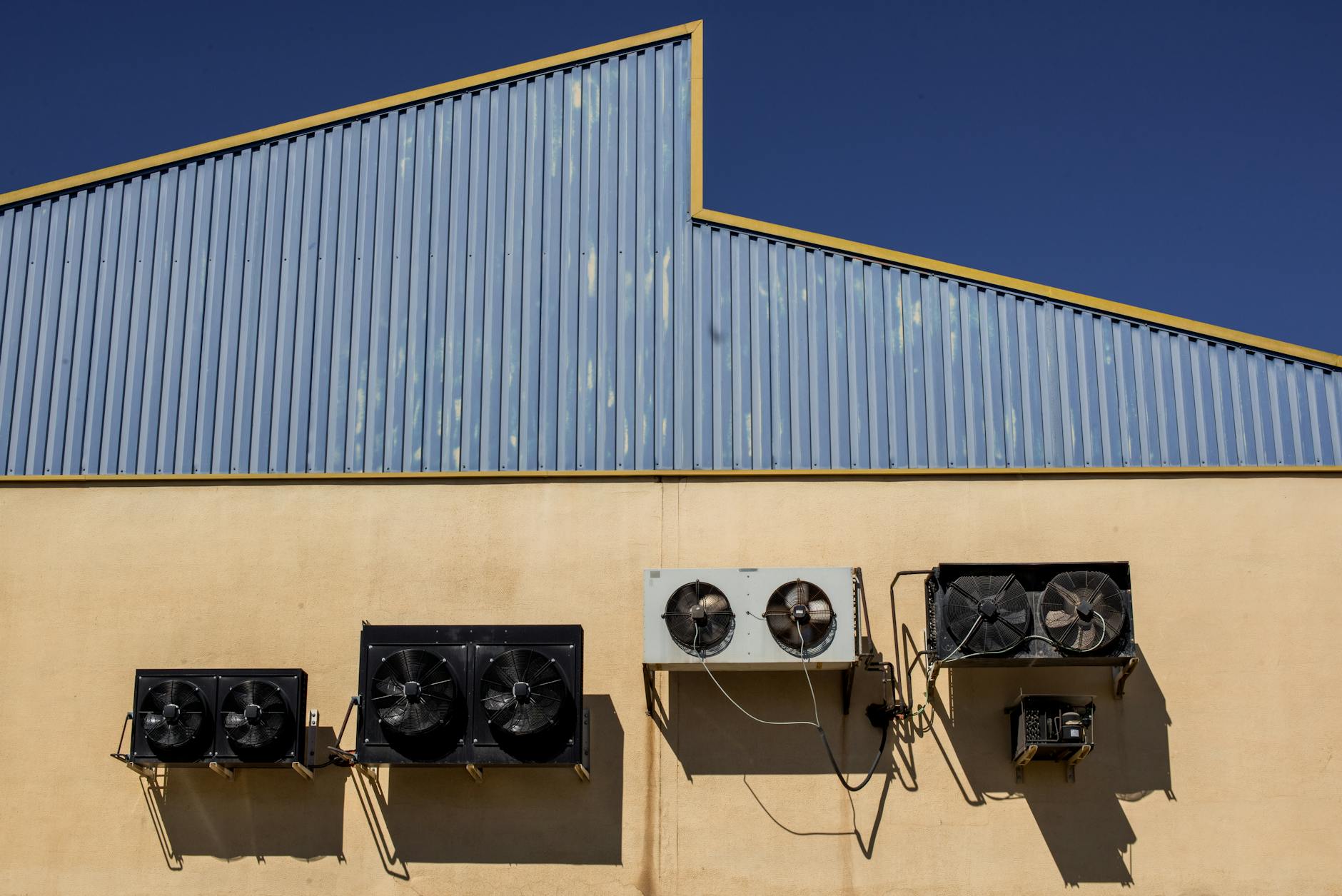
Photo by Victor Moragriega on Pexels.com

Many people believe that growth will only continue. “We’re gonna need stadiums full of electricians, heavy equipment operators, ironworkers, HVAC technicians,” Dwarkesh Patel and Romeo Dean, AI-industry analysts, wrote recently. Large-scale data-center build-outs may already be reshaping America’s energy systems. OpenAI has announced that it intends to build at least 30 gigawatts’ worth of data centers—more power than all of New England requires on even the hottest day—and CEO Sam Altman has said he’d eventually like to build a gigawatt of AI infrastructure every week. Other major tech firms have similar ambitions.

Listen to the AI crowd talk enough, and you’ll get a sense that we may be on the cusp of an infrastructure boom.

Throughout American history, growth is good. Construction is a sign of growth and provides jobs. A new industry is underway. Society is progressing. Data centers are all over the place (and will end up somewhere even if some communities do not all them). Americans are used to booming construction as this happened across housing and numerous industries throughout the country’s history.

What that growth might lead to is another matter. How do these data centers contribute to communities and landscapes? Do all the data centers in suburbs transform suburban life? When the growth slows, what happens then? Will the data centers still be there in 50 or 100 years or will they be vacant properties?

All this is a reminder that while many Americans will encounter AI through devices and data going through the air, it has a significant physical footprint. To power real-time AI responses to whatever we as users need requires buildings, land, resources.

Several ways AI could transform suburban life

How might AI transform suburban life? A few thoughts that came to mind:

Photo by Tara Winstead on Pexels.com
  1. If AI disrupts works and jobs in significant ways, this will affect suburbs. Many jobs are in the suburbs and people in the suburbs need certain jobs and income to be homeowners and residents. For example, if AI eliminates a lot of white collar office jobs, this will hit residents and communities who depend on corporate offices. Or if work from home becomes more prevalent, this changes people’s mobility and interactions with people and places around them.
  2. Can AI take over driving or render a lot of driving unnecessary? Driverless vehicles have been in the works for a while now but if AI helps accelerate these innovations, it could change a fundamental aspect of suburban life. People could get more time back. Perhaps communities do not need to be designed around cars.
  3. Is there any chance that AI makes suburban community life better – more interaction, deeper relationships – or would it contribute to individualism and atomization? Say AI takes over certain work duties; does this give people more time to socialize? Or do suburbanites rely even more on AI to handle their interactions with others – why wave to that neighbor you don’t really talk to when AI can generate a text to send to them?
  4. Would widely-adopted AI make suburban houses bigger, smaller, or just different? Perhaps it changes the layout. Would suburbanites want less space if AI can do more for them?
  5. This might be the biggest question of all: does widespread AI help suburbs grow or shrink in population?

I do not know the outcomes of these questions. I do know that the ideology and patterns of suburban living in the United States are well-established and establishing other patterns would require substantial forces.

Almost 80% of Illinois farmland devoted to two crops

Illinois farmland has two primary crops: corn (39.9%) and soybeans (38.9%).

Photo by cottonbro studio on Pexels.com

These figures were part of a story about AI farming technologies:

In general, technology is further along for row crops because hundreds of acres of corn and soybeans are relatively simple to tend to en masse. Ag-tech conglomerates such as John Deere and CNH Industrial have also historically catered to the needs of row crop operations since they’re such a large share of the nation’s agricultural sector, accounting for $21 billion of agricultural production in Illinois alone. Specialty crops haven’t received as much attention from corporate America. 

When you drive out of the Chicago area, you can see what appear to be endless fields of these two crops. Illinois may lead the country in pumpkin production but the amount of corn and soybeans grown is much higher. These may not be “exciting” crops but they are used in many ways.

Put it another way: what would Chicago area residents think if “Land of Lincoln” was changed “Land of Corn and Soybeans”? Would they associate those crops with other places (like corn with Iowa)?

And would being a state that leads in corn and soybean AI be an advantage? If so, how much so and where would the benefits go?

More data centers and AI, higher utility bills

With more AI and cloud-based activity in daily life, it may have one clear effect for people: higher prices for electricity.

Photo by Pok Rie on Pexels.com

As the Sun-Times reported in November, the demand for power from big data centers and a delay connecting new power sources, such as solar and wind, to the electric grid is resulting in ComEd customers seeing their monthly bills go up $10.60 a month on average…

Power demand across the country has skyrocketed as big data centers and artificial intelligence operations have created huge demand. Meanwhile, new sources of “renewable” energy, including wind and solar power, have been slow to get connected to an electric grid that spans from Northern Illinois to the East Coast, said Jim Chilsen, a spokesman for the consumer watchdog Citizens Utility Board.

How much will this register with Illinois customers – will they have no problem paying roughly $10 more a month to help support what they expect on their smartphone and online activity? Technology tends to have costs, even if people tend to think the benefits outweigh the downsides, but it can be hard to pin down. While all of the increased rates may not be due to computing activity, at least some is.

Considering indirect costs may just be difficult to do. Having direct feedback with technology probably elicits different reactions than these more indirect costs. Imagine the new AI feature on your phone comes with a $5 a month surcharge on your phone bill to cover its costs. Or each time you do an AI search you incur a charge. Contrast that with the costs of driving. Automobiles opened up all kinds of new opportunities but driving comes with numerous costs, some direct (like paying for gas, insurance, and maintenance) and some more indirect (taxes for infrastructure, changes in land use, pollution).

If asked how much they would be willing to directly pay for AI, what would Americans say?

Housing deed fraud via AI

Fraudulently filing for a property deed might be easier with AI:

Photo by Sora Shimazaki on Pexels.com

One of AI’s hallmarks is its ability to learn and digest enormous amounts of information. Property data is readily available to the public, and in some states, a simple search can unearth appraisal data, blueprints, transaction records, and even pictures of executed deeds. With AI, fake documents could be created faster and more realistic-looking.

“They’re just creating these AI models that are reading all of the public records and public data that they can possibly get their hands on, that are then creating a means by which they can manipulate that information,” Adams said. “So it’s like the ingestion is now automated because of AI models, and then the impersonation is a lot more sophisticated.”

An AI tool might be able to recognize a vacant property in a database faster than a human could or identify homes without mortgages attached to them (which could mark them as targets for a refinancing scheme).

The amount of personal information available to fraudsters also makes impersonation easier.

Kiar said his office has handled hundreds of fraud cases. Only two of those cases so far have involved AI, but he remains concerned that more are on the way.

Public databases have numerous advantages. People can search information more quickly. Processes can be automated. Local governments can demonstrate transparency. Researchers can access information.

But this story hints at the down sides. Anyone – or any system – could access the information. Those with malicious intent might be able to make something of the information intended to serve the public good.

The article suggests a need for verifying the identity for those filing a deed. Two-factor authentication for local government transactions! Could such verification require non-online actions, thus negating some of the advantages of online transactions?

AI generating a new history through pictures?

AI platforms can create images that might look they are historical photos. This could be a problem:

Photo by Nikhil Manan on Pexels.com

Widely shared on social media, the atmospheric black and white shots — a mother and her child starving in the Great Depression; an exhausted soldier in the Vietnam war — may look at first like real historic documents.

But they were created by artificial intelligence, and researchers fear they are muddying the waters of real history…

For now, Amaral and Teeuwissen believe they can still tell fake historical images from real ones just by looking at them.

AI-generated photos often have tell-tale glitches: too many fingers on a hand, missing details — such as the lack of a propeller on the Wright brothers’ plane — or, on the other hand, compositions that are too perfect.

“AI-generated pictures can recreate the look, but they miss the human element, the intent, the reason behind the photographer’s choices,” said Amaral.

With AI text and images, history could be all redone. What is available online, often the first or primary source for many, could provide different historical accounts and evidence.

Of course, history to some degree is always in flux as different actors and different contexts affect how we understand what happened in the past. There are things that happened and then perceptions and interpretations of those happenings that often take time to develop and solidify. AI joins an already existing process.

Do AI images then pose a unique threat to historical knowledge and narratives? If history is primarily created and understood through images online, perhaps. Will others find ways to demonstrate that certain images are truly from the past?

Let an AI robot deliver the commencement address at graduation!

A New York university had a commencement speech – a Q&A with a student leader – delivered by AI:

Photo by Tara Winstead on Pexels.com

The speaker certainly had the résumé for the job. She’d spoken at the United Nations, graced the covers of Cosmopolitan and Elle, and been a frequent guest on the world’s most-watched talk shows.

But she didn’t feel proud of her achievements. She didn’t feel excited to be speaking to the graduates. In fact, she didn’t feel anything at all.

Her name is Sophia, a human-like robot created in 2016 by Hanson Robotics and a “personification of AI in real life,” according to Lorrie Clemo, D’Youville’s president…

Unable to tell personal anecdotes about overcoming adversity or pursuing success, Sophia instead delivered an amalgamation of lessons taken from other commencement speakers.

“As you embark on this new chapter in your lives, I offer you the following inspirational advice that is common to all graduation ceremonies,” the robot said. “Embrace lifelong learning, be adaptable, pursue your passions, take risks, foster meaningful connections, make a positive impact, and believe in yourself.”

If the goal of commencement is to provide a speech that attendees will remember and look to in the future, that is a high bar.

If the goal of commencement is to provide a memorable experience, having a robot talk might fulfill that (even if the speech itself is not memorable).

It might be a niche market but how long until there is an AI robot that delivers a respectable commencement speech and is available for hire at high school, college, and graduate level ceremonies?