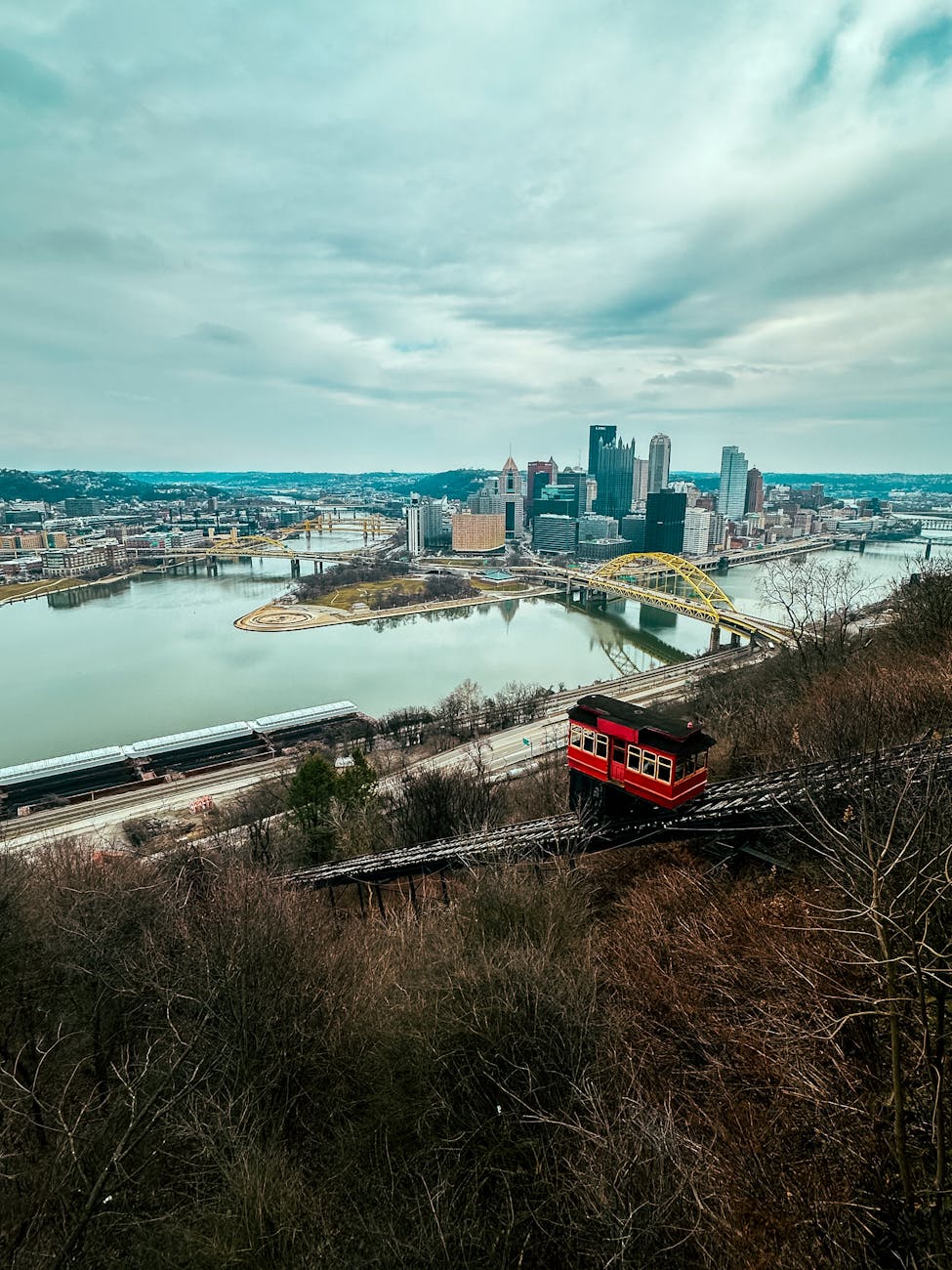
An airport as an economic engine, Pittsburgh edition

Reflecting on the opening of a new terminal at Pittsburgh International Airport, one writer looks back at what the city and region expected the airport to be:

Photo by Enes Tu00fcrkou011flu on Pexels.com

The airport was to be a driver and symbol of the whole region’s evolution. “Planners hope the terminal, with its vaulted ceilings and driverless underground trains, will complete an image transformation begun decades ago,” the Times story said. “Once known as a gritty old steel town of blue-collar workers, Pittsburgh has become a commercial center of office towers and high-technology industries.” That reinvention has continued apace in the 33 years since the terminal opened. But even as a tech, robotics, and health care hub, the area has three-fourths the population that it did in 1970. And no place was a worse reminder of what Pittsburgh had lost than this airport 20 minutes west of downtown…

As a major airline’s biggest hub, Pittsburgh would be taking a piece out of millions of travelers who weren’t even staying in Pittsburgh, and it would also get a tourist boom from people who suddenly had an ultra-easy way of visiting. Before Sept. 11, 2001, the Pittsburgh Post-Gazette reported, USAir was running 542 daily flights in or out of Pittsburgh. As airline-airport relationships go, this was a huge one. (Today, for example, Delta peaks with about 330 daily flights leaving Minneapolis, its No. 2 city.)…

But the oversized airport was a bleak metaphor for a city that was once more bustling and then got let down—first by the shriveling of the steel business, then by USAir itself. The cavernous, quiet terminal created a bad feeling upon landing at home, like you had just entered a place that wasn’t what it used to be. It wasn’t a good way to be welcomed to a city, whether you lived there or not.

It can’t be overstated how much the point of the new airport is to simply move Pittsburgh past this corporate pantsing by US Airways. Yeah, there are practical logistics reasons for an update. As the airport authority chairman said in announcing the project back in 2017, airlines would face lower costs, and the facility would be “very efficient and modern.” But then he got to the point: “And, finally, this is most important for me, the people of Pittsburgh finally get an airport that is built for them, and not USAir.”…

A major city needs a decent airport. It offers travel opportunities to residents and businesses. It connects a place to other places. It is what people see when they arrive in or leave a city.

Can an airport be an economic engine on its own? Pittsburgh is a smaller big city. According to Wikipedia, it is the 67th largest city in the United States with over 307,000 residents and it is the 28th largest metropolitan area. How much air traffic can be expected to go through an airport in such a city?

The story of this airport seems tied up with the fate of the city. It once thought it could be an airline hub. It has a proud history of industry. But the world changed: industry jobs went elsewhere, the airline industry changed, and the large airport did not live up to its potential.

Having effective and inspiring infrastructure is helpful in many ways. It enables other important activity. Pittsburgh may not have a large airline hub or a standalone economic powerhouse but perhaps it now has an airport that serves the region well for decades.
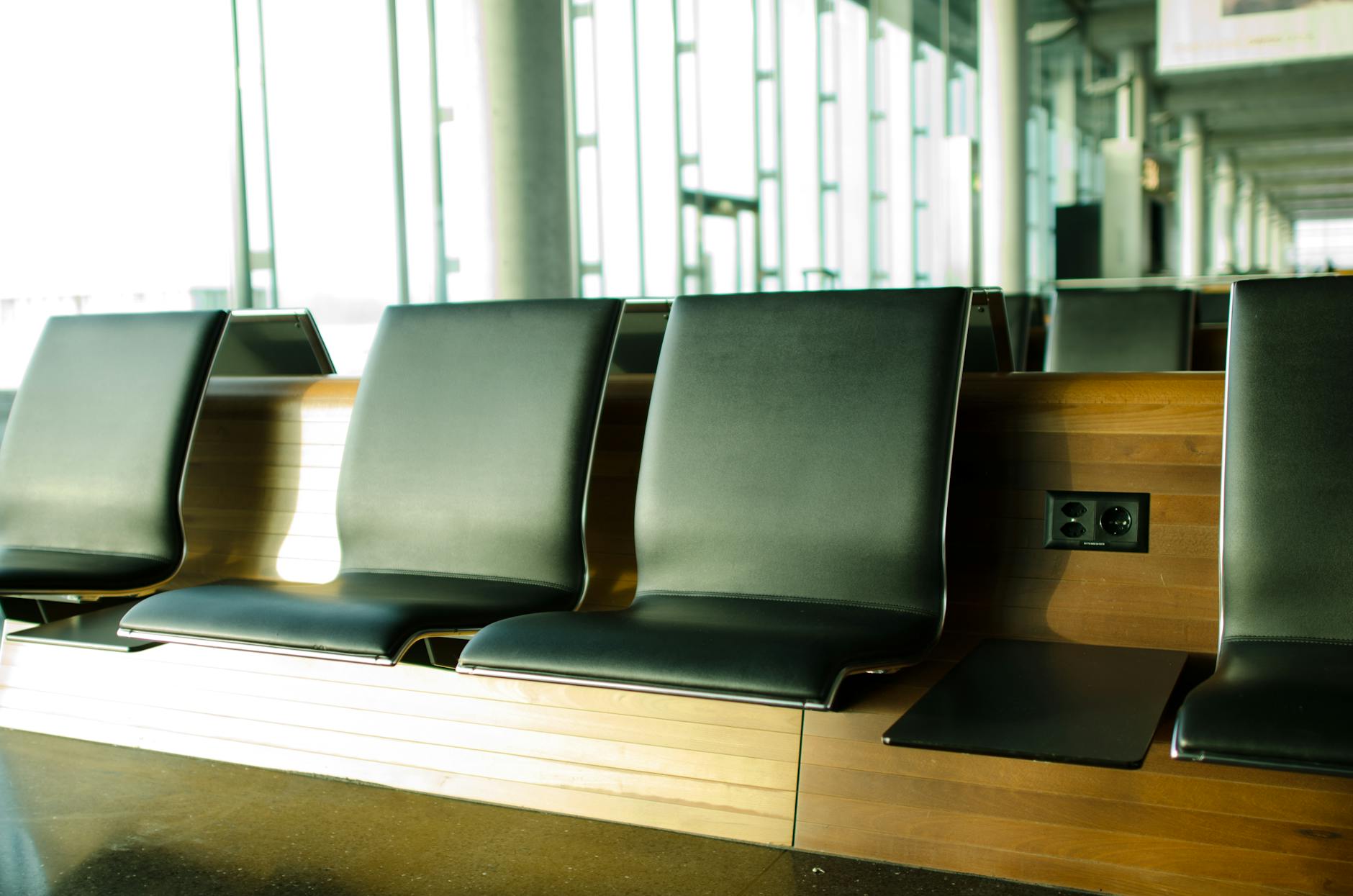
Increased demand for airport lounges is a sign of elite overproduction?

More travelers want to use airport lounges. Does this signal a broader problem in society?

Photo by Download a pic Donate a buck! ^ on Pexels.com

In the context of airport lounges, the “elite” are not just the ultra-wealthy, but the vast upper middle class—armed with a combination of higher degrees, status, and premium credit cards—now jostling for the same perks. But what if much of society has been turning into some version of an overcrowded airport lounge?

In an interview with Fortune Intelligence, Turchin said this theory makes sense and fits with his thesis when presented with the similarities. “The benefits that you get with wealth are now being diluted because there are just too many wealth holders,” he said, citing data that the top 10% of American society has gotten much wealthier over the past 40 years. (Turchin sources this statement to this working paper from Edward Wolff.)…

When asked where else he sees this manifesting in modern life, Turchin said “it’s actually everywhere you look. Look at the overproduction of university degrees,” he added, arguing that declining rates of college enrollment and high rates of recent graduate unemployment support the decreasing value of a college diploma. “There is overproduction of university degrees and the value of university degree actually declines. And so the it’s the same thing [with] the lounge.”

Noah Smith argues that elite overproduction manifests as a kind of status anxiety and malaise among the upper middle class. Many find themselves struggling to afford or access the very symbols of success they were promised—be it a prestigious job, a home in a desirable neighborhood, or, indeed, a peaceful airport lounge. He collects reams of employment data to show that Turchin’s theory has significant statistical support from the 21st century American economy.

The article suggests an increased number of travelers can access airport lounges and this hints at more people with money to spend. But I wonder how these other factors play in:

  1. Different standards of living. How do expectations shift over time about accessing airport lounges or other luxury goods? How many other goods or services over time have moved from luxury goods to being available to masses of people?
  2. Expectations about travel. A standard Internet narrative goes like this: airplane travel was once luxurious (forget the slow speeds). Then it became a mass phenomena and customers were treated poorly. Are airport lounges a way travelers are reclaiming a better travel experience?
  3. The airlines helped create this demand by introducing this perk; now they are surprised it is popular? Do they want it to remain exclusive or do they want more travelers to access lounges (and then the airlines benefit further)? Put another way: did customers want this first or did airlines push the lounges?
  4. Why not offer an upgraded experience for all travelers? Does this not generate as much revenue or status for the airlines?

If Delta is able to figure out how to make the lounge “work,” would their practices then translate to other areas of society?

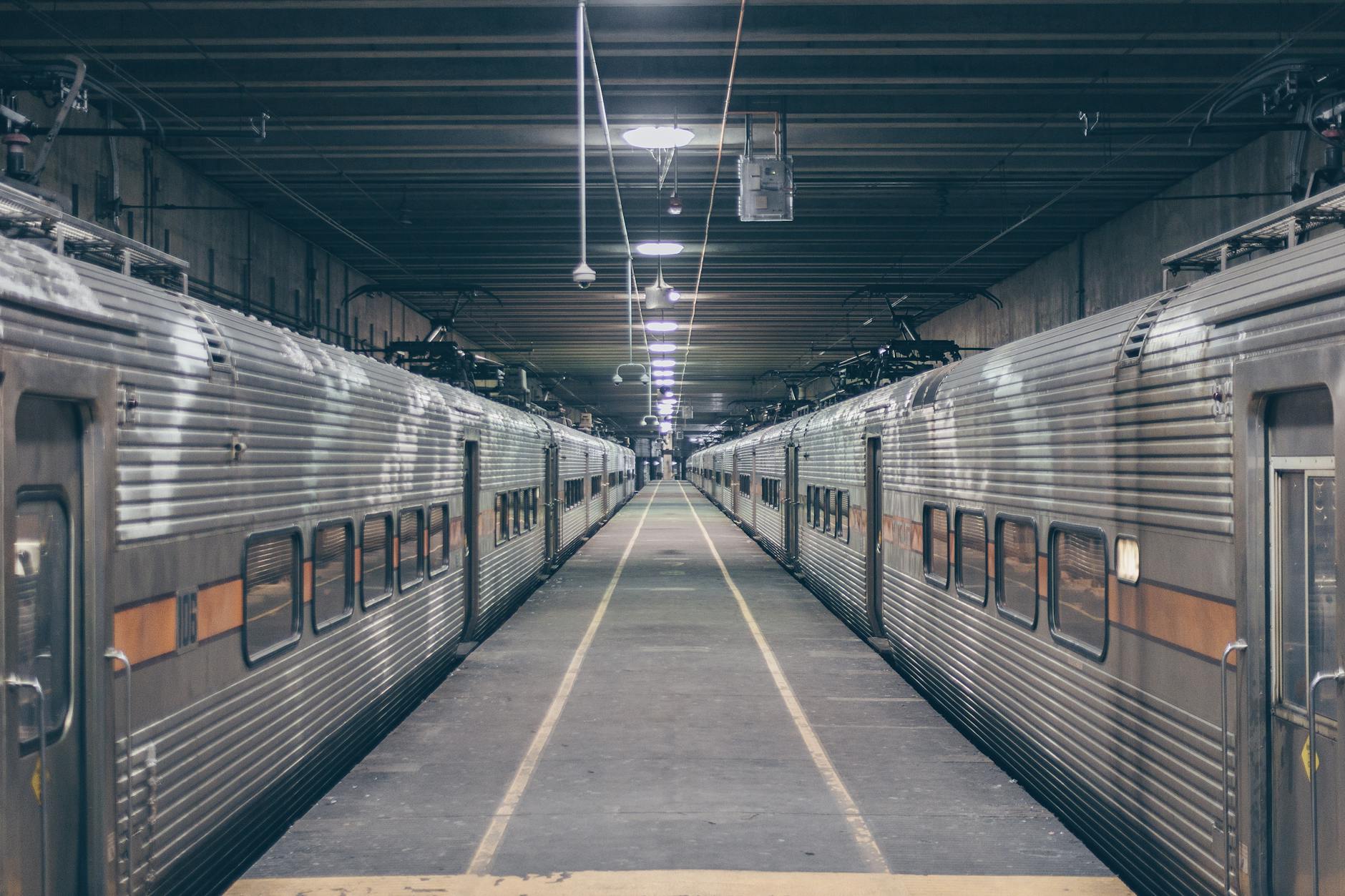
One thousand trains in and out of Chicago each day at the peak of train travel

The book Forgotten Chicago includes the claim that at Chicago’s railroad peak, 1,000 trains daily moved in or out of the city. One chapter of the book details the numerous train stations that are no longer standing that serviced these trains.

Photo by Josh Sorenson on Pexels.com

Chicago continues to be a railroad center in the United States even if the volume of trains is not close to the peak numbers.

And as train travel declined, the Chicago region became home to other transportation options. Two of these are worth considering after the golden age of railroads passed (and Chicago’s port activity also declined). As people used trains less to travel between cities and used trains less within the region as commuting between suburbs picked up,

First, O’Hare Airport is one of the world’s busiest. Today it has over 900 daily flights (mostly domestic, some international). By number of passengers, it is in the top ten among global airports. I do not know how many people moved through Chicago via train at the peak but the flight numbers are large.

Second, many people travel throughout the region and to other regions via highways. For example, one interchange of two interstates roughly 20 miles west of the city has about 300,000 vehicles daily. Numerous highways throughout the metropolitan area have daily traffic counts of over 100,000 vehicles. That is a lot of cars and trucks moving people and goods around.

Finding the end of the airport

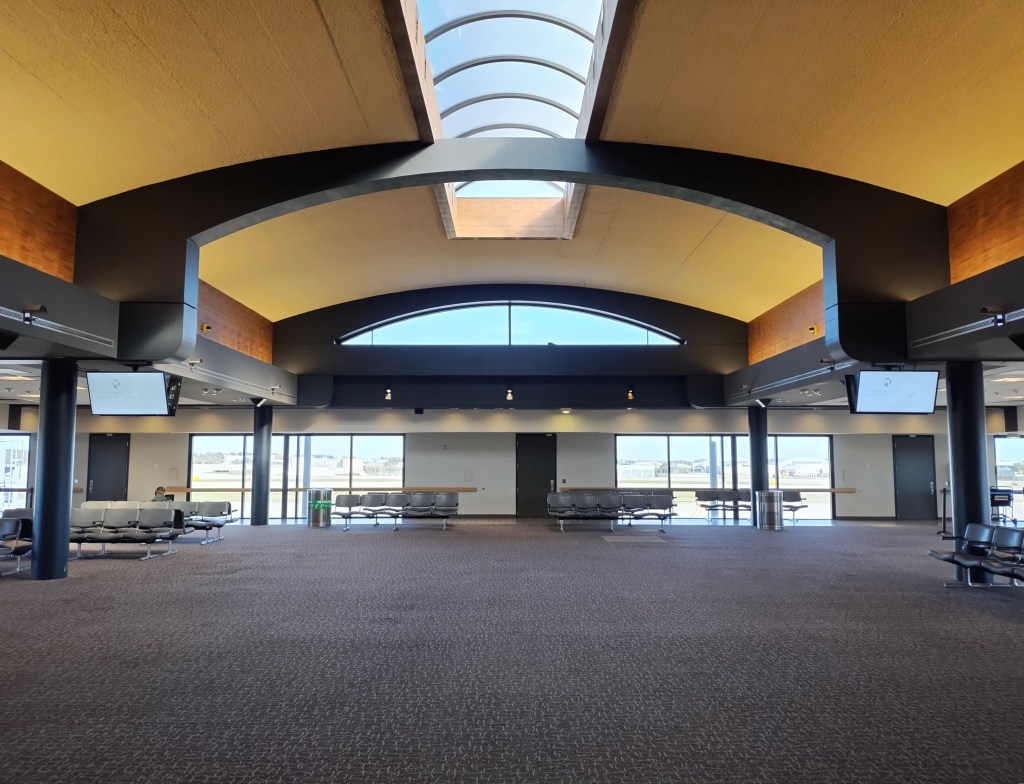
With time to spare on a recent trip, I walked all the way to the end of the airport:

This is both what I expected to find and not what I expected to find. On one hand, there are few spaces that look quite like an airport. The big open space surrounded by banks of chairs, a particular kind of carpet, and plenty of windows to see outside interspersed with a lot of doors no one can enter unless they are officially open.

On the other hand, there was no one at the end of the airport. Well, one person on the left taking advantage of the relative solitude. No planes waiting at this area and actually no used gates even near the end. This is not what I commonly see in the two Chicago airports where it seems the opposite issue is present: there are not enough gates for all the flights and airlines and some people have to wait on a tarmac.

Depending on your point of view, this might be an oasis or an opportunity or a waste of resources. Could this provide a refuge from the hustle of the airport near the center where all the concourses branch out? Could the airport do with fewer gates, thus leading to lower costs for maintenance and staff? Or might this lead to a future of more flights with room to grow? Is this space best experienced when filled with activity and travel?

Imagining 1.65 million people in the two Chicago airports

The airports in Chicago are used to big crowds but I still have a hard time imagining over 1.5 million going through the two airports over Thanksgiving:

Photo by Josh Sorenson on Pexels.com

The Chicago Department of Aviation projects 1.65 million passengers will stream through O’Hare and Midway airports this Thanksgiving season, surpassing 2022 totals. Sunday will be the busiest day at both airports with nearly 300,000 people expected, the CDA reported.

I do not think I have ever flown during the Thanksgiving week due to having a lot of family within driving distance. But, I have been to these airports during Thanksgiving week to pick up and drop off people. There are a lot of cars and big crowds. One memorable trip included a two hour return drive – typically a 35 minute journey – because of lots of traffic and heavy snowfall.

I suspect airports need to be built kind of like big box store or shopping mall parking lots: enough capacity to handle the busiest days of the year but usually not near full use. If airports did not have room for Thanksgiving week travel, people would be upset and airlines would not be able to move as many people as they do. In the times with fewer passengers, everyone can adjust staffing and resources.

For all of those making their way through O’Hare and Midway this week, best wishes to you. Hopefully, the weather here does not wreak havoc on schedules.

Branding when the airport code is SUX

Sioux City, Iowa is working with its airport code:

Photo by Marina Hinic on Pexels.com

Sioux Gateway Airport, or SUX as it appears on tickets and bag tags, has been the butt of jokes in Iowa and beyond for decades.

After complaints and failed efforts to change the code, Sioux City decided to lean into its unfortunate designation and, more recently, has expanded it well beyond the airport. Area businesses are increasingly embracing the branding and SUX is popping up all over the place.

Poo SUX is a pooper scooper service for pets. RentSUX is a leasing company. Cleaning SUX is a commercial-cleaning firm. Radon SUX helps people mitigate radioactive gas from their homes. The Art SUX gallery is downtown. And the SUX Pride festival is held in June…

FLY SUX has been the centerpiece of this city’s airport marketing since 2007. Before that, the Federal Aviation Administration offered five alternatives—GWU, GYO, GYT, SGV and GAY—but airport trustees stuck with SUX, the Associated Press reported at the time…

Mike Collett, an assistant city manager who serves as the airport’s director, said SUX has become so common for people in the area that “everyone thinks of it as a positive statement.” When the city lobbies airlines to keep or expand their service, representatives often hand out T-shirts, caps and other SUX tchotchkes.

Cities and communities in the United States need to find ways to stand out. Whether they are trying to appeal to businesses, potential residents, or tourists, they try to provide a reason their particular community should be chosen when there are thousands of other options.

Here are my guesses at how Sioux City thinks it is presenting itself by leaning into this airport code (though the story makes clear that not everyone in the community does): it is a place that can have fun, they can turn difficult situations into good ones, and they are a little edgy. This puts them on the map, even if some might find the language distasteful.

Does this branding work? It is one thing if local grab hold of this and make it part of local life. It is another if this helps the city and area attract people.

Waiting for post COVID-19 flight traffic at the busiest airports

New data on the busiest airports in the United States suggests there is room for more flights in 2022:

Photo by Maria Tyutina on Pexels.com

O’Hare International Airport remained America’s second-busiest hub behind Hartsfield-Jackson Atlanta International Airport in 2021, but experts say the number to watch is a 27% rebound in flights compared to a dismal 2020…

At the same time, O’Hare continues to climb out of a pandemic slump of 538,211 arrivals and departures in 2020. To put that in context, operations totaled 919,704 in 2019 when O’Hare held the title for most U.S. flights…

What other airports are bustling? The third-most voluminous was Dallas Fort Worth International Airport, followed by Denver International Airport, Charlotte Douglas International Airport and Los Angeles International Airport in sixth place.

I have been to the Chicago airports one time for a flight in the last two years and that visit in October 2021 seemed fairly close to normal. Theoretically, the pandemic provided a little space to make improvements or tackle projects at airports. I saw some improvements underway. At least a few big projects are in process at O’Hare:

An expansion of Terminal 5 is in full swing, with more than $1 billion earmarked to modernize the global facility.

At the same time, plans for major airports like O’Hare likely take place on the scale of decades, not necessarily a year at a time. For example, discussions regarding adding a new western terminal and entrance to O’Hare have gone on for years with some progress toward that goal.

It will also be interesting to see how the role of airports changes as the United States shifts to more electric vehicles. If longer road trips are different, will more people want to fly to destinations more than a few hours away? Flights are not exactly green but the transportation landscape could change in the next few decades.

Living in the shadow of Heathrow and other major airports

A reporter travels to a neighborhood just next to the runways at Heathrow Airport and tries to understand how people live there:

It’s a nice perk, if you don’t mind the to and fro of planes overhead—one taking off or landing every 45 seconds, every day, every year. They soar within a few hundred feet of the rooftops, blocking the sky like giant aluminum birds. And they make a helluva racket too. “It’s almost deafening if you’re standing underneath,” says Bertie Taylor, who photographed Myrtle Avenue for his series Under the Flight Path.

Feltham has been a transportation hub since the early 20th century, when it hosted Britain’s second largest railway yard, targeted by German air strikes during World War II. But it didn’t become the consistently noisy place it is today until January 1, 1946, when an Avro 691 Lancastrian departed Heathrow for Argentina, marking the airport’s first flight. In the 1960s, its two main runways—one located just a quarter-mile northwest of Myrtle Avenue—were extended a few thousand feet to service even bigger planes like the Boeing 747.

Noise levels are allowed to reach up to 94 decibels during the day (equivalent to a jackhammer 50 feet away) and 87 decibels at night (a gas-powered lawn mower)—though they’ve fallen in recent decades with quieter engines and smarter flight paths. Still, last year Heathrow received an average of one noise complaint every seven minutes. Noise isn’t the only nuisance. Nearby communities also receive an extra dose of air pollution from vehicle and aircraft traffic, not to mention the occasional scare: In 2008, a Boeing 777 nearly slammed into Myrtle Avenue after its engines failed.

All this sounds nightmarish—and indeed, it troubles locals. But when Taylor visited Myrtle Avenue in September 2018, curious to see what life near an airport is like, folks seemed more irritated by having their driveways blocked in by planespotters’ cars. Aviation enthusiasts from as far as Germany and the Netherlands throng to the green park near the airport fence to ooh and aah at landing Airbus 380s and Boeing 777s. One middle-aged man even stood atop his van in a nearby field, livestreaming the spectacle on Facebook.

Humans can live in all sorts of conditions, including regular noise and visitors. So what would motivate these residents to stay in this location? A few hypotheses:

1. Housing is cheaper here. The noise would bother a lot of potential homeowners so a dwelling that might be more expensive elsewhere (and this is the expensive London region after all) might be less expensive.

2. Proximity to jobs, particularly in the transportation sector. For people with jobs at Heathrow or in something connected to the air industry, this could be a convenient location.

3. They grew up in this area or have long-term connections to the industries (railways, flying) in the community.

On the other hand, perhaps some of the residents do leave when one of these factors that once pushed them to stay becomes less important. With some personal experience living near a busy railroad line, I know people can get used to noise and rumbling but wouldn’t the average resident leave when they could?

Since airports are not usually too far from dwellings these days (they might have been in previous decades but many metropolitan regions have expanded), someone has to live near the airport. Maybe even some come to like it. But, living that close with the noise and the shadows is a different experience many homeowners would look to avoid.

Bringing in tourists just to see the airport

Airports are often considered gateways to other tourist activities. Yet, they can be tourist destinations in their own right:

Hughey’s at the vanguard of a new phenomenon: terminal tourism. Programs adopted or being considered by a number of airports allow people beyond security checkpoints so they can meet arriving relatives or just hang out. It’s a bit of a return to the days before the 9-11 terrorist attacks, when airport security was more relaxed and you didn’t need a ticket for a flight to get inside. The programs are taking root as airports expand options to fill passenger dwell time, as it’s called — those often mind-numbing hours between when people make it through security and when their flights take off. Now many airports feature live music and art exhibits. There are spas, microbreweries, playgrounds, gourmet restaurants and wine bars.

Pittsburgh was the first airport to open up to non-travelers, in 2017, and Tampa started doing so last month. Seattle-Tacoma is evaluating a pilot it tested earlier this year and Hartsfield-Jackson Atlanta International, the nation’s busiest, may seek approval for a trial run. The idea is under consideration in Detroit and Austin…

Some view it as a potential money-maker; officials with the facilities in Atlanta and Detroit figure they might see additional revenue from parking and concessions. A survey of visitors during Seattle-Tacoma’s trial showed people stayed an average 2.5 hours — though they spent only an average $10.29.

At Pittsburgh International, the impetus was popular demand, said Chief Executive Officer Christina Cassotis. She was peppered whenever she appeared at public forums. “In the top five questions was always, ‘Why can’t we go back to the airport and see what’s going on out there?”’

I know there are security concerns but I cannot believe it took this long to consider this potential revenue generator given the number of cities interested in tourism. If the buildings are already there, why not invite more people in?

Some of the discussion in the article suggested airport tourists are drawn by food and shopping. I also assume the terminals provide some other nice features: watching airplanes and a safe, controlled, clean environment. In all these senses, airports are then like shopping malls with options for dining, shopping, and entertainment all within a pleasant indoor setting. And having been in almost all of the airports listed above, newer facilities are definitely headed toward shopping mall status with large shopping and dining areas plus interesting amenities for people on the go. For example, Sea-Tac offers a large glass window for watching planes.

Now, if only those struggling shopping malls could find something as interesting as planes landing and taking off to attract visitors…

The difficulties of big protests at airports

Airports don’t often attract people for protests so the gatherings of recent days highlighted a few issues:

Moving hundreds of thousands of people to downtown streets for a march is one thing—getting people to an airport is a huge transportation challenge, especially in cities that don’t have adequate transit connections to begin with. In San Francisco and Los Angeles, transit authorities were coyly reminding protesters to use trains or buses to get to SFO and LAX.

Some airports reported delayed flights because crew members could not get to work, and heavy traffic was reported around many airports. Long-term parking lots and shuttles were filled with protesters, and passengers had to wade through sign-holding crowds to get to their gates.

So many New Yorkers were using the city’s AirTrain to get to the protest at John F. Kennedy International Airport (JFK) that security guards blocked people from boarding it until Governor Andrew Cuomo ordered Port Authority to let protesters through

The incident on JFK’s AirTrain also points to another challenge for an airport demonstration. Most airports are a checkerboard of public and private properties with both local and federal oversight. JFK’s international terminal, Terminal 4, which became ground zero for the protests nationwide, for example, is partly owned by Schiphol Cargo, the corporation that manages Amsterdam’s airport…

Globally, this type of “airport urbanism” is actually becoming the norm as airport design worldwide moves away from the fortress model of the past. While continuing to focus on security for boarding areas, new airports are adding more permeable spaces that serve both passengers and the greater public. Munich’s airport has a similar programmed plaza that inspired Denver’s.

It is unlikely that airports can be consistent centers of urbanism because many types of development do not want to locate near loud runways. At the same time, there is little reason why more airports can’t introduce more interesting spaces that give travelers, workers, and other visitors opportunities to relax, shop, and interact. For example, I really enjoyed the grand windows at the Seattle airport last August. (At the same time, that space was past security and wouldn’t be available to protestors.)

Protestors in recent years have shown more willingness to congregate in transportation corridors, whether highways or airports. Such tactics do tend to get people’s attention while also highlighting the lack of large public space sin many locales.