Can McMansions ever add to the charm of a neighborhood or community?

I’ve seen many stories over the years of how teardown McMansions ruin the charm of older neighborhoods. Here is a recent case from the north shore of Long Island:

Call it a neighborhood dispute over home sizes. A small village on Long Island is seeing more and more small homes torn down to make way for so-called ‘mcmansions.’

Some neighbors have been pushing back, saying the huge homes are taking away from the charm of their community.

Are there any conditions under which a new McMansion might be considered charming? While I can’t recall seeing such a positive description used, here are a few scenarios in which it might work:

  1. The replaced home was small, decrepit, and in severe disrepair. McMansions may not be the preferred replacement option but some homes can be terrible shape and such eyesores are appreciated by few neighbors.
  2. The owners of the new home go significantly out of their way to placate neighbors. Regular deliveries of baked goods? Lots of volunteering for local duties? Handwritten notes asking for forgiveness? Hosting regular parties for neighbors in their spacious new home?
  3. The McMansion meets certain conditions: it is not so large compared to nearby homes, it does not seem to be bursting out of its lot, and the architecture is tasteful and consistent with nearby homes. Even with these, I suspect some neighbors will never be able to get past the idea of a McMansion.

Critics of McMansions tend to pick out clear-cut cases but not all larger teardowns are so easily categorized.

Comparing the architecture of Chicago and LA

If baseball teams from two cities square off, why not use it as an opportunity to compare the architecture of the two locations? “Chicago vs. Los Angeles: Which city has the better architecture, public art, and parks?” Here are the comparisons in the iconic skyscraper and landmark categories:

Willis Tower

During much of the twentieth century, Chicago was a merchant city and the biggest name in the business was Sears. In the late ‘60s, the company decided to build a new headquarters and tapped Skidmore, Owings & Merrill to design what would become the tallest building in the world. Designed by Bruce Graham and Fazlur Rahman Khan, the building’s “bundled tube” design not only allowed it to reach new heights, but to also make a grand gesture in the Chicago skyline. With an official height of 1,450 feet (1,729 feet if you include its antennas), the tower held the world’s tallest title until 1998 when the Petronas Towers in Malaysia were completed.

US Bank Tower

The tallest building on the West Coast—until about six weeks ago, anyway—is strong and mighty—it was built to withstand an 8.3 magnitude earthquake. But that hasn’t mattered much to filmmakers. It’s such a standout building that director Roland Emmerich targeted it in no less than three of his blockbuster disaster films; Aliens destroyed it in Independence Day, Tornadoes swept through it in The Day After Tomorrow, and it was felled by an earthquake (presumably above 8.3) in 2012. Completed in 1989, it was designed by architect Henry N. Cobb, who outfitted the structure with its signature crown. This year, the tower unveiled a terrifying glass slide that suspends riders above the street 1,000 feet below. (Even the engineer admitted it’d be “scary as hell” to ride in an earthquake)…

Chicago Water Tower

The Chicago Water Tower in many ways is a reminder of Chicago’s ability to endure through difficult times. The 154-foot tall limestone structure is a physical connection to the city’s early days as it is one of the rare buildings that survived the Great Chicago Fire of 1871 which wiped out most the city’s downtown. Today, it is surrounded by towering skyscrapers but remains a popular tourist destination and symbol of Chicago’s strength and determination.

Hollywood sign

Perhaps the most recognizable landmark this side of the Pyramids at Giza, the Hollywood Sign has come to stand in for so much—show business, fame, excess—but is locally a symbol of the city’s complicated relationship with growth and change. The sign originally read “Hollywoodland” and was merely an ostentatious billboard advertising a new subdivision during a 1920s development boom. Later, when it had become a recognizable local landmark, preservationists sought to restore and preserve the sign. And now, with tourists from around the world flocking to Beachwood Canyon to get a closer look at those giant letters, it’s apparently become the bane of local residents’ existence—some of whom have proposed dismantling the sign entirely.

If we are comparing the most iconic representatives of each categories, the cities may be closer than many realize. Chicago is widely recognized as a capital of architecture yet Los Angeles has a good number of interesting and well-known buildings and designs. Additionally, the “feeling” of each place – spatially, culturally – is quite different so it could be hard to make direct comparisons. Yet, I would guess that if we went with quantity as well as history, Chicago would be a more clear cut winner.

I would be interested to see how many architects worked in both cities. In other words, were they separate architectural worlds or was there a lot of back and forth? Given that the two cities are so different, I wonder how much overlap is possible and then how much either the cities or architects would want to broadcast such overlap.

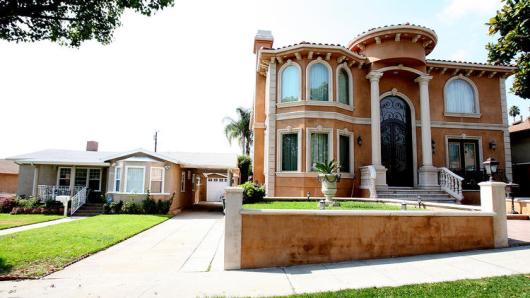
Photo illustrates two of the concerns about teardown McMansions

A news story about possible changes to Burbank’s guidelines for single-family homes includes a great depiction of a teardown McMansion:

burbankteardownmcmansion2013


The image illustrates two common issues neighbors have with such new homes. First, the new home is significantly larger. Not just a little larger; a lot larger. Next to a postwar ranch home now sits a two story property that extends almost to the side property lines and partly due to its higher base now looms over the older, smaller home. Second, we don’t even have to go so far as to claim the architecture of the new home is garish; rather, it is significantly different from the next door ranch home. The small ranch home common to many suburban communities may not be much to look at (though they do have their own enthusiasts) but at least such homes are on blocks of other such homes. Once teardowns begin, the architectural continuity is lost and a hodge podge of homes emerges. A new owner of a teardown could attempt to do a lot to smooth over hard feelings among neighbors but the task is probably more difficult when such a disparity in size and architecture exists.

At the same time, pictures of teardowns can be taken in such a way that either highlight or downplay the differences between adjacent homes. However, I don’t think the picture above can be explained away by angles or camera lenses.


Seeing McMansions as perfect haunted houses

Pile on the McMansion hell: one writer argues McMansions capture all the essential features of haunted houses.

The term McMansion is itself still relatively recent, coined only in 1992 according to the Oxford English Dictionary. But the landscape of America has long been populated by these off-kilter, jumbled houses, homes whose shape defied all balance and order. At least since the 19th century, we’ve had to deal with ostentatious monstrosities, built without symmetry or class, gargantuan hallmarks of the nouveau riche. We didn’t call them McMansions back then; we called them haunted.

The archetypal American haunted house has always been one whose construction was aesthetically unbalanced. Take one of the most famous American haunted houses, Nathaniel Hawthorne’s house of the seven gables. Defined by its “seven acutely peaked gables, facing towards various points of the compass, and a huge, clustered chimney in the midst,” the house is the ill-gotten gains of Colonel Pyncheon, who accuses his neighbor Matthew Maule of witchcraft in order to acquire his land. There is no order or symmetry to the house; indeed, it’s not even clear where the front of the house is, since it lacks any kind of façade or welcoming front door. The titular, odd-numbered gables poke out in different directions, overwhelming the house with secondary masses and voids. A McMansion 150 years before the term was invented, Hawthorne’s creation set the template for a house that exemplifies wealth without class, ostentation without order…

What is this connection between odd constructions and ghosts? Perhaps it’s because these strange buildings defy common sense and time-honed principles, creating in us a sense of unease that’s hard to name. The principles of architecture—the ones so readily abused by McMansions—didn’t appear overnight; they emerged from centuries of use and tradition. They reflect how we move through houses and how we are most comfortable in them. They maximize the kinds of spaces where we feel most at home, organized around layouts that facilitate ease of use and movement…

In the absence of a good vocabulary to describe that sense of unease, we often fall back on the language of hauntings. A house that’s settled uneasily in its foundation, so that doors swing closed by themselves, and whose layout may trigger a feeling that something isn’t it right—how easy it is to call it haunted, to blame that sense of unquiet on a ghost. The lexicon of the paranormal, after all, is far more ubiquitous and widespread than that of architectural principles, and the language of ghosts is often far easier to call upon than that of primary and secondary masses.

McMansions do regularly feature in horror films. But, this argument is a stretch and I suspect this is another McMansion pile on: “I already don’t like the homes so why not link them to something many people don’t like?” By this argument, any building that is not balanced or orderly is haunted. There are plenty of structures that would fit this description, including many older homes and much of postmodern architecture. On the other hand, do prototypical haunted houses share common traits? Probably, particularly as they are depicted in mass media (whether books, films, or television). In other words, haunted houses may be largely cultural constructions and if enough people paint McMansions as haunted, perhaps it will become real.

Additionally, this argument suggests the supernatural potential of haunted houses is nothing more than bad architecture. How many people would accept this argument, whether they are ghost hunters or people who believe in spiritual beings?

Watching the planes in style at SeaTac

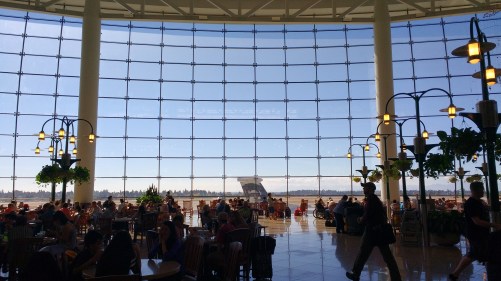
After walking through security at SeaTac, I entered the central food court and shopping area. I was greeted with this view:

IMG_20160823_155444200

From this gallery, you can watch the main runways as planes takeoff and land and you can do so seated in wooden rocking chairs (close to the windows). I assume many airports are designed with providing sufficient gates and access to planes in mind. Think of O’Hare or Atlanta where the concourses are long. Yet, this view took the mall court airport plan – common across many newer airports including ones I’ve seen in Tampa, Orlando, and Las Vegas – to another level: providing a large view of the most interesting work of the airport as planes travel at high speed.

An overview of the airport feature from when it opened in 2005:

The feature attraction, however, is the 60-by-350-foot glass wall that overlooks the runways and, in amenable weather, the Olympic Mountains. It’s more than just a big picture window. The panes are wrenched into a compound curve, convex in the vertical plane and concave in the horizontal. It looks more like a portal to a space warp than a mere window. The web of steel cables, struts and attachment spiders that allow the curtain wall to flex up to 11 inches in a worst-case windstorm or earthquake is all exposed to view, a celebration of virtuoso building technology…

Architect Curtis Fentress, the terminal’s principal designer, is convinced that people want to feel the excitement of travel again, and that it touches a deeper place than momentarily marveling at the apparent miracle of 400-ton cigars storming into the sky. He recalls a boyhood visit to the airport to see his uncle off to the Korean War. “We watched him wave to us from the plane,” Fentress recalls — an impression half a century old, burned indelibly into his mind.

Bonus: this area seemed to particularly fascinate small children. This is no small feat in the harried realm of traveling.

Cutting a suburban house in half for art

In 1974, artist Gordon Matta-Clark sought a suburban house to turn into art:

In the spring of 1974, Gordon Matta-Clark approached his dealers, Holly and Horace Solomon, and asked whether they knew of a house that he could cut in half. As it happened, they had recently purchased an empty, soon to be demolished house, 322 Humphrey Street in the suburb of Englewood, New Jersey – they were interested in the underlying lot rather than the building itself. As the house was going to be pulled down, the Solomons let Matta-Clark work on it for a few months prior to its destruction. [1] It was an ordinary balloon-framed, two-storey house, with a porch back and front and a base of cinder blocks. It was built during the 1930s when Englewood was expanding due to its proximity to New York City and its separation from the decay and lawlessness of the inner city. However, with the postwar economic downturn there had been a decrease in the number of households. [2] The house at 322 Humphrey Street would have been only one of a number of empty lots, and, like the apartment buildings that Matta-Clark had appropriated, was part of the larger system of profit and loss.

Having enlisted the knowledge and help of the German-born artist Manfred Hecht, Matta-Clark jacked up one end of the frame, including one of the porches, removed a layer of cinder blocks, and cut through the entire side of the building – inside and out – with a chainsaw. Gradually he lowered the back of the building onto the remaining blocks, leaving a gap in the cut of about two-thirds of a metre at the top that tapered to a slit at the base. [3] He called this work Splitting, and part of the filmed record features Matta-Clark stripped to the waist, at different times pulling hard on the jacks, up a ladder directing the saw and manipulating the cuts; he appears to be as engrossed in his work as Jackson Pollock in the films that show him dripping paint onto canvas, or indeed Trisha Brown in films of dance performances in which she scales buildings and creates improvised urban encounters. All show the artists’ physical and mental engagement with their work and are performances of a type. When writing about Splitting, Matta-Clark also gave the house its performative role, saying that having made the cut there was a real moment of suspense about how the house would react, but that it responded ‘like a perfect dance partner’. [4] Matta-Clark wrote that the production of the work was not illusionistic, but that it was ‘all about a direct physical activity, and not about making associations with anything outside it.’ [5]…

Matta-Clark felt, like the Situationists, that this dream had been used as a political tool by the ruling classes through the provision of convenience and dwellings, in order to contain and control the masses. [10] It was also integral to the return to family values in America after the war, which were promoted in television programmes, films and magazines. While the home was seen as private, the family was also encouraged to be part of a network of neighbourhood relationships, where conformity was important, but these relationships were ‘sold’ as intrinsic to the ‘good life’. [11] Matta-Clark questioned the interests involved in developing this dream and then providing for it:

The very nature of my work with buildings takes issues with the functionalist attitude to the extent that this kind of self-conscious vocational responsibility has failed to question or re-examine the quality of life being served. [12]

The Whitney Museum of American Art describes the meaning of the project: “This splitting implied both a rupturing of the fabric of domestic space and a liberation of the individual from suburban isolation.” This is one way to cut through the suburban facade…

Adding to the design lesson: “What makes a McMansion bad architecture?”

Mcmansionhell on Tumblr begins with a well-illustrated post: “McMansions 101: What makes a McMansion bad architecture?

We could add several additional dimensions to the negative design of McMansions:

  1. A lack of consistency around the entire home. (This post address the front.) Critics suggest McMansions are intended to impress others with their facades but the rest of the home gets little attention.
  2. Poor quality or a mish-mash of architectural materials. (Think fake stone siding.)
  3. Mixing a variety of architectural styles such as putting together English Tudor and Mediterranean.
  4. An oversized emphasis on the garage. (Hence the nicknames “Snout Houses” or “Garage Mahals.”) Critics suggest this emphasizes the private nature of large homes rather than having architectural elements that interact with the streetscape.
  5. A lack of proportions to the size of the lot, whether it is a large lot or a teardown McMansion sitting on a small lot and near smaller homes.

I look forward to the coming Tumblr posts on McMansions and it some of these design issues listed above will be covered.

Comparing aliens, asteroids, and ghosts destroying cities

Mass destruction of cities is a common feature of action films but what creatures bring about the most destruction?

Anyway, this all got us wondering why aliens hate Earth architecture so much, and then we realized that it’s not just aliens—Earth architecture is also hated by asteroids and ghosts. Let us review the evidence…

Verdict: Asteroids

It’s got to be asteroids. Asteroids are such jerks.

Not exactly a scientific review of the available evidence (how hard would it be to analyze all the movies with such urban destruction) but still an interesting question to ponder. Nature, in the form of asteroids, does not care about what exactly is destroyed. Asteroids of large size rarely hit earth and what are the odds that they would regularly hit major cities as opposed to falling in the ocean. At the same time, asteroids are faceless villains whereas you can fight or negotiate with aliens and ghosts.

We could also ask whether it is best for other worldly villains to take out key architectural landmarks versus other strategic targets. The first has symbolic value but key infrastructure would be much more crippling. Perhaps this is the equivalent of the bad guys always having bad aim as they try to shoot; these villains always go for visible targets, giving responders time to come up with a plan.

Quick Review: A Burglar’s Guide to the City

Joining the subjects of crime and architecture, A Burglar’s Guide to the City by Geoff Manaugh is an interesting if not repetitive read. Some thoughts about a book that would intrigue many general readers:

  1. Manaugh’s main argument is that criminals – burglars in particular – see buildings and cities in very different ways compared to architects. While architects assume people will use the correct entrances and the rest of the building as it is intended, burglars are always looking for unique ways in and out of buildings which leads to going through walls, roofs, and floors. Additionally, the locations of buildings can significantly affect burglary – such as the banks right next to highway on and off ramps in the Los Angeles area. In other words, these criminals are hackers of the built landscape.
  2. Manaugh talks to a number of law enforcement people and records some interesting insights. The best people he talks to are from Los Angeles as he travels with the helicopter crews and tries to see the city from above as well as spot criminal activity from this vantage points.
  3. Oddly, Manaugh doesn’t spend much time talking to architects. Do they think they should pay more attention to possible criminal behavior? Do they need to change how they think about buildings? He does talk to one creator of safe rooms.
  4. Overall, Manaugh seems a bit in awe of the burglars who can see the landscape in the ways that no one else can. He basically admits this at the beginning of the last chapter – he likes heist films – and admits at a few points that the vast majority of burglaries are connected to drugs.

This is an interesting read and those who like examples of daring criminals – such as those bank robbers who build tunnels under bank vaults, emerge from the floor, and escape through water tunnels on 4x4s – will find plenty to like. Yet, Manaugh doesn’t go far enough to connecting of how architects and city planners should respond or even if they should – perhaps this is just collateral damage of living in American cities today.

The common uniformity of prison and suburban design

In A Burglar’s Guide to the City, a reformed bank robber describes a realization he had while walking through the suburbs of southern California:

For Loya, linguist George Lakoff’s book Metaphors We Live By took an unexpected spatial resonance, revealing ways in which the built environment could be read or understood as a series of metaphors or signs. He said that after being released from prison, he spent a lot of time taking long walks around the suburban landscape of Southern California. He began noticing that every twenty-five feet, he would hit a driveway; he’d then walk eight feet across the driveway before hitting another stretch of grass; then another twenty-five feet to the next driveway, and so on, seemingly forever, “and the uniformity of that totally echoed the uniformity of the prison environment,” he said to me, “where I had my cell and my seven feet of wall and then a door. And I remember thinking, ‘Oh my God, man.'” He laughed at the utter despair of it all, having gone from one system of containment to another. How would you get away or escape from this?

This is a common image of suburbs: prisons of conformity and tedium, laid out every twenty-five feet by developers to maximize profits while misguided Americans snap up the properties thinking they have found the American Dream. Yet, sameness in lot size doesn’t necessarily mean sameness in lives. These regular spacing could be a very good sign of a tract neighborhood but even then, the homes – like those in Levittown over the decades – could be altered as various owners put their own mark on the dwellings. Or, the neighborhood could be quite diverse, particularly in older suburbs.

Additionally, prisons are built with very different purposes in mind compared to suburbs. Developers and local officials are not scheming to control people in these homes (except maybe through a capitalistic system that keeps them focused on their own properties and blinded from larger issues). In contrast, prisons are all about surveillance – just think of Bentham’s Panopticon.