“The modern farmhouse is the millennial answer to the baby boomer McMansion”

Of modern farmhouses and McMansions:
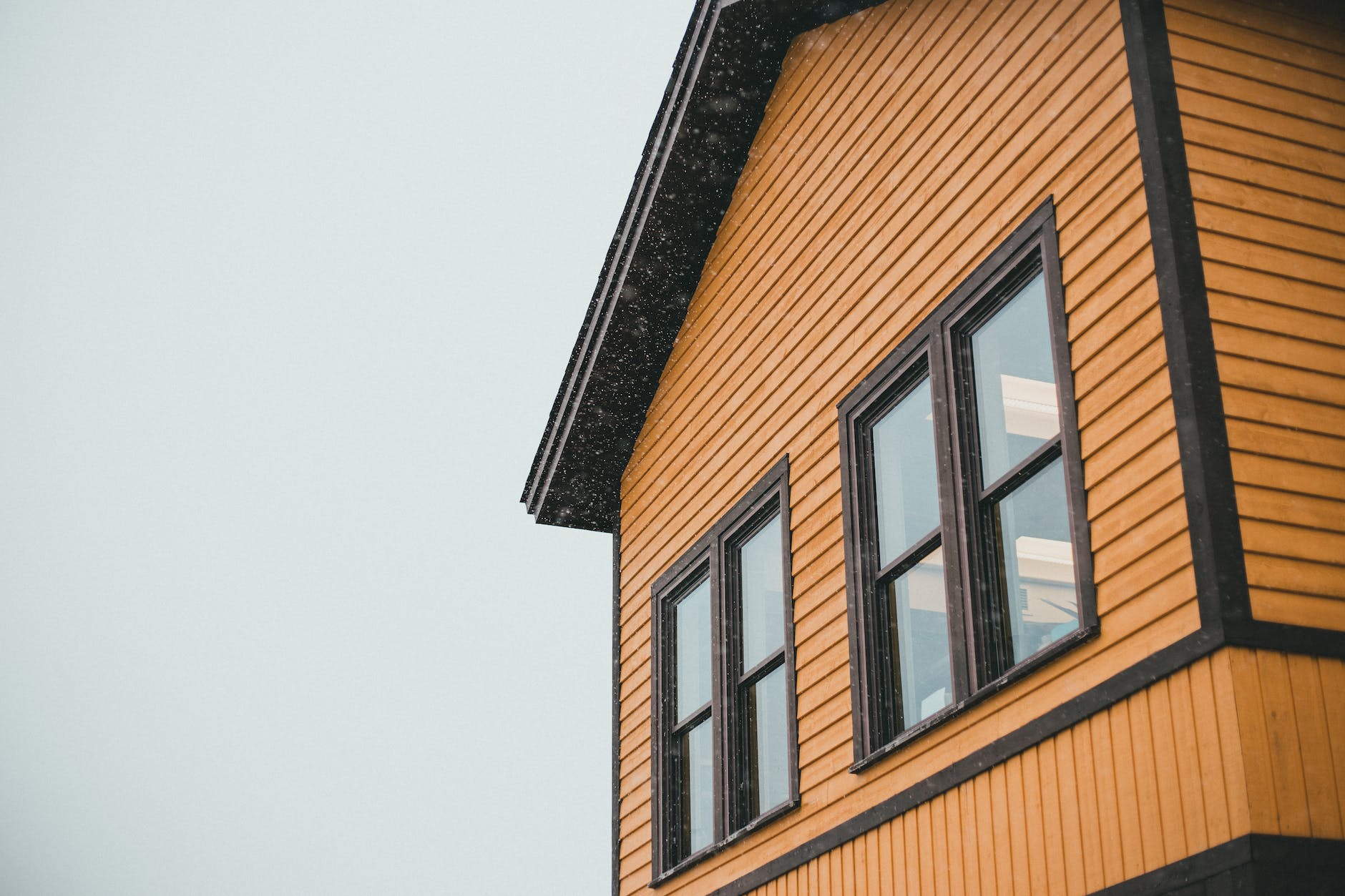
Photo by Erik Mclean on Pexels.com

This post-agrarian look is the defining style of the current era — dominating renovations, new construction and subdivisions in communities with no connection to farming, with interiors that have open concept floor plans, wide plank wood floors, plenty of shiplap, and kitchens with apron sinks and floating shelves made of reclaimed wood. Even multifamily homes are getting the modern farmhouse treatment, falling into the barndominium category, as they embrace vertical siding, gables and tin roofs, giving a folksy nod to apartment complexes…

Modern farmhouse, a contemporary style that bears a passing resemblance to a traditional farmhouse, first entered the American lexicon a decade ago on “Fixer Upper,” the HGTV sensation that catapulted the hosts, Chip and Joanna Gaines, onto the national stage, and persuaded homeowners to decorate their walls with enormous clocks and word art proclaiming the banal — Family! Eat! Coffee!…

The National Association of Home Builders does not track the popularity of the style. But Deryl Patterson, the president of Housing Design Matters, which designs homes for builders, says the look accounts for more than a quarter of her company’s work. “If a builder says, ‘I need three elevations,’ one will always be modern farmhouse,” she said…

Now, at a moment when populism has taken hold amid deep political divisions, the style of the day is one that imagines a romanticized and fantastical agrarian past — a real farmhouse doesn’t have a walk-in shower with a waterfall showerhead or a sliding barn door to hide a well-appointed laundry room with a weathered placard that says “wash and dry.” As the country grapples with existential questions about its identity and its future, the house of choice makes you think about spinning wool into yarn.

Several thoughts come to mind:

-The suggestion here is that housing design trends come in waves. The McMansions of the 1990s and early 2000s have largely come and gone. They are driven by social, cultural, and economic changes. What comes after modern farmhouse? (Just as an example of a housing style that has not had such a large wave, modernist structures have had their proponents for decades and have not caught on in a large way – even if elements end up in new homes today).

-The connection in the headline to McMansions means that homes in this style may not be long-lasting. Is the quality of the modern farmhouse in question? Are they just imitating other homes?

-The nod to an agrarian past is connected to real occupational patterns. For example, in the early 1900s, more than 30% of Americans worked in agriculture. Not so much any longer.

-How much of this is driven by particular real estate owners? The examples in this story involve fairly expensive homes and renovations. HGTV appeals to particular audiences. There are examples in this story of less expensive modern farmhouse items but purchasing a modern farmhouse can require a lot of resources.

We will see how many modern farmhouses are built and/or created and what then happens to them down the road.


Large (fake) animals trying to get into buildings

The first thing I saw on a recent visit to The Children’s Museum of Indianapolis was this:

Seeing this reminded me of this:

I am in favor of both of these for multiple reasons:

-They are whimsical. This is public art but somewhat absurd and fun art. They liven up existing spaces. Both of the buildings above are glass, modernist structures and the animals are a good complement for the style.

-They are unusual. How often does a giant animal appear in these situations? They catch your attention, both outside and inside.

-They are memorable. Museums and convention centers have a certain feel about them. These creatures are a memory in themselves, helping the building and setting to stand out. (They were not created for this reason but these are certainly selfie and social media opportunities.)

All that said, if animals like these were everywhere, they would not be as worthwhile. Take the painted cows campaign in Chicago years ago: it works well once or twice but when lots of communities try it with lots of animals, it becomes less memorable.

Barbie’s DreamHouses and American houses

A new book shows how the Barbie DreamHouse changed over time:

The monograph, which the publishers say is “the first architectural survey of the world’s best-selling dollhouse”, features glossy images of the houses captured by fashion photographer Evelyn Pustka, alongside detailed architectural drawings…

The homes themselves range from contemporary influencer houses all the way back to the mid-century bungalow of the 60s.

In this way, the book establishes the Dreamhouse as an early example of homes turning from private domains into a means of expressing and performing our personality for others – alongside the Eames house, the Playboy apartments and Jackie Kennedy’s televised tour of the White House in 1962…

“So there’s this bifurcation where the Dreamhouse is more in conversation with McMansions, which might reference postmodern architecture but lose the kind of ironic quoting involved in using Doric columns.”

The emphasis here seems to be on how the Barbie homes reflected architectural styles. However, how much did these toys shape architectural styles? As people played with these houses, how did it change their perceptions of houses? This might be difficult to ascertain but presentations of homes and what is normal or aspirational can help shape what people expect.

A question: have any constructed houses been inspired by the Barbie DreamHouses? This could be another signal of how Barbie has affected homes.

Set up the millennials in a McMansion for a horror film

The recently released film Bodies Bodies Bodies takes place in a McMansion:

Photo by Elu012bna Aru0101ja on Pexels.com

What happens to a group of vapid, bored, rich gen Z-ers/millennials holed up in a McMansion during hurricane season when the wi-fi goes out?

If the film Bodies Bodies Bodies is anything to go by, they’ll probably end up killing each other — unless someone else does it first.

While some might say the McMansion itself is a horror, McMansions are no stranger to horror stories. How exactly might a horror film involve a McMansion? A few ideas:

-This particular film follows 7 friends. This means plenty of space for people to sleep, live, and interact. A McMansion provides plenty of space.

-The tackiness or gaudiness or lack of authenticity of a McMansion can provide a creepy or unsettling backdrop.

-The McMansion falls apart at a key moment or the limited architectural quality lets the characters down.

-The extra interior square footage a McMansion offers provides more space for nefarious actors to operate.

-The McMansion could be set in a neighborhood of McMansions, perhaps unfinished, that are all creepy and ominous.

A horror film set in suburbia can play off a common idea that suburban life is not as happy or successful as it seems. How much more so could this be true in a McMansion, a home that tries to broadcast its success in obvious ways.

Combine a horror film with the negative traits of a McMansion and there are plenty of options!

Linking “newness” in a home with particular materials, styles

The impression of “newness” in a home is connected to particular updates and items:

Photo by Curtis Adams on Pexels.com

But not simply any new floors and counters will create the desired effect. The feeling of newness is largely relative, and the only real key to creating it is banishing the things that people expect to see in a dwelling built decades ago—“landlord beige” walls, all-white appliances, dingy carpet, laminate counters, wood so warm-toned it’s practically orange. Gray floors and all of their comorbid design phenomena are cool and crisp and modern by comparison, even if they’re also crushingly boring and totally character-free and really limit a space’s potential capacity to feel warm and alive and like a home.

And the purpose of these changes is to sell properties:

In theory, the things that make up the interior of your home should be either beautiful or useful; if you’re lucky, they’ll be both. And surely some people do lose their mind for gray laminate or subway tile or barn doors, and not just because there’s no accounting for taste. Once a particular design element becomes a shorthand for newness and freshness and successful domesticity, people come around to it precisely because they want their home to reflect those qualities. But that’s a different phenomenon than appreciation for the thing itself—for how nice it is to look at, or how much more functional it makes a space. In the hands of flippers and landlords, these choices are generally made not by people who want to fill the world with the best, safest, most comfortable homes possible but by those looking for a return on the bets they’ve made on the place where you’ll start your family or play with your future grandkids. They’ve chosen these things just as much for what they aren’t as for what they are—inoffensive, inexpensive, innocuous. These houses aren’t necessarily designed to be lived in. They’re designed to go into contract.

I wonder if this process mirrors that of the fashion industry and other culture industries. The production, sale, and popularity of created works and objects moves in waves and trends. Not too long ago, homes featured granite countertops and stainless steel appliances; now it is subway tile and grey floors; shortly it will be something else. Or, formal living rooms were a thing to open concept to providing smaller spaces to enable working from home. The key for those who want to make and sell properties is to appear on trend or close to it.

A related argument: homeowners and sellers exhibit their investment, emotional and economically, in a property by updating it to more recent trends. They show that they care about the home fitting in a new era rather than being left behind. It can suit a new family just as well as it did its original occupants.

Would it be possible to signal newness in different ways? A particular smell? How the occupants use the space? Altered infrastructure (ranging from new furnaces or electrical systems to greener options)? Integrating the Internet, screens, and sounds?

Summing up the environmental issues McMansions present

Australian architect and artist Mathieu Gallois working with several groups described the negative environmental consequences of McMansions:

Photo by Frans van Heerden on Pexels.com

The project organisers made the following conclusions about McMansions: “the brick veneer construction’s thermal performance is poor and inappropriate for Australia’s hot climatic conditions; the foundations are laid on a large concert slab that possess high levels of embodied energy; the terracotta tiled roof’s thermal performance is poor and inappropriate for the Australian climate; the aluminium window frames have a high level of embodied energy and their thermal performance is poor; the window glazing is of a poor level, as is its thermal performance; the PVC plumbing has a high embodied energy; the steel lintels have a high embodied energy and represent lazy design solutions”.

On this basis they argued that “Australian brick veneer homes are the biggest and most poorly designed built homes in the developed world; too big, not built to be recycled, not responsive to climatic conditions, not built for future adaptability, with poor cross ventilation. Moreover, such houses are designed to face the street rather than being orientated to maximise the site’s positive climatic engagement; their multi-faceted roofs do not optimise or facilitate the provision of PV panels or solar HWS; their roofs do not harvest rainwater; the stairwells are not sealable; and the rooms and living spaces are generic, unresponsive to different seasonal climatic conditions”.

That is a negative assessment, particularly compared to how homes might be constructed in a greener manner.

Just thinking about these negative environmental consequences, I wonder if it is possible to create a greener McMansion that roughly keeps the size, architecture, and price that a decent number of Americans and Australians are willing to buy. Could strategic choices be made to make a significantly greener home without too many alterations? This would provide a different product and help address concerns some might have about McMansions.

Kanye West does not like McMansions

I missed this information from two years ago; here is what Kanye West thinks about McMansions.

Photo by Thirdman on Pexels.com

The “YZY SHLRS” are not West’s first try at real estate development. Together with his wife Kim Kardashian West, the rapper transformed a McMansion in suburban Los Angeles into a cavernous, eclectic abode that has since unfolded on the covers of several esteemed magazines.

Earlier this year, Architectural Digest described the Wests’ residence as “one of the most fascinating, otherworldly, and, yes, strange pieces of domestic architecture on the planet.”

Characterized by clear, geometrical lines and white open spaces, filled with equally futuristic furniture, the home resembles a modern-day spin on a Belgian monastery, as West told AD.

The standout nature of the home, a reflection of West’s highly individualistic style, is not a surprise given the rapper’s annoyance with luxury properties that, despite their own embellishments, more often than not come off as the products of the same mold.

“The relationships that I have with architects, my understanding of sacred proportions, this new vibe, this new energy,” is what is driving West, the real estate developer. “I am tired of McMansions,” he told Charlamagne tha God. “That is wack. Everybody’s house is wack.”

His critique of McMansions and large homes is a common one: they are produced with similar features and styles. West hints that this is even the case at the level of home above McMansions where more resources does not necessarily translate into unique or quality homes. You can purchase a very expensive property and it may not be interesting or suit the particular needs of the residents.

At the same time, with his wealth and connections, West operates at a level beyond the typical McMansion owner. He has the resources to transform a large home based on a new vision. Mansion as monastery, as it were. He can pursue a particular plan and mold the home in ways that many McMansion owners cannot.

Now, if someone with fame and resources could help find a way to transform McMansions or relatively large houses (think 3,000-6,000 square feet) in the ways that West wants, this could help change the image of such homes. I imagine many McMansions owners would be interested in the idea of “sacred proportions” in their homes or differentiating their residences in significant ways from neighbors.

It cannot be a McMansion if it is valued at over $30 million and has mansion features

Actor Chris Hemsworth has turned a big home into an even bigger and more luxurious home in recent years. Is it a McMansion?

Photo by Lex Photography on Pexels.com

After buying his Byron Bay family home for $7million back in 2014, Chris, 37, transformed the sprawling property into a compound that has been valued at between $30million and $60million.

The actor carried out extensive renovations on the six-bedroom home, and it now boasts a steam room, gym, media room and games room.

There’s also a stunning outdoor living area, play areas for his three young kids and a 50-metre rooftop infinity pool, which overlooks the ocean…

Angry neighbours were quick to say the rebuild reminded them of a suburban shopping centre, a refurbished RSL club or a regional airport terminal.

Others compared the home, which sits on 4.2 hectares, to a multi-storey car park and a ‘McMansion’.

While there is no mention of the square footage of the home, this description suggests this home is a mansion. Here are several reasons why: it likely has more space that a spacious McMansion (imagine 3,000-6,000 square feet there); it is not a mass-produced, cookie cutter home; it has numerous luxury features; it is not owned or renovated by a regular wealthy person but rather a global film star.

So why would a neighbor call it a McMansion instead of a mansion? I would guess that this was done to link the home to a pejorative term and to critique the architectural style of the home. A “mansion” could still be critiqued but the negative connotations are implied in McMansion. The other descriptions by neighbors have to do with the architectural style of the home, whether they are viewed as ugly or not consistent with the surroundings.

Is there a lesson in this? Here is one option: to fight the big home in the neighborhood, call it a McMansion. Label it a mansion and it might just justify the size, features, and architecture.

If you replace a suburban colonial with “a very modern house” rather than a McMansion, is this a win?

A profile a recent teardown in Bethesda, Maryland highlights that the new structure is not a McMansion:

Teardowns can often raise concerns in established neighborhoods when a McMansion suddenly arises in a collection of bungalows. The design team didn’t want that to happen. “We didn’t want it to look like a UFO just landed in their yard,” Bloomberg says. “We looked at scale, proportion and massing.”

This quote above highlights what the new home is: it is has better scale, proportion, and massing compared to McMansions which tend to get these wrong. It was designed by an architectural firm rather than builders.

The best text description of the new home is this paragraph:

“Everything feels very scaled,” Bloomberg says. “It has a warmth to it even though it’s a very modern house – there [is] lots of wood, which helps make it very warm and welcoming.”

The pictures of the interior reinforce this description: it is a more modern structure.

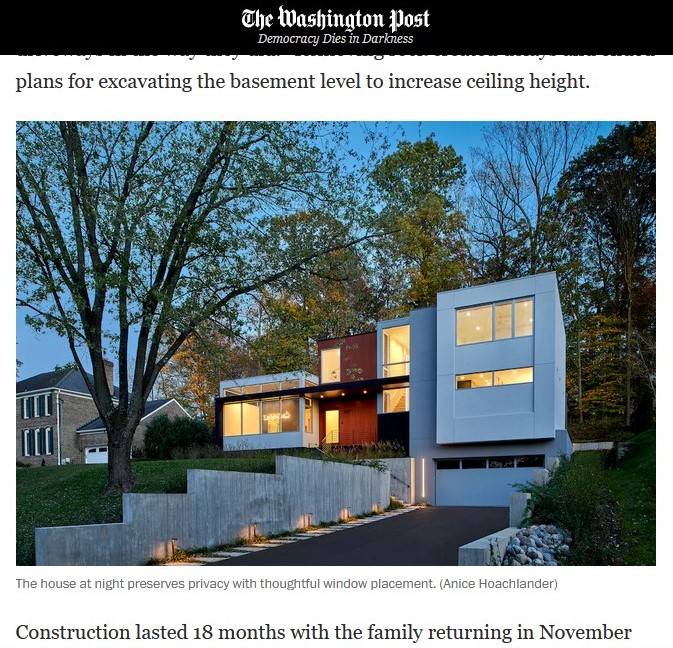
But, one picture early on in the article hints at a contrast between the new home and the neighbor:

The teardown does not appear to be that much different in size than the neighbor but it certainly presents a different style of home compared to the brick and shuttered Colonial. Teardown McMansions are often criticized not fitting in with the existing style of homes.

I have asked before: would Americans prefer to live next to a McMansion or a modernist home? The article says “there has been no neighborhood backlash” to this new teardown. Now, what happens if a teardown McMansion goes up next to this modern home…

Prefabricated McMansions

A debate in Rhode Island about what counts as an affordable housing unit included this suggestion about prefabricated McMansions:

Photo by Mike B on Pexels.com

But although the state’s definition of manufactured home could include a prefabricated McMansion, House spokesman Larry Berman said the bill requires units to qualify under the U.S. Department of Housing and Urban Development definition of manufactured homes, which is much narrower.

I wonder (a) how many prefabricated homes might qualify as McMansions and (b) how a prefabricated home fits with the critiques of the poor construction and/or architectural quality of McMansions.

On the first point, I imagine most prefabricated homeowners are not intending to create a McMansion. It is possible, but I do not imagine there are many prefabricated McMansions. If they do exist in sizable numbers, I would be interested to see them.

On the second issue, would a prefabricated home be a better construction choice compared to concerns some have with mass production builders? Or, could prefabricated homes successfully address the architectural issues of McMansions such as too many gables, poor proportions, and a mishmash of styles? I do not know how more expensive prefabricated homes rate in terms of quality and I suppose prefabricated homes could look like anything.

If the number of prefabricated homes in the United States increases, some might be McMansions or some might be the new McMansions in what could be a fluid term.