Oak Brook is a diverse community, welcoming to everyone except criminals. We’re open for business!
A little bit more on each of the three pieces of diversity, welcomes, and business activity.
Regarding diversity, the U.S. Census Bureau QuickFacts say the community of just over 8,000 residents is 61.8% white, 30.3% Asian, 4.5% Hispanic or Latino, and 0.6% Black or African American. The median household income is $146,409, the median housing value of owner-occupied units is over $801,000, and the poverty rate is 4.9%.
Many suburbs say they are welcoming and few, if any, would say they welcome criminals.
The community has plenty of business activity as it is home to Oakbrook Center and numerous offices along I-88.
Is this formula – diversity + welcoming + business – the secret to suburban community success? Or, is this a viewpoint from suburbs with certain features and character?
A new large plot of land may soon be available in the middle of Lake County, Illinois. What should go there? Here is an early idea:
The family that owns the Chicago Blackhawks wants to turn more than 700 acres of farmland it owns near Mundelein into a housing, commercial and industrial development, village officials confirmed.
If the Wirtz family’s vision becomes reality, the land would be annexed into Mundelein and become the largest development by acreage in Lake County, Village Administrator Eric Guenther said.
“This is a big deal,” Guenther said. “(It) could prove to be a very extraordinary development for Mundelein, the Wirtz family and Lake County as a whole.”…
Guenther declined to detail the family’s specific plans for the land. They will be unveiled to the public at the village board’s Dec. 12 meeting.
Given what I have seen regarding suburban development, here are some of the steps to come and the common responses from involved actors:
The landowners will bring a plan to the municipality that maximizes or at least includes a lot of profit through developing the land.
The Village of Mundelein will receive the proposal and work on it through elected and appointed officials plus professional staff.
There will be public hearings regarding the property and proposed plans.
Community residents will chime in with a variety of concerns, including regarding traffic and noise. The local school district and other actors will wonder how new development will affect local services and amenities. The village will want to consider the tax base on how the tax revenues add up from such a property. Some actor(s) will propose keeping the property or part of it as green space.
There will be some negotiations between the developers and the community. This could go relatively quick or slowly, depending on the changes asked for and the vision of the developers. They could happen behind the scenes or be more visible to the public.
Roughly 1-2 years from now a plan will be in place and development can start.
Each of these steps could proceed differently with the potential for plans to move more quickly or more slowly. There is no guarantee that the proposed project will go forward.
However, given the size of this parcel, there will be a lot of interest from everyone about what happens with this land and how this might affect Mundelein – whether it is the community’s character, revenues, or land use – for decades to comes.
A “bridesmaid suburb” is a second-choice postcode and could become a strategic buying trend as ballooning interest rates bite into borrowing capacity…
“Buyers will still have to consider alternatives or the bridesmaid suburbs to their first preference, possibly not because of price but because of diminished borrowing capacity.
”Bridesmaid suburbs are adjacent to higher-profile neighbouring suburbs. They cost less to buy into but share many similarities to the first-pick suburb next door, including access to public transport routes, schools and major shopping hubs…
“A bridesmaid suburb can still allow you to secure a lifestyle with comparable amenities and appeal, and only a short drive down the road.”
While this is used in Australia- a quick Google search suggests this term has been around there for several years – I wonder if it might also apply to suburbs in the United States. Are there many homeowners who would have preferred to live in the most desirable suburb but could not afford it and so settled in nearby communities? There are several assumptions at work here:
Many people want to live in the most desirable suburbs. If supply and demand is the only factor at work, more people wanting to live in desirable suburbs drives up home prices so much that there is not enough housing. Additionally, my own sense of American suburbs is that some of the most desirable and exclusive suburbs also intentionally limit their housing supply to help maintain their character and status. Are there such suburbs that always stand out above any other location in the region and where most people would want to live?
Suburban homeowners want to max out their borrowing capacity and get the most they can – a more expensive home – through their mortgage. People can borrow up to a certain point decided by lenders, but how many go all the way to the maximum allowed?
The exact community in which you live matters less than the clusters of suburban communities you can access. It is less about a particular zip code and more about a cluster of adjacent zip codes. Suburbia offers driving access to a lot of communities so perhaps you do not have to live in a particular place to enjoy the benefits. At the same time, communities that appear similar on certain factors can be quite different in terms of character and everyday experiences.
“Probably the strongest work ethic of laborers is the folks in the Midwest,” the Houston-based founder of SparrowHawk Real Estate Strategists said, definitely not rhyming. “They’re just, I don’t know what they put in the water there, but they’re hard workers. And so you’ve got a good labor force.”…
Illinois Manufacturing Association president and CEO Mark Denzler recalls a businesswoman who recently moved her small manufacturing operations of about 50-70 workers to Mississippi with the goal of saving on costs. She regrets the decision, he said…
“When I’m around the warehouse workers in the Midwest — Chicago and all these other Midwestern cities — they’re different than the folks in the southeast and the folks in the West Coast. They just have a different work ethic,” he said…
“It would be really hard. I’d be suspicious of anybody who said they can do it,” Bruno said. “But there is this strong experience with work in the Midwest that it’s part of your development. It’s connected to your health and well-being.”
Contrary to the final paragraph above, I bet this could be measured. But, what would it show? And how would workers in Boston or New York City or Atlanta or San Francisco respond to the argument that Chicago workers have a stronger work ethic? Or, within the Midwest and Rust Belt, how about workers in Milwaukee, Cleveland, or Pittsburgh?
This is part of a bigger narrative about Chicago. it is part of its character. Even as it is a global city with an important finance sector and many professional and white-collar workers, it imagines itself as a blue-collar city relying on manufacturing. The loss of manufacturing jobs in the last sixty years hit Chicago hard, as it did many cities, yet the narrative continues.
I would be interested in a more recent study that looks at how residents of the Chicago area think about the purported work ethic. Does the narrative hold across locations, groups, and occupations? Does the idea of “the city that works” extend throughout the region and different kinds of workers?
In recent weeks, the Bolger family, which owns the Gladstone Ridge horse farm on Leask Lane in Wheaton, asked area homebuilders for bids to develop the property. And on Tuesday, the Forest Preserve District’s board voted unanimously to authorize district staff to pursue negotiations with the Bolger family to buy the horse farm.
While no purchase price has yet been determined, some recently developed subdivisions in the immediate vicinity have sold for between $275,000 and close to $500,000 an acre, suggesting that the Bolger family could expect to reap between about $10 million and $17 million for the land from a developer…
“We have not expressed an interest in selling the property to the Forest Preserve (District) and hope you are not of a mind to condemn our property,” she told commissioners. “Please value the rights of our private property and practice open communication.” Forest preserve districts use condemnation to purchase land through eminent domain…
Forest Preserve District officials haven’t yet said publicly if they would consider using condemnation powers to acquire the farm now if they are unable to reach an agreement with the Bolger family. And Wheaton officials said that they have not yet been approached by a developer seeking to develop the Bolgers’ land.
This is different than noting decades ago that the last farms were disappearing from DuPage County. At that point, the farms disappeared to new subdivisions that continued the process of mass suburbanization. Redeveloping a horse farm or an office park or another large property now is different: it does not occur under conditions of mass construction, there are neighbors to the property who likely have concerns, and municipalities and other government agencies think carefully about what the next use for a property could be. The character of the nearby neighborhoods and communities are already established yet a sizable redevelopment could alter future experiences. In other words, when larger parcels of land are infrequent, the stakes for getting this right may be even higher.
Rather, changes in home price growth, the supply of homes for sale and upticks in rock-bottom interest rates are more likely to stabilize the market after an unpredictable 2021, they said. That likely won’t mean an end to competition or high prices — and it doesn’t bode well for first-time homebuyers — but the market could ease up compared with 2021…
In the nine-county Chicago metro area, the median home sale price from January to November was $300,000, up nearly 12% over the same months in 2020, according to the Illinois Association of Realtors…
Prices are likely to rise next year, but won’t continue the exponential growth of 2021, said Daniel McMillen, head of the Stuart Handler Department of Real Estate at the University of Illinois at Chicago. Without an influx of new residents to the area or big increases in incomes, that growth will become unsustainable, he said…
Homebuyers are continuing to look for amenities like home offices and workout areas, Melbourne said. Kitchens are a priority. Condo-buyers are looking for bigger units, rather than one-bedrooms.
The pressure from COVID-19 moves will hopefully subside. Then, the more regular patterns in Chicago area real estate might take over again. There are at least several interrelated factors:
Uneven development within the region where some neighborhoods and suburbs will be popular and others not. Prices will go up in desirable places.
Construction of new residences has been down. What kind of units will be built? If recent trends hold, it will be housing aimed more at wealthier residents. Additionally, these units will be constructed in some locations and not others.
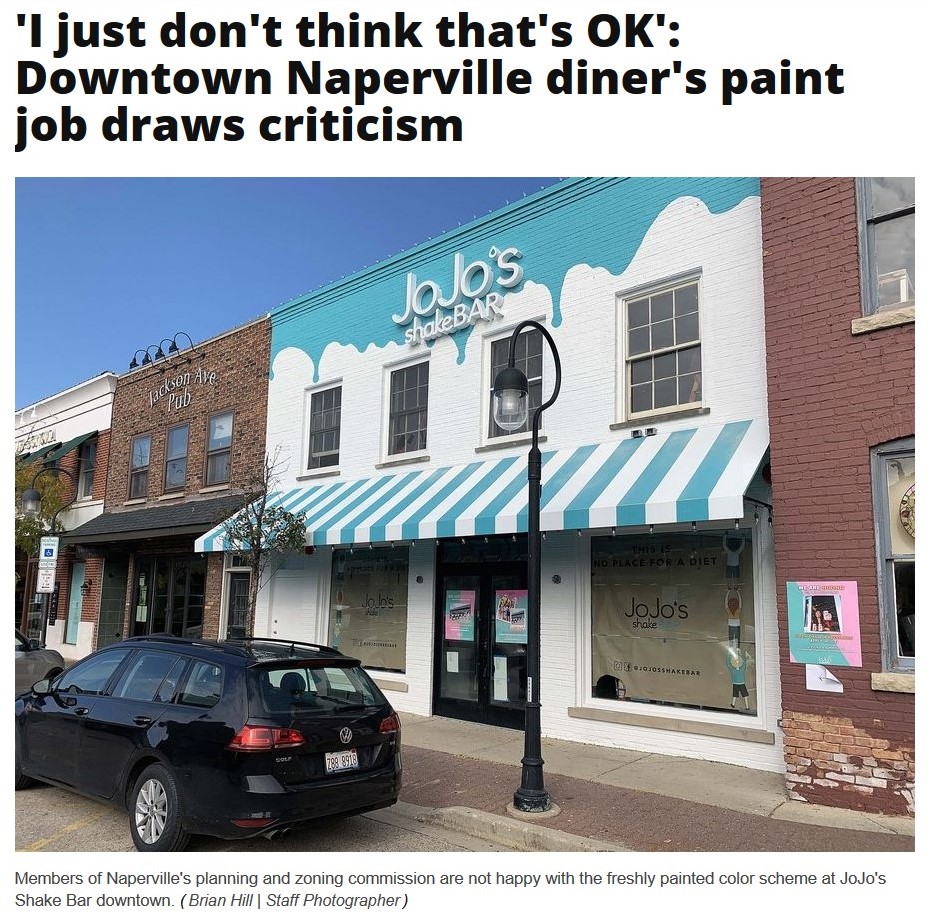
Members of the city’s planning and zoning commission gave a chilly reception to the freshly painted exterior at JoJo’s, a self-described “next generation diner” with milkshakes, milk and cookie flights and diner classics that’s scheduled to open this month at 5 Jackson Ave.
But because JoJo’s adhered to city codes regarding its main color choice and the amount of accent color it used, there’s not much the commission or the city can do except possibly ask JoJo’s to change the facade and create stricter guidelines for the future…
Behind white raised letters reading “JoJo’s Shake Bar” is a turquoise background stretching across the two-story building that looks like dripping ice cream extending down past the top of the second-floor windows.
Commission members said a uniform block of turquoise across the top would have been acceptable. They believe the dripping effect, however, isn’t appropriate for downtown Naperville…
The issue came up at the end of Wednesday’s meeting when Commissioner Anthony Losurdo said he saw the facade while driving by, labeling it a “sore thumb.” Stressing he wouldn’t have approved the look had it been subject to a vote, Losurdo said he has received complaints about the paint scheme from residents.
Many communities have guidelines for signs and facades. This helps create a more uniform look, ensures that no single property sticks out too much from others, and can limit concerns from nearby residents (such as signs that are too bright or too big). The aesthetics help contribute to an overall character the community wants to promote.
Naperville’s downtown is important for the community. With its revival in recent decades, the city is proud of the bustling business and social activity downtown. It wants to both nurture and protect that for the future. The downtown helps the community stand out from other suburbs and generates revenue.
So, protecting the look of downtown buildings makes sense. On the other hand, concerns about this new business could send out other signals. It sounds like JoJo’s followed existing guidelines. The end result may not be what some leaders and residents desire but it was within regulations. This commission is supposed to talk about issues like these; their task is to see how properties align with the city’s guidelines. The regulations can be changed to prevent such outcomes.
Even having an article with a headline like this might contribute to perceptions that Naperville is a snobby place. The appearance of dripping paint is a big problem for the community? Does a negative reaction welcome the new business? Is it helpful to have these conversations through a local newspaper?
It is unclear how many people and leaders in Naperville have concerns with the paint job. Will it soon be changed and/or the regulations updated to avoid a similar case? Or, can one building stand out a little in a successful downtown?
More than 150 years ago, the 19th-century farming community’s prosperity was inextricably tied to its proximity to the railroad line, which served as a trading hub bolstering the town’s agrarian economy. By the 1920s, the community would become home to professionals boarding commuter trains headed to and from the city.
Despite many of those residents working at home these days as a result of the pandemic, the Union Pacific Northwest line dissecting the village of 77,000 residents is still viewed as an economic engine. But Arlington Heights is no longer beholden to the fortunes of Chicago, making the prospect of a Bears stadium in town interesting, yet not essential…
Embracing change has been a recipe for success for the revitalization of downtown Arlington Heights, which like central business districts across the U.S., was languishing in the 1970s and ’80s after mom and pop businesses were devastated by shopping malls and big-box stores, said Charles Witherington-Perkins, the village’s director of planning and community development…
To build the Arlington Heights of today, crafting a new downtown master plan was only the first step. In order to execute the vision, officials needed to loosen building height and density restrictions — stringent regulations that were making it impossible to create an economically and aesthetically vibrant downtown, Witherington-Perkins said…
The contingent of new residents arriving in Arlington Heights — many of whom were commuters attracted to the complex’s proximity to the Metra station — ushered in a surge of downtown residential and retail development that has served as a model for neighboring communities along the Metra line.
Take out the name of Arlington Heights and a few other regional details, and this story might be told for dozens of suburbs in the Chicago region as well as dozens more outside of older American big cities. Here are a few of the common features:
A founding before mass suburbanization. Communities were small, farming was a primary industry, and the railroad was very important for the initial mass of people at that spot.
Mass suburbanization of the twentieth century brought many residents and changes.
Revitalizing suburban downtowns became a priority in the last four decades as competition from shopping malls and strip malls moved business activity away.
This revitalization included adding residential units in denser structures.
As noted elsewhere in this article, these choices about downtown redevelopment often involved choosing more expensive housing units rather than affordable housing. Even when cases went to court (as one did in Arlington Heights), relatively few affordable housing units were created in these denser suburban areas. This leaves Arlington Heights as wealthy and whiter.
This theoretically means the community is more independent from Chicago with its own ecosystem of residential and commercial life downtown and in the suburb.
Does all of this add up to a new state-of-the-art stadium with a multi-billion dollar price tag being constructed in the suburb? That may be a separate issue given how few stadiums are in even large metropolitan areas and the sizable available property at play here.
Is Arlington Heights now truly independent of Chicago and self-sufficient? I would prefer to consider metropolitan regions as a whole as the fate of particular suburbs are connected both to the health of the big city and the suburbs. While a Bears stadium in Arlington Heights will be discussed as a win for the suburb (mostly – as the article notes, some residents oppose it) and a loss for the city of Chicago, the team and the benefits that come with it are still in the region.
Yet, it is worth noting that how the changing suburb understands itself is important. No longer a small farming community, Arlington Heights likely views itself as ambitious and making choices today to help secure its future success. A denser downtown provides a different experience than a bedroom suburb strictly made up of single-family homes. A Bears stadium would put them on the map in a way that few other nearby suburbs could equal. What Arlington Heights is and will be depends on choices made and responses from all of the actors involved.
It is not a coincidence to see two recent articles about effects of growth in Texas communities as this part of the country – and the Sun Belt more broadly – is growing fast. One is the story of a big city where housing is in high demand while the second is a small town that is now a booming suburb.
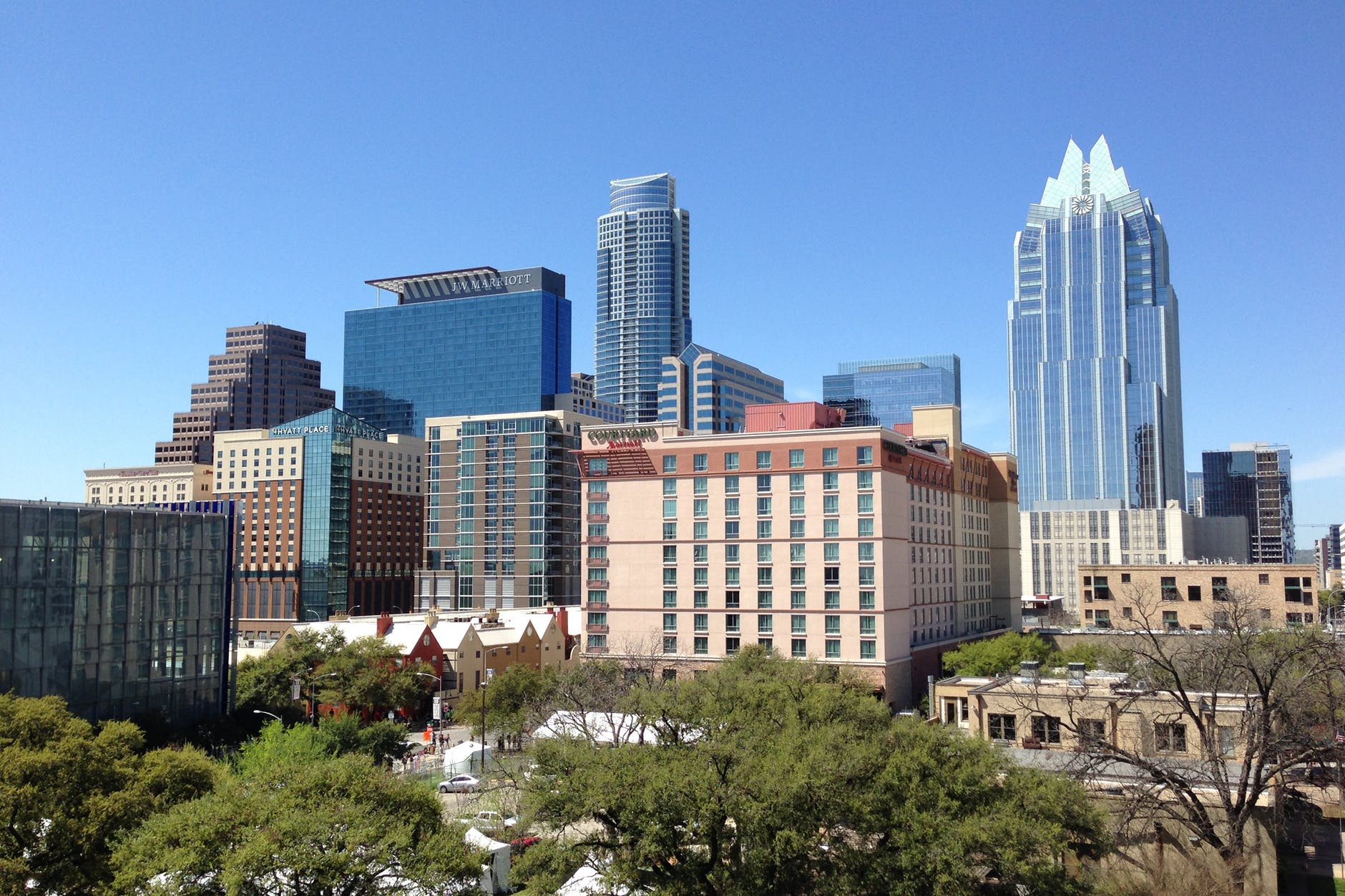
Nearly 2,700 homes in the Texas capital have sold this year for $100,000 or more above their initial listing price, according to an analysis by Redfin Corp. that examined sales through Aug. 11. While a few other U.S. cities have had more properties sell at that premium to the asking price, none have experienced as big a percent rise in homes transacting at that lofty an increase, Redfin said…
The number of homes sold year-over-year for at least $100,000 over asking price has grown nearly 10-fold in Seattle, and fivefold in Oakland, according to Redfin. In Austin, that figure grew by 57 times the number for last year at this time.
The jump in these sales at six figures above the listed price shows how Austin, which has attracted young professionals for years, has become an even more competitive place to buy in recent months.
Today, the cattle are gone, replaced with clusters of sleek apartments, gated communities and big-box stores. And New Braunfels, the third-fastest-growing city in America, tucked in one of the fastest-growing regions, finds itself at a crossroads…
A once quaint town known for its German roots and the Schlitterbahn water park, New Braunfels grew a whopping 56 percent over the last decade, adding about 32,500 residents…
Newer residents to New Braunfels have been drawn to the region for its affordable cost of living and by larger employers who have settled there, including several distribution centers and technology companies. Over the past decade, the median salary has jumped to $90,000 from $65,000 in Comal County, which includes much of New Braunfels, one of the highest averages in the state…
The community has also grown more noticeably diverse, with the presence of Latinos particularly evident on the city’s West Side. Residents flock to eateries like El Norteño for typical Mexican dishes, such as menudo, a spicy stew known colloquially as a hangover remedy. This week, a server took orders wearing a red T-shirt that read “Menudo Para La Cruda” or “Menudo For the Hangover.”
The emphasis on growth is a long-term pattern. When Census data is released, many like to highlight the fastest growing areas of the country. This can shine a spotlight on places that are changing but it also reinforces a consistent American narrative: growth is good for communities. Indeed, discussion of the opposite trend – losing population (or somehow not losing residents) – reinforces the notion that growth is good.
At the same time, focusing on population numbers is worth considering alongside what is happening to the character of communities with population growth or loss. These two articles highlight both phenomena. In Austin, what happens to a local housing market when so much competition drives up prices? At the least, this means some are priced out of the adjusted values, existing community members may see their property values rise, and builders, developers, and local officials respond to the changes. And the rising prices are often interpreted as a sign that Austin is a desirable place to live.
In New Braunfels, this is both a common American story – small town outside big city turns into a sprawling community in a relatively short time – and a story with particular traits as the community has a particular character. The German roots of the community now sit among a more diverse population. A quaint town is now much bigger and there is a lot of building activity. The businesses there for a long time are now joined by new ventures.
Even as population growth is usually viewed as a good thing, it comes with costs and changes. Few communities would reject growth just to avoid change but there can tension over how to respond to growth. Many cities and suburbs have struggled to match their existing character to changes and what the community will end up being once a construction boom and/or sprawling subdivision growth subsides.
Economists believe agglomeration — like the clustering of tech in the Bay Area — has historically been the result of two main forces. The first is what they call “human capital spillovers” — a fancy way of saying that people get smarter and more creative when they’re around other smart and creative people. Think informal conversations, or “serendipitous interactions,” over coffee in the break room or beers at the bar. These interactions, the theory says, are crucial to generating great ideas, and they encourage the incubation and development of brainiac clusters. The other force is the power of “matching” opportunities. When lots of tech firms, workers and investors clustered in Silicon Valley, there were lots more opportunities for productive marriages between them. As a result, companies that wanted to recruit, grow or get acquired often gravitated to places like the Bay Area.
However, remote work could actually improve certain matching possibilities. Companies can hire smart people anywhere in the world when they drop the requirement that they physically be in a central office. Not only that, they can pay them less. Moreover, killing the office can significantly lower costs for companies, which no longer have to pay for expensive real estate.
So, in this theory, the future of work and the economic geography of America really hinges on whether companies can create those “human capital spillovers” through computer screens or in offices in cheaper locations.
This is a phenomenon with a pretty broad reach as cities could be viewed as clusters of firms and organizations. What has been interesting to me in this field in recent years is how places like this come to develop and what it means for the character of the place.
Take Silicon Valley as an example. This is the home of the tech industry and, as the article notes, the big firms have committed to physically being there with large headquarters (including Google, Apple, and Facebook). These headquarters and office parks are themselves interesting and often a post-World War Two phenomena as highways and suburbanization brought many companies out of downtowns to more sprawling campuses. At the same time, the impact of all of this on the communities nearby is also important. What happens when the interests of the big tech company and the community collide (see a recent example of a Facebook mixed-use proposal)? What did these communities used to be like and what are they?
This is bigger than just the idea of employees working from home. This potential shift away from clustering would affect places themselves and how they are experienced. If thousands of workers are no longer in Silicon Valley, what does this do to those communities and the communities in which more workers are now at home? Silicon Valley became something unique with this tech activity but it could be a very different kind of place in several decades if there is new activity and new residents.
The same could be said for many other communities. What is New York City if Wall Street and the finance industry clusters elsewhere or disperses across the globe? What happens to Los Angeles if Hollywood disperses? And so on. The character of places depends in part on these clusters, their size, and their history. If the agglomerations shift, so will the character of communities.






 Legally Sociable