McMansions as short-term rentals, fake images of downtown Chicago, and news about housing

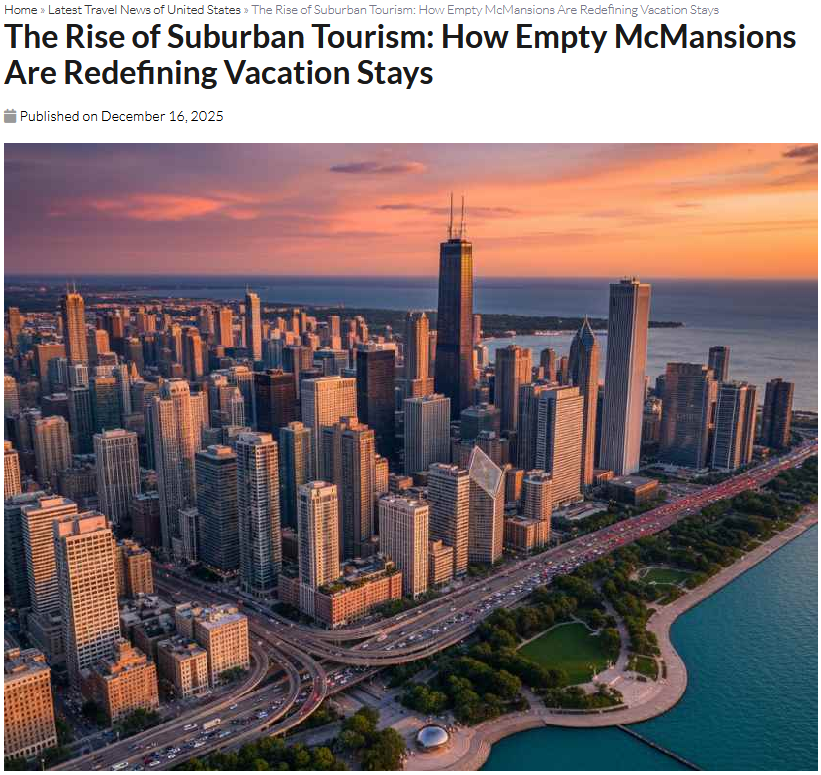
I search regularly for interesting news about McMansions. I recently ran across a headline that seemed plausible: “The Rise of Suburban Tourism: How Empty McMansions Are Redefining Vacation Stays.” But the headline was paired with a particular picture:

Image at link

I am familiar with the Chicago skyline and lakefront. This image is…interesting. It has elements of the Chicago lakefront. A big body of water. Some iconic buildings. The Bean. Jean Baptiste Pointe du Sable Lake Shore Drive and parks along the water.

But it is also clearly wrong. The buildings are not where they should be. The lakefront is not in the right pattern. The Bean is not located on a pedestal next to the water. The local highway does not empty onto the lakefront road in that manner. And so on.

So is the McMansion story true? The summary/conclusion:

Empty McMansions in the suburbs of the United States are reshaping tourism patterns, with many tourists now seeking more dynamic urban destinations. However, these empty homes also present new opportunities for suburban areas to adjust and offer new experiences for visitors. Through creative uses of space, a focus on sustainable tourism, and rebranding efforts, suburban regions can continue to evolve as attractive destinations for a new generation of travelers.

Are more McMansions being rented out? Is this changing tourism patterns in metropolitan regions? is there any evidence of this happening? There is little in the story to provide evidence for the argument.

I will keep my eyes open for similar news but the fake image of Chicago does not inspire confidence.

Schwinn once an important Chicago company but the industry and the world changed

A look at a new documentary on the bicycle company Schwinn tells of how it was once a Chicago company and then it was not:

Photo by Jess Loiterton on Pexels.com

The story starts in 1895, when German immigrants Ignaz Schwinn and Adolph Arnold founded Arnold, Schwinn & Co. in Chicago. Schwinn would subsequently buy out his partner and build an enduring family business that would reign over the bicycle industry for generations, surviving the rise of the automobile, the Depression and two world wars.

In fact, the original six-story Schwinn factory at Lake and Peoria streets in Fulton Market still stands as a monument to Chicago’s erstwhile bike company, with plans to redevelop the now-vacant building into office space…

As market share dwindled, Schwinn began outsourcing production. By 1983, Schwinn ceased its Chicago manufacturing, laying off 1,800 employees and moving most of its production overseas to Taiwan.

In 1992, struggling with debt, the storied Chicago company filed for Chapter 11 bankruptcy under fourth-generation owner Ed Schwinn…

The bike company has rolled on under a succession of new owners and is now part of Dutch conglomerate Pon, with Schwinn based in Madison, Wisconsin. But the movie focuses on the Chicago glory years, when the Schwinn brand ruled the sidewalks, schoolyards and bike lanes.

This might be the story of a number of companies over the years. They had success with lots of work and new ideas. They rose to become a known and popular brand. But then industries and places changed. People no longer wanted the product in the same way. They moved manufacturing overseas. They hit hard financial times and even though the brand name lives on, it has done so under the ownership of different companies and the company is now based in another city.

And this could also be the story of places. Chicago, like a number of American cities, particularly in the Northeast and Midwest, were centers for manufacturing. American companies produced a lot for decades. And much of that went elsewhere by the end of the twentieth century. Sociologist William Julius Wilson describes these shifts and their effects on neighborhoods in When Work Disappears. The loss of tens of thousands of manufacturing jobs was a hard blow to many cities who struggled to pursue or grow other businesses or industries in subsequent years.

In the big picture, both companies and places go through cycles and lifespans. They do not necessarily continue as they have been, even when they are successful. We tend to like the stories of their rise and it can be harder to wrestle with their falls. But both are part of the human experience.

A railroad merger that would stop Chicago area practice of freight handoffs between railroads

A proposed merger between Union Pacific and Norfolk Southern railroads would end a long practice of railroads meeting in Chicago and then moving their freight from one provider to another:

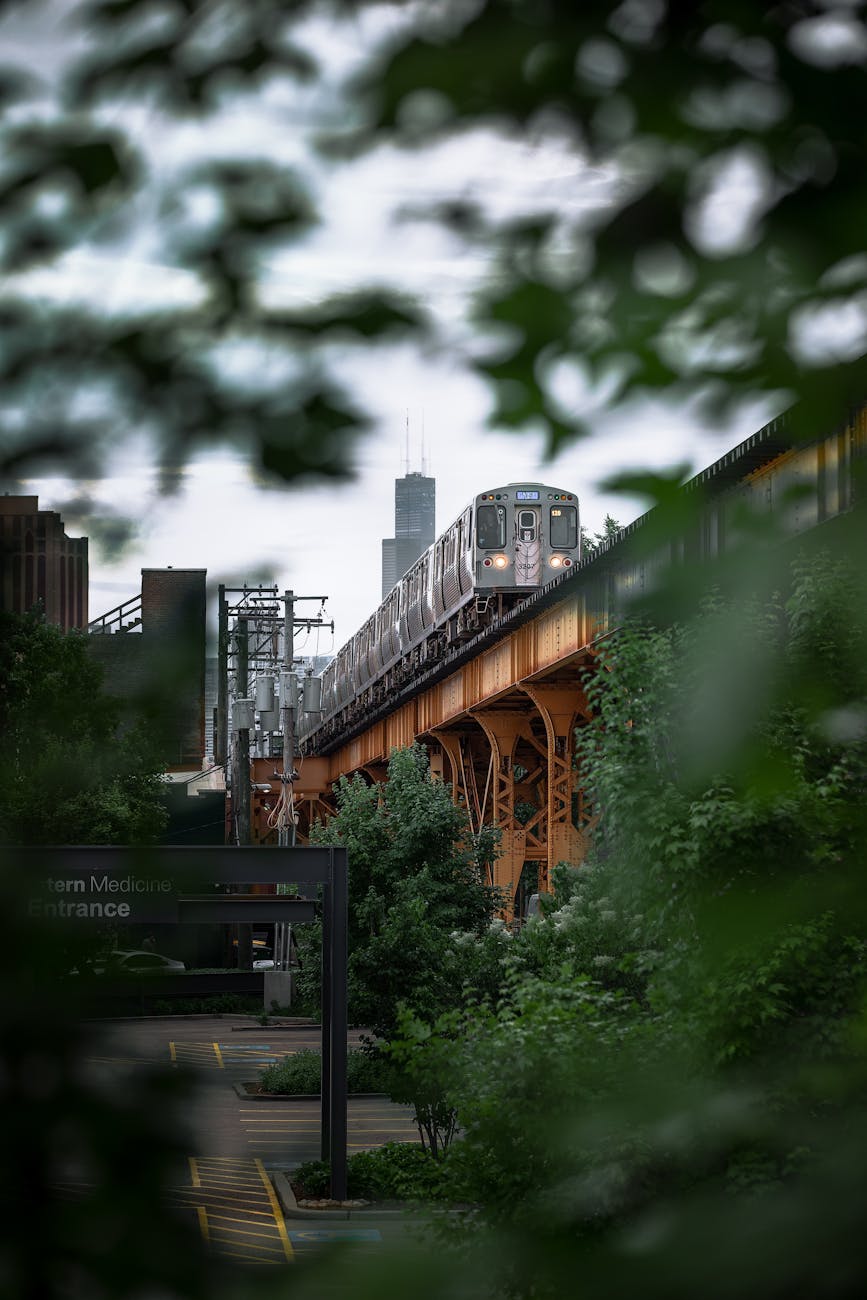
Photo by Blu2221ke on Pexels.com

Starting in 1848, railroads raced to make Chicago the preeminent commercial and financial crossroads between booming factories on the East Coast and voracious markets and vast natural resources in the West.

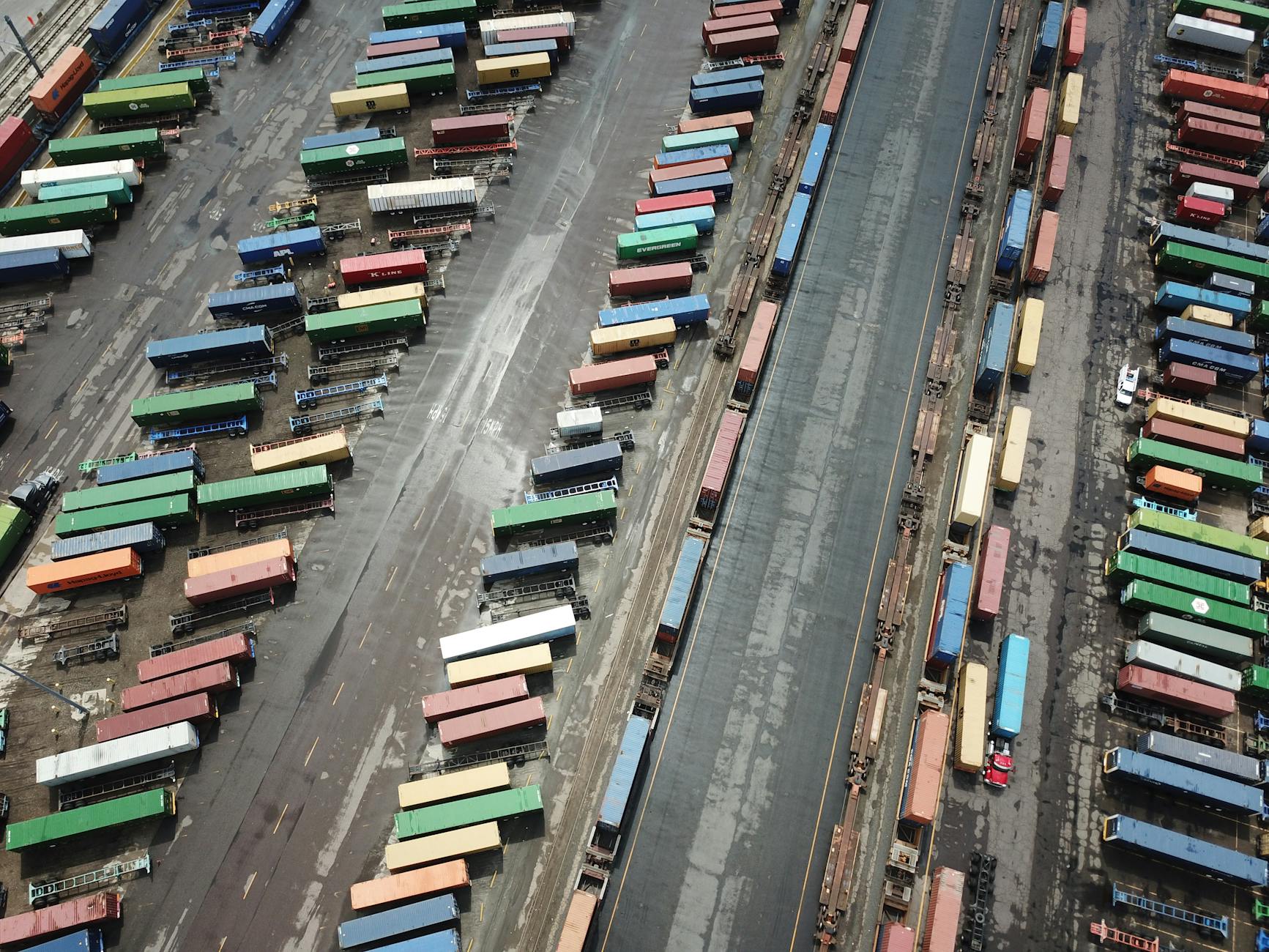
But they always found it easier and cheaper to hand their freight off to each other in and around the city than to build transcontinental railroads that actually passed through Chicago. In some yards, including near McKinley Park 4 miles southwest of downtown, Union Pacific and Norfolk Southern exchange groups of railcars. Elsewhere, they hand off individual shipping containers to each other and to different railroads.

By running a single transcontinental railroad, Union Pacific says it can shave one or two days off the full week that 40-foot shipping containers now spend traveling from Los Angeles to Chicago and then on to, say, the western suburbs of New York City…

With a unified rail network, Union Pacific hopes to eliminate hundreds of rubber-tire container moves each day in and around Chicago, and hundreds more between Chicago and surrounding Midwest cities like Detroit; Columbus, Ohio; and Louisville, Kentucky.

There must be more to this story. How much of this has to do with the history of when railroads were founded and which areas they serviced? How much of this is about the railroad industry and companies working together and/or competing? How much of this is due to policies about railroad mergers?

In many industries, the trend over time does seem to be consolidation among the more powerful actors. This might appear to occur for good reasons, such as being able to ship goods through Chicago from coast to coast on one railroad system. But, as the article notes, this then affects markets, prices, and consumers with fewer companies.

At this point, the railroad industry in the United States is nearing 200 years old (1826 might be the first year of commercial operation). This is a long history compared to numerous other commercial or industrial sectors in the United States. What would it take to truly transform the railroad industry at this point as it operates in a much different context than it did when the first companies were founded? Railroads are an important part of the infrastructure of the United States and making it 200 more years might require foresight and adaptation.

Chicago as the epicenter for the creation of American time zones

When Americans decided on time zones in the late 1800s, where did they gather to formalize the boundaries and clocks? Chicago, a railroad center:

Photo by Crono Viento on Pexels.com

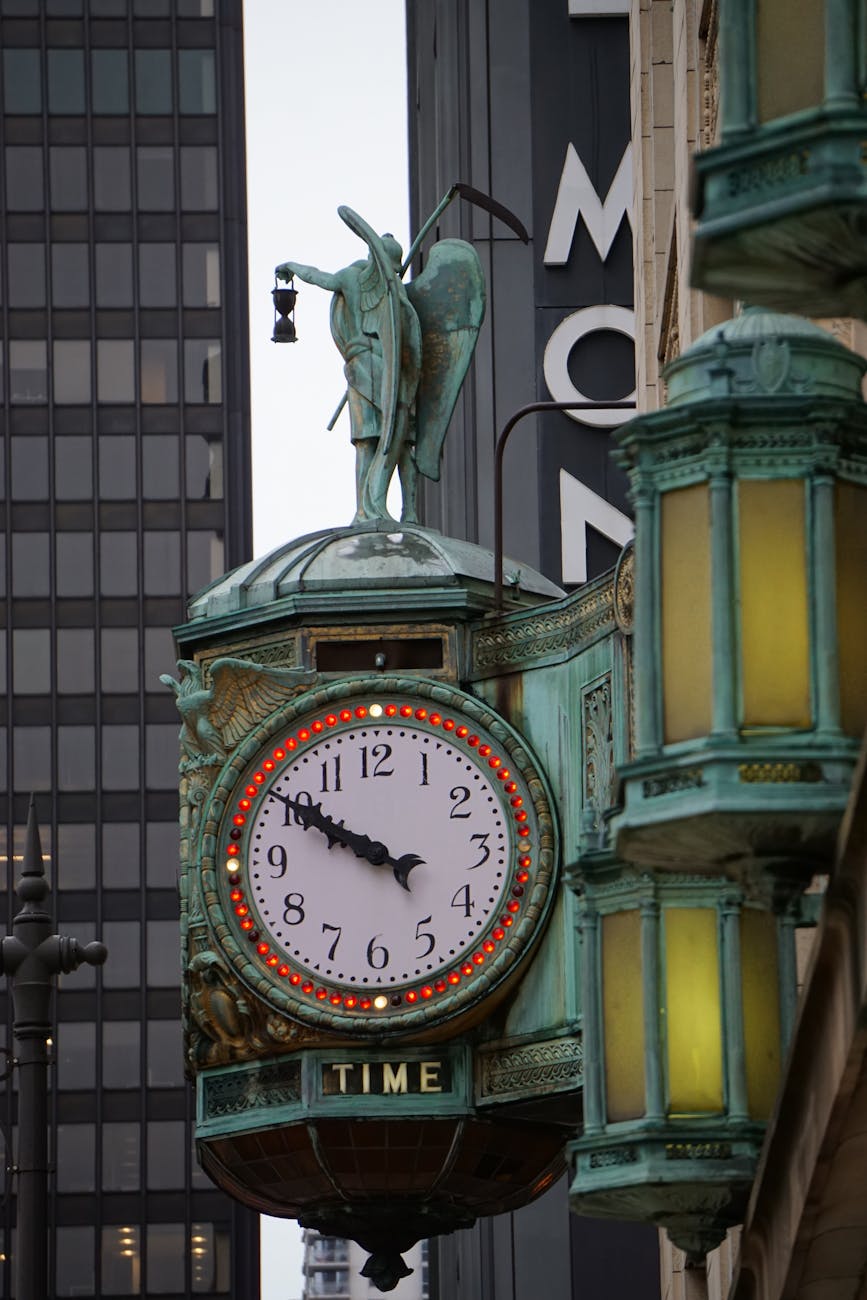
Until 1883, a Chicagoan asked to tell what time it was could give more than one answer and still be correct.

There was local time, determined by the position of the sun at high noon at a centrally located spot in town, usually City Hall. There was also railroad time, which put Columbus, Ohio, six minutes faster than Cincinnati and 19 minutes faster than Chicago. Scattered across the country were 100 different local time zones, and the railroads had some 53 zones of their own.

To do away with the inevitable confusion, the railroads took the matter into their own hands, holding a General Time Convention in the fall of 1883 at the Grand Pacific Hotel at LaSalle Street and Jackson Boulevard. (Today, a plaque at the location — which is just north of the Chicago Board of Trade Building — notes its significance).

Its purpose: to develop a better and more uniform system of railroad scheduling. The Standard Time System — based on the mean solar time at the central meridian of each time zone — was formally inaugurated on Nov. 18, 1883, a day that came to be known as the “Day of Two Noons.”

Another summary of the same story ended this way:

But it was an astonishingly rapid and successful shift, syncing up almost the entire country in the space of a week, with all roads leading back to Chicago.

Three interrelated features of Chicago stand out to me as contributing to being the place where time zones were agreed upon:

  1. A railroad center with numerous major railways running in and through the city and region.
  2. Business leaders, specifically railroad leaders, pushing for standard time zones in order to help their commercial activity. Chicago was a center for commerce and industry.
  3. The ease of getting in and out of Chicago – lots of railroads, central location in the United States – helped facilitate a meeting there.

These features of Chicago still hold today. The city continues to be a railroad center with lots of traffic throughout the region. It is still a business center, a leading global city. And it still serves as a transportation hub. Just as the railroad executives found it a good place to gather, see the number of important meetings that take place near O’Hare Airport, in the city, and throughout the region.

Might such a meeting in 1883 taken place elsewhere? Perhaps. If something as consequential as time zones were to be decided in 2025, which American city might we expect to host the discussion: the political center of Washington, D.C.? The leading global city of New York? The tech capital in San Francisco?

Chicago, a city of (many suburban) neighborhoods

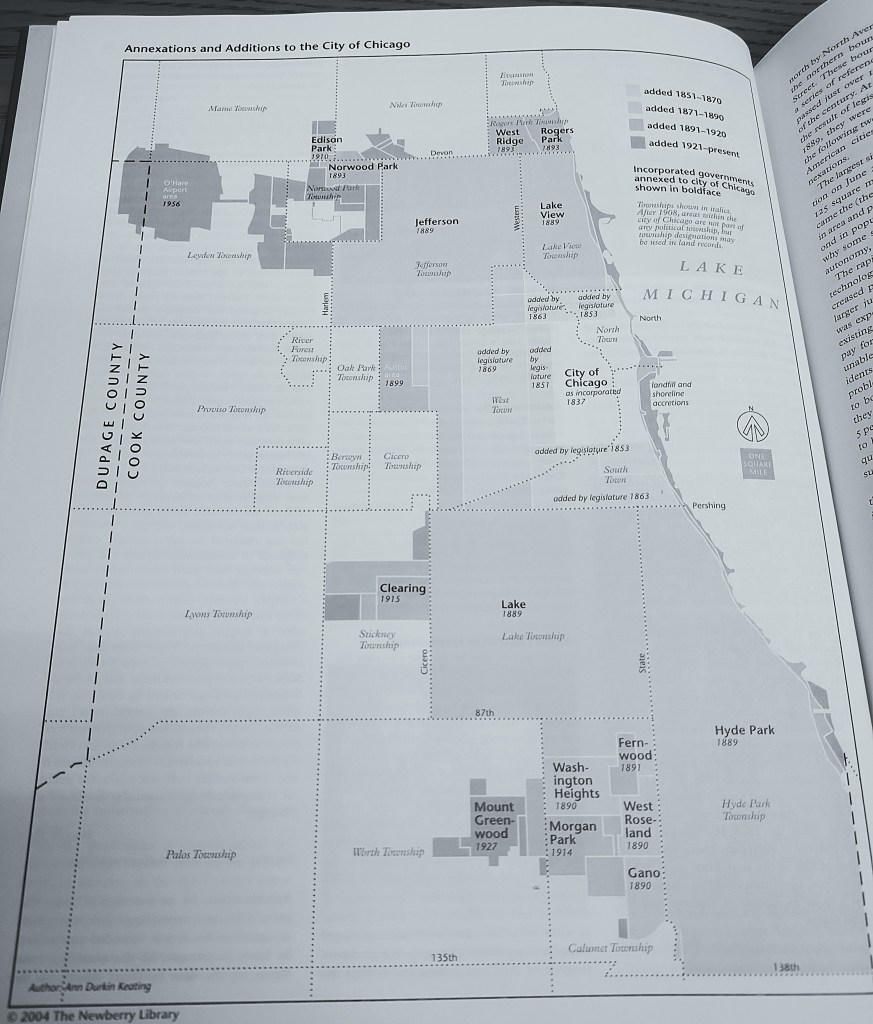
Chicago grew in a way that many American cities have grown: they annexed land and communities just outside their borders. Famously, New York City annexed Brooklyn in 1898 when the separate community across the East River was one of the most populous communities in the United States. But Chicago also had its share of large annexations that helped it add neighborhoods and expand to the borders it has today. The Encyclopedia of Chicago summarizes this process:

The Encyclopedia of Chicago (The University of Chicago Press, 2004), 22

For Chicago, the period of extensive annexations extended from 1851 to 1920. The largest annexation occurred in 1889, when four of five incorporated townships surrounding Chicago (as well as a part of the fifth) were annexed to the city. Most annexations to Chicago during these years came because Chicago offered superior services, from better water connections in the nineteenth century to better high schools in the early twentieth. Later, prior incorporations and suburban resistance to the power and urban complexity of Chicago halted the process.

Chicago is often known now as a city of neighborhoods and starting with efforts by University of Chicago sociologists in the 1920s to define Chicago neighborhoods, it has 77 community areas. But many of these areas were once suburban. Historian Elaine Lewinnek in The Working Man’s Reward discusses what happened in Lake Township, bordered by Pershing, State, 87th, and Cicero, as it developed as an industrial suburb with working-class residents. It was added to the city in 1889, an important year for the city’s boundaries as several other large suburban areas were incorporated into the city including Hyde Park just east of Lake Township and Jefferson Township and Lake View Township on the north side of the Loop.

As these suburban areas became part of the city, they received city services and became part of the larger city’s fabric. They added residents and structures. But they also have hints of suburban life. Row upon row of single-family homes. Strip malls and big box stores. Residents might drive more.

Such neighborhoods can be found in many American cities. Big cities are not just the dense downtowns with skyscrapers, major corporate offices, and certain cultural institutions. They include numerous residential, commercial, and industrial neighborhoods on their edges where the borders of municipal boundaries can blur.

The geographic restrictions placed on Chicago’s Black residents by the turn of the twentieth century

Historian Elaine Lewinnek in The Working Man’s Reward summarizes where Chicago’s Black residents lived in the late 1800s:

Photo by Alex Qian on Pexels.com

By 1870 Chicago’s five thousand black residents lived in every ward of the city as well as numerous suburbs. Chicago had instituted some progressive policies during Reconstruction, including a civil rights law and, in 1874, an officially desegregated school system. After the collapse of Reconstruction, many blacks who had held political office in southern states relocated to Chicago in what observers called “the Migration of the Talented Tenth.” By 1893 Chicago’s black population was fifteen thousand, still just a small fraction of the more than million Chicagoans. Some blacks settled north of Chicago, near domestic service jobs in the suburb of Evanston, as well as on the near West Side. Many gathered in the neighborhood around Clark and Harrison Streets, on the south fringe of Chicago’s business district, an area that escaped the Great Fire of 1871 but was completely burned in 1874.

During the 1880s and 1890s, pushed by racism and pulled by their own preferences for living near black-led institutions, new black migrants were increasingly limited to Chicago’s Black Belt on the South Side. Extending just two blocks west and east of State Street, stretching south to Thirty-fifth Street and eventually Fifty-fifth, this narrow strip contained 56 percent of Chicago’s blacks in 1900, 78 percent, and 90 percent by 1930. (152-153)

This mirrors national trends. W. E. B. Du Bois discusses this in The Souls of Black Folk where he looks at what was possible during Reconstruction and then quickly disappears once that period ends. James Loewen argues in Sundown Towns that after the movement of Black residents all over the United States after the Civil War, many communities in the United States by the late 1800s restricted Black people and other people of color from staying or living in their towns.

And Chicago is a particularly noteworthy example of this because of how strong these geographic lines become. By the early 1900s, violence, formal and informal policies, and social interactions reinforce these boundaries in such a way that Chicago is one of the most racially segregated cities in the United States by the end of the century.

But these boundaries were not always there. They do not have to be there in the future. Lewinnek argues they were the result of particular actions and conditions, including the efforts of working-class homeowners.

How to make Toronto’s suburban streets look like Chicago’s suburban streets on screen

A new Peacock show on John Wayne Gacy filmed many scenes in Toronto but wanted them to look like Chicago. Here is how they did it:

Photo by Andre Furtado on Pexels.com

The series was filmed largely in Toronto, though the sets bear a striking resemblance to Chicago’s suburban sprawls in the 1970s. Macmanus works with a private researcher, Patrick Murphy, on most projects; Murphy scoured local reports from the Chicago Sun-Times and the Chicago Tribune, as well as news footage, and produced a “great bible of photos” that was passed off to the production team to scout and replicate.

And they needed the scenes to look like a particular Chicago neighborhood (Norwood Park):

“I didn’t realize how close he was to O’Hare. That was just shocking, in the sense that he truly was hiding in plain sight. The house wasn’t in some remote area, it was a suburban street like so many other suburban streets, with houses right next to each other, right next to the airport,” Chernus said in a recent chat over Zoom.

Will the average viewer be able to tell that the filmed scenes are in Toronto and not actually in Chicago? Probably not. If the production team found similar settings and then adds a combination of establishing shots and internal sets (that could be located anywhere), it may be hard even for people with lots of Chicago experience to spot differences.

I have heard people suggest Toronto and Chicago are similar in character (and population). How much harder would it be to make it look like Chicago if it were filmed in Vancouver (a common Canadian setting for American production) or Atlanta (still in the same country but different landscape) or another American city with bigger tax breaks?

Is there any evidence that filming in the actual location improves the final product? If filming elsewhere is about saving money, what could be gained by filming on location in Chicago? Are there particular producers or networks that prioritize filming in the actual location?

Jobs as economic engines and prestige for big cities

Walgreens recently announced it will move employees from Chicago’s Loop to its suburban headquarters. The Chicago Tribune discusses the consequences:

Photo by Yuugen Rai on Pexels.com

But let’s be honest: this news stings. The city loses many hundreds of workers who are downtown most days of the week. Grabbing lunch. Shopping. Going out after work.

And it loses just a little bit more prestige.

Jobs are often thought of in terms of their economic benefits. A company is hiring and paying people. Those employees then spend money in the community. Having lots of good-paying and/or stable jobs can be a sign of a strong local economy.

But jobs are also about prestige for cities. In this case, the jobs are attached to a large company founded in the city. Having jobs of prominent companies in a community suggests the community is a desirable place to be.

Politicians and leaders love to talk about gaining jobs. “We added this many jobs.” Or “major corporations added jobs here.” It is partly about economics but it is also about status; they can claim to be the one who brought the jobs to the community or they created the conditions that led to the jobs.

In other words, a region may have lots of jobs but if there are constantly stories – or even just perceptions – that companies are eliminating jobs in a city, this can be a blow to the place’s prestige. To lose jobs to another community hints that the place losing the jobs is not as desirable.

Chicago movie theaters converted years ago into churches

After writing Building Faith: A Sociology of Religious Structures with Robert Brenneman, I am always interested to see stories of buildings converted into religious spaces or vice versa. Here is a story about movie theaters that became churches in Chicago:

Photo by Bence Szemerey on Pexels.com

But since 1969, this building has been a church, shepherded by four generations of the same family. The blue part of the façade is their improvement to the building, 56 years of stewardship that extends up to today. They’re making extensive repairs to the roof this fall with a grant from Landmarks Illinois and remodeling the interior…

At 113 years old, the building once known as the Ideal Theatre is one of the oldest purpose-built movie theaters in the city, a rare remnant from before they blossomed into the grand movie palaces we treasure now.

And as the home of New Precious Grove Missionary Baptist Church for more than half a century, it’s a long-tenured piece of a Great Migration phenomenon, where Black people coming up to Chicago from the South created church communities as anchors, either transplanted from their place of origin or planted new…

Although the building’s façade has changed much since 1912, the red brick garland remains, along with one more hint of the entertainment that went on within: Above the door, a terra cotta panel depicts a lyre, the classical musical instrument. A historical photo of the building shows there were at least two more ornamental panels, comedy and tragedy masks on the two upper corners…

The palatial Central Park is also now a church, the House of Prayer Church of God in Christ since 1971. Another movie palace, the Ambassador, later Knute Rockne, about 3.5 miles from New Precious, is also a church now and also in need of protective roof repair.

It sounds like as neighborhoods and consumption patterns changed, at least several movie theaters became available and were converted into churches. Depending on the size and condition of the theater, it may not take much work for a congregation to make it a religious space. The rough structure of a movie theater seems like it could suit religious purposes; a theater would have a lobby at the front and then people would walk into a seating area with a screen and stage at the far end.

From the pictures in the article, it might be hard now for those passing by to see the movie theater in the past of the current structure. This could be due to the changes made by congregations but it may also hint at the ways the architecture of movie theaters has changed. The boxy multiplexes of recent decades look different compared to the ways movie theaters looked more like theaters – places for live stage performances – in the past.

It would be interesting to hear more about the building energy present in these congregations today. As Brenneman and I discussed in our book, we found congregations exhibit an energy about their buildings as they budget, maintain, and plan for their physical spaces.

Record office vacancy rate in Chicago’s Loop

Over a quarter of the office space in Chicago’s Loop is empty:

Photo by Yusuf Mahammed on Pexels.com

The vacancy rate in the Loop was 24.7% in the second quarter of 2025 — a record high, according to research from commercial real estate firm Bradford Allen. That’s up 1.3% from the first quarter, and a 2.7% increase compared to the second quarter of 2024.

The firm said the second quarter was also one of the weakest periods for overall office demand since the beginning of 2024. Direct net absorption, a measure of space that’s been leased versus vacated over a period of time, hit negative 1.5 million square feet. That means more companies vacated than leased office space in the second quarter…

But it’s reassuring to see more foot traffic in the Loop, and he said more companies are requesting office tours for larger spaces, signaling strong interest in the Loop. He also said his firm is doing more office and retail deals downtown.

Leasing activity is starting to return after companies pulled back on signing larger leases during the pandemic. There’s a lot of larger tenants in the office market right now, and it feels promising, DeMoss said.

Each time I teach Urban Sociology, we consider the famous concentric circles map of Chicago produced by the Chicago School. At the middle of the map is the Loop, the central business district. For decades, it has been an economic center for the city. With its placement at the center, it represents the importance of economic activity in the big cities of today.

But what if the Loop became something else? The vacancy rate cited above suggests about one-quarter of the office space is empty. In a setting where there is a lot of office space overall, this adds up to a lot of space. What if this space was used differently?

This could be a shift toward more residential units in the Loop. Mixed-use development is popular in many places as it can help create a 24-hour vibrancy that can be lacking in places primarily consisting of office space used during workday hours.

But it could also mean a shift toward other land uses. More food and retail spaces? More recreational and cultural spaces? More community and municipal spaces? Less need for parking spaces?

While the record vacancy rate gets the headlines, it would be interesting to hear more about people and institutions that could help shape the future. What will the Loop be in 10 or 25 years and does this hint at shifts across many American cities?