Pumping water from the ground leads to sinking American cities

A new study finds American cities are sinking:

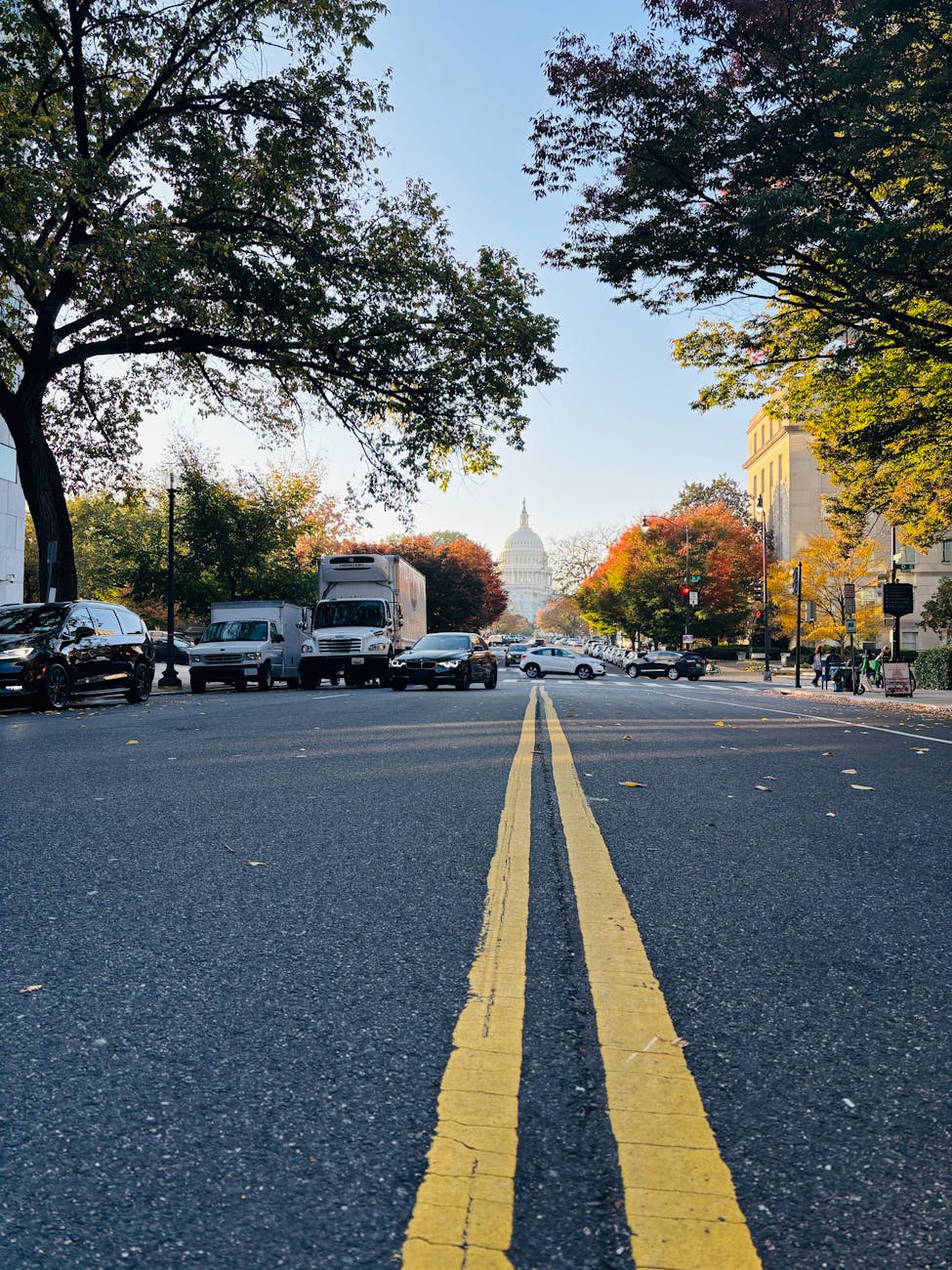
Photo by Alexander Zvir on Pexels.com

The new research, published in the scientific journal Nature Cities, built on previous work using satellite measurements to paint a detailed picture of rising and falling land. It also closely examined the connection between changes in land elevation and changes in groundwater, using data from individual monitoring wells.

Water pumped from wells isn’t something that people think about often. “You just turn on your tap, do what you need to do, and you go on your way,” said Leonard Ohenhen, a researcher at Columbia University’s Lamont-Doherty Earth Observatory and lead author of the study.

But extracting more water than can be replenished “can have a direct relationship with what happens on the surface,” he said. “You can cause the ground to sink significantly.”…

Other factors also influence land elevation. For example, a vast expanse of bedrock beneath parts of the country, pressed downward by enormous glaciers during the last ice age, is slowly rebounding back into place. But over time it creates a sort of see-saw effect that today is adding 1 to 2 millimeters per year to subsidence rates in much of the northern United States.

If pumping water from directly underground leads to this issue, what could happen next? Here are a few ideas that come to mind:

  1. Getting water from further away. At least then if it is pumped out of the ground it does not affect cities and metropolitan regions – the issue is pushed off elsewhere.
  2. Somehow pumping something back into the ground to refill what was depleted.
  3. Factoring in sinking ground at initial construction. This would lead to boosting the elevation of new sites in anticipation of what might happen in the future.

Or not much might happen until one city experiences dire effects from this sinking. Imagine a whole neighborhood or an important development sinks to a point where the land becomes unusable. Would that prompt urgent action?

Would Americans view cities differently if the current drop in violent crime continues?

Crime appears to be down in a number of American cities:

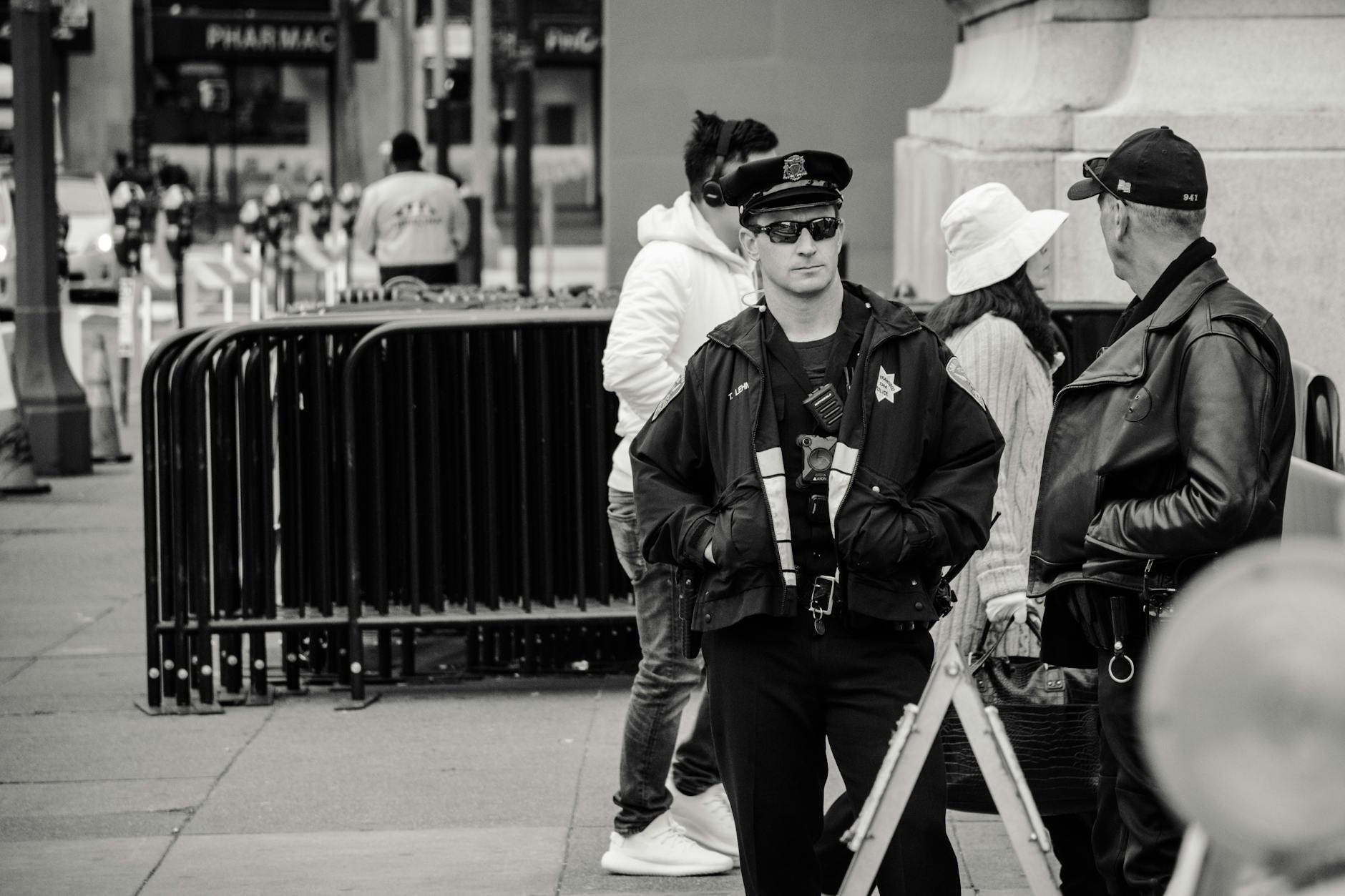
Photo by Brett Sayles on Pexels.com

Nineteen people were killed in Chicago last month, which is the fewest murders the Windy City has experienced during any April since 1962. In Baltimore, there were just five murders in April—the lowest number in any month since 1970. Three other major cities—Los Angeles, Philadelphia, and Detroit—recorded their fewest first-quarter homicides since the 1960s.

Criminologists tend to speak in caveats, with warning of reversion to the mean and admonitions to wait for better data, but even they must admit: These are some eye-catching numbers. “It’s really encouraging,” said John Roman, a crime researcher at the University of Chicago’s National Opinion Research Center. “It’s worth taking a moment and noting that we are approaching the numbers in most crime statistics we haven’t seen since the 1960s. In these cities, if you’re under 55, this is probably the safest moment you’ve ever lived in. That’s great, and it should be celebrated.”

The early 2025 crime decline builds off numbers from 2023 and 2024 and appears to include not just homicide but also robberies, rapes, burglaries, and auto theft. In many respects, we are returning to a pre-COVID world of public safety, with profound implications for residents of neighborhoods tormented by gun violence, the police who are supposed to solve the problem, and the politicians who love to campaign on the issue.

For decades, many Americans have associated big cities with crime. This can be in comparison to the settings in which they live – and a slight majority of the country is suburban – and can persist despite fluctuations in the actual crime rate.

But this is also connected to long-standing anti-urban sentiments. In a country that idealizes small-town life and where many love the suburbs, cities can look unappealing. Any reports on crime – whether crime is up or down – could feed into this broader narrative.

This goes beyond politicians trying to make political points by playing up particular issues cities face. How about the media and how it reports crime? How about the ways Americans perceive safety? How about police? And so on. There are facts about crime and perceptions about crime. For a long time, Americans have connected crime to cities. It might take a long downturn in crime for that connection to be broken.

When the pedestrian mall swept across American cities

Part of the story of the American shopping mall included in Meet Me at the Fountain is the rise and fall of the pedestrian mall in cities:

Photo by Alexas Fotos on Pexels.com

From 1959 through the early 1980s, more than two hundred American cities closed blocks of their downtowns to car traffic. B 2000, fewer than twenty-four of those original malls remained. (89-90)

As people and shopping moved to the suburbs, larger cities responded by trying to create something like an outdoor mall on busy urban shopping streets. But the experiment did not work:

By 2000, fewer than twenty-four of these original malls remained. The design intervention that was supposed to bring people back from the suburban mall had, instead, exacerbated the very problem it was trying to solve, turning downtown into car-centric, retail-first monocultures rather than pedestrian-first, mixed-use places. (90)

Many cities thought this was the answer but it turned out not to be; few of the pedestrian malls survived even a few decades.

Two thoughts hearing this account:

  1. Cities did not know what to do regarding the millions of Americans who moved out of big cities and to the suburbs after World War Two. Were they moving out of cities in part because of shopping opportunities? This was not the biggest issue but cities hoped they could at least attract more visitors with pedestrian malls.
  2. The copycat nature of retail development across places is interesting to consider. As malls proliferated, often borrowing architecture and techniques regardless of location, many communities also jumped on the pedestrian mall bandwagon. And then when they did not bring about the desired changes, they disappeared en masse as well. It makes sense that cities and developers would look to each other to see what works but it also seems like it can lead to fads and trying to shoehorn generic solutions to what can be complex local settings.

Seeing the relative decline of small Rust Belt cities by looking at the early years of the NBA

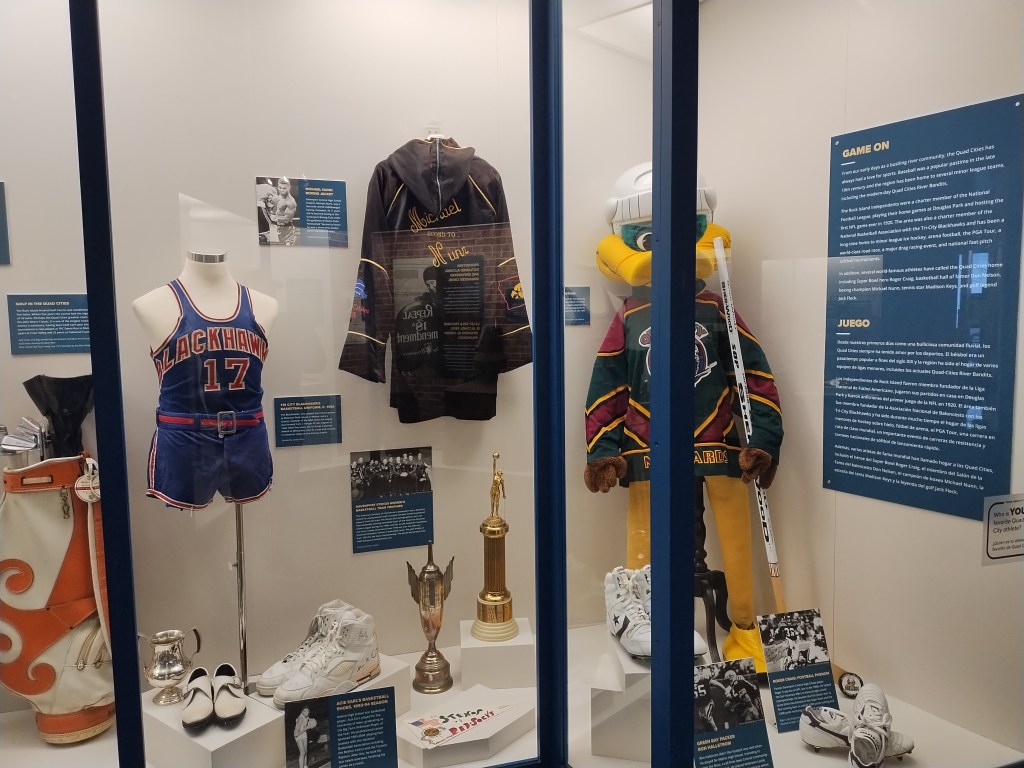
On a recent trip, I found out that the Tri-Cities Blackhawks – based in Moline, Illinois for several years – were once a professional basketball team.

They played in Moline for 5 years before moving and becoming the Milwaukee Hawks (later the St. Louis Hawks and the Atlanta Hawks).

Having a team in Moline would not fit in the modern NBA where teams are located within the largest cities in the United States. Even at the start of pro basketball, many teams were in large cities. But, Moline was not alone in having an early pro basketball squad. Here are some of the other Rust Belt cities that had early teams:

-Providence

-Pittsburgh

-Fort Wayne

-Rochester

-Syracuse

-Anderson, Indiana

-Sheboygan, Wisconsin

-Waterloo, Iowa

What does it mean that all of these cities are out of the NBA within a few years? It could be part of a larger restructuring and expansion of professional sports around this period. More cities in the West and South gained teams. I recently read that the St. Louis Cardinals were the furthest south and west team in baseball for a long time; this is hard to remember when all pro leagues stretch coast to coast.

But it could also be partially due to the relative decline of the Rust Belt. These places that were once sizable and/or important places fell behind as other cities grew in population and status. Or the region itself, stretching from the middle of New York and Pennsylvania through the eastern Great Plains, fell on harder times.

Pro basketball may have started in small big cities in the Midwest but it did not stay there long as the sport and other places grew.

Immigration enforcement operations taking place in cities – and suburbs

It is easy to find headlines regarding cities and U.S. Immigration and Customs Enforcement raids. But, reading a number of these stories shows these are also happening in suburbs. This one story detailing locations across the United States includes these suburbs:

Dallas, Texas, its eastern suburbs, and Lake Ray Hubbard by NASA Johnson is licensed under CC-BY-NC-ND 2.0

-Tucker, Georgia

-Irving, Arlington, and Collin County in Texas

-Federal Way, Washington

-Wilsonville, Oregon

Or see this story of operations in Chicago area suburbs.

These are suburbs of major metropolitan areas. Cities may be the target of particular political ire but there is less recognition that many people who come to the United States live in suburbs (or rural areas).

And how will suburbs respond to these federal efforts? When migrants were sent to suburbs of Chicago in 2023 from other locations in the United States, few suburban communities were interested in having them stay (see posts here, here, and here). A number of big cities have announced how they will respond but there are thousands of suburbs in the United States.

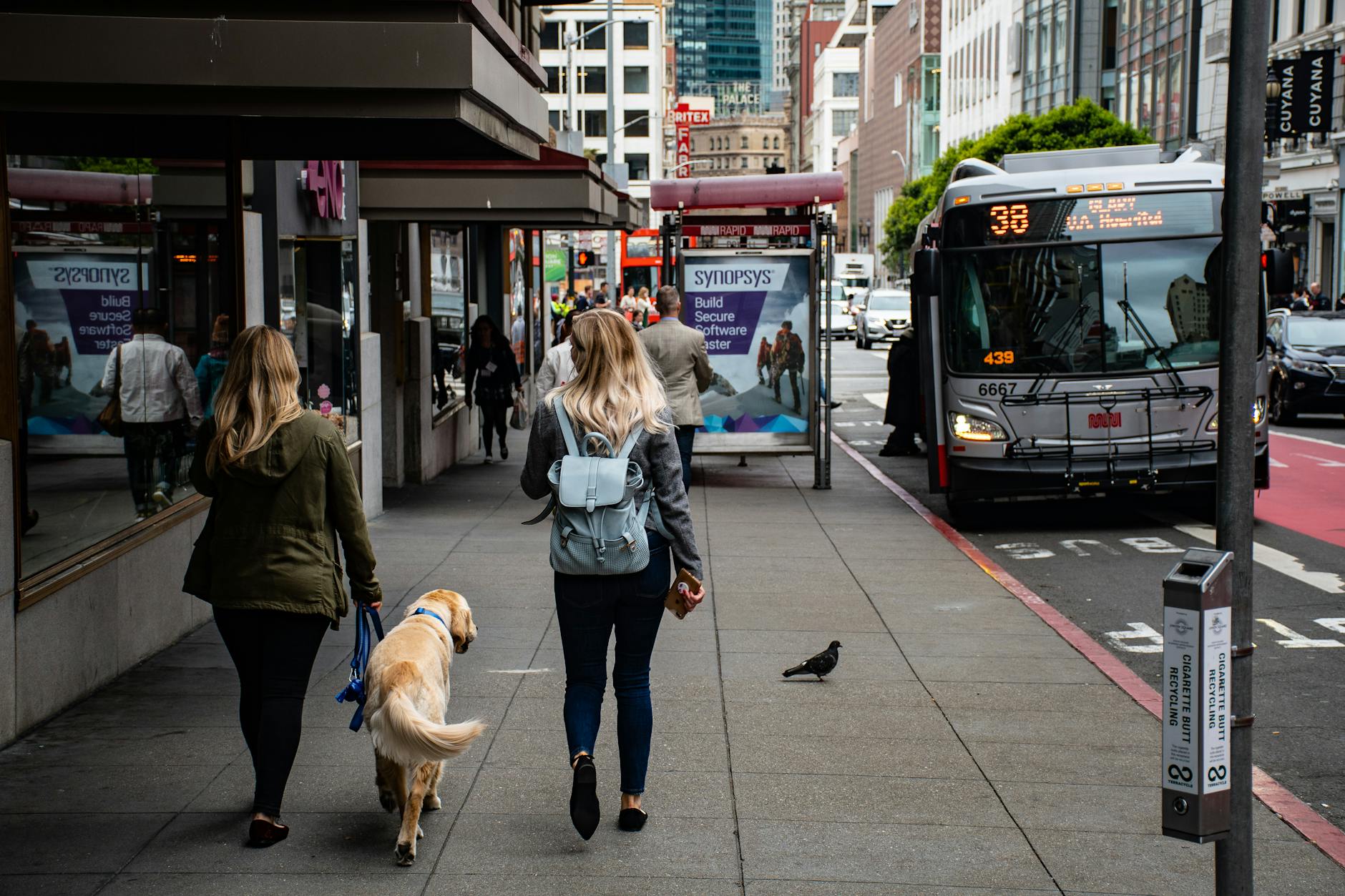
These city sidewalks were not made for talking

A new study suggests Americans are interacting less with others on city streets:

Photo by Brett Sayles on Pexels.com

Are city streets places for pedestrians to hang out, or are they routes to be traversed as quickly as possible?

Americans are increasingly treating them as the latter rather than the former.

That is the striking implication of a recent interdisciplinary study published by the National Bureau of Economic Research. Applying modern artificial intelligence techniques to old video footage, the researchers compared pedestrian activity in 1980 and 2010 across prominent locations in Boston, New York City and Philadelphia. Their unsettling conclusion: American ambulators walked faster and schmoozed less than they used to. They seemed to be having fewer of the informal encounters that undergird civil society and strengthen urban economies…

Salazar-Miranda said that video analysis alone cannot explain why pedestrian behavior changed, but she sees several possible factors. Since average incomes rose among those who lived and worked near all four locations, individuals’ higher value of time could deter them from engaging in leisure activities like casual conversation or strolls that now carry a higher opportunity cost. City dwellers might be having fewer social interactions of all kinds, a phenomenon that has been linked to rising rates of loneliness. And some of the pedestrians observed in 2010 could have been socializing remotely: By then, 80% of US adults had cellphones. Mobile devices may be inducing people to hang out online instead of in person. Salazar-Miranda suggested those who do get together might opt for climate-controlled, pay-to-enter “third spaces” like coffeeshops that she said have become more widely available.

I have heard some similar research presented before and I like the methods of comparing videos of city streets decades ago to observations today. Changes over time are important to consider as cities and societies change.

At the same time, I wonder about how to think about fewer interactions on city sidewalks to societal changes overall. If broad arguments in Bowling Alone and similar work are correct that Americans are engaging civically less over time, would we expect to see fewer interactions on city sidewalks and in suburban parks and rural communities? If phones are everywhere, are they affecting people in different places in different ways? Showing that city sidewalks were once one thing and are now something else is important but what if social interaction between strangers or in public has dried up in all places? Is this evidence similar or different to conversations about kids of the 1970s playing outside all the time and big changes since then?

If the exurbs are way beyond the basketball three-point line, where are downtown and the suburbs?

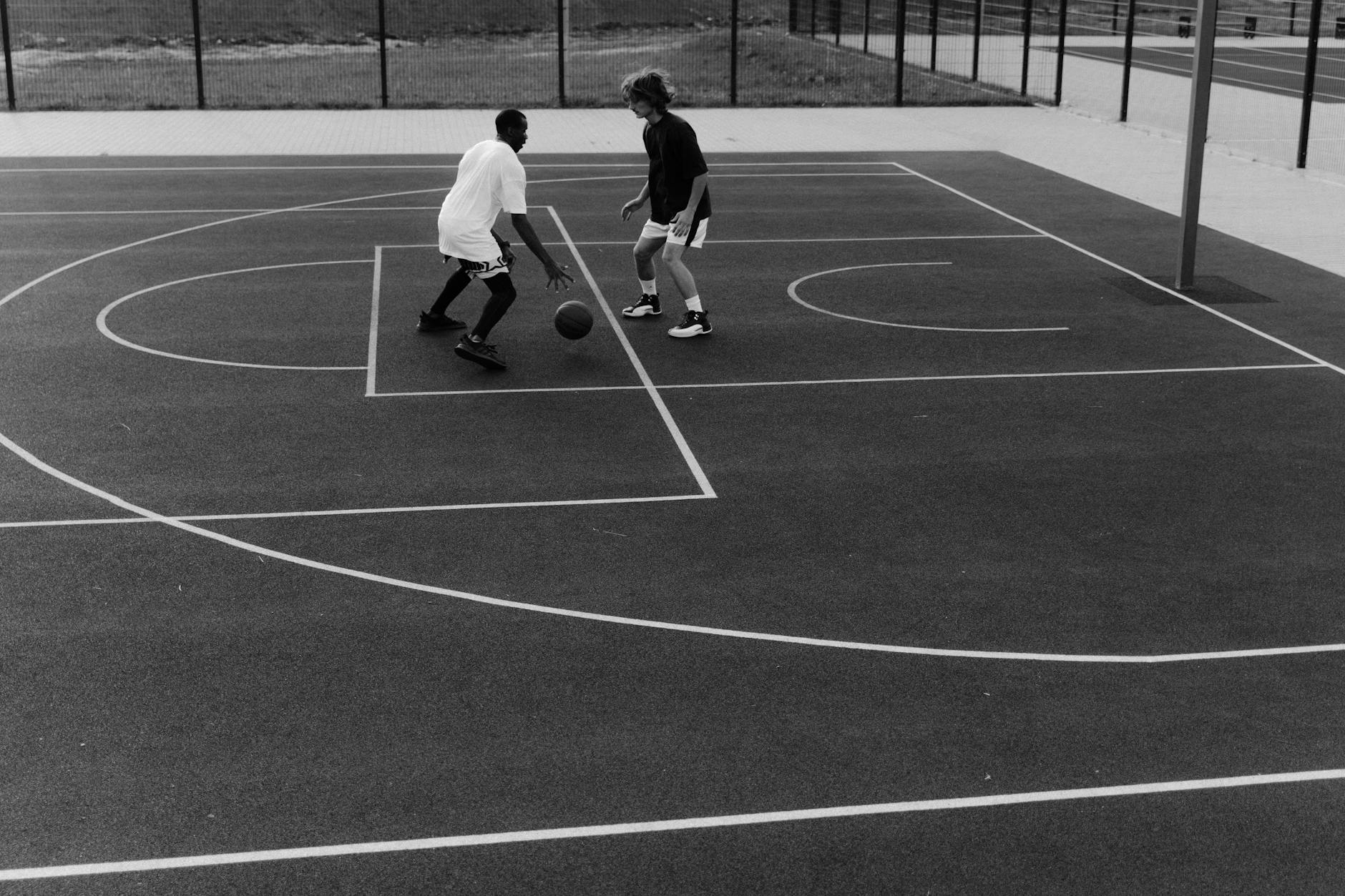
With more NBA action taking place beyond the three point line, this description likened it to the exurbs:

Photo by Tima Miroshnichenko on Pexels.com

This is some wild stuff happening between the circles. Minnesota’s Jaden McDaniels is guarding Steph Curry nose-to-nose more than 40 feet from the basket, no space between them, two guys sharing a shirt. The other eight players on the court might as well be in another galaxy; this dance in the exurbs is its own game. The player who has the ball is somewhere behind McDaniels, far outside his sphere of interest. His mandate appears settled: He will go where Curry goes, and he will turn his attention to the ball if, and only if, he sees it in Curry’s hands.

The idea invoked is that the dribbling is taking place on the outskirts of a region. Forty feet out is a long way from the basketball and closer to the half-court line than the hoop.

But continue the spatial analogy. One issue is that some announcers say a three-point shot is from “downtown.” From Hunter S. Thompson:

My grudge against Brent Musburger has been smoking on a personal back burner for many years — since the early 1980s in fact, when Brent was covering the NBA Finals for CBS-TV, and it involves the word “downtown.”

That is when Musburger changed the language of sports forever when he kept repeating this ignorant notion that any basketball player firing off a long 3-point shot is shooting from “downtown.” (Celtics announcer Johnny Most might have coined the “downtown” trademark in the 1960s, but it was Musburger who beat it to death.)..

Downtown is where you score — not somewhere out in the wilderness, where people are far apart & not much happens. You don’t fire a long jump shot from Downtown, you fire it into Downtown. The Real definition of “Taking it downtown” is to suddenly drive to the basket & into a cluster of 7-footers who seem to have you sealed out — like Iverson launching himself at Robinson & Duncan & dunking it over them. To think Otherwise would be to think like a Baseball Writer, or like Brent Musburger.

Thompson did not like the term and he points out that it makes more sense to say downtown is right where the basket is. If downtown is at the center of the city and the region, why would taking a three-pointer be from downtown?

If the basketball court is likened to American geographic categories, how about downtown is under the basket, the city is the paint, the suburbs span between the paint to just outside the three-point line, the exurbs are between the normal three-point shots and the half-court line, and rural areas are in the backcourt. That is probably too many categories but it more accurately applies categories Americans use.

More colleges in places with higher costs of living

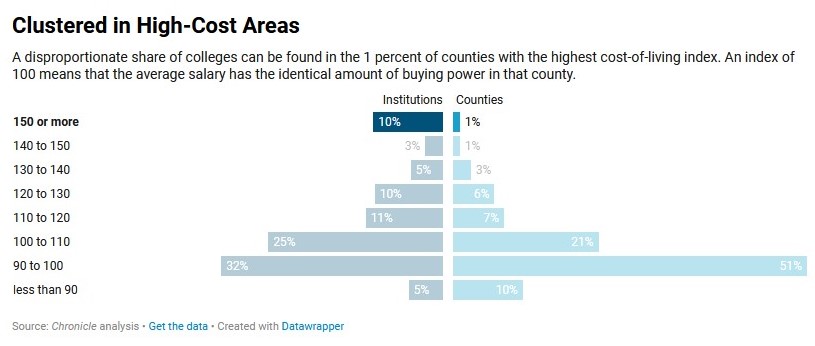
Where do colleges tend to be located? This graph in The Chronicle of Higher Education uses one metric:

Two quick thoughts in response:

  1. Does the presence of these colleges over time help contribute to a higher cost of living? I am reminded of Richard Florida’s argument about the creative class. If I remember the analysis correctly, places with colleges tend to have higher percentages of creative class residents. And he suggests colleges and universities can help attract people and development.
  2. When Ben Norquist and I looked at the locations of smaller Christian colleges, we found they tended not to be in the biggest cities (which account for some of these higher cost of living places). In contrast, research schools are often in big cities according to the article: “Almost a third, or 32.2 percent, of colleges in The Chronicle’s analysis were in counties where cost of living was at least 15 percent higher than the national average. The types of institutions found in these expensive regions tended to vary. About 10 percent of doctoral-granting universities and 23 percent of four-year special-focus institutions (like those specializing in health professions or religious training, for example) are in the priciest 1 percent of the nation’s counties, where the cost of living is more than one-and-a-half times the national average. In contrast, nearly half of associate- and bachelor’s-granting institutions were in counties with below-average costs of living.”
  3. The other category with a larger percentage discrepancy is among the percentage of institutions in counties at 90 to 100 in cost of living.

When American big cities devote much of their land to single-family homes

The big city in the United States is dense. It has tall buildings and busy streets. There are plenty of apartments and mixed-use structures. They look and feel different than suburbs, small towns, and rural areas.

Photo by Phu Nguyen on Pexels.com

But even American cities have lots of single-family homes. Chicago, for example, has a lot of land devoted to single-family homes:

More than 40% of the city is zoned for single-family housing…

This figure might even be higher in other cities, particularly sprawling ones.

What might this figure mean? Some thoughts:

  1. Denser populations can fit into less space. But the amount of space given to one kind of land use, homes in this case, still matters.
  2. These neighborhoods and residents are going to get at least some attention and representation. Their interests might converge and diverge in important ways from interests of other locations and residents in big cities.
  3. This fits with an American emphasis on single-family homes, even if these homes happen to be in cities.
  4. Suburbs are in between cities and more rural areas. Are city neighborhoods of single-family homes often in between denser populations and suburbs? Do these city places feel more like suburbs or like life in different densities in the big city?

Another way to think about this percentage: even the places that Americans tend not to associate with houses and the lives that go with them have lots. of single-family homes.

Unique noise features in populated areas

People might generally think of cities as noisy. Amid this volume level, there can be unique noise phenomena in cities and populated areas. Here are two examples, starting with temperature inversion layers:

Photo by Anthony ud83dude42 on Pexels.com

Temperature inversion layers, like the one happening the night Tamblyn heard Billy Joel from her backyard, occur when cool air gets trapped underneath a layer of warm air.

The warm air prevents the cool air from rising, along with smog and sound. The sound waves bend away from the inversion layer and back to the ground, bouncing across further distances.

This is more likely to happen during the fall season, as well as during certain times of day.

The second example involves different kinds of surfaces:

Skyscrapers lining the street can amplify city sounds, according to acoustic consultant Scott Pfeiffer.

That’s because sound waves easily reflect off rigid, hard surfaces, like glass and brick, Pfeiffer said. Sounds bounce back and forth like the two sides of the street are playing tennis.

The end result is a sound “canyon,” which often creates an echo…

Trees, grass and other plant life act as natural absorbers and deflectors of sound.

Three thoughts in response:

  1. Does public noise matter less in an era where lots of people use AirPods and other headphones? People have used headphones for decades but the noise-cancelling features of today’s devices plus their ubiquity might mean more people are in their own soundscapes.
  2. If cities are greener in the future, particularly with more plants and greenery among the buildings, does this mean they would be quieter? Having fewer motorized vehicles could also help.
  3. It is common to think of cities in terms of neighborhoods or scenes. These are often defined with physical boundaries. Do sound boundaries roughly match these boundaries or are there different sonic neighborhoods in places?