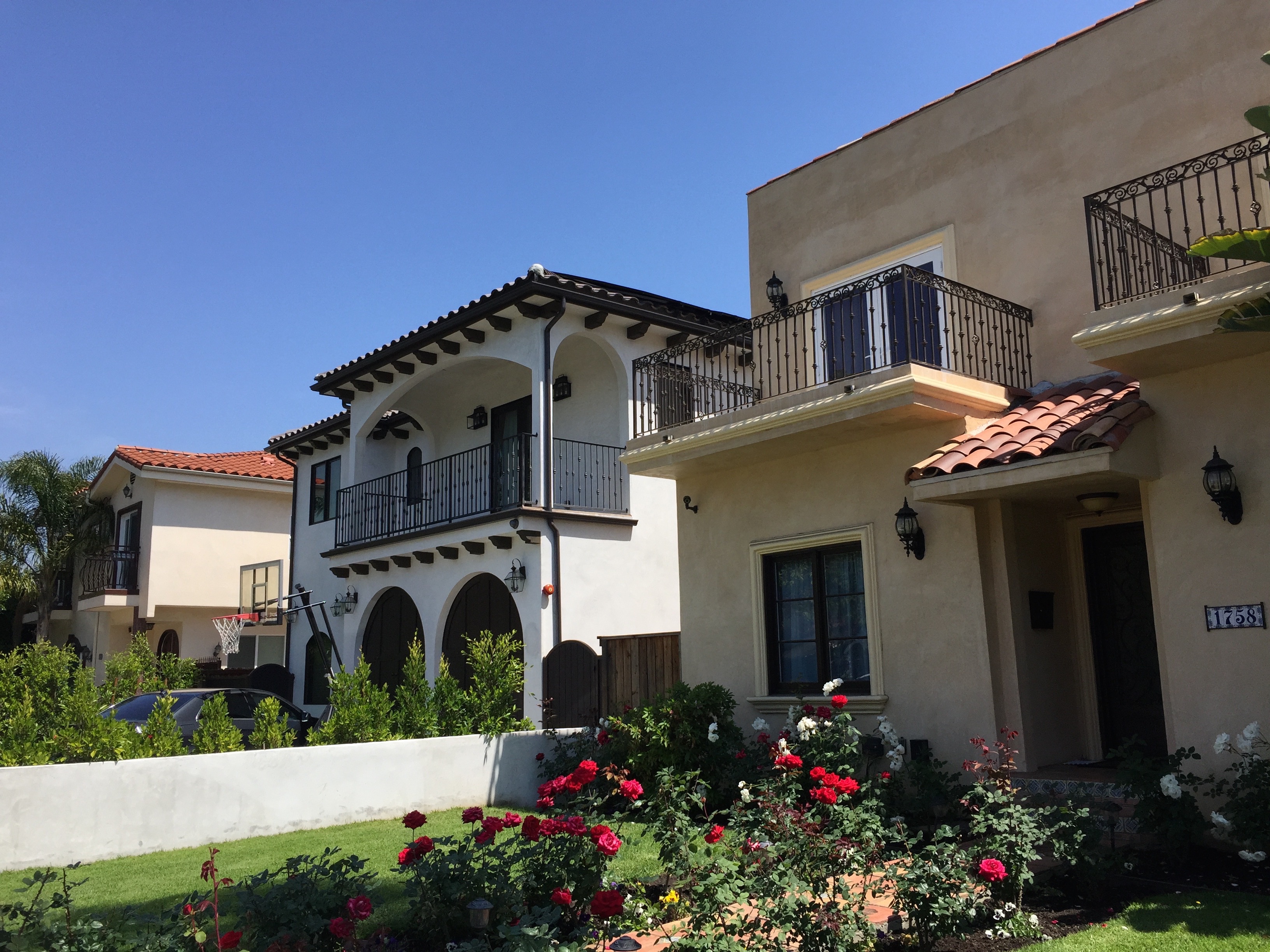
A gallery of “spite houses”

Curbed provides a look at the rare residences intended to spite someone else:

What’s not to love about a building called a “spite house?” In an essay in the New York Times, writer Kate Bolick discusses her dream of owning the Plum Island Pink House, a forlorn, decaying structure in Newbury, Massachusetts set in the middle of a salt marsh. The romantic, reclusive home stands alone for a reason; built by a recently divorced husband for his ex-wife as a condition of their separation, it’s an exact duplicate of their shared home, just uncomfortably moored in the middle of remote wetlands and constructed without any running fresh water. The square loner is part of a small but ignoble tradition of spite houses, buildings created for malice instead of comfort meant to irritate or enrage neighbors, or occasionally piss off anyone unfortunate enough to be dwelling inside. Normally built to block a neighbor’s light or access, they can be found as early at the 18th century. Here are some examples of homes or apartment that were built, or painted, out of anger.

Given the amount of work it can take to construct a home, these people must have had some serious spite. But, how exactly the spite translated into the form of a home took on some different patterns (based on the examples offered by Curbed): using particular pieces of land in unique ways (particularly small lots), exterior decorating that transforms what might be a normal home into what the neighbors would consider an eyesore, and then homes with specific architectural features (such as being overly large or emphasizing particular elements).

Two quick things I would want to know in these cases:

  1. Did building the spite house pay off? In other words, did constructing the home as a symbol help the aggrieved person feel better?
  2. How does the quality or longevity of these homes compare to typical residences? If constructed in haste or if more concerned about spite than construction, perhaps they wouldn’t stand the test of time.

Offset House on display in Chicago peels layers of balloon frame homes

One of the featured designs in the Chicago Architecture Biennial involves a large home taken down to the timbers:

The droll Offset House by Otherothers in Sydney addresses lot-hogging McMansions by tucking smaller homes into the flabby frames of McMansions that have been stripped to the studs to serve as balconies and porches.

And a further description from the American Institute of Architects:

One of the most striking examples here is the Offset House from the Australian firm otherothers, which tears away the derivative façades of typical suburban housing to reveal simple stick-framed structural grace. The balloon frame was developed in Chicago, and otherothers uses it to create semi-public open-air verandas.

This is the best image I could find with some further description:

Using the Sydney suburb of Kellyville as its prototype, Otherothers suggests the adaptive reuse of timber-framed suburban homes by stripping off the outer cladding (often brick), exposing the outer frame, and creating a verandah in the space between the outer and interior frames. They claim there is beauty to be found in the exposed frames. They also propose that since the verandah would now define the home’s outer border, fences would no longer be necessary and spaces between houses could become shared common areas for gardening and communing.

The design seems to shrink the interior square footage (a waste to many McMansions critics) as well as alter the private nature of single-family homes (another critique of McMansions and suburban homes). The design also seems similar to some of the buildings in the post-World War II era that flaunted their essential infrastructure rather than cover it up. The retrofitted home still takes up the same footprint and the exterior balloon frame still requires maintenance. Yet, some of the critiqued aspects of the McMansion are softened and social life might improve. I’d be interested to see this in action across a whole neighborhood…

Pizza Hut buildings with new uses

What happens to Pizza Hut buildings around the world once they are no longer home to the pizza chain?

Many of the vintage red roof buildings have been repurposed. Tran and Cahill, aren’t the first to notice or even document this change, but their photos nevertheless offer a fascinating glimpse at the weird ways these buildings are being used now.

They’ve found old huts reincarnated as Asian restaurants, dry cleaners, liquor stores, churches, and even funeral homes. Google Maps helped find locations, and online communities of hut fans have provided invaluable help since the started the project in 2013.

The pair, based in Sydney, has logged about 8,700 miles photographing almost 100 locations. They covered Australia and New Zealand before taking a great American “pizza hunt” road trip. They travelled through California, Florida, Illinois, Ohio, Virginia, Pennsylvania, New Jersey and New York, just to name a few states. Wherever they went, Cahill and Tran made a point of getting to know the locals and getting the scoop on a building’s history. “In Chicago, we made a phone call to a business because we weren’t sure if it was a legitimate hut, and a very helpful store clerk gave us a full history of the building dating back to ’91,” Cahill says.

The fast food/restaurant experience is not just about the food but also includes the building and their architecture. Looking at the images from their book Pizza Hunt, it doesn’t take much imagine to them as functioning outlets of a global brand. I wonder if this previous architecture helps or hinders the new occupants. For example, does turning an old Pizza Hut building into a church (image 10/10) bring in more or less people? Does the Asian food (images 1/10 and 4/10) taste any different in such a building? I’m guessing the architecture and design may have little effect on later behavior and attitudes; perhaps this really says something about our approach in constructing functional, suburban buildings where one of the top priorities is that it can be easily adapted to numerous uses.

Building beautiful American sports stadiums

One writer asks whether Americans can build beautiful sports stadiums:

So why don’t any of them look like the Nouveau Stade de Bordeaux? For a country with such a deep and abiding love for professional sports and lighting money on fire, the U.S. really isn’t in the business of building iconic sports arenas. Museums: Fine. Libraries: We’re golden. Those things are built to make the case for themselves and their cities. It’s different with stadiums…France’s latest soccer stadium, which opened to great fanfare in September, is the work of Herzog & de Meuron. It was designed with an eye toward Bordeaux’s landscape, according to the firm’s website, with heavy emphasis on elegance and “geometrical clarity.” At a glance, it looks like a juiced-up John F. Kennedy Center for the Performing Arts.

Herzog & de Meuron are what you would call elite architects. The firm is best known for projects such as the Elbphilharmonie in Hamburg and 56 Leonard Street in New York. Not that they’re not known for sports architecture: The firm designed the unforgettable Bird’s Nest Stadium, a collaboration with Ai Weiwei that served as the centerpiece for the Beijing 2008 Summer Games. Herzog & de Meuron has also produced jewel-box arenas for Munich (Allianz Arena) and Basel (St. Jakob Park).

But Europe is home to lots of ballparks and arenas by smaller firms that, for better or worse, push the boundaries of what stadium architecture can be. In the U.S., most sports venues are designed by one of a handful of giant specialty firms, namely Populous, HKS, HOK, AECOM, NBBJ, and a few others. While these are fine firms—great firms, even—stadium designs for American clients trend toward the conservative.

The argument seems a bit convoluted: local leaders, taxpayers, and teams are going to build more of these stupid things anyway so why not make them better looking? This could go a few different directions instead:

  1. Iconic buildings – those with unique architecture and often designed by starchitects – can become draws on their own. Both status and tourist dollars are at stake here. Of course, there are issues with promoting such iconic structures as they can often have little connection to existing styles in the community.
  2. Any sort of major public building, from museums to libraries to parking garages to stadiums, should be pleasing to look at and contribute to the community. For example, New Urbanists argue civic structures should occupy prominent locations and be landmarks for the community. In other words, you could have a beautiful structure but if it is located next to a highway junction to best serve those trying to get to the park or in order to take advantage of cheap land, what’s the point?
  3. What counts as a beautiful or well-designed building is difficult to define. Who gets to decide if stadiums are ugly? The fans who regularly go there? A survey of local residents? Team owners? Could utilitarian structures be considered beautiful in their own way? The example discussed from Bordeaux appears to be the sort of modernist structure that never really caught on in the United States. (For example, it never really gathered much steam for houses.)

Still, I imagine there are some American stadiums that the general public would consider more beautiful than others. Whether Americans want daring stadiums, ones that don’t look like the typical American stadium, may be a tough sell…

Quick guide to 10 common Chicago housing styles

Chicago has some unique residential architecture. The design shop ALSO put together a quick guide:

The Bungalow

Screen Shot 2015-09-03 at 9.45.58 AM.png

With more than 100,000 bungalows in the Chicago metro area, this structure was the Windy City’s new workers cottage for the 20th century. Constructed between 1910 and 1940, the bungalow was originally built for working-class owners and is characterized by it’s one-and-a-half stories, brick construction, street facing verandas, and full basements. The Chicago bungalow was commonly built with limestone accents, dormered roof, and concrete entry stairs. The typical interior layout consisted of a living room, dining room, and kitchen on one side of the building, while the other side contained a series of bedrooms and a bathroom. The attic had ample storage and many homes featured a back porch, all of which was decorated in Arts and Crafts style woodwork. This truly was a new way life in the 20th century…

The Courtyard Building

Screen Shot 2015-09-03 at 9.51.47 AM.png

The distinct U-shaped courtyard building was built around green space visible from the street. Largely constructed between 1910 and 1930, the units were initially sold as luxury housing. With a front entrance stairwell shared with only 5 neighbors, a large back staircase, and a design that allows for good cross ventilation, these buildings made for very pleasant city living. Courtyards were rarely built taller than 3 stories as Chicago ordinance made it expensive for developers to build higher, due to fire-code restrictions and elevator requirements.

See the print options here.

Some of these are more iconic than others. For example, there is a non-profit group dedicated to Chicago bungalows but classic Dutch Colonials or Four Squares don’t get as much attention. And I’m a little surprised that some version of a bigger multi-story building didn’t make it here. What about all those big and bland lakefront condo buildings from the 1950s-1970s?

I wonder what such a list would look like in 50 years. While the options presented here might still dominate the list – not all neighborhoods are going to have major renovations – there will certainly be additional options. The South Loop Loft? The Slick Brick Renovated Three Flat?

The odd McMansions of Mill Basin, Brooklyn

Some recent McMansions in the Mill Basin neighborhood in Brooklyn caught the eye of a photographer:

Photographer Nate Dorr recently shot some of the more interesting edifices in the neighborhood, noting that some of the architecture seems to come from “a sculptural confusion of design elements that suggests the owners just opted to combine all possibilities in one facade rather than make any attempt to decide between them.” And that pretty much sums up the look of the area…

This is indeed a unique collection as well as a apt description. Perhaps the eclectic mishmash of styles actually creates its own unifying aesthetic? Hip neighborhoods can make this work – artists and creative types can’t be confined – but perhaps not wealthy ones.

A 1991 New York Times article suggests the waterfront property attracts the wealthy:

Waterfront houses eclipse these in cost — up to $4 million — and luxury. More than 200 have their own docks and a few have elevators. One, on National Drive, has a six-car garage and on Indiana Place stands a three-story house with an all-glass facade. Such high-profile houses have been built or bought by politicians, restaurateurs, physicians and, reportedly, leaders of organized crime.

An interesting outcome for a neighborhood with history dating back to the 1620s.

How the ADA changed architecture

The passage of the Americans with Disabilities Act in 1990 had a profound effect on architecture and design:

The Americans with Disabilities Act created a comprehensive civil rights approach to accessibility at the federal level. Before its passage, architects worked under a varying system of state and local buildings codes that governed design requirements. Federal laws that were precursors to the ADA, such as the 1968 Architectural Barriers Act, the Rehabilitation Act of 1973 (especially section 504) and the Fair Housing Amendments Act of 1988, mandated better access. But since they only applied to federal properties, those built with federal money, or housing programs funded by federal sources, they didn’t address varying codes for other structures, and had no impact on privately owned buildings. People with disabilities still had to navigate on unstable terrain, legally speaking. Wright told lawmakers the patchwork of protection was akin to a “piece of Swiss cheese” spread across the country…

The battle for passage, which foreshadowed many of the issues surrounding its implementation and eventual effectiveness, boiled down to three main issues, according to Wright: civil rights, an implicit part of the debate; architects’ desire to have freedom in their choice of designs; and the cost of retrofitting buildings. While architects eventually accepted the changes as another set of guidelines, like a code change, every section of the bill encountered different forms of corporate resistance. During debates over transportation, for instance, Greyhound complained about the cost of retrofitting buses and rebuilding all their stations. During months of negotiations, Wright was assisted by her “right-hand man” Ron Mace, an architect and designer with Barrier-Free Environments, who used a wheelchair due to polio. He continually gave her facts and figures on the costs of different alternatives and upgrades, helping to assuage fears and correct inflated cost estimates from the opposition…

At first, architects greeted the ADA as just another code change, according to many in the field. Patrick Burke, a principal at Michael Graves Architecture & Design who started there in the ’70s, admits that his colleagues at the time rarely thought about people with wheelchairs. But a few years after the ADA was introduced, it quickly became “part of design DNA.” While sustainability often provided a quantifiable, monetary impact, accessibility, which almost always requires a bigger building and more money, is just the right thing to do…

“It’s changed the way we enter buildings, and the way we design for monumentality,” says Steinfeld. “The ADA has created a new way of thinking, a much more convenient, egalitarian approach. It’s no longer like the days of imperial Rome and England, with the elite of society standing up on the second floor, watching the peons go by below.”

The suggestion here is that addressing accessibility led to more open, flowing, lighter designs that all people could benefit from. While the legislation may have been aimed at helping a specific group, the benefits can be shared by all. Think about the trend of having first floor master bedrooms in houses; they may have benefits for those with mobility concerns or allowing the homeowners to stay longer since they don’t have to travel up or down stairs as much but such a layout could have other benefits such as a more private space away from the other bedrooms and having closer access to the main living spaces.

On the other hand, I wonder if the normal person has noticed these changes in public places beyond seeing a ramp here or there. Many people don’t have to think about accessibility issues. Granted, it may be our often lack of attention to architecture and design in our daily lives and the inability to read/understand this architecture that is more of an issue. Yet, I suspect this is still a hidden issue.

Photo essay demonstrating LA’s mansionization

Here is a photo essay that shows the incongruity of a number of teardown McMansions in Los Angeles:

A developer wants to make as much money as he can as quickly as he can, where the only people whose feelings or quality of life he cares about are himself and whoever buys his newly-built mansion. A normal, thinking, feeling person could find many reasons why she would not want to rob her neighbor of privacy or sunlight by building a looming addition onto her house, with perhaps the most powerful reason being that her neighbors would hate her for it. A developer who will never live in a house he has built doesn’t have any relationships with neighbors to preserve. He actually stands to benefit from being indifferent/contemptuous to neighbors’ concerns, especially if it means he is able to build a bigger, more expensive, more obtrusive structure without the impediment of a guilty conscience. And don’t forget the long, noisy, messy, utterly unpleasant experience of living near a house under construction…

And that’s perhaps the biggest danger of mansionization. Regardless of what you think about mansionization and how it should or shouldn’t be regulated, there’s something about it that I’ve found to be consistently true.

When the first mansion goes up on a block of more modestly-sized homes, it sticks out like a garish eyesore. But if a second mansion is built on the same block, that first mansion suddenly doesn’t look nearly as big and out of place as it did before…

2015-07-01-1435742962-2381680-3inaRowGOOD.jpg
Three of a kindAnd at that point, the entire block might as well be mansionized — and chances are it will be. Having one mansion next to you is bad enough, but if the house on the other side of you gets mansionized, blocking sun and privacy from two sides, who would want to stay? Better to take what you can get and sell, leaving the house to a developer or new buyer who would inevitably go big — and another reminder of the now “old” neighborhood will be gone.

The critique of these new homes focuses on three areas:

1. It is often developers, and not neighbors, who go forward with the oversized homes. Neighbors might be more sensitive to the needs of others but developers are simply trying to maximize the property for profit. This may be true though there are plenty of cases where people buy properties with smaller homes and then make the decision to build a huge home. Developers aren’t the only ones to blame here.

2. The architecture and design of these new large homes are lacking. The homes are unnecessarily large and depart from traditional Southern California styles (stucco, clay tile roofs, etc.). These new homes clash with the older, smaller homes.

3. McMansions spread like a contagion: once a neighborhood or block has one, newer ones are soon to follow. The hint is that the teardowns need to be stopped at the start. A number of LA neighborhoods have been pushing for housing restrictions. But, it may be that one of these homes has to be built before neighbors really rally around the cause.

“McAnger” over new big homes in New York City suburbs

Some new large homes in Westchester County have drawn some “McAnger”:

“This is really stupid,” wrote Laura Kerns. “No one needs this much house.”…”It’s sad, really,” David Raguso wrote. “This county just doesn’t care about the average person.”

Said Dana Doyle, “Bye bye, middle-class! The rich folk are taking over!”…

Like others, Daphne Philipson questioned the need for so much square footage. “The Gilded Age is back – and we know how well that went for everyone.”…

“Wretched excess,” he wrote. “There is nothing wrong with being financially successful, but why then not be reserved about it? How much house does a man need? Find meaning in meaningful things.”…Some were not so much annoyed but still critical of the new homes, critiquing the exterior appearance specifically as a hodgepodge of conflicting architectural styles. “Looks like it was thrown together at different times by different moods,” wrote Erika Kislaki-Bauer.

Eileen Healy Rehill lamented the addition of “more overly priced McMansions” in Westchester rather than “nice yet affordable housing for the middle class.” She was far from the only one, with housing for seniors and the disabled also mentioned.

Some familiar comments when McMansions are involved. Three quick thoughts, with the first two mentioned briefly in this summary of feedback:

1. Westchester County already is a wealthy county. It was known as the home to many wealthy estates as New York City was growing. A number of high-profile companies moved there post-World War II, including IBM. It is home to “Hipsterurbia.” In other words, McMansions are just symptomatic of a wealthy county where many communities would not welcome affordable housing and builders see ongoing opportunities for wealthy buyers.

2. These new homes are indeed large and luxurious. But, the conversation about “who needs this” can get sticky. How much do Westchester County residents consume? How many suburbanites buy a home that is too small for them? How many people don’t seek through the exterior of their home or the things inside to provide some markers of their social status? On one hand, Americans have historically tended to frown upon opulent wealth (hence, everyone wants to be middle class) yet consumption is rampant and the American middle class is very well off by American standards (though there may be a big gap between them and many Westchester County residents).

3. The critique of the architecture might seem class neutral. After all, people could build both big and small houses that match the local styles or are done in good taste. Yet, architectural styles and design are likely class-based tastes, a la Bourdieu.

Teardown McMansion owner asks why people hate their home

A teardown McMansion owner in McLean, Virginia wants to understand why people don’t like the home:

I don’t understand why people get so upset on this board. When we bought a new build a few years ago, we were very excited and actually liked the brick over the hardieplank.

We live in a teardown area in McLean with many original homes. We always keep our lawn nice and upkeep our landscaping.

Why do you dislike my house and maybe me or family?

[edited for original errors]

The responses come pretty quickly and include a number of arguments:

1. Building any newer home within a “historic” neighborhood (even if just from the post-World War II era) would be a problem for disrupting the existing character.

2. Specific design elements of teardowns are problematic, particularly certain kinds of siding.

3. Maintaining the lawn and exterior of the house might be necessary in many suburban neighborhoods bu it probably isn’t going to make up for the design of the house itself.

Despite the objections – which sound fairly permanent and independent of the people actually living in the home – the pace of teardowns has actually increased.