How can a city reduce driving by 45%? Sustained effort over decades

Paris has significantly reduced traffic since 1990 but this was not an easy or quick task. This article suggests sustained effort from the city’s mayors was critical:

  • Jacques Chirac, Paris’ famously conservative (and public fund-embezzling) mayor from 1977 to 1995, helped encourage pedestrianism by increasing the number of bollards to prevent illegal sidewalk parking, Héran writes. Chirac also rehabilitated the Champs-Elysees into a true public promenade, with widened sidewalks, street parking eliminations, and refreshed green spaces.
  • Chirac’s chosen successor, Jean Tibéri, came under fire for not cracking down hard enough on Paris’ air quality problems (and was accused of election fraud!), but he does get credit for banning cars in the Place de la Concorde. In an effort to reduce traffic, he also introduced the city’s first bike plan in 1996, which established paths along the city’s main arteries and lower-speed neighborhood zones, Héran notes.
  • Elected Paris’ first openly gay mayor in 2001, the socialist Bertrand Delanoë “vowed that automobile interests would no longer dominate the city and he would focus on improving public spaces,” wrote Stephane Kirkland for the Project for Public Spaces in 2014. Delanoë made good on those promises during his 13-year tenure (while largely avoiding scandal): A number of streets were reconfigured to accommodate dedicated bus lanes. Some 400 miles of bicycle lanes were created. The banks of the Seine began to close to traffic in the summertime to make way for public “beaches.”And in 2007, the city introduced its bikeshare program, Vélib, now arguably the largest and most used such system in the West.
  • Delanoë’s protégé and current Mayor Anne Hidalgo is an outspoken environmentalist responsible for “some of the most systematically anti-car policies of any major world city,” CityLab’s Feargus O’Sullivan wrote last year. Hidalgo has implemented a ban on older cars on roads during weekdays, and has pedestrianized the lower quays of the Seine. “Car space is being slashed in many major squares, while car-free days have been introduced annually as a form of publicity campaign for a future without automobiles,” O’Sullivan wrote. (Furthermore, recent trip data from city hall do not support the claim by some motorists that Mayor Hidalgo’s car-free policies have made congestion worse. There’s been a sharp decline in the kilometers-traveled within the city, but only a small dip in kilometers-per-hour.)
  • Paris’ commitment to public transport far surpasses that of any city in the U.S., where it has been more than 30 decades since any new system opened. RATP, the public transport operator for the Île-de-France region, has increased its reach with new bus rapid-transit lines and a steadily growing suburban tram network whose first line opened in the early 1990s. New routes have been accompanied by sidewalk improvements, bike paths, and a variety of traffic calming measures. The lines are frequent and fast. Some are even driven autonomously.

Three quick thoughts regarding this brief history of Paris:

  1. Sustained effort across mayors and local government officials is not easy to do. This article covers 25+ years where different actors from different perspectives contributed to a desirable outcome. The amount of emphasis on reducing traffic probably differed quite a bit across administrations yet the small and big steps added up over time. Significant social change in large cities does not often happen quickly.
  2. The reasons for pursuing less car traffic are varied. Some might decry the environmental issues. Others might want more space for bicycling. More public space might motivate others. I wonder if any of these one reasons would have been enough to motivate these actions and push forward big changes. But, put together multiple reasons and people with different interests might be more likely to come together and promote fewer cars.
  3. How much easier is it to pursue such plans in a European city versus an American city? Additionally, this is Paris, a tourist hot-spot where people want to walk around and experience charming sights and neighborhoods. American cities may also desire less traffic – who wants to be delayed? – yet this is difficult to reconcile with American desires for individual transportation. At the same time, a chart in the article suggests London and Berlin are more like New York City in terms of driving.
Towns that restrict road access to app users only address the symptoms and not the bigger issue

The decision in a New Jersey suburb to fight back against drivers directed to their streets by apps raises all sorts of questions:

In mid-January, the borough’s police force will close 60 streets to all drivers aside from residents and people employed in the borough during the morning and afternoon rush periods, effectively taking most of the town out of circulation for the popular traffic apps — and for everyone else, for that matter…

But Leonia is not alone. From Medford, Mass. to Fremont, Calif., communities are grappling with the local gridlock caused by well-intentioned traffic apps like Waze, which was purchased by Google in 2013 for $1.15 billion.

Since Waze uses crowd sourcing to update its information, some people — frustrated at the influx of outside traffic — have taken to fabricating reports of traffic accidents in their communities to try to deter the app from sending motorists their way. One suburb of Tel Aviv has even sued Waze, which was developed by an Israeli company….

“It’s a slippery slope,” said Samuel I. Schwartz, the former traffic engineer for New York City known as Gridlock Sam, and the author of the early 1990s book “Shadow Traffic’s New York Shortcuts and Traffic Tips.” “Waze and other services are upsetting the apple cart in a lot of communities. But these are public streets, so where do you draw the line?”

See an earlier post about a Los Angeles neighborhood that raised similar objections.

I can see the reasoning by small communities: the roads are partly or mostly paid for through local tax dollars and thus they should primarily be reserved for the use of locals. These sorts of situations can become big deals in suburbs where residents are often resentful of ways that their local tax monies serve others.

At the same time, this hints at a larger issue: efforts like this by single communities could end up having deleterious effects on the region as a whole. What if every suburb or community employed such tactics? Traffic would only be worse. This then suggests a metropolitan approach is needed to tackle these congestion issues. This might be difficult to do considering how local residents like to hold onto their own monies but drivers across the region might be too mad at that point to care if there are no alternative routes. The best way to tackle this issue may be to lobby for more mass transit and decreased reliance on cars in the New Jersey suburbs.

Study suggests traffic would flow much faster if we kept the proper distance between cars

The science of traffic once again suggests we all could be driving faster if we followed a simple rule:

But a new study in IEEE Transactions on Intelligent Transportation Systems mathematically models the implications of the larger problem: You’re not keeping the right distance from the car behind you.

That may seem counterintuitive, since you don’t have much control over how far you are from the car behind you—especially when that person is a tailgater. But the math says that if everyone kept an equal distance between the cars ahead and behind, all spaced out in a more orderly fashion, traffic would move almost twice as quickly. Now sure, you’re probably not going to convince everyone on the road to do that. Still, the finding could be a simple yet powerful way to optimize semi-autonomous cars long before the fully self-driving car of tomorrow arrives.

Traffic is perhaps the world’s most infuriating example of what’s known as an emergent property. Meaning, lots of individual things forming together to create something more complex. Emergent properties are usually quite astounding. You’ve probably seen video of starlings forming a murmuration, a great shifting blob of thousands upon thousands of birds.

But it feels so much better to let that pokey driver ahead know you are there by following closely!

For an earlier blog post about how science could improve traffic, read about zipper merges and other individual actions drivers can take.

What social level should help better protect Illinois pedestrians in crosswalks?

The Daily Herald did an “informal study” of using crosswalks in the suburbs and the results were not good for pedestrians:

Daily Herald journalists conducted 49 tests of crosswalks not connected with stop signs or traffic lights in Cook, DuPage, Kane and Lake counties in November and December. Among the findings in the informal study:

• In 20 percent of tests, drivers whizzed through crosswalks despite a reporter either standing or walking within the striped area.

• Walkers were temporarily stranded in the middle of crosswalks 12 percent of the time as traffic continued without allowing them to reach the other side.

• One reporter on a busy stretch of Central Road in Mount Prospect waited more than 10 minutes while at least 99 vehicles surged through the crosswalk at Emerson Street until a vehicle stopped. It took more than 99 vehicles until it was safe for the reporter to proceed.

• Ninety percent of the time, traffic continued through crosswalks without heeding people on the curb.

Illinois’ nuanced law saying cars can continue through crosswalks until a pedestrian has both feet in the crosswalk is pure “Catch-22,” widower Eric Jakubowski of Mount Prospect thinks.

There are various levels that could be blamed for these issues:

  1. Local government. Why not put more stop signs or traffic lights in that would give pedestrians more help? (Easy answer: drivers do not want the flow of traffic impeded.) My own anecdotal evidence also suggests these traffic devices are also not guarantees for the safety of walkers, joggers, and bicyclists.
  2. Local law enforcement. Why is this law not enforced more? It reminds me of the cell phone laws in Illinois that are rarely enforced (and some communities have basically said as much).
  3. Pedestrians. Are they aggressive enough in stepping out into the street? Of course, one could hardly blame them as you often have to step out into traffic and catch the eye of drivers.
  4. State officials. Why not clarify the law so that pedestrians come first and also impose steeper penalties for lack of compliance?
  5. American society. Why must we privilege driving so much? And the suburbs are particularly designed around cars where people often have to go several miles to reach basic needs. Pedestrians slow down traffic and suburbanites dislike traffic. Different approaches to community life and urban design could help address these issues.

All of this is the case when many would suggest Americans should walk more for their own health as well as for building community.

Arguing that $40 congestion charges are good for drivers

The new express lanes on I-66 outside Washington D.C. may just be what driving looks like in the future:

The express lanes on Interstate 66 near DC, previously reserved for vehicles carrying two or more people, opened up to solo travelers. Except those single-occupancy vehicles have to pay a toll, one that fluctuates according to demand. The world watched, aghast, as tolling prices hit $40 for folks headed into the capital on Tuesday morning…

“Transportation pricing usually takes several months or even years to achieve its full effects, so the current maximum prices are probably two or three times what will occur once everybody becomes familiar with the system,” says Todd Litman, executive director of the Victoria Transport Policy Institute in British Columbia. “Over the next few months, many travelers will probably change when and how they travel, so the maximum price will probably decline to a few dollars per trip.”

One of congestion pricing’s greatest strengths is convincing drivers to skip trips they don’t really need to take, or convince them to go at another time. Though the express lane scheme targets commuters, not everyone who travels during those periods is going to work. In fact, some might be taking totally optional trips—grabbing milk, meeting a friend for coffee. “The percentages vary by metro area and travel corridor (as do the timing and duration of peak periods) but the data show that about half of peak period trips are for other purposes,” says Elizabeth Deakin, who studies regional planning at UC Berkeley and has evaluated congestion tolling in the Bay Area.

Eventually—and you’ll have to wait a while to see this—congestion pricing can influence where people choose to live. If you don’t have to pay for tolls, the big house out in the suburbs with the huge backyard looks like a great option. When it costs $20 in tolls to get to work every day, not so much. If every one of those McMasion abandoners drives to work, well, that can make a dent in a traffic jam. Remember: You’re not in traffic. You are traffic.

The main purpose of such charges is to get drivers to think twice about traveling to that location via car or using that route. Not everyone will take the alternative – and Americans do like their driving and the freedom they think it offers even as they regularly complain about all the traffic in urban areas – but enough will do so to at least stop the increase in congestion.

As these options expand, it will be interesting to see how residents of each area respond. Will they protest by not taking those roads? (I remember such claims here in the Chicago region a few years back when tolls were raised.) Will they pursue public referendums? Will they refuse to pay? Would they vote out those who enabled these traffic changes? Even though there is likely to be a lot of complaining, it is also difficult to mount a serious political response to congestion pricing.

Finding the price and usage at which to not own a car

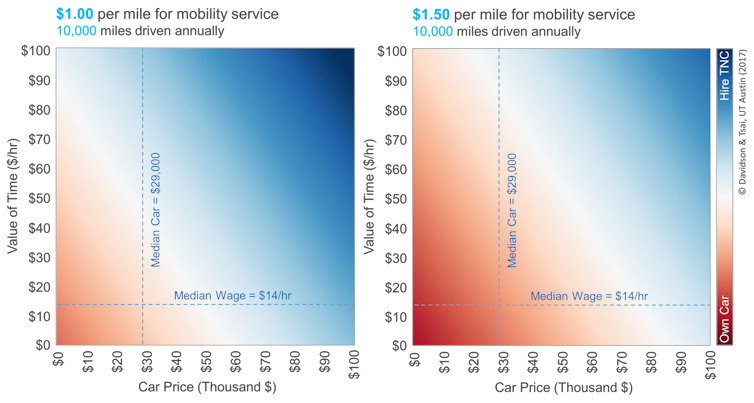
Two researchers crunched the numbers and have some thoughts about when you should not own a car:

The decision for owning a vehicle or using mobility services is unique to every individual. If you purchase a highly efficient vehicle for less than $25,000 and drive it more than 15,000 miles per year until it falls apart, then you should definitely own a car if your goal is to save money.

But, if you drive less than 10,000 miles per year, face long waits in traffic, or place a high value on your time that would otherwise be spent driving, our calculations show that mobility services might be the cheaper option. Geography can also play a role—it’s not a coincidence that there have historically been so many taxi cabs in New York City, where the high cost of parking and slow pace of traffic consume time and money.

As noted before on this blog, owning a car can be a substantial part of middle-class expenses. With their physical layout, the sprawling suburbs probably then do not make much sense for not having a car. Yet, those denser suburbs for the older millennials and companies hip to them may be the true spots where suburbanites can ditch their cars. A combination of walkability, some mass transit, and car sharing in these denser suburbs could be enough to push people toward limiting car ownership.

On the other hand, perhaps driverless cars will render this all moot within a short amount of time. Within ten or twenty years, few of us will even need to own a vehicle if we just buy into a car sharing option.

I drove past the same scenery for almost eight years

I realized a few days ago that I drove almost the same route every day to and from work for almost eight years. It was not a bad drive: it usually took about 15-20 minutes to go roughly 7 miles, I saw a lot of greenery due to Forest Preserves and a private park, I drove past some important local institutions, and there were not too many traffic lights.

But, as I was recently driving part of this route for another destination, I noticed that I had not seen this part of the world for a few months – and I live just a few miles away. With no daily commute along this route, I do not need to bother with this territory.

Does it matter that I do not keep up with this area any longer? It did not appear that much had changed. Yet, I felt like I missed something that had been part of my life for years. Now, I see different things on my daily route: new houses and buildings, new cars, and new obstacles to avoid in order to reach work faster.

It was easier when I was younger to simply explore my own suburbs and those around it. Although slower, this could be accomplished best by bicycle and with no set destination. This could even be accomplished when driving was still exciting in the early years (and gas was very cheap and what else was there to do in high school and college). Today, my goal is usually to get to a place quickly.

In the end, it is easy to see one set of sites for years and years. At the least, we can try to pay attention to those sites and be a part of the place (even if that means passing through at 30+ MPH). On the flip side, we can blindly go along that same route for a long time and also miss out on numerous other nearby places that are just off our daily route.

Second Chicago area diamond interchange opens; how many will follow?

Diverging diamond intersection number two in the Chicago region is opening over the course of a week at I-90 and Elmhurst Road:

Essentially, “northbound and southbound vehicles take turns crossing the intersection,” Garrett explained. “They’ll cross over to the other side, which makes all ramp movements unrestricted. There’s no opposing traffic when turning onto I-90 ramps, which means unopposed left turns and unopposed right turns.”…

On Monday, it will switch to two lanes, and two rebuilt I-90 ramps carrying vehicles to and from the east will reopen. Those ramps will handle about 21,000 vehicles daily.

On Tuesday, two new ramps taking traffic to and from the west will debut, accommodating an estimated 12,000 vehicles a day…

Underneath the diverging diamond is a tangle of utility pipes that carry liquids ranging from jet fuel to O’Hare International Airport to drinking water for suburban communities.

The article notes that only a few motorists had trouble on the opening day.

Looking forward: how many of these can we expect to see in coming years or are these a highway interchange fad? The first diamond interchange in Naperville has had some success – see this earlier post. But, drivers tend to be fussy about changing the roadways, whether with a new interchange or through introducing roundabouts. And, I imagine few residents would be happy to rip out old intersections just to put in a new pattern (think of the costs as well as the lost time to increased congestion). Perhaps we might see a few more of these over the next ten years or so but I don’t think they will become the new normal (which also might decrease people’s comfort with them if they encounter them infrequently).

Americans fearful of driverless cars

Recent surveys suggest a majority of Americans don’t want to hand over their steering wheels yet:

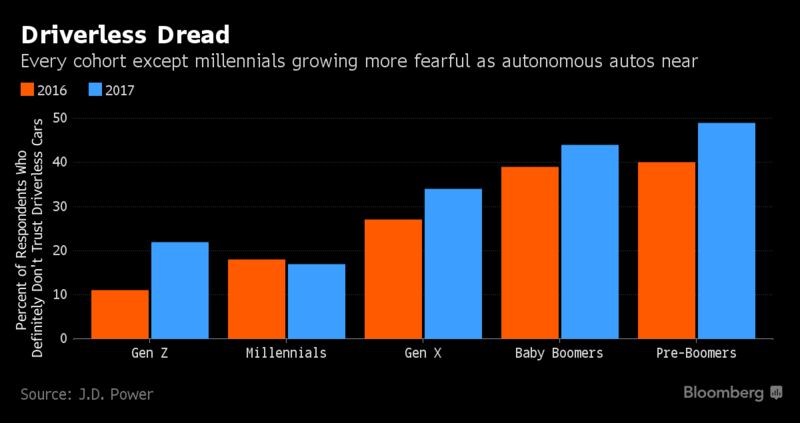
Autonomous autos are advancing so rapidly that companies like Uber Technologies Inc. and Alphabet Inc.’s Waymo are beginning to offer robot rides to everyday consumers. But it turns out the traveling public may not be ready. A recent survey by the American Automobile Association found that more than three-quarters of Americans are afraid to ride in a self-driving car. And it’s not just Baby Boomers growing increasingly fearful of giving up the wheel to a computer, a J.D. Power study shows — it’s almost every generation.

Consumers will only become comfortable with driverless cars after they ride in them, Mary Barra, the chief executive officer of General Motors Co., said this week. The largest U.S. automaker is testing 180 self-driving Chevrolet Bolts and ultimately plans to put them in ride-hailing fleets, though it won’t say when…

Dangerous as it may be to operate cars themselves, many drivers are anxious about autonomous technology because they associate it with the fragility of electronic devices. Laptops crash and calls drop with nagging regularity. The consequence of a computerized car crash is much greater.

Americans tend to like technology: we like progress and new and exciting options. Is the fear related to safety or also connected to how Americans view driving (despite all the hours spent commuting and stuck in traffic, Americans like the freedom it offers)?

I’m guessing this fear will drop within a few years as stories of mishaps become normal (and even the occasional mishap would be safer in the long run compared to the tens of thousands of Americans killed each year in vehicles) and the technology improves. Could we also imagine a scenario where governments impose self-driving vehicles because of their improved safety?

Is the Naperville diamond interchange working?

The relatively rare concept of a diamond interchange opened at the Naperville intersection of I-88 and Route 59 in September 2015. Was the effort to reconstruct the interchange worth it?

The short answer: there has not been an official pronouncement. Proponents suggested the design has several advantages: fewer accidents since drivers are not making left turns onto or off of highway ramps, improved efficiency since cars can merge onto ramps on red lights, and less space needed. Here some pieces of evidence regarding the matter:

–The Illinois Tollway is constructing another diamond interchange at I-90 and Elmhurst Road. Would they do this if their first attempt was unsuccessful?

–Crashes at the intersection were down between 2015 (73) and 2016 (53).

-Since it is a busy intersection – over 180,000 vehicles a day – wouldn’t drivers and officials gone public if there were major issues with the new design? Some drivers still thought it odd as of April 2016 but Naperville issues said they were pleased.

–According to DivergingDiamond.com, there are a number of diamond interchanges in the planning or construction stages across the United States.

The evidence seems to suggest the diamond interchange in Naperville is working. It still may be worthwhile to see when officials are willing to take credit or take a victory lap for their decision.

–