The limits in Chicago on a lower city speed limit

Chicago’s City Council disagreed on whether to lower the city’s default speed limit and ultimately voted against it:

Photo by Airam Dato-on on Pexels.com

The 28-21 vote against lowering the speed limit followed a spirited and emotional debate that pitted traffic safety advocates, many of them on the North Side, against African-American alderpersons concerned about uneven enforcement and a surge in pretextual traffic stops targeting Black drivers.

West Side Ald. Jason Ervin (28th), Mayor Brandon Johnson’s handpicked Budget Committee chair, led the charge against the lower speed limit.

Ervin said he “understands the logic that, if you go slow,” there will be fewer traffic fatalities and serious injuries. But when Johnson’s 2025 budget is balanced, in part, by installing more speed cameras, he is concerned about an avalanche of speeding tickets that struggling Chicagoans cannot afford to pay…

Wednesday’s vote was a bitter and emotional disappointment to Ald. Daniel La Spata (1st), an avid cyclist who represents Bucktown, Wicker Park, West Town and Logan Square, where several fatal accidents have occurred…

La Spata has estimated the lower speed limit could save the lives of more than 300 Chicagoans over the next decade.

The summary of the discussion hints at the meaning of speed limits. Are they about safety and discouraging higher speeds? A good number of American roads are built to be wide and straight such that the design itself can help drivers feel comfortable in going faster. And since many drivers go above whatever speed limit is posted, is a lower limit necessary to reign in the higher speeds?

Or are they about police enforcement? Are they about collecting revenue? Whether administered via law enforcement personnel or a speed camera, there is a legal process at work. In a society where driving is often required, the enforcement element matters.

Trying to think outside the box a bit, couldn’t the Council meet in the middle and settle for a 28 mph speed limit? Do all speed limits need to be in 5 or 10 mph increments?

This likely will be an ongoing discussion given the amount of driving in Chicago, interest in biking and pedestrian options in the city, and concerns about police activity.

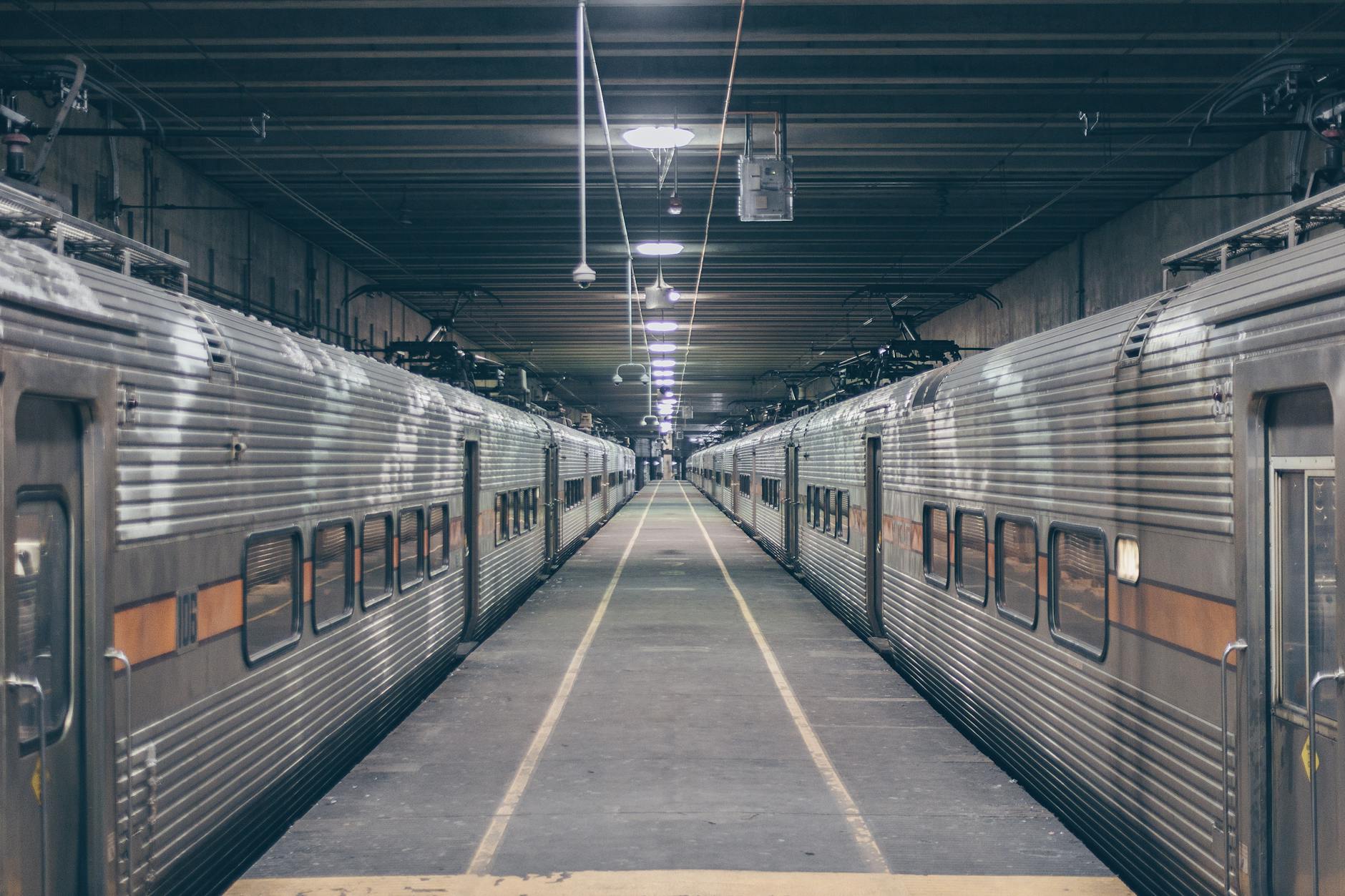
One thousand trains in and out of Chicago each day at the peak of train travel

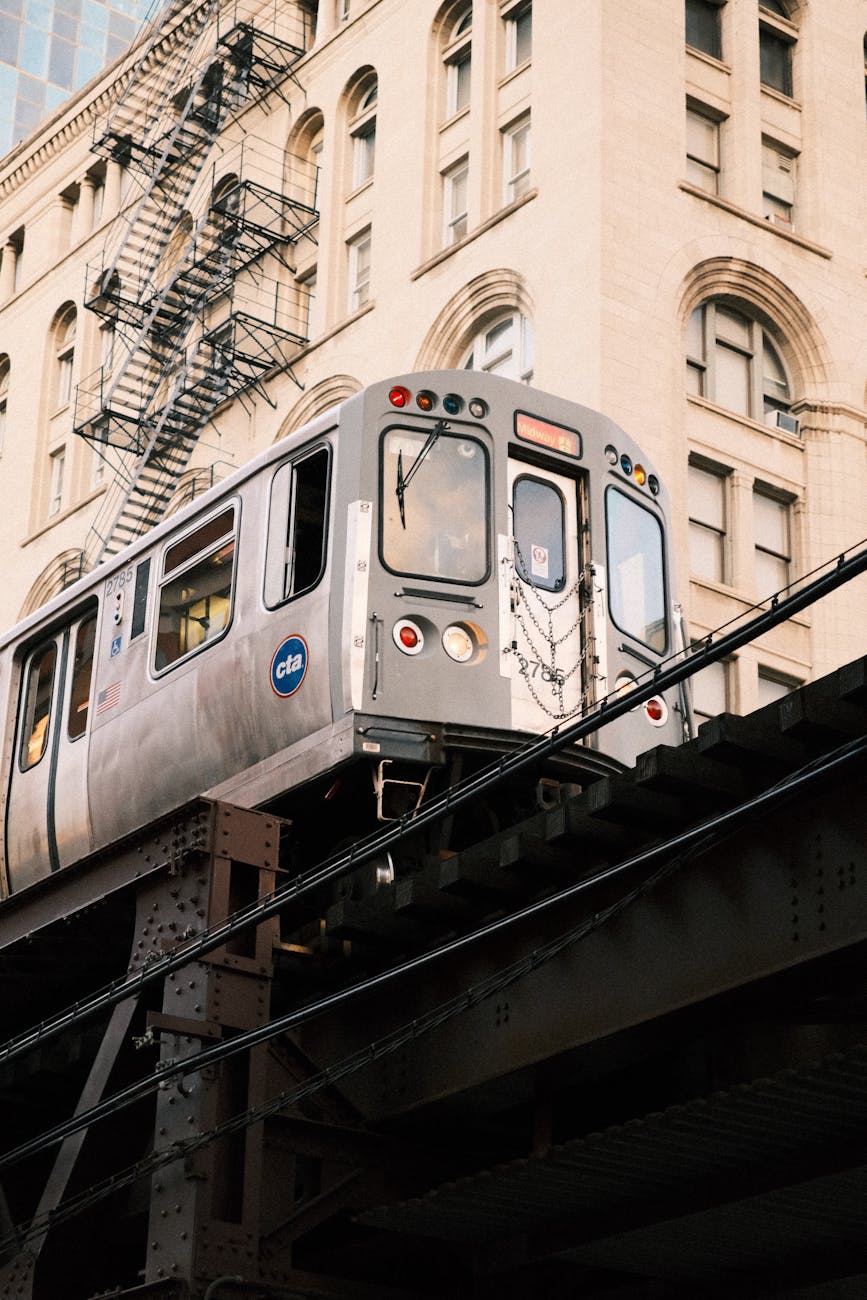
The book Forgotten Chicago includes the claim that at Chicago’s railroad peak, 1,000 trains daily moved in or out of the city. One chapter of the book details the numerous train stations that are no longer standing that serviced these trains.

Photo by Josh Sorenson on Pexels.com

Chicago continues to be a railroad center in the United States even if the volume of trains is not close to the peak numbers.

And as train travel declined, the Chicago region became home to other transportation options. Two of these are worth considering after the golden age of railroads passed (and Chicago’s port activity also declined). As people used trains less to travel between cities and used trains less within the region as commuting between suburbs picked up,

First, O’Hare Airport is one of the world’s busiest. Today it has over 900 daily flights (mostly domestic, some international). By number of passengers, it is in the top ten among global airports. I do not know how many people moved through Chicago via train at the peak but the flight numbers are large.

Second, many people travel throughout the region and to other regions via highways. For example, one interchange of two interstates roughly 20 miles west of the city has about 300,000 vehicles daily. Numerous highways throughout the metropolitan area have daily traffic counts of over 100,000 vehicles. That is a lot of cars and trucks moving people and goods around.

Increasing pedestrian deaths in Chicagoland area

What helps explain a rise in pedestrians deaths in the Chicago region from 2023 to 2024?

Photo by Vladimir Kudinov on Pexels.com

In Cook, DuPage, Kane, Lake, McHenry and Will counties, pedestrian crash fatalities totaled 144 last year, a 6.7% rise from 135 in 2023…

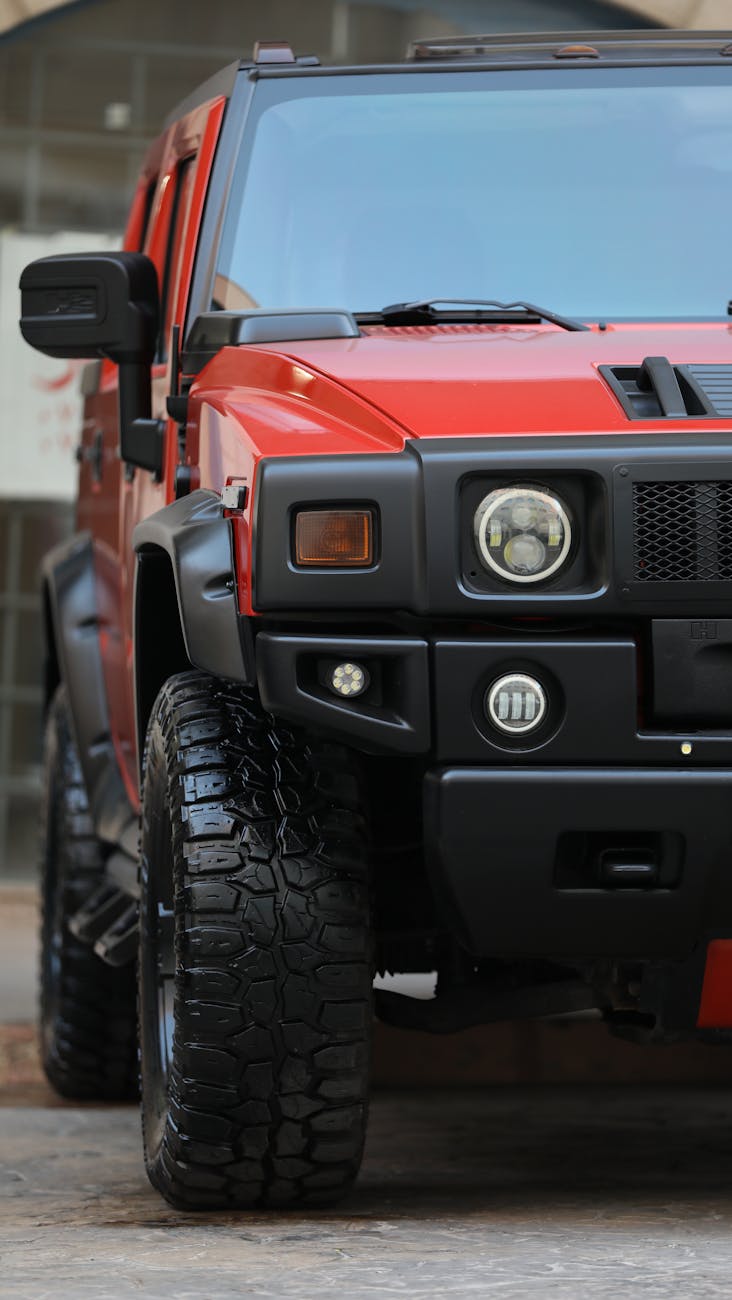
Asked to explain the trend, CMAP Senior Transportation Planner Barrett cited Insurance Institute for Highway Safety research that found SUVs, pickups and vans with hood heights greater than 40 inches are about 45% more likely to cause pedestrian deaths in crashes than vehicles with shorter hood heights. Blunt, vertical front ends also increase risks…

Barrett and Active Transportation Alliance Advocacy Manager Alex Perez also listed distracted driving, COVID-19-era bad habits such as speeding, and traffic enforcement drop-off as contributors to collisions…

Street design also plays a role with busy suburban corridors such as North Avenue — multilane, fast-flowing intersections that are problematic at best for pedestrians and cyclists, he added.

There are lots of factors at play that make walking and biking dangerous in metropolitan areas. Each of the factors listed above – size of vehicles, safer driving practices, and street design – could each be addressed.

But the goal of reducing pedestrians deaths or having safer streets might be best served by reducing driving and encouraging other forms of transportation. Driving is deadly across the board for drivers and pedestrians. Americans accept the risks of driving because they tend to live driving, or at least like driving compared to other options.

Or rather than prioritize safety efforts that try to play around the edges of the dominant system of driving that seems required in almost all American communities, could communities that from the beginning that serve a variety of mobility options do better? Retrofitting existing communities is hard. Adding bike lanes, establishing good mass transit, and prioritizing other uses of streets takes time and money.

Of course, reducing driving might be unpopular. Wildly unpopular. It is often associated (positively) with the American way of life. So if public officials or residents or others want safer roads, they might have to address individual factors that each have limited impact.

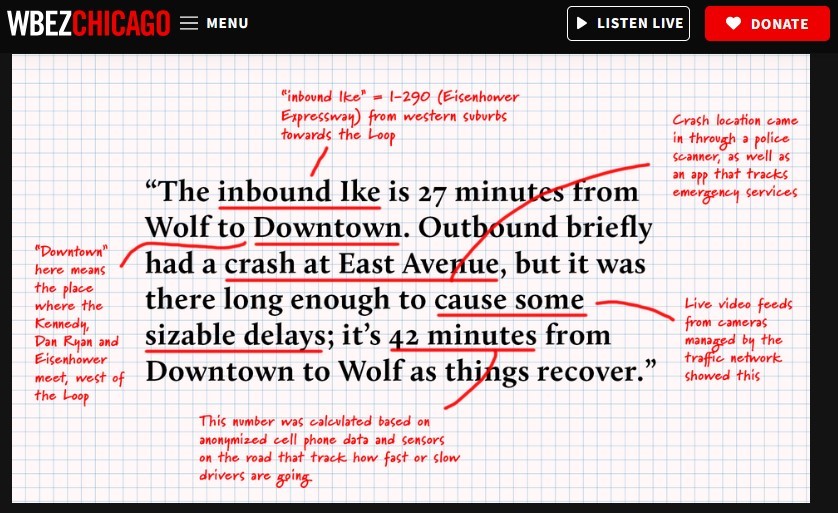
Where “downtown” is in Chicago traffic reports

Listen to or watch or read Chicago traffic reports and “downtown” is likely to come up. Here is what that refers to:

In Chicago, the downtown is like it is in the many big cities: it is the central business district, marked by skyscrapers and business activity. Downtown and the Loop – marked by mass transit lines – are pretty synonymous. The Loop is one of the city’s 77 community areas that have been defined for decades.

But the downtown referenced above is outside the Loop. It is across the Chicago River. It is marked not by financial matters but by the convergence of highways. It arose on top of existing neighborhoods. This is technically the Jane Byrne Interchange, a busy location where people are driving in and out of the city. Depending on traffic, it can take a while to get from this location to downtown.

While they are not the same place, this sounds very American: the center of the city is actually where the most vehicles meet. As so much day-to-day life involves driving, perhaps this is downtown for many.

The numerous consequences of “car bloat”

Vehicles on American roads have gotten bigger over the years. This has various effects:

Photo by Ameer Aljdou on Pexels.com

I use the term car bloat to describe the ongoing expansion of vehicle models over the past 50 years. Although car bloat is a global trend, it is especially pronounced in the United States, where sedans and station wagons have been largely replaced by the SUVs and pickups that now account for about 4 in 5 new car purchases. At the same time, individual models have grown heftier. A 2024 Chevrolet Silverado pickup, for instance, is around 700 pounds heavier and 2 inches taller than the 1995 edition. According to federal data, the average new American car now weighs around 30 percent more than it did 40 years ago.

Car bloat creates numerous costs that are borne by society rather than the purchaser, or “negative externalities,” as economists call them. These include increased emissions, faster road wear, and reduced curbside parking capacity. But car bloat’s most obvious and urgent downside may be the danger it presents to anyone on the street who isn’t cocooned inside a gigantic vehicle.

Although occupants of big cars may be slightly safer in a crash, those in smaller ones are at much greater risk. A recent analysis by the Economist found that among the heaviest one percent of American cars, 12 people die inside smaller models for each person saved by the enormity of their vehicle. Pedestrians are still more exposed. A recent study by the Insurance Institute for Highway Safety found that vehicles with tall, flat front ends—common on SUVs and pickups—are more than 40 percent more likely to kill a pedestrian in the event of a crash than those with shorter, sloped ones. Worse, giant cars are more apt to hit a human in the first place because drivers sitting high off the ground have an obscured view of their surroundings. A 2022 IIHS study found that large vehicles’ A-pillars (the structure between a windshield and side window) frequently conceal pedestrians at intersections, and TV news stations have run segments demonstrating that an SUV driver cannot see as many as nine toddlers sitting in a row in front of her.

Having a bigger vehicle may help increase the safety of the driver and passengers but causes issues for others. If the American emphasis on driving and planning around cars was not enough, having even larger vehicles makes it more difficult for pedestrians, bicyclists, and users of smaller vehicles.

The article goes on to discuss options to limit the danger to pedestrians while still allowing vehicles to be big. It might be harder to think of realistic ways that American vehicles could shrink over the next few decades. Imagine an American landscape in 2050 where large vehicles are rare. Large SUVs and pickup trucks are small in number. More vehicles are smaller. How did it happen? Will Americans come to care more about the environment? Will there be a larger groundswell for alternative modes of transportation? Will there be influential financial incentives to move to smaller vehicles? Is there political will to set size and/or weight limitations?

I also imagine there might be some limits to how big vehicles could get. Do lane widths and parking spots all need to be redesigned? Is there a significant loss in drivability and/or fuel efficiency at some point?

The Wild West of parking lots with no traffic signs

Parking lots may appear to be safe and controlled traffic environments. Drivers are usually not traveling very fast. Drivers need to be attentive to carts, curbs, and people walking around. New drivers go to parking lots to build their skills.

Photo by Wendy Wei on Pexels.com

Yet parking lots can be the Wild West of driving situations. This is particularly true of lots where there are few or no traffic signs and markings. You have rows and arteries through the parking lot that have no stop signs or signs of where to go.

Last year, we had an incident in such a lot. Driving around the outside of the lot on a roadway separated by curbs from the parking rows, someone pulled out and into the side of the front of our vehicle. There was no stop sign at the end of the row or marking on a pavement. Anyone could be turning in and out of the rows. Presumably they should look to see if vehicles are coming toward them? Presumably everyone is supposed to yield (though there are no yield signs)?

I feel this in parking garages as well where there may be signs and markings but they can be hard to see in the lighting and a cramped environment. Vehicles come quickly around turns. Drivers are looking to back out and pull in.

Since parking is essential in American places due to the heavy reliance on driving, are there better solutions to lots with few signs? Is the primary goal of a parking lot to move vehicles quickly through the space? Is it to help customers or residents or visitors to safely make it to their destination? Is it to fit as many vehicles as possible in/

Trying to cut through a street grid on a diagonal to save time and distance

Street grids have benefits, including offering multiple routes should congestion arise at one intersection or certain routes are off-limits. But what if a driver or pedestrian wants to move quickly through the grid at a diagonal?

Photo by Pixabay on Pexels.com

Different communities may offer options for this. Perhaps there are alleys one can cut through. These back ways offer even more alternatives through the grid if the main streets are congested. Or there might be an occasional diagonal roadway that crosses at an angle to other roads. Depending on the way one is traveling, the diagonal route might be more direct.

Chicago is a good example of having both options in numerous neighborhoods. The flat Midwestern city primarily has a road grid that stretches for miles. East-west and north-south streets can go a long way from one end of the city to the other (and beyond). At the same time, alleys and diagonal streets provide other travel options. The diagonal roadways can create some interesting intersections – these present travelers with different visuals and traffic patterns than they might be used to – but offer more direct routes at an angle to the grid. Numerous alleys take some pressure off the roads for garages, garbage, and other uses.

I imagine other places might offer different options. Any city offer an underground grid at a 45 degree angle to the ground-level grid? Or pedestrian skyways or tunnels that offer paths that cross the grid in different ways?

Aiming for zero road deaths in Chicago

Bicycle fatalities are down in the last year in Chicago. Could this help lead to zero road deaths in the city?

Photo by Chait Goli on Pexels.com

It was the only bicyclist death so far this year, suggesting what some hope signals the beginning of a decline in such fatalities.

Some even contend the number of all traffic deaths in Chicago — cyclists, motorists and pedestrians — could be reduced to zero with the right improvements.

Others are more guardedly optimistic.

Before that August crash on the West Side, Chicago had gone 10 months without a cycling death. That was the longest such duration dating back to at least the beginning of 2019, the earliest year available from the city’s daily traffic crash data.

“Statistically, this drop appears too large just to be entirely good luck,” said Joseph Schwieterman, a transportation professor at DePaul University. “It’s not likely the fatalities will stay at this level, unfortunately, but this is encouraging.”

The rest of the article talks about methods that could be implemented to make roads in Chicago safer.

As I have read about similar efforts in recent years, reducing traffic deaths seems to go well with multiple other efforts:

  1. More sustainable cities with fewer cars on the road and other viable non-driving transit options.
  2. More inviting and lively streetscapes with less emphasis on motorized vehicles.
  3. Encouraging walking and biking, which are healthier options.

Safety alone may or may not be a compelling reason to change conditions but combine safety with other interests people have and perhaps there will be a steady shift away from only emphasizing driving.

Seeing a steam locomotive roll through suburbs created by such vehicles

At least a few suburbs in the Chicago area and outside cities throughout the United States owe their founding to early railroad lines that provided quick access to the bi city and other points beyond. So when a large steam locomotive passed along the same suburban tracks in 2024, at least a few people took note:

With a shiny yellow-and-gray streamlined passenger train in tow, the Union Pacific “Big Boy” No. 4014 steam locomotive rolled through the western suburbs Monday morning to the delight of railroad enthusiasts and casual observers alike.

Roughly two hundred years ago, steam locomotives opened up all kinds of possibilities. One opportunity involved the possibility of larger and further-flung suburbs: a resident outside could travel quickly in and out of the big city. It no longer took a day or more to use horses or a carriage. No more need to travel a long distance over poor roads. Large amounts of freight could be shipped overland from the interior to big cities.

The early railroad lines tended to connect important cities and locations to each other. Along these lines, residents gathered near stations. Lots were developed. Businesses moved there. Churches opened. Houses were built. Communities grew. Regular train service emerged.

Eventually, these railroad lines were dwarfed in importance by cars, trucks, roads, and highways. Many of the lines still exist but more people drive. Much suburban development since World War Two has happened between railroad lines as cars offered access to more land.

Amid the regular clatter of passenger and freight trains through suburbia, an occasional steam locomotive with a loud whistle and billowing smoke provides a reminder of an older era. Yet, that older era helped give rise to the automobile dominated suburbia of today.

The new 10-to-4 office hours and commuting patterns

When rush hour is continues to change:

Photo by Pixabay on Pexels.com

The traditional American 9-to-5 has shifted to 10-to-4, according to the 2023 Global Traffic Scorecard released in June by INRIX Inc., a traffic-data analysis firm.

“There is less of a morning commute, less of an evening commute and much more afternoon activity,” said Bob Pishue, a transportation analyst and author of the report. “This is more of the new normal.”

Now, there is a “midday rush hour,” the INRIX report found, with almost as many trips to and from the office being made at noon as there are at 9 a.m. and 5 p.m.

Also, commuters have all but given up on public transportation. Ridership sank during the pandemic, Federal Reserve Bank of St. Louis data shows, and never fully recovered.

The rush hour increasingly seems to be “traffic all the time!”

Since this has now been going on for a few years and also includes changes to truck use and ride sharing, what are cities and regions doing differently? What incentives do drivers and organizations have to choose other than drive by themselves when they want?

There does seem to be some possible good will to change traffic patterns when there are major issues, like significant highway repairs or the Olympics. When does regular traffic become a large enough issue that people start acting together?

Like I asked yesterday, are there cities and regions that do a better job at this than others?