The prime suburban real estate available when restaurants close

Want a prime location in the suburbs? Red Lobster and TGI Fridays might have an answer:
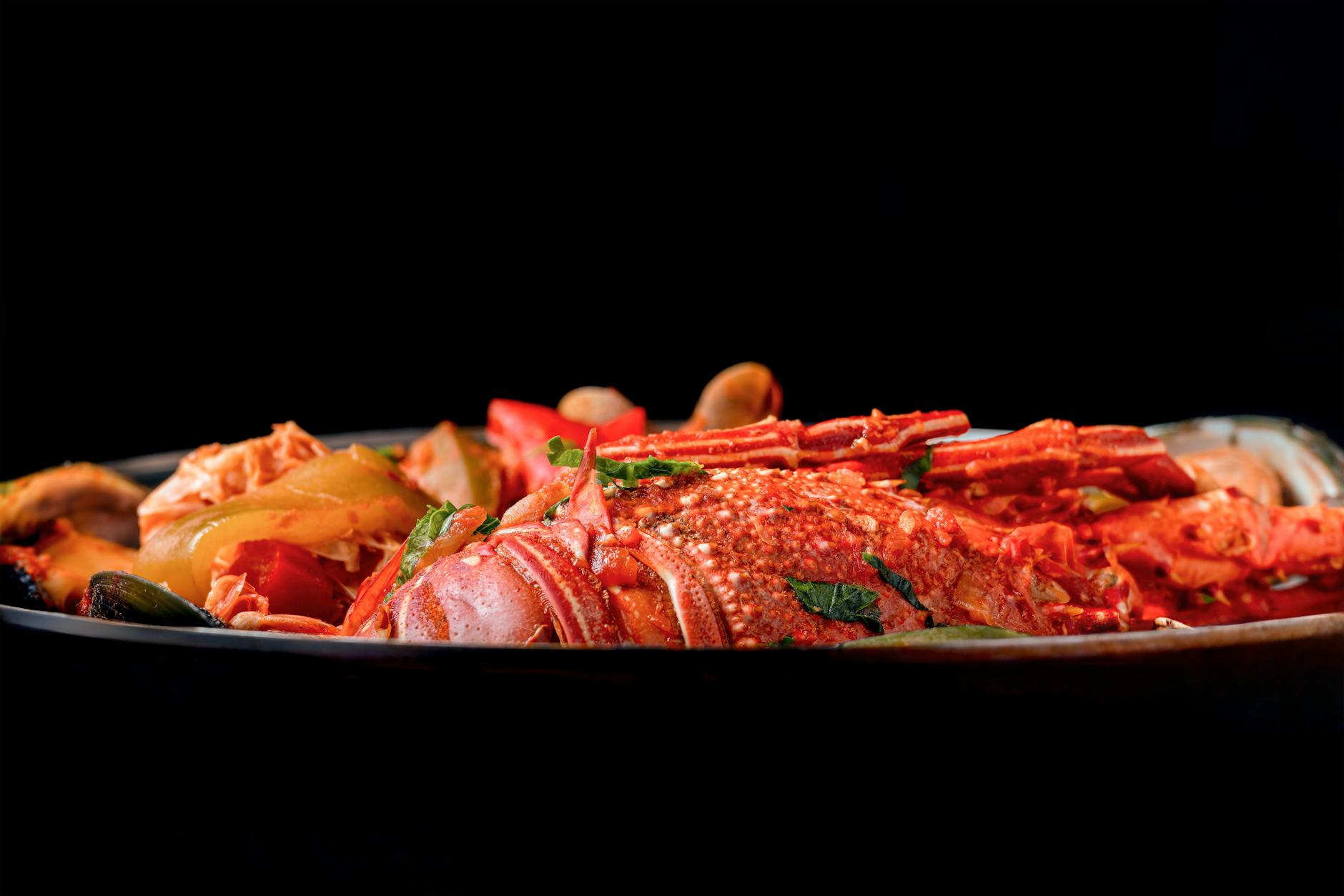
Photo by Armando Oliveira on Pexels.com

Vacant restaurant chains are creating prime real estate for a wide range of companies looking for spots to grow, especially fast-food chains that want to install drive-thru lanes on spots where diners once sat down for dinner.

Chains like Red Lobster and TGI Fridays filed for bankruptcy this year and closed more than 175 restaurants combined. Red Lobster was driven into bankruptcy by mismanagement under a previous owner, global shrimp supplier Thai Union, while TGI Fridays fell under private equity owner TriArtisan Capital Advisors. Denny’s is also closing 150 restaurants…

In the past, these restaurants would often be replaced by a different restaurant chain, with tables to sit at and servers to bring out the food. But now, fast-food and fast-casual chains are taking these spaces and building more drive-thru lanes. Chipotle is building 4,000 new locations, the majority with drive-thru lanes, while Chick-fil-A is building new spots with four-lane drive thrus…

Many of these restaurant locations are also attractive to prospective tenants, as they are freestanding buildings, not located in the back of decaying indoor malls. Indoor malls have struggled in recent years, and mall vacancies reached 6.5% last quarter, according to CBRE. Macy’s, JCPenney, Nordstrom and others have closed hundreds of their stores in malls as online shopping has grown to around 16% of retail sales. Real estate research firm Green Street estimates about 150 enclosed malls have closed since 2008, leaving about 900 today.

Most of the closed restaurants are also located on high-traffic streets with large parking lots or adjacent to a shopping center, making them attractive sites.

I have heard before that certain restaurants and retailers are less into the business of selling things and more into the business of real estate. Think just of the largest fast food chains in the world: how many prime locations do they occupy? If all that land went up for sale at once, how many other businesses would be interested in jumping in?

I have been thinking about locations like these in terms of religious congregations recently. They often occupy important locations within communities, sometimes at busy intersections or in important historic locations. If that location is no longer occupied by a congregation and/or a religious building, it could be a loss in the community (and a possibility for something else).

In the case of these restaurants, it appears there is plenty of demand for the land and plenty of interested parties want to make more money with these properties. Additionally, I would guess most municipalities love that another restaurant will take over. Those new restaurants and businesses can generate even more revenue. The worst possible outcome is that the land remains vacant with limited demand and the property becomes an empty eyesore.

How long before these new restaurants that take over are selling off their own properties? Ten years? Twenty years? At least in this moment, new restaurants want to snatch up these properties but that might not always be the case.

The sameness and authenticity of coffee shops around the globe

Why do so many coffee shops tend to look the same?

Photo by Anna Urlapova on Pexels.com

I often typed “hipster coffee shop” into the search bar as a shorthand because Yelp’s search algorithm always knew exactly what I meant by the phrase. It was the kind of cafe that someone like me – a western, twentysomething (at the time), internet-brained millennial acutely conscious of their own taste – would want to go to. Inevitably, I could quickly identify a cafe among the search results that had the requisite qualities: plentiful daylight through large storefront windows; industrial-size wood tables for accessible seating; a bright interior with walls painted white or covered in subway tiles; and wifi available for writing or procrastinating. Of course, the actual coffee mattered, too, and at these cafes you could be assured of getting a cappuccino made from fashionably light-roast espresso, your choice of milk variety and elaborate latte art. The most committed among the cafes would offer a flat white (a cappuccino variant that originated in Australia and New Zealand) and avocado toast, a simple dish, also with Australian origins, that over the 2010s became synonymous with millennial consumer preferences. (Infamous headlines blamed millennials’ predilection for expensive avocado toast for their inability to buy real estate in gentrifying cities.)

These cafes had all adopted similar aesthetics and offered similar menus, but they hadn’t been forced to do so by a corporate parent, the way a chain like Starbucks replicated itself. Instead, despite their vast geographical separation and total independence from each other, the cafes had all drifted toward the same end point. The sheer expanse of sameness was too shocking and new to be boring…

My theory was that all the physical places interconnected by apps had a way of resembling one another. In the case of the cafes, the growth of Instagram gave international cafe owners and baristas a way to follow one another in real time and gradually, via algorithmic recommendations, begin consuming the same kinds of content. One cafe owner’s personal taste would drift toward what the rest of them liked, too, eventually coalescing. On the customer side, Yelp, Foursquare and Google Maps drove people like me – who could also follow the popular coffee aesthetics on Instagram – toward cafes that conformed with what they wanted to see by putting them at the top of searches or highlighting them on a map…

Simply existing as a coffee shop isn’t enough; the business has to cultivate a parallel existence on the internet, which is a separate skill set entirely. “It almost feels like, you must have a social media acumen, you must be savvy in this area that is adjacent to your business, but not directly embedded in your business, in order to be successful and visible,” Walsh continued. That means plenty of tagged photos on Instagram and positive user reviews on the business’s listing on Yelp or Google Maps…

The other strategy is to remain consistent, not worrying about trends or engagement and simply sticking to what you know best – staying authentic to a personal ethos or brand identity in the deepest sense. In a way, coffee shops are physical filtering algorithms, too: they sort people based on their preferences, quietly attracting a particular crowd and repelling others by their design and menu choices. That kind of community formation might be more important in the long run than attaining perfect latte art and collecting Instagram followers. That is ultimately what Anca Ungureanu was trying to do in Bucharest. “We are a coffee shop where you can meet people like you, people that have interests like you,” she said. Her comment made me think that a certain amount of homogeneity might be an unavoidable consequence of algorithmic globalisation, simply because so many like-minded people are now moving through the same physical spaces, influenced by the same digital platforms. The sameness has a way of compounding.

As a different kind of place, fast food restaurants are often criticized for their sameness. As part of a larger brand, individual locations feature similar food, aesthetics, and signs that provide familiarity for patrons.

Coffee shops are supposed to be the antithesis. They are cool while fast food is formulaic and bad for you. They offer sophistication rather than mass production. They allow space for quietly working or interacting with friends while fast food places are about efficiency and moving people in and out.

But, this piece suggests the Internet and a particular class of people have helped contribute to sameness across continents. These may be independent coffee shops but they are trying to respond to global patterns. Do customers really want a unique place or do they want some predictability? The McDonaldization (from sociologist George Ritzer) of space is worth considering more as physical spaces are shaped by Internet realities. People operate and interact in both realms. The suggestion here is that the Internet is driving the shaping of physical spaces and the reverse could happen as well.

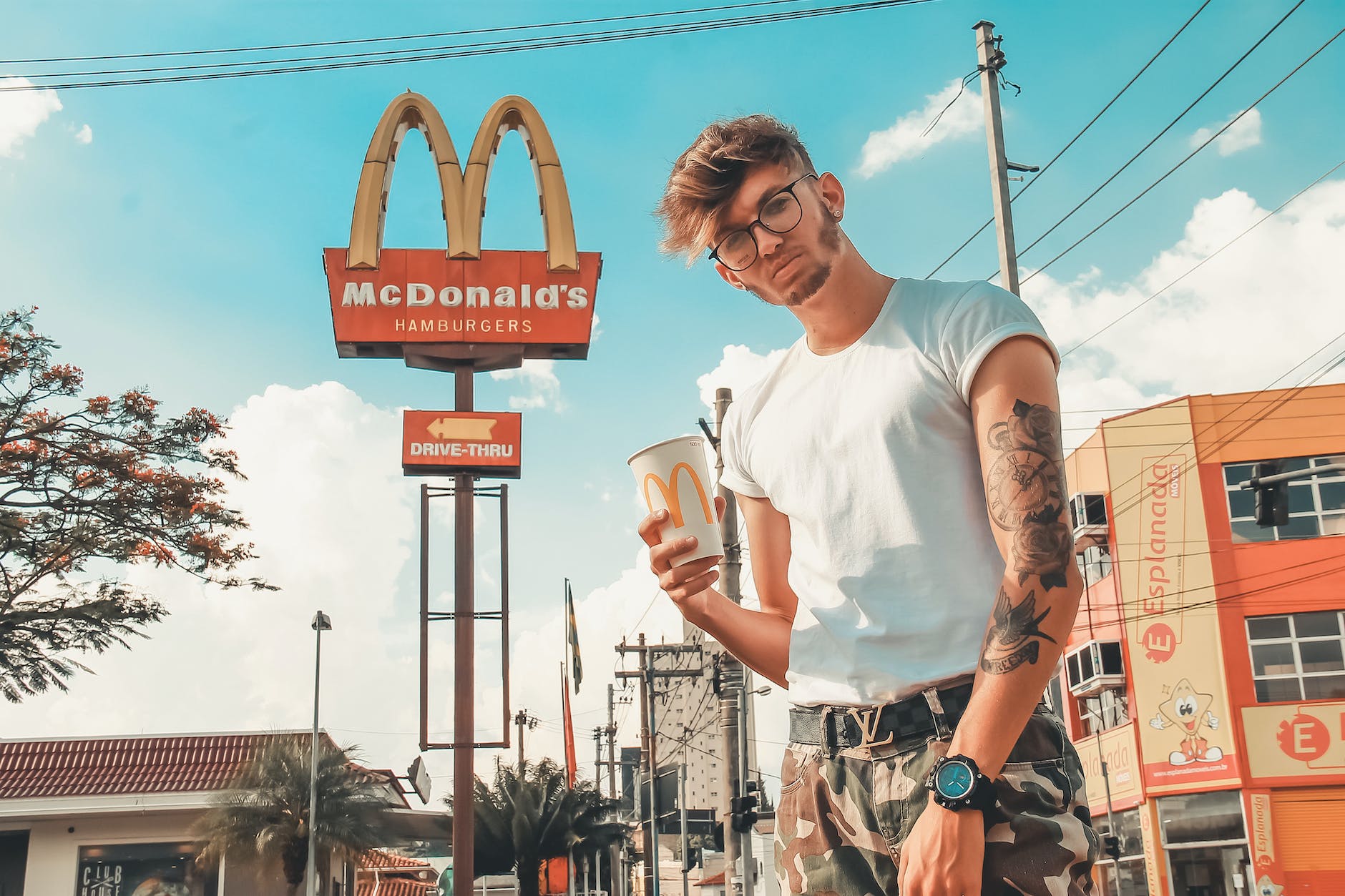
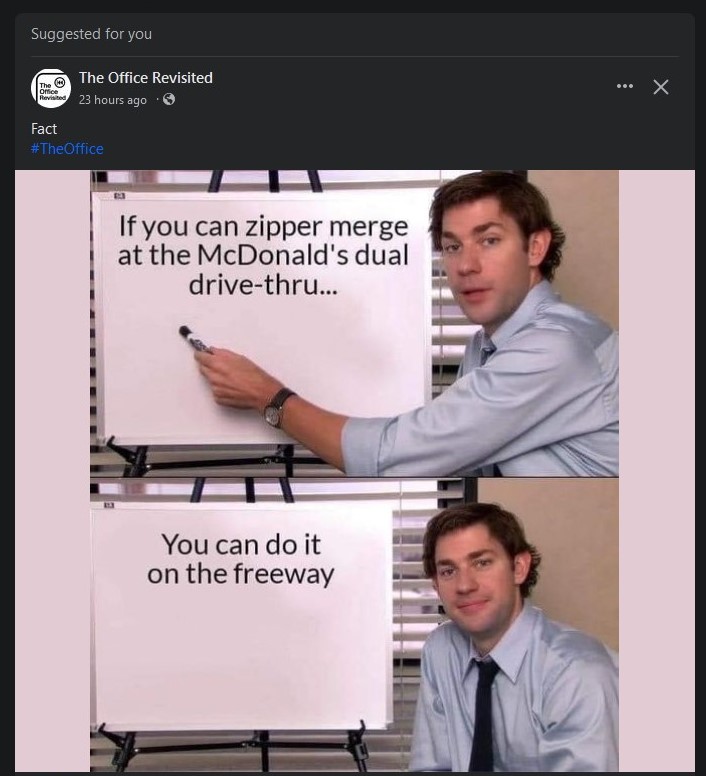
Zipper merges work great at…McDonald’s?

Highway drivers sometimes struggle to use full lanes to merge when a lane is closing or ending. This is known as the “zipper merge.” Thankfully,McDonald’s has helped show Americans they can do it?

McDonald’s has several advantages in encouraging a smooth zipper merge process:

  1. A shorter runway to merging. You often go around a turn, order, and immediately merge. In contrast, highway merges can sometimes be seen from a mile or more away and some want to block all that space.
  2. A physical separation of the lanes before merging. The vehicles are ordering before merging and the need to have a display board and speaker means the lanes cannot be crossed into. Even if a driver wanted to block the other lane, the physical barriers make that difficult.
  3. People want to get their food. While driving on the highway, the goal is to get somewhere quickly. Different motivations.
  4. Might it matter that McDonald’s is private property while highways/roadways are more of open or public space?

Some of these principles could be applied to highways. Imagine temporary physical barriers between the lanes to force a merge closer to the end of the lanes. Or, reminders that blocking lanes has (legal?) consequences even though it is more public space.

Emphasize the drive-thru and delivery, ditch the indoor dining

More fast food, coffee, and fast causal restaurants are moving toward no indoor dining space:

Photo by Alexandro David on Pexels.com

Last August, Dunkin’ opened its first “digital” location on Beacon Street in Boston. There are no cashiers, replaced by touchscreens and mobile ordering, and no seats or tables.

Dunkin’ is far from alone. Name a fast-food restaurant and the odds are the company has recently developed a branch without any restaurant at all. Chipotle’s first “Digital Kitchen,” which opened in upstate New York in 2020, has no dining room. A branch that opened last year in the Cleveland suburbs doesn’t even let customers inside the store. This summer, Taco Bell opened something it calls Taco Bell Defy, which is not a restaurant at all but a purple taco tollbooth powered by QR code readers and dumbwaiters that bring the food down from a second-story kitchen. The operation is, by most accounts, astoundingly efficient. Wingstop’s “restaurant of the future” doesn’t have seats or take cash.

What’s driving this trend? Partly savings on real estate and labor. But mostly it’s a response to consumer preference. Pushed by pandemic restrictions and pulled by the increasing ease of mobile transactions, customers have rushed into drive-thrus, delivery, and mobile ordering. Even with coronavirus fears in most Americans’ rear-view mirror, Chipotle’s in-restaurant sales now account for just a third of its business. At Panera, which opened its first to-go-only locations this summer, that figure is under 20 percent…

Like the parallel remote-work phenomenon, the rise of what McDonald’s calls the Three D’s—digital, drive-thru, and delivery—may reflect an ongoing social atomization as the shared spaces that emptied out during the pandemic are slow to fill back up, to the point that walk-up, dine-in customers like me are no longer the focus, and might even be a nuisance. Often lauded as a vital “third space” for seniors, teenagers, and families in communities that lack friendly public spaces, McDonald’s unveiled a concept store in 2020 that has no seating at all.

This kind of eating works in the United States largely because of the amount of driving Americans do. In commuting and other trips from place to place that are required for daily life, they want access to food on the go. The option of indoor dining might be nice for some – see the idea of third spaces above and the ways this can enhance public life – but much business via people who never leave their car.

If those who used to eat inside these restaurants cannot do this, where will they go instead? This could lead to an uptick in eating restaurant food at home. This is a different kind of experience, more private with the diner have much more control over lighting, screens, sound, and more. It is much harder to fix wrong orders or to get more food. The restaurant experience might be limited to only larger outlays of money and specific foods in particular locations.

A McMansion with a real McDonald’s/fast food theme inside?

A home in suburban New York has an interior devoted to McDonald’s and fast food:

There is a New York house for sale that was decorated as a love affair with fast food and it’s crazy. The kitchen looks like a modern McDonald’s complete with a kids section with old playland furniture. There are also tons of old fast food memorabilia like Ronald McDonald statues and stained glass that was used in McDonald’s restaurants in the 70s.

The fast-food theme doesn’t just start and end with McDonald’s. It includes Burger King, Wendys, and White Castle too…

This is the actual kitchen in this house. Does that not look like a modern McDonalds? Just about the only things missing are cash registers and a drive-thru window…

I swear I didn’t just run down to my local McDonalds and snap a picture of their bathroom. I mean really, how creepy would that be? This one of the bathrooms off the kitchen and it looks just like one you’d find in a typical fast food joint.

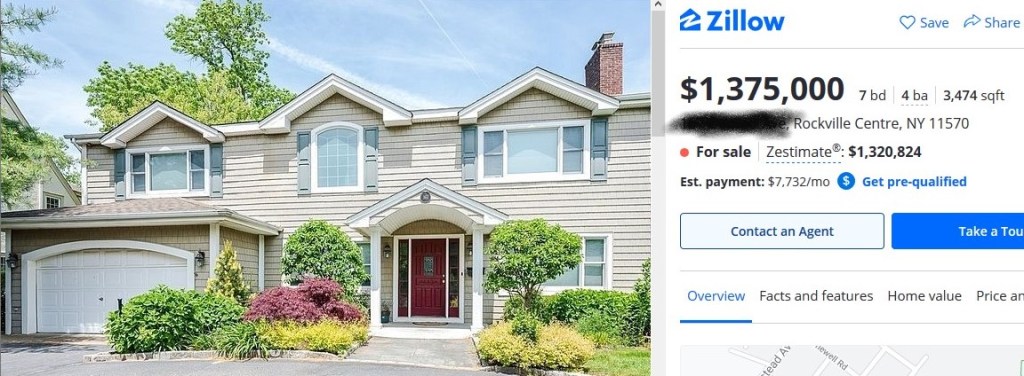
According to Zillow, the home is over 3,400 square feet and has seven bedrooms:

The term McMansion is linked to McDonald’s in that the “Mc-” prefix implies something mass produced with relatively poor quality. Does this home fit? The home is big, roughly 1,000 more square feet than the average new home. The exterior is interesting: the proportions are off as the top windows which look like they are symmetrical do not line up with the bottom features where the entryway (completely with columned portico) and garage are offset. The gables over the top windows are unncessary though the siding looks consistent.

Is the house a bit odd looking? Yes. Is the McDonald’s and fast food interior unique? Yes. But, I wonder if something else is going on here that does not quite line up with the McMansion moniker. When I first saw the home and location, I wondered if this was a postwar house. Indeed, the Zillow listing says the home was constructed in 1947. My guess is that this home had at least one addition or major change since its initial construction and these add-ons contributed to the odd facade. When people use the term McMansion, they tend to refer to a home built since the 1980s that was constructed with the poor features and quality. This home is not that. When looking on Google Street View, many of the nearby homes look to be older homes as well.

Perhaps this home is more like a McMansion because the interior specifically references fast food. Is it ironic? Nostalgic? Does all of it come the property? Put a Golden Arches in front of the house and this might be accurately termed a McDonald’s House, not a McMansion.

Finding the “unstandard McDonald’s”

A Twitter account titled “unstandard mcdonald’s” features unusual McDonald’s buildings.

Recently discovering this account reminded me of some earlier posts about unusual McDonald’s (see here and here). There might be some things worth researching here…

  1. How often are fast food companies – or any large corporations with many locations – willing to compromise their architectural identity to either meet (a) local standards or to (b) be located in a potentially profitable location? In the first case, different communities might want a fast food restaurant to look a certain way. Some might consider a typical McDonald’s tacky or vulgar but the business might be more acceptable if it fits with local architecture. In the second case, McDonald’s might prefer to have a drive-thru and huge identifiable arches but can you pass up a location in a heavily trafficked location like an urban street corner or a museum?
  2. What makes the cases featured on this Twitter account stand out is that they are deviations from what McDonald’s typically looks like. Fast food – and other industries – value recognizability, especially when drivers are going by at a high rate of speed. McDonald’s helped standardize all sorts of things (hence McDonaldization), including architecture and design. Of course, that look can change over time but it typically takes place within a corporate-defined time period to refresh locations or project a new image.
  3. Can fast food have local variation? Different regions have different chains while other businesses are all across the country. Perhaps the most famous example in a similar space to McDonald’s is In-N-Out Burger. As the chain expands (and the recent opening of locations in Colorado drew lots of customers), does it lose some of its cachet and quality as it becomes just another national chain? Fast food is part of the American lifestyle but it also draws much critique.

Can Starbucks be a third place when its drive-through is so full?

Starbucks aspires to be a third place, a setting where people of different backgrounds can gather in between home and work. Coffee shops, and restaurants more broadly, can play this role as people need to eat and drink and such activity is often tied to social interaction.

In my morning commute, I pass a Starbucks in front of a strip mall and right next to a busy suburban road. The drive-through line is always very full. The size of the line is particularly noticeable in this location because once the Starbucks line has more than eight cars, it spills over into the roadway through the shopping center and can block traffic.

The inside of this location is attractive. A month ago, I spent a morning working there. The store had dark walls and what looked like a tin ceiling plus a variety of seating options (tables, upholstered chairs, work counters). A steady flow of people came in and out and there were at least a few others like me hunkered down for several hours doing work. From my working location inside, all morning I could see the steady flow of people going through the drive-through.

Can a coffee shop or any restaurant so dependent on drive-through traffic for business (think McDonald’s) truly be a gathering spot, a social space, a third place? Perhaps the issue is much bigger than Starbucks:

1. Businesses do need to make money. Starbucks has encountered this problem before with people and visitors who might restrict or limit sales. Not having a drive-through is a bold statement but might not be financially viable (or might not generate the kind of revenue Starbucks desires).

2. The suburbs require driving (and many Americans seem to like it this way). Starbucks locations in denser settings do not have drive-throughs and perhaps they can better function as third places.

3. American fast food combines the ability to drive and getting food quickly. Without a drive-through, Starbucks is both missing out on business and putting itself into a different category of place.

4. Americans in general may not like third places given their preferences for single-family homes and private dwellings alongside their devotion to work. Any business or restaurant trying to fight against this may not make much progress. Even if people come to Starbucks or similar locations, how many engage with the people around them as opposed to focusing on their own work or interacting with a companion who came with them or who met they there? Public spaces where people come together are rare.

Maybe Starbucks can only be a third place in a certain kind of location with denser populations and less reliance on cars. Or, perhaps Starbucks can never really be a third place in a society dominated by driving and quick food.

Fast food restaurants move from one-size-fits-all architecture to “curated” design

Americans often can recognize a McDonald’s or Taco Bell anywhere in the country with their familiar architecture. This may be changing:

“What is different now from what we used to do is we are breaking away from a one-size-fits-all model and going to more flexibility, more variations, to end up with a more curated approach,” says Deborah Brand, Taco Bell’s vice president of development and design. Taco Bell has spent the past two years rethinking its restaurant design, and Taco Bell Cantina is just one result. “I think it’s a different approach to value,” Brand says. “We’ve always known that we have inexpensive food that is craveable, but we also look at value as serving the same food at the same price point in a potentially much more elevated dining environment.”…

Many other fast-food chains—“quick-service restaurants,” or QSR, in industry parlance—are doing the same. Restaurants from McDonald’s to KFC to Starbucks are rethinking their spaces inside and out, in a wave of design interventions that, given the sheer number of these restaurants, will spread throughout the U.S. These designs are setting a new standard for the commercial landscape, guiding the look and feel of the stores and restaurants on our streets and in our daily routines….

A quirk of designing for chains with thousands of restaurants and global marketing campaigns means that the design of the physical spaces often has to align with the image of the restaurant being portrayed in advertisements. In recent years, the KFC brand has built its advertising campaigns around an updated interpretation of the chain’s white-haired founder and human mascot, the long-deceased Colonel Harland Sanders, playing on his Southern gentleman character, while also making him, and the restaurant he represents, a little feisty. McCauley and FRCH were tasked with redesigning the restaurants to reflect this new attitude…

Today, in the era of the Taco Bell Cantina, the chain has diversified its approach to design, shifting far away from this signature building style. But branding through architecture is still a strategy used by some fast-food chains. Take the white castle-shaped buildings of the White Castle brand, for instance, or the sloping, hat-shaped red roof of the Pizza Hut chain. In its early years, McDonald’s required that its franchised restaurants use the famed “golden arches,” two parabola-shaped yellow bands on each end of the building that became a form of physical advertising. Now, for reasons such as cost and flexibility, brands are putting less emphasis on highly defined ornamental architecture and paying more attention to the experience of the customer, both in the drive-thru and inside the building.

This has the potential to both make the structures more attractive to certain demographics – and it sounds like the young adult consumer is in the crosshairs – while disrupting a common experience across locations. Are smaller branding elements like logos enough to carry the architecture if it varies quite a bit across locations? Might this chase away older consumers who are used to a particular aesthetic?

Another thought: some of this change may be in response to local guidelines where communities are more resistant to typical fast food restaurants which are viewed as lower-class. There are plenty of McDonald’s and other fast food locations that adhere to local design standards to fit in with the streetscape. Imagine you are a big city and McDonald’s wants to open a new location: would you prefer a standard looking restaurant or something unique that does not immediately scream McDonald’s?

Suburban settings and McDonald’s filmed in Georgia

The new film The Founder tells of the founding of McDonald’s and involves a number of suburban sites – that were all recreated in Georgia:

Because of their limited budget and ultrafast 34-day shooting schedule, the filmmakers had to be resourceful in showing McDonald’s restaurants all over the United States, without actually leaving Georgia.

So, they repurposed their “Des Plaines” building.

“When you see Schaumburg, when you see Minneapolis, when you see all the McDonald’s from around the country, those are subtle reworkings of only one set,” Corenblith said.

“Just by changing the parking lot stripes configuration, it was a very subtle way to tell the audience that, no, this isn’t the place you just saw because the cars are now parked perpendicularly and not diagonally or parallel.”

Corenblith’s eye for authentic detail fooled even Keaton. He assumed the crew had found an old McDonald’s restaurant and rehabbed it for the film shoot.

The magic of Hollywood…or the similarities in suburban settings?

This movie may be worth seeing just to consider the American suburban lifestyle. Would McDonald’s and other fast food companies exist without it? Fast food takes perfect advantage of a number of factors: suburbanites need to/want to drive, all that driving means it would be convenient to eat along the way, fast food restaurants are often located at busy intersections or along busy roads, the dining experience is standardized, and the reasonable prices appeal to the middle class. No suburbs, likely no McDonald’s or a very different kind of McDonald’s.