The amount of building going on in the US to support AI

Perhaps contrary to those who argue the United States struggles to build, an AI construction boom is underway:

Photo by Victor Moragriega on Pexels.com

Many people believe that growth will only continue. “We’re gonna need stadiums full of electricians, heavy equipment operators, ironworkers, HVAC technicians,” Dwarkesh Patel and Romeo Dean, AI-industry analysts, wrote recently. Large-scale data-center build-outs may already be reshaping America’s energy systems. OpenAI has announced that it intends to build at least 30 gigawatts’ worth of data centers—more power than all of New England requires on even the hottest day—and CEO Sam Altman has said he’d eventually like to build a gigawatt of AI infrastructure every week. Other major tech firms have similar ambitions.

Listen to the AI crowd talk enough, and you’ll get a sense that we may be on the cusp of an infrastructure boom.

Throughout American history, growth is good. Construction is a sign of growth and provides jobs. A new industry is underway. Society is progressing. Data centers are all over the place (and will end up somewhere even if some communities do not all them). Americans are used to booming construction as this happened across housing and numerous industries throughout the country’s history.

What that growth might lead to is another matter. How do these data centers contribute to communities and landscapes? Do all the data centers in suburbs transform suburban life? When the growth slows, what happens then? Will the data centers still be there in 50 or 100 years or will they be vacant properties?

All this is a reminder that while many Americans will encounter AI through devices and data going through the air, it has a significant physical footprint. To power real-time AI responses to whatever we as users need requires buildings, land, resources.
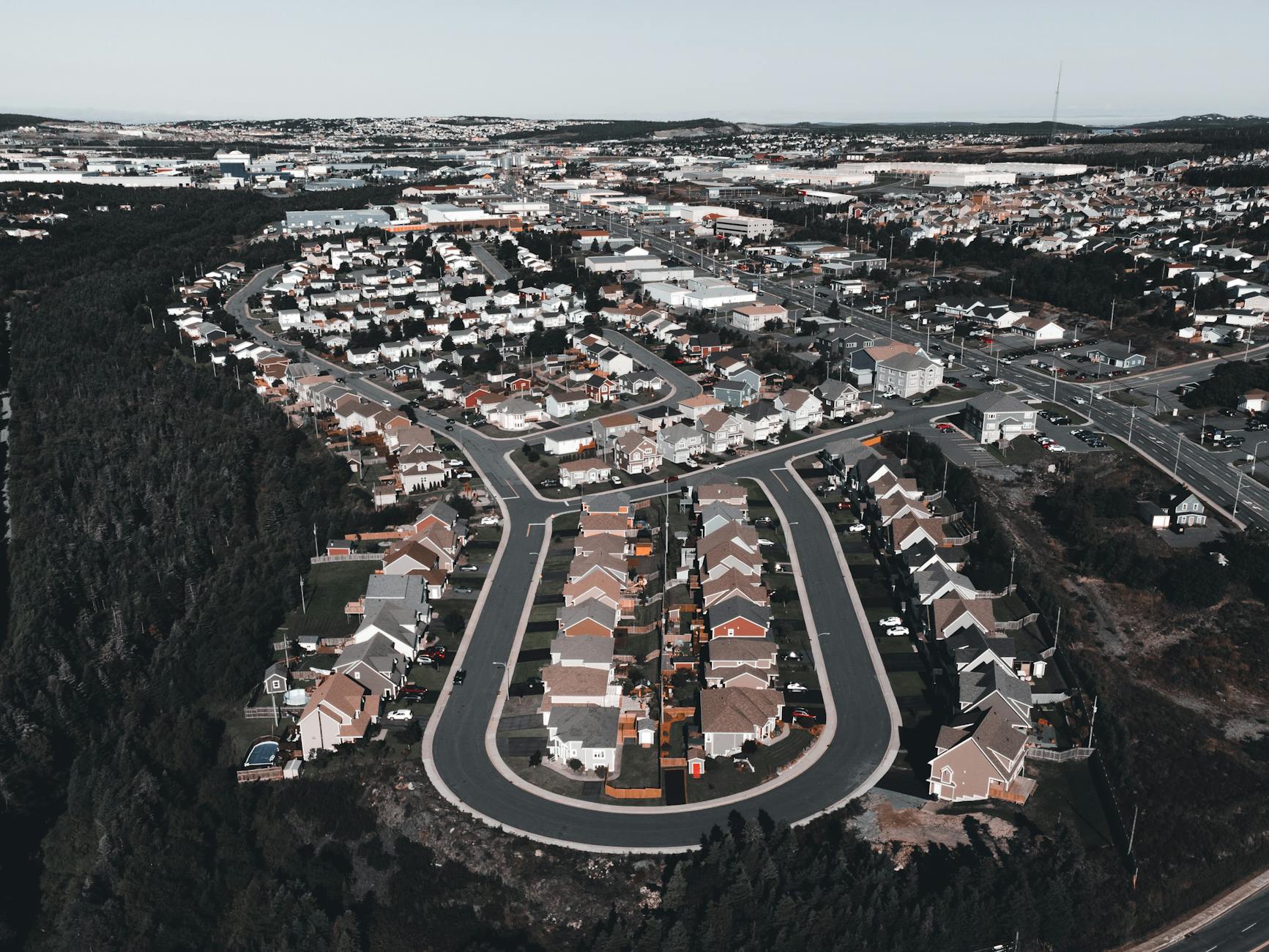

Seven suburbs added over 40,000 residents between 2013 and 2023

American suburbs are used to growth; as a whole, they have been growing for decades. But some suburbs grow much more quickly than others. A recent analysis suggests these seven suburbs added more than 40,000 residents in just ten years: Meridian, Idaho, Horizon West, Florida, Buckeye, Arizona, Santa Clarita, California, McKinney, Texas, Frisco, Texas, and Enterprise, Nevada.

Photo by Erik Mclean on Pexels.com

All of these locations are in the South or the West. All of them are sizable communities; the smallest has over 60,000 residents and several are over 200,000 residents.

Imagine how this much growth in a short period of time could change a community. More development and land in the community. Increased levels of local services, everything from school to libraries to firefighters to road maintenance. More traffic and activity. A different sense of who the community is.

At some point, the rapid growth of these ten years slows or stops. There is less land for development. There is limited appetite for building up or at higher densities. Growth moves to other nearby communities or other metropolitan areas.

It may take years for these suburbs to settle into being a place (1) that once had such fast growth and (2) that lives with the consequences of their now larger size.

If population growth in the US slows, this will make competition between cities for people even more intense

For cities and communities in the United States, growth is good. It signals progress, status, new development. To be flat in population or to lose residents hints at problems or failure.

Photo by Burak The Weekender on Pexels.com

Throughout the history of the United States, the growth rate each decade has been over 10% for every decade except for 4 (1930s, 1980s, 2000s, 2010s). The population growth came through births and immigration. This population growth means many communities could grow. Some places might lose people – such as several prominent cities in the second half of the twentieth century – but there was growth in many places.

So if population growth across the United States slows, how can many cities, suburbs, and metropolitan areas also grow? There will be fewer people to go around. This could lead to some different outcomes:

  1. There will be clearer “winners” and “losers” in population.
  2. Communities and commentators could adjust their image of how much growth is needed. They could adjust their expectations down.
  3. Americans could decouple population figures from their ideas about quality of life. Perhaps population change has little relationship with whether communities are doing well.

My guess is that #1 would lead the way as people are used to growth and the perceived benefits that go with it. #2 and #3 could happen but would take time as people adjust to different realities where growth is more limited and fewer communities can expand in population.

And if population growth is harder to attain, what might communities and governments do to try to encourage more of it? Bigger incentives? More advertising? Promoting particular amenities or quality of life concerns?

Illinois drops state’s 1% grocery tax, over 150 communities have adopted one

Local governments need revenue for local services. So when the state of Illinois dropped its 1% grocery tax, many municipalities have adopted their own 1% tax:

Photo by Pixabay on Pexels.com

Even though the measure failed in Bensenville, at least 163 communities around the state have recently enacted local grocery taxes.

Gov. JB Pritzker signed a bill last year repealing the state’s 1% grocery tax, saying it hit poorer families harder. But the bill also allowed municipalities, which depend on the revenue, to implement their own tax. Bensenville put the proposal on the ballot to get voters’ input, but local officials are not required to do so. In many municipalities, local governing bodies are casting the deciding vote…

The state suspended the grocery tax for fiscal year 2022 to help fight rising inflation, but municipal leaders say losing the stream of revenue permanently forces them to consider cutting services, raising sales or property taxes, or implementing a local grocery tax. If they approve a local grocery tax by Oct. 1, it would take effect on Jan. 1, 2026, when the state tax expires…

Illinois residents already pay the highest combined state and local taxes in the nation, at more than $13,000 annually, according to a recent report by WalletHub. Food prices rose 3% in the past year as of March, and the federal government forecasts them to rise another 3.5% this year…

“If local governments believe it is necessary to tax milk, bread, eggs, etc. to fund local services/local government, then they should be responsible and accountable for that decision to local taxpayers,” Illinois Department of Revenue spokeswoman Maura Kownacki told the Tribune. “The state should not be imposing a regressive, statewide sales tax on groceries especially during a time when inflation is hitting the pocketbooks of Illinois families.”

The cynical take would be that in a state with high taxes the Illinois governor wanted to paint the state in a good light by dropping the tax. Municipalities have limited options for filling the budget hole so they quickly move to adopt a local tax. The grocery shopper notices no change in taxes while the politicians debate who was more responsible.

I get the reaction from communities. They want a balanced budget each year and don’t want to have to cut services or acquire debt. Getting money from groceries is dependable money as people need to buy food.

At the same time, adding local taxes and fees can make residents angry. They already see the amount the federal and state governments take in each paycheck. Why do local governments charge for car registration and ask for more money for schools and keep coming up with new revenue ideas?

I wonder if this is also part of the larger issue of limited growth in Illinois. If communities were growing – adding residents, businesses, energy, status – this can cover up revenue issues. New growth leads to growing budgets with new tax money coming in. But if many communities in Illinois are growing slowly or not growing at all, this means stagnant budgets. Or worse, communities have to spend more to maintain older infrastructure that supported growth decades ago.

It may just be a grocery tax but the issues could be much larger.

Examining gentrification in the suburbs

While gentrification is often associated with neighborhoods in cities, scholar Willow Lung-Amam describes what gentrification can look like in Maryland suburbs:

Photo by Pixabay on Pexels.com

Just as there was nothing natural about the processes that prompted suburban decline, there was nothing natural about the vast funds poured into these communities to make redevelopment happen. County and state governments led the way through planning, policies, and public investments meant to entice private investment. As Silver Spring and Wheaton vividly revealed, their efforts were layered and robust: enterprise zones, urban and art districts, eminent domain, tax breaks, parcel assemblage, parking regulations, new transit investments and infrastructure. Public agencies created new market pressures that directed and enabled profitable private development. They served as the promotional arm of private corporations, advertising new suburban downtowns as safe for middle-class consumers and residents. They were critical actors in creating displacement pressures and were, as many activists argued, responsible for their redress.

But for the millions of dollars in tax breaks, incentives and assistance that developers were given, what was asked in return for those who lost their homes, businesses and sense of community? What was gained for those who had lived with broken sidewalks and run-down playgrounds for decades? Were they the beneficiaries of this progress – or was the development, as many suspected, for someone else?

As visions for new suburban downtowns emerged, long-standing communities could scarcely see themselves in the sketches of shiny new plazas and pedestrian streets. As in downtown Silver Spring, these images projected futures that allowed for the comfortable return of the white middle classes, catering to their tastes and preferences for what an authentic and safe urban experience looked and felt like. They did not honor marginalized groups’ deep histories, struggles or valued places. If suburban boosters dared to look back at all, their visions sugarcoated the past in ways that did not trouble their present plans.

Even diversity became a selling point. In Wheaton, multicultural festivals crowded the downtown plaza and colorful art displays featured faces from across the world. Yet many wondered whether its fragile diversity was simply a transition to a future in which they no longer existed.

This is gentrification — and it is suburban. While the language of retrofitting or renaissance may be much more genteel, their processes are no less brutal nor disruptive. They affect the lives and livelihoods of countless neighborhoods and threaten the sense of place that people of color and new immigrants have fought to establish and protect, sometimes with, but largely in the absence of, white neighbors and public support.

This sounds similar to what studies of urban gentrification find: the promises of new development and growth can have negative consequences for residents already there.

I wonder if resisting gentrification in the suburbs might be harder for two reasons:

  1. Growth is good in the United States. This is true across numerous American communities but might even be more baked into the idea of suburbia. Suburbs are meant to grow. To resist growth is to resist a higher status. (An exception might be that communities that are already well-off and exclusive can resist growth.)
  2. It can be hard at times to find local suburban narratives that highlight the difficulties some face in the suburbs or the ways that exclusion shaped suburban communities. The argument above appears to highlight that gentrification limits opportunities; this goes against local and broader narratives that suburbs are about opportunity and securing a portion of the American Dream.

I look forward to reading this book and considering further gentrification in suburbia.

What happens when a place is no longer growing quickly, Florida edition

Populations and demand in housing markets can ebb and flow. What happens when a state known for growth for a while starts to lose its luster?

Photo by Del Adams on Pexels.com

Florida was one of the epicenters of the pandemic’s great migration, but while crowds of people are trying to settle into places like Orlando, Tampa, and Jacksonville, many Floridians want to dump their homes and get out.

The exodus is mainly being driven by higher housing costs, a higher cost of living, and souring attitudes toward the influx of people who moved to Florida in recent years. Those factors combined are making daily life in the state way more difficult, current and former Florida residents said.

While 730,000 people moved to Florida during 2021 and 2022, nearly half a million people left, according to US Census data.

The state, meanwhile, just lost its status as the most moved-to region this year, according to an analysis conducted by the Florida-based moving service PODS. South Florida, in particular, ranked among the regions people were most keen to move out of, the report said.

Waning enthusiasm for the state is evident in housing activity, which has fallen from its pandemic highs. The number of homes for sale in Florida has soared 42% compared to levels last year, according to Redfin.

In the United States, growth is good. A growing population is connected to an increasing status that hopefully just brings in more people and business.

But population booms do not last forever. A good number of American communities have had periods of rapid population growth, including many big cities and numerous suburbs, and then other periods of slow growth or even population loss.

From the evidence above, it sounds like Florida’s growth has slowed. It is another matter if the state starts losing residents. If that happens, dire descriptions can emerge such as it being a “failed” state.

If growth slows in Florida, what other states might take up the mantle of those with rapid growth? Can they have a sustained run of growth that brings prestige?

“Phoenix is a guide to our future”

A new cover story in The Atlantic looks at Phoenix, Arizona and considers what the United States is and what it could be:

NASA Satellite Captures Super Bowl Cities – Phoenix [annotated] by NASA Goddard Photo and Video is licensed under CC-BY 2.0

The Valley is one of the fastest-growing regions in America, where a developer decided to put a city of the future on a piece of virgin desert miles from anything. At night, from the air, the Phoenix metroplex looks like a glittering alien craft that has landed where the Earth is flat and wide enough to host it. The street grids and subdivisions spreading across retired farmland end only when they’re stopped by the borders of a tribal reservation or the dark folds of mountains, some of them surrounded on all sides by sprawl.

Phoenix makes you keenly aware of human artifice—its ingenuity and its fragility. The American lust for new things and new ideas, good and bad ones, is most palpable here in the West, but the dynamo that generates all the microchip factories and battery plants and downtown high-rises and master-planned suburbs runs so high that it suggests its own oblivion. New Yorkers and Chicagoans don’t wonder how long their cities will go on existing, but in Phoenix in August, when the heat has broken 110 degrees for a month straight, the desert golf courses and urban freeways give this civilization an air of impermanence, like a mirage composed of sheer hubris, and a surprising number of inhabitants begin to brood on its disappearance.

Growth keeps coming at a furious pace, despite decades of drought, and despite political extremism that makes every election a crisis threatening violence. Democracy is also a fragile artifice. It depends less on tradition and law than on the shifting contents of individual skulls—belief, virtue, restraint. Its durability under natural and human stress is being put to an intense test in the Valley. And because a vision of vanishing now haunts the whole country, Phoenix is a guide to our future.

Several thoughts in response:

  1. How many Americans know Phoenix is the fifth-largest city in the country – growing from over 106,000 residents in 1950 to over 1.6 million today – and the tenth-largest metropolitan area?
  2. Like many American communities, Phoenix and the region depends on growth. More residents, more business activity, more infrastructure. What happens to Phoenix when/if growth slows? How would a mature region in 50 or 100 years look similar or different?
  3. The environment plays a role in Phoenix and the region. At the same time, Phoenix expanded at a particular point in American history, later than many big cities. How do these two factors intersect?
  4. How would urban sociologists think about Phoenix compared to other American cities and region? Is it more unusual or does it follow similar patterns to other sprawling regions? What marks Phoenix as unique? Do the same social, political, and economic factors propel the region or is there something different going on?

Rockford as the top real estate market in the US

One source suggests affordable housing plus job opportunities means Rockford has a lively real estate market:

Photo by Erik Mclean on Pexels.com

ROCKFORD — The city is now home to the top real estate market in the country, according to a new ranking released Thursday by the Wall Street Journal and Realtor.com.

The housing market ranking evaluates the real estate market and economic health of the 200 most populous metro areas in the country. The Rockford metro area was the only one in Illinois to crack the Top 50. Peoria landed at 59.

“It’s a great validation of what we’re seeing locally in the market with our year-over-year price increases, hitting our record highs,” said Conor Brown, CEO of the NorthWest Illinois Alliance of Realtors. “We know we’re such an affordable market, but we have seen an influx of people from Chicagoland and elsewhere coming into the market being so impressed with how much they can buy, and they’re really helping drive the prices.”

The new report is a major turnaround from one released by the Wall Street Journal a decade ago, when Rockford was declared the underwater mortgage capital of America. At that time, about 32% of the metro area’s homes were valued at less than the money owed on the mortgage.

Now, the city is being praised for an affordable housing stock and growing health care, aerospace and logistics industries.

Several things strike me as interesting in this ranking and reaction:

  1. An important part of the story is that the city/real estate market was not doing well not too long ago. This is not just about things improving; it is also about coming back from challenges.
  2. Increasing housing prices is seen as a good sign. Do these rising prices also make it more difficult for some to find housing?
  3. Missing from this story is any mention of the population. Rockford’s population is roughly flat over the last two decades. Is Rockford growing? Or growing in certain areas (like particular sectors or neighborhoods or communities)?
  4. Proximity to Chicago appears to be a positive factor. Do these people commute to the Chicago region or need to be in the office infrequently? Is Rockford seeing an influx of remote workers?
  5. How long can such a streak continue? Rockford can have the hottest market at the moment but it could be surpassed by other places or the local market could cool off. What does the narrative become then?

Cities and metro areas like growth – but do not necessarily like the changes it brings

Growth is good in the United States for cities and metropolitan regions. But, the changes that come with growth is not always viewed fondly by the people already there. The most recent example: Nashville.

Photo by Isaac Loredo Vargas on Pexels.com

Remacia Smith watches her children play in a grassy park by the Cumberland River, not far from where software giant Oracle said last week it would base its new headquarters. It is bittersweet—her hometown is thriving, but it has reached a point where it no longer works for her…

“There are pain points of this growth,” said Kate Webster, a 35-year-old real-estate agent who has lived in Nashville for 14 years. “But at the end of the day, I’d rather live in a city that is growing than one that is declining.”…

The region needs to focus on improving transit options and traffic flow, and on more housing options, Gaughan said. Many neighborhoods need to rezone for construction that allows more people to live there, he said.

John Michael Morgan, a lifelong resident of the area, said he remembers when Nashville’s prospects weren’t so hot. The growth is exciting, he said, but he worries about Nashville losing some of its personality.

“Nashville’s always been a big town that felt like a small town,” said Morgan, who is 44 years old. “Now we’re a big town that feels like a big town.”.

Change can be hard for residents of a community. They are used to the way things were. They may have moved there for particular features of the community.

Increased population growth tends to lead to more construction, higher housing prices, more traffic, and different streetscapes.

However, the United States tends to treat growth as a good thing. What community wants to stagnate or decrease in terms of population and business activity? How many people want to be in an undesirable community?

At some point, the growth in Nashville will level out and that will offer an opportunity to assess what has changed. Is the city and metropolitan region now a different place? What has fundamentally (and perhaps unalterably) changed?

Lack of groundwater means limiting new development in the Phoenix area

The sprawling growth that characterizes Phoenix will have to contend with new regulations tied to groundwater:

Photo by Gabriel Peter on Pexels.com

Arizona officials announced Thursday the state will no longer grant certifications for new developments within the Phoenix area, as groundwater rapidly disappears amid years of water overuse and climate change-driven drought.

A new study showed that the groundwater supporting the Phoenix area likely can’t meet additional development demand in the coming century, officials said at a news conference. Gov. Katie Hobbs and the state’s top water officials outlined the results of the study looking at groundwater demand within the Phoenix metro area, which is regulated by a state law that tries to ensure Arizona’s housing developments, businesses and farms are not using more groundwater than is being replaced.

The study found that around 4% of the area’s demand for groundwater, close to 4.9 million acre-feet, cannot be met over the next 100 years under current conditions – a huge shortage that will have significant implications for housing developments in the coming years in the booming Phoenix metro area, which has led the nation in population growth.

State officials said the announcement wouldn’t impact developments that have already been approved. However, developers that are seeking to build new construction will have to demonstrate they can provide an “assured water supply” for 100 years using water from a source that is not local groundwater.

The sprawl of the United States depends on cheap and abundant water available for the new properties. Phoenix is not alone in pursuing sprawl or in not having to think much about water for a long time.

However, the immediate and long-term future in at least a few metro areas involves a lack of water. This is certainly an issue in the West and Southwest. It could be in play in other regions as well.

Since sprawl is so ingrained in American daily life and in assumptions about successful communities, seeing how developers and communities procure water could get really interesting.