According to a memo, The Residences at River Point would set aside one-quarter of the apartments for households making 30% or less of the area median income. Roughly half would be earmarked for households making 60% or less of the AMI, and the rest would be for those making 80% or less of the AMI.
According to the federal Housing and Urban Development Department, the AMI for the Chicago metropolitan area, which includes Kane County, is $50,976 for a four-person household.
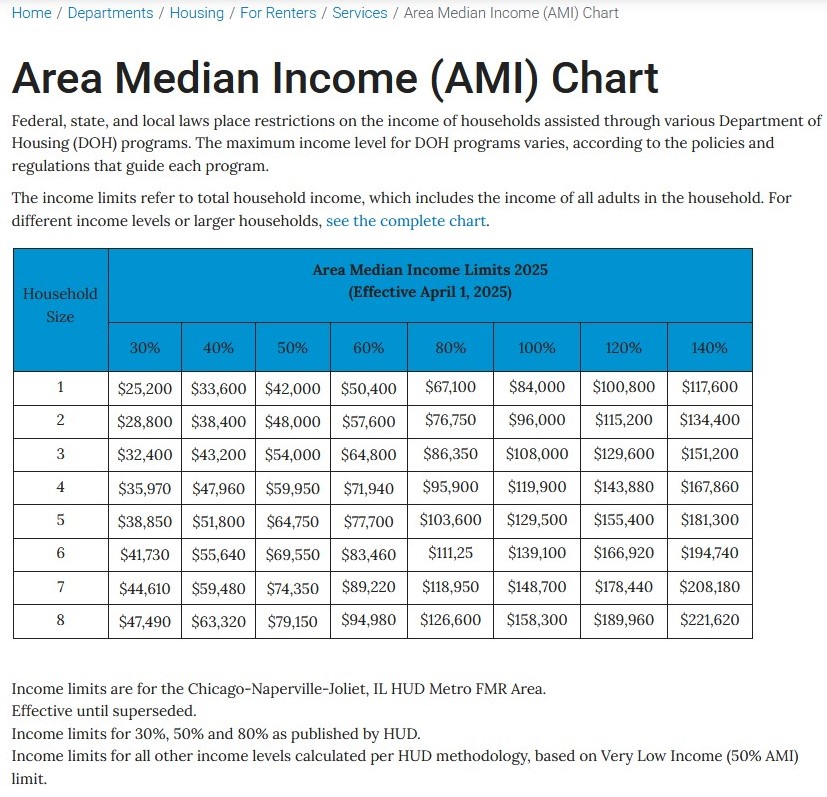
The AMI is set by HUD who has a chart of the various cutoff points for the AMI for the entire region. From the City of Chicago:
For those who have not run into these figures before, several things from this chart might stand out:
The AMI depends on household size. Discussions of housing and affordability can often focus on median household incomes but HUD adjusts for the total number of people in the household. This fits with housing with more space and bedrooms generally being more expensive.
The AMI figures are for an entire region. The Chicago region includes more than 9 million residents and hundreds of municipalities. While the AMI limits for Chicago might differ quite a bit from other regions, there can be quite a bit of variation within the region as well regarding incomes and housing prices.
These income guidelines apply to a number of programs but are not the only metrics that might be used regarding housing affordability.
The problem is structural: Washington just isn’t set up to address the housing crisis. The federal government plays a large, but largely indirect, role in the housing market. It operates through incentives, credits, guarantees, and subsidies. Rather than building housing, it makes mortgages cheaper and covers part of market rents. Rather than setting up retirement communities, it provides tax breaks for developers. You could say the country’s real department of housing and urban development is the Treasury Department, along with Fannie Mae and Freddie Mac. The Senate committee responsible for housing is the Banking Committee…
It wasn’t always that way. Indeed, Washington played an aggressive role in expanding the country’s housing stock from the 1930s to the 1970s. As part of the New Deal, the government financed the construction of homes for tens of thousands of families. HUD was founded during Lyndon Johnson’s administration and, as part of his Great Society, set out to build or rehabilitate millions of housing units…
Something else is stopping Washington from addressing the housing crisis: the Tenth Amendment to the Constitution. Land-use policy is not the purview of the federal government. It’s the purview of the states. Congress cannot rewrite Los Angeles’s building code. The White House can’t decide to upzone West Hartford, Connecticut. “I used to spend time with my counterparts in other countries and they’d say, Well, we just updated our national building code and national zoning code. We just wrote a national housing strategy,” Donovan told me. “I’d say, Wait, you have a national building code?”
As my colleague Jerusalem Demsas has written, we have delegated our housing policy not just to state and local governments but to every neighborhood’s homeowners association. Residents of a given place have ample opportunities—zoning-board meetings, candidate forums, historical architectural reviews, city-council open mics—to stop development. So they do. And thus mostly wealthy, mostly older people shape policy to their preferences: keeping new families out, maintaining single-family zoning, stopping development, and prioritizing the aesthetics of buyers over the needs of renters.
I understand the difficulties of creating federal laws or policies that then run into local government and zoning issues. I have written about this.
But, I am a little confused about the argument overall. It might be more accurate to say that the HUD and federal agencies have been reluctant to be directly involved in providing housing. The United States tried to provide some public housing in the mid-twentieth century and this did not go well. The federal government ended up retreating and, as the article notes, largely provides help now through housing vouchers.
At the same time, the federal government has an impact on financial markets, housing policy, and housing aspirations. Look at all of the interest in addressing interest rates. Or, the interest in mortgage regulations. Or, how politicians discuss homeownership. In other words, one journalist provided this quote of how housing works in the United States: “The former governor of the Bank of England, Mervyn King, told me this: “Most countries have socialized health care and a free market for mortgages. You in the United States do exactly the opposite.”
Could the federal government do more to provide actual housing units? Yes, it could. This would require a concerted effort and resources as this has not been the approach for a while. Does the federal government promote housing, specifically supporting single-family homes? Yes, it does.
Housing activists and lawyers filed a complaint over aldermanic prerogative with HUD in 2018, alleging that allowing aldermen de facto veto power over most development proposals in their wards promotes housing discrimination by keeping low-income minorities from moving into affluent white neighborhoods.
The complaint against the city alleges that “aldermanic prerogative” helps residents who fear racial change pressure aldermen to block affordable housing projects by publicly raising concerns over school overcrowding, declining property values and other “camouflaged racial expressions.”
HUD officials continue investigating the matter and sent a letter to aldermen Dec. 1 asking them a series of questions about aldermanic prerogative, including how they define the term.
This reminded me of how aldermen helped shape the locations of public housing projects after World War Two. From the Encyclopedia of Chicago:
When Congress passed the Housing Act of 1949, which provided substantial funding for public housing, CHA was ready with a map of proposed sites for projects to be built on open land throughout the city, but the city council rejected this map altogether. White aldermen rejected plans for public housing in their wards. CHA’s policy thereafter was to build family housing only in black residential areas or adjacent to existing projects. This rejection explains the concentration of public housing in the city center on the South and West Sides.
In a city marked by residential segregation, numerous methods for keeping Black residents out of white neighborhoods, and white flight away from the city, the protection of certain areas has been a major emphasis. Affordable housing and public housing are typically viewed as unattractive land uses in whiter and wealthier communities with residents and leaders expressing concerns about property values, safety, and other matters with a sometimes stated and sometimes not underlying factor of race and ethnicity.
The U.S. Department of Housing and Urban Development filed charges against social media giant Facebook on Thursday, alleging that its advertising platform violates the Fair Housing Act by allowing lenders and realtors to target Facebook users on the basis of race, gender, religion, familial status, disability, and national origin.
“Facebook is discriminating against people based upon who they are and where they live,” said HUD Secretary Ben Carson in a statement. “Using a computer to limit a person’s housing choices can be just as discriminatory as slamming a door in someone’s face.”
According to Axios, HUD and Facebook were close to a settlement. Citing anonymous sources, the Axios report says the decision to file charges could be motivated by a desire to appear on the offensive on housing discrimination prior to Carson’s meetings with lawmakers on Capitol Hill next week.
The features that make online advertising so attractive – the ability to target particular consumers rather than addressing larger populations – do not work so well in the real estate field where housing is supposed to be available to all.
This reminds me of the conclusion of American Apartheidwhere the sociologists suggest the necessary rules are in place to combat housing issues but the political will is lacking. If the online realm is now indeed where a lot of housing is rented or sold, then discrimination in online listings needs to be addressed when it does occur.
Add these online occurrences to the ongoing findings of audit tests suggesting differential treatment and there is likely plenty of housing discrimination still to battle. While the 1968 Housing Act banned discrimination on the basis of “refusal to sell or rent a dwelling to any person because of his race, color, religion, or national origin,” many American communities – including the suburbs on the basis of race and class – are what they are today because of exclusion.
KELLY: This is being described as something that President Obama has had in the works for years, but has only now found the guts to actually put out there as a Housing and Urban Development proposed final rule because his term is almost done and this is the time to do it. The last thing on the list? Change the neighborhoods.
(….)
KELLY: They don’t want, quote, “unequal neighborhoods.” Unequal neighborhoods. It – they think too many cities are too white, too privileged with too big McMansions, too big McMansions and they – they want to diverse the communities whether the communities want it or not…
If I had to guess, McMansions owners are probably disproportionately white. Perhaps these are the same people who are “proud Americans“!
Then Kelly provides the typical hard-work narrative to explain her own ability to live in a nice neighborhood:
KELLY: I mean, I didn’t grow up in a fancy neighborhood. I wanted to be in one, but we couldn’t afford it and you know, then getting to an adult, I made more money and now I live in a nice neighborhood. It’s alright. It’s a nice home. The neighborhood – anyway. The point is, that’s the way it was usually done. It’s not like, you must diversify because Uncle Sam feels it’s too white or it’s too rich.
Yet, leaving it simply to hard work and market forces leaves us where we are today and where we have been for decades: ongoing residential segregation. Vouchers by zip code rather than by price point could help poorer families access the places that have the good schools and other features that can help them get ahead.
I imagine this will draw more pushback as one of the themes running through whiter and wealthier communities is exclusivity.
But now New York City is in a bind. It didn’t have to tear down its high-rises under HOPE VI. But it also didn’t receive federal funding to improve its public housing, as HOPE VI recipients did (in the first decade of the program, the government dispersed $5 billion through HOPE VI). Now, NYCHA is left trying to figure out how to maintain decades-old buildings and reduce the number of people on the waiting list for public housing, all as federal funding for public housing continues to drop.
Popkin, with the Urban Institute, worries that this means that certain high rises in New York’s public-housing system are becoming as bad as the worst projects initially targeted in HOPE VI. Brownsville, in Brooklyn, is now the largest concentration of public housing in the country, for example. Brownsville also has the lowest median household income in New York City. In many other areas of the country, an area of one square mile of public housing would not be allowed to exist anymore. In New York, it still does, even as violence worsens and gangs take over. And the city doesn’t have the funds to change that, let alone improve other public housing buildings.
Public housing in New York City hasn’t received as much attention from scholars and the press as it has in other cities – particularly compared to Chicago. Perhaps this is because the situation was never quite as bad, whether due to lower levels of isolation (as noted in the article) or because the NYCHA was better managed than the chronically mismanaged Chicago Housing Authority. Or perhaps the urban sociologists in NYC focused on other topics. Or maybe the glittering portions of New York City are overwhelming – don’t forget the current luxury construction boom in the city.
In the long run, New York City is not immune to the same issues of inequality and a lack of affordable housing that many major cities face. If the city wants to avoid facing bigger problems down the road, it would be prudent to take action on housing now.
Compared with white homebuyers, blacks who inquire about homes listed for sale are made aware of about 17 percent fewer homes and are shown 18 percent fewer ones. Asians are told about 15 percent fewer units and are shown 19 percent fewer properties. Researchers are unsure why Hispanic buyers were treated more equitably than other minority populations.
Among renters, all minority groups found out about fewer choices than did white consumers. Hispanic testers who contacted agents about advertised rental units learned about 12 percent fewer units available and were shown 7 percent fewer than white renters saw. Black renters learned about 11 percent fewer units and saw 4 percent fewer available rentals, while Asians were told about 10 percent fewer available rentals and shown 7 percent fewer units.
In the Chicago area, researchers found that African-American and white renters got equal access to information and showings of apartments, but African-Americans were less likely than white consumers to see at least one home that had no problems.
Blacks also were more likely than whites to be told that a credit check had to be performed and that particular rental units carried fees. They also were quoted higher fees than the ones quoted to white testers. On average, the extra fees quoted to blacks put the first-year cost of securing a rental unit at $350 more than the cost for white renters.
Hispanic testers in Chicago reported that they heard comments about their credit standing more often than the white testers, and the extra payments quoted to them were $131 more than white testers’.
As the HUD Secretary notes, these actions are less obvious than the redlining, blockbusting, and restrictive covenants of the early 1900s but they still lead to similar outcomes. This kind of study with pairs having the same qualifications and traits except for their race/ethnicity has been conducted for several decades with similar results: whites consistently have better access to housing options. Limiting access to housing options like this is illegal but happens regularly both in cities and suburbs. And housing and patterns of residential segregation is related to all sorts of other important life chances including job opportunities, schools, community resources and services, and social networks.
This article fails to mention what can be done about such discriminatory practices. Housing providers and those in real estate can be sued. However, this takes place on a case by case basis and thus it can take a while to crack down on a large number of offenders.



 Legally Sociable