Hub-and-spoke railroad systems, buses, and migrants getting to Chicago

If Chicago makes it harder for bus companies to bring migrants to the city, where else can they drop them off? In suburbs with train connections to Chicago:
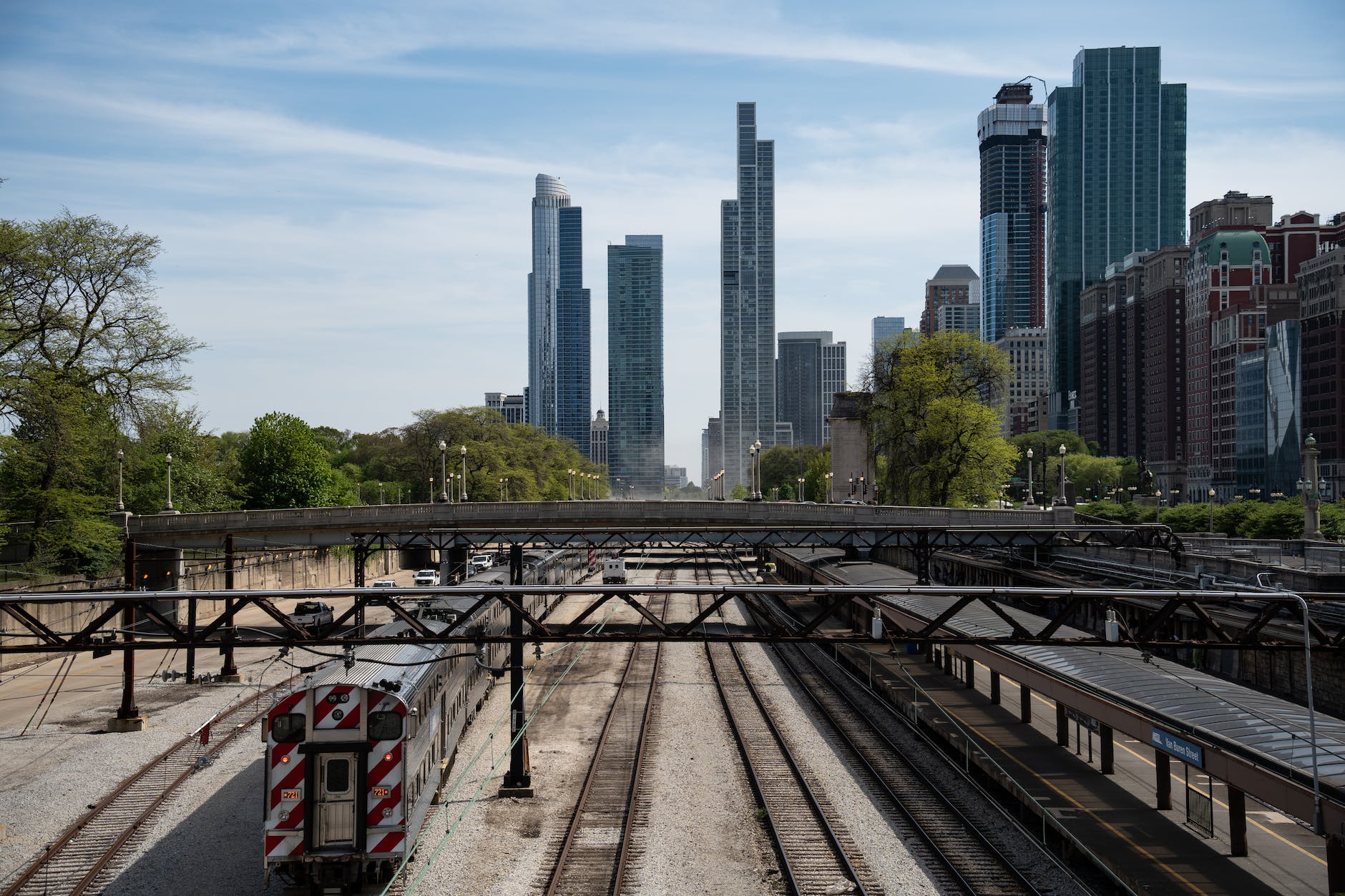
Photo by Chris Duan on Pexels.com

Naperville is one of a growing list of suburban cities that have seen buses ferry migrants to their communities — unannounced — over the past few weeks. The spread of migrant-carrying buses to collar communities comes in the wake of more stringent rules for migrant drop-offs adopted by the city of Chicago earlier this year…

In an effort to hold bus owners accountable to the November policy, Chicago aldermen on Dec. 13 approved tougher penalties for rogue arrivals. Essentially, buses face seizure, impoundment and fines for unloading passengers without a permit or outside of approved hours and locations…

Instead of more coordination, Chicago officials have said that bus drivers, in direct correlation with tighter drop-off rules, have started to unload migrants in unauthorized places — including suburban train stations — to work around penalties…

Migrants reportedly have been left in Lockport, Kankakee, Fox River Grove and Elmhurst.

Last week, five buses stopped at Aurora’s Transportation Center. In response, the Aurora City Council Friday passed an ordinance regulating buses coming to the city to drop off migrants who are en route to Chicago.

Chicago has long had a hub-and-spoke railroad system where lines radiating out from the city bring passengers downtown. This system has been around for over a century as lines coming out of Chicago connected surrounding counties to the growing city.

This same system that enable commuting to the Loop makes it possible for migrants to get to Chicago without having buses dropping them in the city proper. There are numerous trains stations spread throughout the suburbs that could serve as points where people can board trains for Chicago.

How many suburbs will end up restricting buses from dropping migrants off at suburban train stations? Some have already moved to limit migrants. Few seem interested in joining the efforts of Oak Park.
Another technique to limit migrants coming to suburbs: fine bus companies

As several Chicago suburbs consider the possibility that migrants might arrive in their community, they have another technique for limiting their presence: fining bus companies who bring migrants.

Photo by Jakob Scholz on Pexels.com

Rosemont could cite and fine bus companies from Texas, impound their vehicles, and arrest drivers for dropping off migrants in town, under an ordinance approved Monday.

The new rules — which are similar to ones in Cicero and tighter penalties being considered by the Chicago City Council this week — come after about a half dozen buses started bringing asylum-seekers to Rosemont last Wednesday.

Each bus had about 40 to 50 people, who were being let off in front of the Donald E. Stephens Convention Center, the Metra Rosemont station on Balmoral Avenue, and the Metra O’Hare transfer station on Zemke Boulevard on airport property next to Rosemont.

“We’re not going to let them just drop people off and drive away,” Mayor Brad Stephens said Monday. “It’s inhumane dropping them off on a concrete sidewalk on a day like today.”

Add this to restrictions on housing migrants long-term.

Chicago has added similar penalties to buses:

Migrants are no longer being dropped off at the city’s landing zone on buses from the southern border, causing people to wander with no direction looking for shelter, according to an aide to Mayor Brandon Johnson.

Cristina Pacione-Zayas, Johnson’s deputy chief of staff, said the lack of communication is directly correlated with the city’s harsher penalties for bus owners whose vehicles violate rules to rein in chaotic bus arrivals from the southern border. She suspects bus companies are finding other ways to get migrants into the city. As of Saturday, more than 25,900 migrants had arrived in Chicago since August 2022, according to city records.

Under revised rules Wednesday, buses face “seizure and impoundment” for unloading passengers without a permit or outside of approved hours and locations. Violators will also be subject to $3,000 fines, plus towing and storage fees.

If this “works,” how many suburbs and cities will adopt similar approaches?

Oak Park is supporting migrants; other suburbs could do the same?

The Chicago suburb of Oak Park has agreed to continue spending monies to help migrants new to Chicago and the United States:

Photo by Matt Barnard on Pexels.com

The village board in Oak Park voted Monday night to allocate hundreds of thousands of dollars to help migrants through the winter.

It was a divisive vote that sparked controversy among Oak Park trustees, with the debate going late into the night.

In the end, Oak Park trustees decided to extend its emergency declaration and spend an additional $500,000 to support migrants through the winter. That’s a compromise from the original proposal to spend $1 million through March.

The additional money is coming from unspent federal funds, not from local taxes. The vote was four to three to approve the measure…

There are hundreds of migrants in Oak Park that are being helped by the village or by churches.

In an earlier discussion, one trustee suggested more suburban communities could be involved:

Straw said “it’s time” for Oak Park to be a leader, and “work on stepping out in front so we can bring along our neighboring communities.

“The goal should be for this to be a coordinated western suburban response, where we are not alone at the front, but linking arms with our neighbors,” Straw said. “But the only way to get there, when no else is willing to step out first, is to step out. And it’s time.”

In the recent public and political discourse about migrants, cities have provided the primary setting. But, suburbs are now often the communities newcomers to the United States go to. This may not have been common in earlier periods but it is more common today. In a country where a majority of residents live in suburbs and there are a variety of suburban communities, many immigrants start in the suburbs.

How many suburbs might join Oak Park in welcoming migrants? Will there be “a coordinated western suburban response”? Given that there are hundreds of suburbs in the Chicago region, there is a lot of potential for suburbs, religious congregations, other organizations, and residents to respond.

Housing migrants amid a tight housing supply

New York City does not have much available housing and this leads to problems:

Photo by Pixabay on Pexels.com

You can see it by looking at residential-vacancy rates, which have been as low as 2 percent in recent years. You can tell by looking at the size and price of rentals and homes for purchase: The average rent in Manhattan is more than $4,000, and the average home in Brooklyn costs roughly $1 million. You can see it in the shrinking of New York’s middle class and the stagnation of its population and the widening of its income and wealth inequality. Housing supply has simply not kept pace with housing demand, squeezing everyone except for the very rich.

The same forces shunting families to the suburbs are weighing on the migrants. The same forces driving New Yorkers out of unaffordable apartments and into homeless shelters are weighing on the migrants. Migrants cannot afford housing for the same reason that the city itself struggles to raise money for new facilities. New York really is full…

High housing costs have a way of making every problem a housing problem. A homeless person needing help with a substance-abuse disorder needs housing first. A migrant requiring legal aid more pressingly needs a roof over their head. And high housing costs, of course, force millions of vulnerable people into homelessness. “Our homeless-response system has turned into a crisis-response system,” Gregg Colburn, an associate real-estate professor at the University of Washington’s College of Built Environments, told me. “So many other systems have failed or delegated responsibility to it.”

The opposite is also true: Low housing costs make other problems simpler to solve. Cheap housing reduces the number of people who become homeless. It also allows the entities providing assistance to do more for less, because their overhead costs are lower. And it frees up lawyers to work on immigration cases, substance-use experts to work on substance-use issues, and mental-health counselors to work on mental-health issues.

It is enough to make one think that seriously and sufficiently addressing housing should be a major priority!

The problem is not just limited to New York City. Multiple big cities in the United States need more housing units and lower-priced yet good quality housing. Having a stable place to live at a reasonable price goes a long way to better life outcomes and opportunities.

But, adding a lot of good housing takes a lot of work and there does not seem to be political will to address it. Additionally, it can be easy to look for other solutions to some of the different problems listed above. Would building more good housing automatically solve these issues? No, but it could help a lot and make it more possible for people to live and enjoy major cities.

Preserving an important Chinese American church building constructed in 1968

Here is a discussions of whether to preserve an important church building in Queens, New York:

Photo by Brett Sayles on Pexels.com

Classis Hudson, the regional governing body of the CRCNA, will vote on Tuesday on whether to authorize an interim committee to figure out the future of the congregation. The Queens church officially has only 27 members, according to the denomination’s website, and no full-time CRC pastor. The church’s founder, Paul C. H. Szto, led the church until he died in 2019 at the age of 95…

The Queens church raised its own funds to build a church building next door in 1968. It is believed to be among the first—if not the very first—Chinese congregation to build its own church building in the US. With the church building in place, and a new wave of Chinese and Taiwanese immigrants pouring into the country, the Queens CRC became a waystation for Chinese American Christians and a center for Reformed thought in the Chinese American community…

Pastor Szto, who had studied under the Dutch Calvinist philosopher Cornelius Van Til at Westminster Theological Seminary and under Christian existentialist Paul Tillich at Union Theological Seminary, turned the space into a lecture hall, seminar room, and theological library with more than 18,000 books. According to The Banner, an official CRCNA publication, Szto and his wife housed and hosted more than 2,000 students, immigrants, and refugees in his home…

Mary Szto would like to see the parsonage become a museum and cultural center to carry on that legacy and tell the story of her father’s life’s work and the history of Chinese American Christianity in New York City. She notes that Chinese American church history tracks closely with real estate laws and business ownership restrictions that limited where Chinese families could buy property until the Immigration and Nationality Act of 1965.

At this point, it sounds like the fate of the building is still under conversation among particular involved actors. Not all congregations last forever and making decisions about what to do with their buildings can be difficult.

More broadly, there are many church buildings in the United States that are no longer used by a congregation. Some older structures find new life as a home for a different congregation and others are converted to new uses. In places where there is demand for land, such as in New York City, the end of a religious congregation may present an opportunity for a new owner to raze the building and construct something else. Some argue more religious buildings should be preserved as they are important parts of community life.

Additionally, Queens is an important site for religious activity, particularly in the post-1965 era when immigrants arrived in the community in larger numbers. For more, see the work of historian R. Scott Hanson on religious pluralism in Flushing, Queens.

I am struck in this case by the relatively recent construction of the church building. Historic preservation conversations about churches can often consider much older structures. This building is just over 50 years old but it is also socially significant. The church building in an alternative form – museum and cultural center – could serve as a reminder of the efforts of the religious congregation that once gathered there as well as its impacts.

Racialized McMansions

When I examined the complexity of the term McMansion in New York City and Dallas newspapers, I did not run into this dimension from the San Gabriel Valley as detailed by Wendy Cheng in The Changs Next Door to the Díazes:

In early twenty-first-century multiethnic suburbs with a significant immigrant Chinese presence such as the West SGV, struggles over the landscape are still racially coded in terms of values and territory. For instance (as mentioned in Chapter 2), public discourse around McMansions or “monster homes” – a practice associated with wealthy ethnic Chinese immigrants of tearing down a newly purchased house in order to build a larger house, usually resulting in significant reduction of yard space – is one way in which Asian immigrants are depicted as being unable to conform to American values and ideals. Such practices render them unfit as neighbors and, by extension, as members of American civil society. In short, places coded as Chinese or Asian, like the nineteenth- and twentieth-century Chinatowns before them, continue to be seen either as threats encroaching on implicitly white, American suburban space or as autonomous foreign spaces that serve particular functions but are not to exceed their prescribed bounds. The prescription and negotiation of these bounds is a conflictual process, with both symbolic and material consequences. (133-134)

Here, the term McMansion is fulfilling two dimensions of the term McMansion I discussed: it is meant as a pejorative term and it applies to a situation where a property owner tears down a home and constructs a larger home. Both are common uses for the term.

Typically, McMansion concerns involve wealthier and white residents. The term can have classist connotations: the nouveau riche may purchase a McMansion to show off their wealth while those with more taste would purchase a modernist home or go a custom architect-designed home. In this particular context, McMansion is applied to a particular group of owners as well as their position in the community and the country. This is not just about a newcomer coming in with resources and disrupting a particular neighborhood character. This usage links McMansions to a broader history of race and ethnicity plus ongoing conflicts in many American communities, suburbs included, about who is welcome. Single-family homes are not the only feature of the suburban American Dream; this ideal also includes exclusion by race and ethnicity. And to welcome a new resident with the term McMansion is not intended to be a kind beginning.

I will look for further connections of McMansions to race and ethnicity. Are there other communities in the Los Angeles area where McMansion is used in similar ways? Is the term applied to other racial or ethnic groups in other places?

Why small rural towns turn down economic development opportunities

Not every rural small town wants to add a meat processing plant:

Regional economic development officials thought it was the perfect spot for a chicken processing plant that would liven up the 400-person town with 1,100 jobs, more than it had ever seen. When plans leaked out, though, there was no celebration, only furious opposition that culminated in residents packing the fire hall to complain the roads couldn’t handle the truck traffic, the stench from the plant would be unbearable and immigrants and out-of-towners would flood the area, overwhelming schools and changing the town’s character…

The village board unanimously voted against the proposed $300 million plant, and two weeks later, the company said they’d take their plant — and money — elsewhere.

Deep-rooted, rural agricultural communities around the U.S. are seeking economic investments to keep from shedding residents, but those very places face trade-offs that increasing numbers of those who oppose meat processing plants say threaten to burden their way of life and bring in outsiders…

Nickerson fought against Georgia-based Lincoln Premium Poultry, which wanted to process 1.6 million chickens a week for warehouse chain Costco. It was a similar story in Turlock, California, which turned down a hog-processing plant last fall, and Port Arthur, Texas, where residents last week stopped a meat processing plant. There also were complaints this month about a huge hog processing plant planned in Mason City, Iowa, but the project has moved ahead…

The question of who would work the tough jobs was at the forefront of the debate, though many were adamant they aren’t anti-immigrant. Opposition leader Randy Ruppert even announced: “This is not about race. This is not about religion.”

On one hand, not all jobs are necessarily good jobs. On the other hand, there seem to be larger issues at play: who will get these jobs? What happens when all the workers – who may not share the background of the small town – show up? It would be intriguing to explore what changes to the processing plants would lead to support from community members: guarantees of local hires? Higher wages? No minorities hired?

It would also be worth tracking where these processing plants end up. What one community turns down may be seen as an economic savior in another area. For example, scholars have noted the rise of immigrant populations in American rural areas in recent decades including places like Iowa and Georgia which don’t have the traditional immigrant gateway big cities.

Census projects record proportion of foreign-born residents in 2060

Recent projections from the US Census Bureau suggest the immigrant population will continue to grow:

The nation’s foreign-born population is projected to reach 78 million by 2060, making up 18.8% of the total U.S. population, according to new Census Bureau population projections. That would be a new record for the foreign-born share, with the bureau projecting that the previous record high of 14.8% in 1890 will be passed as soon as 2025.

Yet while Asian and Hispanic immigrants are projected to continue to be the main sources of U.S. immigrant population growth, the new projections show that the share of the foreign born is expected to fall among these two groups. Today, 66.0% of U.S. Asians are immigrants, but that share is predicted to fall to 55.4% by 2060. And while about a third of U.S. Hispanics (34.9%) are now foreign-born, the Census Bureau projects that this share too will fall, to 27.4% in 2060. These declines are due to the growing importance of births as drivers of each group’s population growth. Already, for Hispanics, U.S. births drive 78% of population growth…

Foreign-Born Share of Population to Reach Historic High by 2060


The U.S. today has more immigrants than any other nation. As the nation’s immigrant population grows, so too will the number of children who have at least one immigrant parent. As of 2012, these second generation Americans made up 11.5% of the population, and that share is expected to rise to 18.4% by 2050, according to Pew Research Center projections.

This is the first time in 14 years the Census Bureau has made projections of the foreign-born population. Predicting future immigration and birth trends is a tricky process, and the bureau has substantially changed its projections from year to year in light of reduced immigration and birth rates.

While these numbers are sure to contribute to political debate about current policies, they continue trends started in the late 1960s where immigration policies were changed. Additionally, the projections suggest the United States is still a desirable place to immigrate to and that the growing foreign-born population is a significant contributor to the overall growing population of the US.

I would be interested to hear about the discussions behind the scenes regarding the 14 year gap in making such projections. How much of this was guided by politics? What are the upper and lower bounds of the confidence intervals for these projections? Have our projection abilities improved significantly?

Immigrants might save the American housing market?

The real estate market may be sluggish but some data suggests immigrants offer hope with their desires to own homes:

But in some groups the dream, at least of homeownership, is alive and well. During the past two decades, immigrants have accounted for 27.5 percent of all household growth, according to the Harvard Joint Center for Housing Studies. When it comes to growth among younger generations, the foreign-born population is even more significant, accounting for nearly all the household growth for those under the age of 45.

Last year, immigrant households made up 11.2 percent of owner-occupied housing according to the JCHS—that’s up from only 6.8 percent in 1994…

The exact rate of homeownership varies among different immigrant groups, but overall the share of immigrants who own homes is growing. In 2000, the rate of homeownership among immigrants stood at 49.8 percent, according to a study by the Research Housing Institute of America. By 2010 the rate was 52.4 percent, and by 2020 that number will climb to about 55.7 percent, the study predicts. In the third quarter of 2014 the overall homeownership rate in the U.S. was 64.4 percent, according to the Census Bureau.

There are several reasons behind the growth rate in homeownership for immigrants, but part of the impetus may be that many immigrant populations are less cynical about the idea of homeownership than their American-born counterparts. “They view homeownership as a piece of the rock. It’s a benchmark of being settled,” says Dowell Myers, a professor at the Sol Price School of Public Policy at USC. “They view homeownership as the American Dream and they buy into that.”…

Even more compelling are the possibilities for homeownership among the children of immigrants. “When you look at the children of immigrants they actually exceed the native born on a lot of measures: on income, on education, on homeownership,” says Masnick.

Is there some irony here if it is conservative and older whites and immigrants who buy into the American Dream of owning a home the most? Of course, they may not be buying homes in the same places given ongoing patterns of residential segregation as well as different preferences of urban, suburban, and rural living.

Chinese homebuyers flood LA suburb with big homes

Bloomberg examines an influx of large-home purchases by Chinese buyers in Arcadia, California:

A year ago the property would have gone for $1.3 million, but Arcadia is booming. Residents have become used to postcards offering immediate, all-cash deals for their property and watching as 8,000-square-foot homes go up next door to their modest split levels. For buyers from mainland China, Arcadia offers excellent schools, large lots with lenient building codes, and a place to park their money beyond the reach of the Chinese government.

The city, population 57,600, projects that about 150 older homes—53 percent more than normal—will be torn down this year and replaced with mansions. The deals happen fast and are rarely listed publicly. Often, the first indication that a megahouse is coming next door is when the lawn turns brown. That means the neighbor has stopped watering and green construction netting is about to go up.

This flood of money, arriving from China despite strict currency controls, has helped the city build a $20 million high school performing arts center and the local Mercedes dealership expand. “Thank God for them coming over here,” says Peggy Fong Chen, a broker in Arcadia for many years. “They saved our recession.” The new residents are from China’s rising millionaire class—entrepreneurs who’ve made fortunes building railroads in Tibet, converting bioenergy in Beijing, and developing real estate in Chongqing. One co-owner of a $6.5 million house is a 19-year-old college student, the daughter of the chief executive of a company the state controls.

Arcadia is a concentrated version of what’s happening across the U.S. The Hurun Report, a magazine in Shanghai about China’s wealthy elite, estimates that almost two-thirds of the country’s millionaires have already emigrated or plan to do so. They’re scooping up homes from Seattle to New York, buying luxury goods on Fifth Avenue, and paying full freight to send their kids to U.S. colleges. Chinese nationals hold roughly $660 billion in personal wealth offshore, according to Boston Consulting Group, and the National Association of Realtors says $22 billion of that was spent in the past year acquiring U.S. homes. Arcadia has become a hotbed of the buying binge in the past several years, and long-standing residents are torn—giddy at the rising property values but worried about how they’re transforming their town. And they’re increasingly nervous about what would happen to the local economy if the deluge of Chinese cash were to end.

Interesting look at how this affects one particular community. It seems to bring together several issues that might trouble the average American suburbanite:

1. An influx of immigrants. This is happening across the suburbs as many new immigrants move directly to the suburbs. At the same time, there are a number of ethnoburbs in the LA region so this is not unknown.

2. An influx of immigrants from China. The United States has an interesting current relationship with China and Americans didn’t treat Chinese immigrants well in early California. A large group of wealthy foreigners from a country with a huge economy and shadowy government might make some nervous.

3. This big money means older homes are being torn down and replaced with big houses. A large number of teardowns in an established community tends to attract attention as the homes can change the character of neighborhoods as well as raise prices (though this is also presented positively in this story as long-time residents can cash out).

All together, this rapid change will be worth watching.