The return of Rust Belt housing markets, Buffalo edition

Many Americans will not move to the cheapest metro areas just because housing prices are attractive. But, what if Rust Belt areas became popular again? Zillow thinks this will happen with Buffalo, New York:

Shark Girl is a fiberglass sculpture in the Canalside area of Buffalo, New York. by Michelle Frechette is licensed under CC-CC0 1.0

Buffalo, New York is projected to be the hottest housing market of 2024, according to an analysis from real estate company Zillow.

Zillow called affordability the “most powerful force driving real estate,” bringing lower-cost markets in the Great Lakes, Midwest and South regions to the top of the company’s 2024 rankings.

“Housing markets are healthiest where affordable home prices and strong employment are giving young hopefuls a real shot at buying and starting to build equity,” said Anushna Prakash, data scientist for Zillow Economic Research…

According to Zillow’s analysis, Buffalo has the highest number of new jobs per home permitted – a measure of expected demand, as new jobs often mean new residents.

The key seems to be the expected job growth in Buffalo. Yes, there is cheaper housing in the region but a growth in jobs means more people which means more demand for housing. How many people would choose a job in Buffalo because of the cheaper housing instead of going elsewhere where housing would be more expensive?

On the list of the predicted top ten housing markets are 6 regions in the Midwest or Northeast – the Rust Belt. This includes Buffalo, Cincinnati, Columbus, Indianapolis, Providence, and Cleveland. If this prediction comes true, would this help create more momentum in these places for a brighter future?

For example, Buffalo’s population peaked in 1950 with over 580,000 residents. In the 2020 Census, Buffalo had over 278,000 residents. The metropolitan region peaked in population in 1970. Similarly, Cincinnati (#2 on the predicted list) peaked in population in 1950 and has lost nearly 200,000 residents since (even as the metro area has grown slowly since then).

More suburban sprawl = disappearing night sky

A resident of Naperville, Illinois describes one consequence of the growth of the suburb and the Chicago region:

Photo by Benjamin Suter on Pexels.com

Growing up, Carhart said he learned the intricacies of the Milky Way from his suburban backyard in Naperville. But slowly, the 64-year-old said, he watched the stars disappear. If someone were to visit his childhood home today, he said, they could count the number of stars they see on their fingers…

“The light pollution is tremendously worse. Out by Naperville we could see the glow in the nighttime sky of Chicago off in the distance, but it only went a little ways up in the sky,” he said. “Over the years we watched it get brighter and then extend overhead and all the way to the other horizon and just take over the sky.”

What can help reduce this light pollution in a large metropolitan area?

The National Park Service suggests considering whether outdoor lighting is necessary, or if reflective tape or reflective surfaces could be used instead. Other sustainable outdoor light specifications, according to the Park Service, are LEDs at 2700 Kelvin. These lights emit a warm color hue instead of blue or white. The Park Service also recommends purchasing LED bulbs that have the lowest lumens possible — the unit of measurement used to specify brightness — and ones that can accommodate motion detectors or dimmers, which it says can enhance health and safety…

Referencing a study from 2020 that found only about 20% of a city’s brightness can be linked to streetlights, Walczak said regulation or policies surrounding light pollution should be directed toward commercial businesses, such as parking lots or building facades.

The proposed solutions – and another suggested later in the article that uses special equipment to avoid certain light wavelengths – are efforts to work around the sprawl of the region. If there are over nine million people living in the Chicago region, is it possible to have a visible night sky?

This could be another argument against suburban sprawl. As Americans develop more land outside of cities, light spreads. Homes and yards have lights. Roadways have lights. Buildings have lights.

Naperville’s success – rapid population growth, vibrant downtown, lots of jobs – comes with lights. It could come with less light than it might have now . But, how many suburbanites are willing to trade lights for seeing the night sky? How many lights are for safety purposes that suburbanites care about (roadways, properties, etc.)?

It would be interesting to see some major suburban communities lead the way on this. And it would likely take significant regional efforts or numerous communities going this direction to make a visible difference.

An expanding Bay Area megaregion moving toward Sacramento…

How big could a Bay Area megaregion get?

Photo by David Henry on Pexels.com

The Bay Area exodus may be mostly a myth, but the trend of people moving inland, leaving coastal metros in search of more space at better prices, is growing. There are more people moving to Sacramento from the Bay Area than anywhere else in the country, according to Redfin data. People moving from the Bay Area to Sacramento isn’t a new phenomenon, but COVID-19 sped up a process that experts say was inevitable, and it could have long-lasting effects on the state…

They’re far from the only ones who have made the move, and all the new transplants are having a significant impact on Sacramento’s population, which grew 26% between 2000 and 2019, according to census data. The Bay Area’s grew just 14.6% during the same period. A recent study conducted through a collaboration between the University of Southern California, Occidental College, and UC Davis suggests increased migration could even be creating a “megaregion,” breaking down barriers that traditionally separated the coastal cities of the Bay Area from the inland region around Sacramento.

The “megaregion” and the resulting demographic shifts will have an outsized impact on traffic and infrastructure, creating new needs for California’s future. While the study showed there was a small dip in the proportion of people commuting to the Bay Area from Sacramento County, the percentage of people “supercommuting” — defined as a commute of more than 50 miles — had grown from 17% in 2008 to 20% in 2018. That percentage grew in every Central Valley county studied and is likely to continue as high-wage earners with jobs centered in the coastal metros seek larger homes inland…

The issues are not limited to Sacramento and the surrounding suburbs, according to Rodnyansky, and his research suggests the megaregion could stretch all the way to Fresno. Past Sacramento, people are also spreading out to surrounding El Dorado and Amador counties, where they will likely face challenges they’re not prepared for, like managing their land for increasing wildfire risk.

Three thoughts come to mind:

  1. Is there anyone these days seriously opposed to megaregions? I could see some concerns rising about distinct identities of particular cities and communities or addressing increasingly complex problems in a growing region. Yet, having a larger region means a larger economy, a bigger population, and an increased status.
  2. It would be interesting to hear more about communities in between these areas. What is it like to live between Oakland and Sacramento that might feel a pull one direction or another?
  3. Now is the time to be planning ahead to the issues an expanding region brings. Can the infrastructure handle this? How should disputes between communities and major actors be resolved? Are there new population and business nodes that will develop? (Is there a point where development should not continue? This is not the kind of question that tends to be asked in the United States when growth is good.)

Could metropolitan areas have NIMBY-free zones for land uses residents do not want to live near but that are needed in the region?

After considering several recent NIMBY cases in the Chicago region (a football stadium, addiction treatment facility, waste transfer station), I had an idea: could a region develop a central zone where important but less desirable land uses could be placed and everyone in the region could benefit without having to live near them? Noisier, dirtier, and busier facilities could be separated from residences and a central location could mean more people in the region could access them.

Photo by Magda Ehlers on Pexels.com

I suppose this could happen now without the need for a NIMBY zone. Municipalities might put less desirable land uses on their edges or against certain barriers, like bodies of water or transportation corridors. Or some communities are willing to pursue industrial and commercial land uses rather than single-family homes.

But, one big advantage of a zone managed for the whole region is that the overseers could be freed from the concerns of residents. Balancing land uses in suburbs is often tricky as existing residents and leaders often have strong opinions about what and who they think might fit. And because local government officials often need to be elected or are appointed by elected officials, there are certain consequences for land use and development decisions.

Take the Chicago region as one example. Imagine creating a zone around O’Hare Airport where a number of less desirable land uses could be clustered. It would take time to develop this and address the concerns of people who live there. But, a location near highways and a busy airport means this could be a site where clustering certain facilities could benefit the entire region.

Americans may move close to home to be near politically like-minded residents

How far are Americans willing to move to be in a political environment they are comfortable with? Fewer may move to other countries or other states compared to those who move within a county or region to find residents or communities with similar political views:

Photo by Element5 Digital on Pexels.com

“This idea of ‘red state versus blue state’ misses a great deal of heterogeneity within states, as well as clusters and spatial patterns that occur within states,” said Ryan Strickler, a political scientist at Colorado State University, Pueblo. “Instead, we’re seeing more of a micro level of political sorting.” …

[E]xperts say the more significant phenomenon is people moving within the same state where they can find others who are politically like-minded. These migrations aren’t about specific political outcomes like the Dobbs decision. Instead, they’re linked to social polarization. “There’s a lot of local reshuffling,” said Alexander Bendeck, a Ph.D. student in the Georgia Institute of Technology’s School of Interactive Computing.

In one of his current projects, Bendeck explores U.S. relocation patterns in the 2010s, using population migration data from the IRS to track the number of migrants between counties nationwide. Bendeck recognized the shift in migration from the coasts to the South or Midwest but also emphasized the effects of moving within metropolitan areas. Many natives of major Southern cities have moved out to the suburbs or to smaller cities. And the locals of those suburbs or cities move to more rural areas or even smaller cities.

But there’s a huge caveat to any migration data: It is impossible to attribute all instances of relocation, even within the same state, to politics. In fact, politics has not been a major factor why most Americans have moved in recent history, Strickler said. Instead, migration is more financially driven, whether people are seeking out a lower cost of living, better job prospects or proximity to family. 

I would be very interested in seeing more data on this micro-sorting within region. As noted in this piece, regions are often broken up this way: denser cities at the core vote more Democratic, far-flung suburbs vote more Republican, and in-between suburbs are more mixed. When people move within a region, how often do they end up in a community that aligns with their political sensibilities compared to their previous home?

One way to interpret this is that people are more tied to finances, jobs, and family within local places or geographies than to politics. Another way to put this is that Americans may express concerns about political trends, but they can often find more agreeable conditions not too far from where they currently live.

This highlights the importance of local government and politics even as there is a lot of attention paid to national politics. Even as state or national patterns may not be what individuals desire, they can rest assured that local communities or representatives share their positions. This could be related to the pattern where more Americans approve of their local Congressional representative than they approve of Congress as a whole.

Should millionaires and billionaires in the suburbs count when looking at the wealthiest cities in the world?

A new list ranks the wealthiest cities in the world by the number of the wealthiest residents. Do the wealthy in suburbs count? For New York City, the top city on the list, they appear not to:

Photo by Lukas Kloeppel on Pexels.com

The Big Apple is home to 345,600 millionaires, including 737 centi-millionaires (with wealth of USD 100 million or more) and 59 dollar billionaires. New York is the financial center of the USA and the wealthiest city in the world by several measures. It is also home to the world’s two largest stock exchanges by market cap (the Dow Jones and NASDAQ). Perhaps most notably, total private wealth held by the city’s residents exceeds USD 3 trillion — higher than the total private wealth held in most major G20 countries…

It should be noted that there are several affluent commuter towns located just outside New York City that also contain a large amount of top-tier wealth. Notables include: Greenwich, Great Neck, Sands Point and Old Westbury. If these towns were included in our New York City figures, then billionaire numbers in the combined city would exceed 120.

The San Francisco listing, #3, includes a broader set of communities:

The San Francisco Bay area — encompassing the city of San Francisco and Silicon Valley — is home to 276,400 millionaires, including 623 centi-millionaires and 62 billionaires. Home to a large number of tech billionaires, Silicon Valley includes affluent towns such as Atherton and Los Altos Hills. This area has been steadily moving up the list of millionaire hubs over the past decade and we expect it to reach the top spot by 2040.

Los Angeles, #6, also includes suburbs:

This area is home to 192,400 resident millionaires, with 393 centi-millionaires and 34 billionaires. Our figures for this area include wealth held in the city of Los Angeles, as well as nearby Malibu, Beverly Hills, Laguna Beach, Newport Beach, and Santa Monica. Key industries include entertainment, IT, retail, and transport.

And the methodology suggests there are six cities on the list where the city is defined more broadly.

There could be a variety of reasons for looking at wealthy residents just in cities or also including metropolitan regions. Depending on setting these different boundaries, how much might it change the rankings?

The places in the United States with a housing surplus

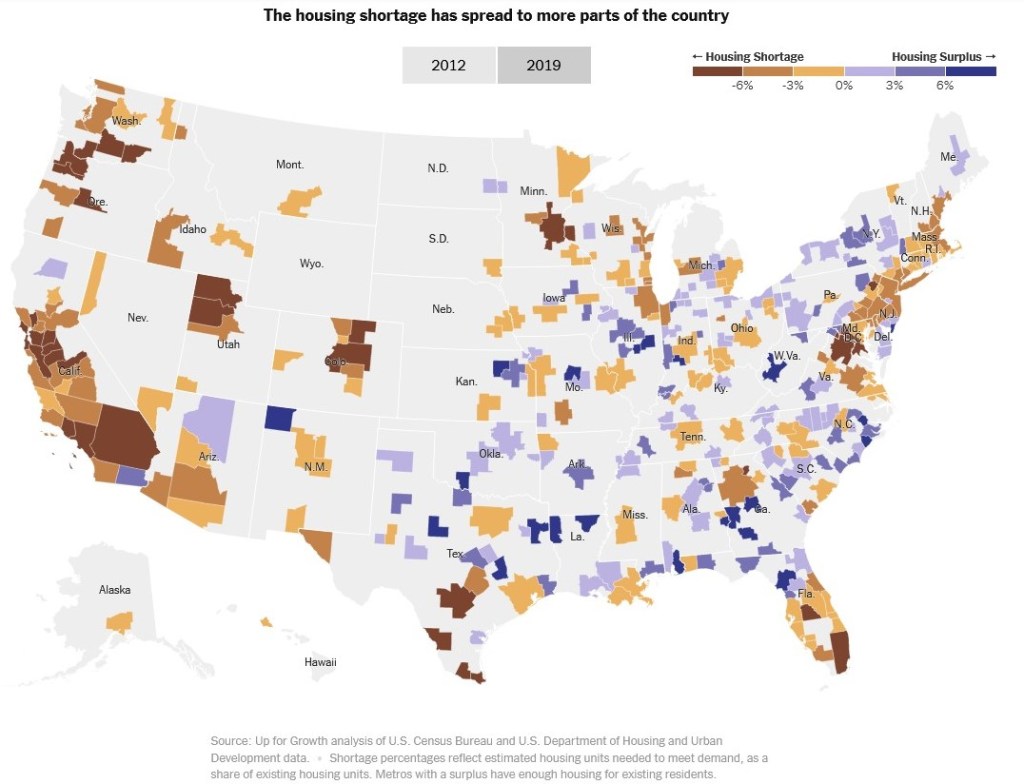
A new analysis shows which metropolitan areas in the United States have a housing shortage or surplus:

A quick look at this map shows the biggest metro areas tend not to have a surplus while smaller regions have a higher likelihood of having a surplus. There is additional analysis showing at least a few metro areas that had a housing surplus in 2012 that did not in 2019.

While it is intriguing to see that some places have housing while others need it, the answer is not to have people in large numbers move from the housing shortage areas to those with a housing surplus. Both the rise of certain cities in recent years and the COVID-19 pandemic offered some hints of what this leads to: the effects of cities losing residents (if just temporarily) and rising housing prices in markets experiencing a lot more interested housing seekers. At the same time, as noted in the article, a national policy is difficult to imagine and/or enact.

Hopefully, by the time a similar time period passes and a new map is released, there are more metro areas with available housing.

Are American cities in trouble or are we focusing too much on the business core of cities?

Recent data suggests the biggest American cities are facing several issues, including population loss. I wonder if the bigger issue is too much focus on the business and downtown core:

They are all among the 20 largest metropolitan areas in the country. All of their populations were growing in 2011. And then, in 2021, they all shrank by a combined 900,000 people, according to an analysis of census data by the Brookings scholar William Frey. That’s an urban exodus nearly the size of two Wyomings.

The great metro shrinkage is part of a larger demographic story. Last year, the U.S. growth rate fell to a record low. The major drivers of population—migration and births—declined, while deaths soared in the pandemic. But America’s largest cities are getting the worst of this national trend. In the past three years, the net number of moves out of Manhattan has increased tenfold. In every urban county within the metros of New York City, Los Angeles, and San Francisco, immigration declined by at least 50 percent from 2018 to 2021. In downtown Detroit and Long Island, deaths actually exceeded births last year.

The great metro shrinkage also appears to be part of a broader cultural story: The rise of remote work has snipped the tether between home and office, allowing many white-collar workers to move out of high-cost cities. Nearly 5 million Americans have moved since 2020 because of remote-work opportunities, according to Adam Ozimek, the chief economist for the Economic Innovation Group, a think tank in Washington, D.C…

So what might this period of urban struggle look like? Just check out what’s happening now. Mass-transit ridership has collapsed from its pre-pandemic highs in New York, Boston, the Bay Area, and Washington, D.C. Although restaurant bookings and travel have bounced back almost entirely, office occupancy remains 50 percent below its 2019 levels. In San Francisco, vacant office space has nearly quadrupled since the pandemic to 18.7 million square feet. In New York, Mayor Eric Adams has practically begged white-collar workers to return to Midtown, even as those workers patronize businesses in more residential parts of the city, closer to where they live. America’s downtown areas support millions of jobs that can’t be made remote—in retail, construction, health care, and beyond. But for millions of white-collar workers, something important has changed: They don’t work “in” cities anymore. They work on the internet. The city is just where they go for fun.

The overall numbers are what they are. Yet, the emphasis in this piece and in others I have read are about a downtown core that COVID-19 weakened. What if American cities no longer need a dense downtown core in the same way? With more work from home, less demand for downtown office space and more interest in downtown residential space, and the ways cars and mass transit allow workers to live in different places from their workplaces, how much focus should be placed on struggling cores?

This could be a larger existential issue about American cities. In the 1990s, a group of scholars in Los Angeles wrote about a new Los Angeles School of urbanism built around the unique features of the LA region. This includes a decreased emphasis on a downtown core and more sprawl and fragmentation across the region. In contrast, Chicago and New York and many other American cities stand as the established alternative: an important business core in response to which all other city activity is oriented.

So is the problem really cities are in big trouble or that the model of an ultra-dense center with all that comes with it is breaking a bit? This could be a huge change for certain places – particularly parts of Manhattan, downtown San Francisco – but there would also be opportunities throughout cities if development and business and residential activity could be more spread out. Indeed, the picture attached to the story says a lot about this:

This picture is taken from the vantage point of a sizable property just south of Chicago’s Loop. Why is it not developed? If the core did not have to be as dense, could this significant property be better woven into the fabric of the city?

More broadly, observers can think about complete cities and complete regions in addition to changes or issues facing the downtown. If activity is moving elsewhere, what does this mean and how might it improve life elsewhere?

View housing – and America? – as “a country of 384 metro areas”

Housing is all about location so why not view it as a metro by metro issue?

Photo by Maria Orlova on Pexels.com

When it comes to housing, it might be better to think about the U.S. as a country of 384 metro areas (plus 50 million Americans who don’t live in places big enough to qualify as a metro area) rather than one continuous country. In 2021, the U.S. population grew just 0.1% – the lowest annual expansion rate since our nation’s founding. But housing dynamics are best viewed through the different metro areas that are growing and shrinking. Of the 384 metro areas, 72 had declining populations in the decade leading to 2020, according to the Census.

The general argument makes some sense: supply and demand for housing depends on the metropolitan region. I have lived in one of these regions that has very limited demand for housing and experienced numerous foreclosures in the late 2000s. In places such as these, housing is cheap and plentiful – but there are relatively few people who want to move there and, if they do, there is limited desire to rehab older homes. On the other hand, the activity in particular housing markets – such as the coverage of housing and population in Manhattan and San Francisco during COVID-19 – draws all sorts of attention because of the prices and demand. All of this contributes to why housing is difficult to address at a national level.

More broadly, seeing the United States as a collection of metropolitan regions (or expanded city states?) may make some sense. For example, the 9+ million people in the Chicago region may see themselves as more of a collective than describing people from Illinois or people from the Midwest. These people share a particular housing and jobs market, common sources of information, entertainment options, a transportation network, and regional forces.

Of course, some regions may be more like other regions. Scholars have examined some of these broader collections, such as Rust Belt or Sunbelt regions or immigrant gateways, or used particular cities as models – particularly Chicago, New York, and Los Angeles – by which we can better understand all cities and regions. Yet, even these regions that share common characteristics have particular histories and current realities that would help set them apart from other.

All of this gets at an ongoing issue in sociology and other disciplines: at what point is it worthwhile to group phenomena together because of common traits or is it better to leave them as distinct entities because of their differences? There are both common traits in and a lot of variation among the 384 metro areas (plus all the other people living outside metro areas). At least for housing, it is tempting to treat each market as unique even as there are common patterns.

The United States as “a decentralized nation”

One analysis of the concentration of people and activity in American cities leads to this conclusion about the country today:

The modern U.S. is thus a decentralized nation, where despite an urban revival in recent years the periphery has kept growing faster than the center. Rural areas aren’t growing; most American counties actually lost population in the 2010s. But low-density suburban counties attached to large metropolitan areas grew faster than either high-density suburbs or urban counties, economist Jed Kolko calculated recently, while the fastest-growing major metro areas (Austin, Orlando, Raleigh, Nashville) aren’t among the largest.

This is a little hard to square with claims that large cities continue to wield great political clout. If it weren’t for the Electoral College, according to one oft-heard argument, voters in New York, Los Angeles and/or Chicago would choose every president. How they would manage to do this with only 4.7% of the nation’s population is a bit of a mystery. True, the three cities’ metro-area populations added up to 13% of the U.S. total in 2020, but that was down from 13.3% in 2010 and traditionally suburbs and cities largely canceled each other out politically — although that has been changing lately.

There’s a stronger argument to be made that economic power and cultural clout remain concentrated in a few places. Gross domestic product grew more slowly in the 10 largest metro areas than the country as a whole from 2010 to 2019 (2020 data aren’t out yet), but per-capita personal income grew faster. New York still dominates finance and the news media, Washington dominates government, Los Angeles rules entertainment and San Jose and San Francisco technology.

Census data suggests that the majority of the American population lives in suburbs. But, population alone cannot explain the importance and persistence of big cities. They will continue to remain powerful and important for multiple reasons. They help anchor broader metropolitan regions. They are centers of finance, innovation, real estate, cultural opportunities, key transportation infrastructure, and other essential activity. They occupy some of the most important and strategic locations. They have long histories.

At the same time, a decentralized landscape means (1) no single city or set of cities may dominate activity and/or (2) residents of the United States may not feel the importance of cities. For example, even with data showing the importance of cities and their regions for economic activity, Americans consistently discuss small businesses and farmers. Or, Manhattan and Washington, D.C. may dominate headlines but many Americans will be more invested in their local regions or communities.

More broadly, it may be safe to describe all of American society as more decentralized than other developed countries. I am thinking of Frank Dobbin’s book Forging Industrial Policy where France is the example of a more centralized state, both in terms of government structure – more power at the state level – and geography – all roads/rails lead to Paris. The United States has had from the beginning a system with distributed powers at the federal, state, and local levels as well as a broad landscape with many kinds of settlements.