The pandemic gives residents to some places, the years afterward take them away

What happened to the places that gained residents during the pandemic? Some are now experiencing less growth:

Photo by Tracey Mahoney on Pexels.com

Flash forward to today, and the big “winners” of the work-from-home reshuffle — metros that drew hordes of footloose workers and disaffected coastal dwellers — have turned into losers. Fewer people are moving to so-called Zoomtowns. Home listings are piling up on the market. Prices are dropping. The anxiety has shifted from buyers trying to elbow their way in to sellers just trying to offload their properties. A new report by the real estate analytics firm Parcl Labs, shared exclusively with Business Insider, shows that home sellers in the lower half of the US, also known as the Sun Belt, are the most desperate in the country…

Housing demand surged early in the pandemic — the country’s homeowning ranks swelled by a whopping 2.2 million people between the first quarter of 2020 and the same point in 2022, an analysis by the Harvard Joint Center for Housing Studies shows. But for all the talk of upheaval, movers more or less stuck to those pre-pandemic flight patterns — just at warp speed. People kept migrating from big-city centers to the suburbs and from the North to the South. Sun Belt states, including Florida, Texas, Arizona, and North Carolina, experienced the largest population gains from domestic migration between mid-2020 and mid-2021, per a Harvard analysis of Census data. The Dallas metro, for example, gained around 63,000 people from other parts of the country that year, a huge jump from just 19,000 the year prior. Phoenix, Tampa, Austin, and Charlotte recorded similar increases. Expensive states with large urban areas, including California, New York, Illinois, and Massachusetts, saw the biggest losses…

The North-to-South movement still holds, but the North is losing fewer people, and the South isn’t gaining like it once was. The most recent numbers, for the yearlong period ending in mid-2024, show net domestic migration to the South was down almost 38% compared to the first year of the pandemic. Domestic migration to the Midwest, on the other hand, is up about 60% in that same period, though it’s still negative in absolute terms. The Northeast’s net loss was down to 192,000 in the latest tally, compared to a loss of 390,000 at the height of the pandemic. With the migration tide receding, sellers in once-hot metros are getting real. In Denver, Charlotte, Jacksonville, and a smattering of other Sun Belt markets, more than half of single-family homes for sale have seen a price cut, Parcl Labs data shows. In the Boston, Philadelphia, and Buffalo metros, the share of listings in that bucket drops to fewer than a third.

That’s just one metric. To gauge sellers’ desperation these days, Parcl Labs created what it calls the Motivated Sellers Index, which combines four factors: the number of price cuts on home listings, the time in between those cuts, the size of the price decreases, and the length of time homes are spending on the market. The higher the score, the greater the homeowners’ urgency to sell. The lower half of the US, with the exception of much of California, is awash in high scores, indicating sellers are ceding negotiating power to buyers. Same goes for much of the West. The Midwest and Northeast, on the other hand, registered some of the lowest scores in the nation: Sellers there are sitting pretty by comparison.

This is something I have wondered about a lot in recent years and even addressed, with Ben Norquist, in a chapter in my book Sanctifying Suburbia: in today’s world of smartphones, the Internet, and easy travel, why do people and organizations stay where they do when they could be located almost anywhere?

Evangelical non-profits described the benefits of being near other evangelical organizations. They thought they could find employees in certain places and could partner with other actors in the community. Some had long histories in their community while others had made a major move to help their budget.

Residents do not just go where there is cheap housing or plenty of jobs. They have ties to places and people. Moving comes with its own costs.

So some more people moved related to the pandemic following similar patterns in previous decades: away from metro areas in the Northeast and Midwest to the South and West. And that appears to be continuing, but at a slower pace and with some indicators that the rapid growth in the South and West is slowing. What does this all mean?

Perhaps the pandemic years were an aberration. Yes, people can work from home but this is not what all companies and organizations want. Bring a bunch of new people to new places and the housing prices go up and the communities change.

Does this mean all that movement would stop completely? Or that places in the Northeast and Midwest would grow? Not necessarily. Long-term patterns are hard to break.

Seeing the relative decline of small Rust Belt cities by looking at the early years of the NBA

On a recent trip, I found out that the Tri-Cities Blackhawks – based in Moline, Illinois for several years – were once a professional basketball team.

They played in Moline for 5 years before moving and becoming the Milwaukee Hawks (later the St. Louis Hawks and the Atlanta Hawks).

Having a team in Moline would not fit in the modern NBA where teams are located within the largest cities in the United States. Even at the start of pro basketball, many teams were in large cities. But, Moline was not alone in having an early pro basketball squad. Here are some of the other Rust Belt cities that had early teams:

-Providence

-Pittsburgh

-Fort Wayne

-Rochester

-Syracuse

-Anderson, Indiana

-Sheboygan, Wisconsin

-Waterloo, Iowa

What does it mean that all of these cities are out of the NBA within a few years? It could be part of a larger restructuring and expansion of professional sports around this period. More cities in the West and South gained teams. I recently read that the St. Louis Cardinals were the furthest south and west team in baseball for a long time; this is hard to remember when all pro leagues stretch coast to coast.

But it could also be partially due to the relative decline of the Rust Belt. These places that were once sizable and/or important places fell behind as other cities grew in population and status. Or the region itself, stretching from the middle of New York and Pennsylvania through the eastern Great Plains, fell on harder times.

Pro basketball may have started in small big cities in the Midwest but it did not stay there long as the sport and other places grew.

Mapping Carnegie Libraries

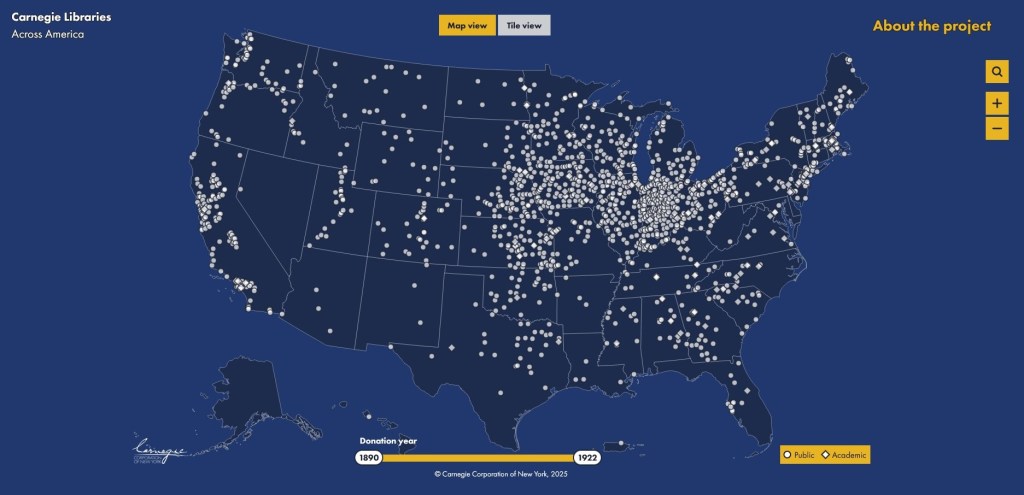
The Carnegie Corporation of New York has a map of the libraries Andrew Carnegie funded around the turn of the twentieth century:

I have not studied this beyond the map but I am intrigued that the map seems to show a lot of libraries between roughly western Pennsylvania through Nebraska. The Midwest has a lot of libraries, except for Missouri which seems to have fewer. There are some pockets of libraries elsewhere; northern California, the Northeast. But Indiana, Illinois, Ohio, Minnesota, and other midwestern states have a lot of libraries.

Why the Midwest? A few ideas come to mind:

  1. Its population is growing rapdily at this time. (Population growth in the South and West would come later and the East Coast already had established communities.)
  2. Did Carnegie’s life in Pittsburgh connect him to life in other midwestern locales or familiarize him with midwestern values?
  3. These communities valued civic institutions, like libraries.

If someone had come along in the 1960s and wanted to help fund civic buildings, how much different would the map look?

Places that represent America, in memes and other forms

Ohio is a running meme in social media:

Photo by Mohan Reddy on Pexels.com

According to Know Your Meme, treating Ohio as a joke started in 2016 after the meme “Ohio vs the world” went viral on Tumblr. User @screenshotsofdespair posted a photo of a digital marquee in an unknown city that read, “Ohio will be eliminated.”

At the time, the joke was Ohio was secretly plotting to take over the world, hence the photo calling for its silencing. By the time 2020 rolled around, jokes about the state had evolved…

Now, most memes about the state are saying “so Ohio” or “only in Ohio” about something bizarre or random. It’s usually tied to images, GIFs or videos that highlight something ridiculous. The memes imply that Ohio is a place where strange things happen. Ironically, it’s actually been named one of the “most normal” states in the U.S.

Describing the internet trend, Know Your Meme explains how the memes have essentially re-branded Ohio. Now it is “an American middle place, existing as a capitalist wasteland of chaos and mayhem, akin to creepypastas, lore and randomness, becoming an imagined epitome of American signifiers such as Breezewood, Pennsylvania.”

The Ohio memes have become so near-constant that they’ve taken on a life of their own. To date, the hashtag #Ohio has 33 billion views on TikTok, while #OnlyInOhio has about three billion. In some cases, people have made memes about the memes.

I am intrigued by this idea of particular places embodying America, whether normal or weird. Breezewood? I look forward to driving by it several times a year. The Midwest as the “heartland”? In the sociological tradition, how about “Middletown” and the long set of studies devoted to this community (which was Muncie, Indiana)? Or, what about the claim that Chicago is the most American city? Or, the idea that one can see real America at Walmart or at an emergency room on a weekend night? Perhaps this has a long tradition, even if it is now taking the form of memes.

And then there could be places and communities that are known but cannot embody all of America. Could New York City all about America or does its status as the leading global city and its particular history and character mean that it cannot embody all of the United States? (Perhaps normal American cities are Cleveland.)

Brazil leads the world in exporting corn; consequences for Chicago and the Midwest?

A new nation is the world leader in exporting corn:

Photo by Todd Trapani on Pexels.com

Brazil is set to overtake the U.S. this year as the world’s top corn exporter, reflecting both a bumper harvest and logistical breakthroughs such as the consolidation of northern export routes, which are boosting the competitiveness of the South American grains powerhouse.

Corn exports through Brazil’s northern ports, which use the waterways of the Amazon River basin to ship grains globally, are on track to beat volumes via the most traditional port of Santos for a third consecutive year, according to a Reuters analysis of grain shipping data.

The shift underscores how Brazil, which churns out three corn crops per year and still has huge expanses of under-used farm land, is finally overcoming some of the infrastructure bottlenecks that have long made it hard to get its bountiful harvests to global markets.

That and a new supply deal with China announced last year suggest Brazil may be opening a longer era of supremacy over U.S. corn exports, unlike the last time the Brazilians briefly grabbed the global corn crown during North America’s drought-hit 2012/13 season.

Three thoughts connected to this shift:

-The image of the Midwest in the United States often involves corn. Corn mazes, corn palaces, endless fields of corn. Does this diminish anytime soon in the Midwest? Does Brazil have similar regional and cultural connections to corn?

-One of the reasons Chicago grew rapidly and became a global city is because it became a center for buying, selling, trading, and shipping commodities like corn. Corn poured into the city and helped make it wealthy and influential. Now, activity involving commodities has increased elsewhere. Will the traders in Chicago be betting on Brazilian corn?

The number of people involved in agriculture in the United States dramatically declined in the last 120 years. Food production has continued to grow. So, if more food s grown outside the United States, do most consumers notice? I wonder if we would ever see Brazilian corn at a store near us.

Midwest cities lead the way in % of AM radio listeners

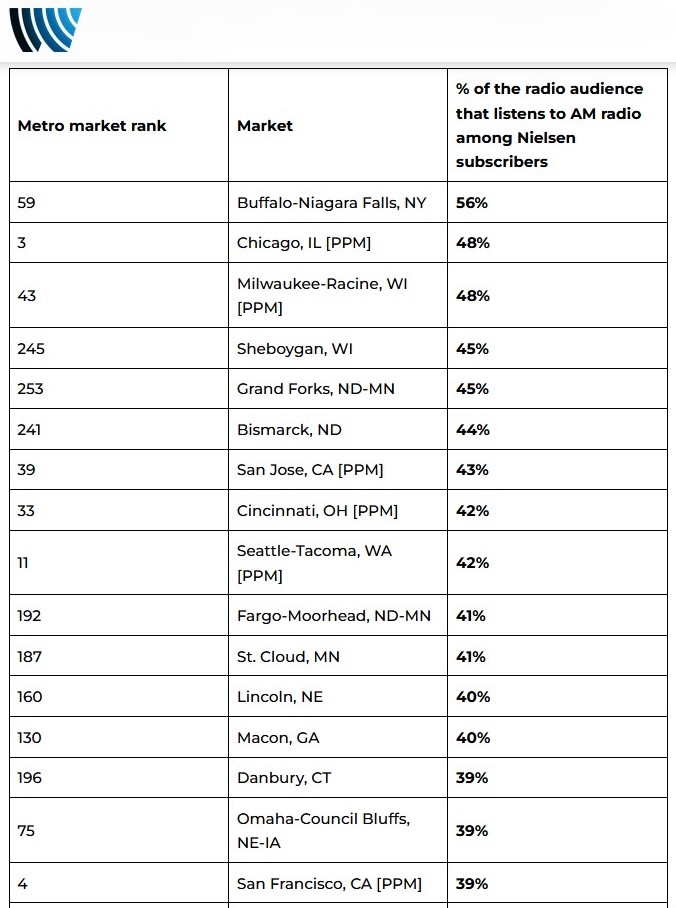
A recent look at “the % of the metro radio audience that listens to AM radio in a month” shows these cities at the top:

The top six cities on the list are Midwest cities (including Buffalo on the western edge of New York). In this list, the first city in the West is San Jose at #7, the first city in the South is Macon, Georgia at #13, and the first Northeast city is Danbury, Connecticut at #14.

I do not know if these differences are statistically significant but it is interesting to consider why Midwest metropolitan areas might lean toward AM radio. A few possibilities:

-A long history of important AM stations.

-Is the Midwest less dense compared to some other parts of the country or Midwest people do further drives and AM’s longer signal keeps them connected?

-Radio stations on FM or AM in different areas provide different content. Is this linked to more or less interest in music, news, sports, talk, or other content?

-Are there are other lifestyle markers of Midwesterners that are somehow linked to AM radio?

Of the top 20 radio markets in the country, I think only the Washington, D.C. area is not on this list with at least 20% of listeners tuning into AM radio. What are people in DC listening to?

Midwest leads the way in homes selling for under $250k in February

In a larger story about home prices falling in February, this graphic shows the percent of homes in each region sold in different price categories:

Only in the Midwest region are close to 50% of the homes sold at $250,000 or under. The Northeast is roughly at 33%, the South is roughly at 26%, and the West is roughly at 6%.

So does this mean there are more starter homes in the Midwest? Not necessarily. Perhaps this is linked to incomes in the region and less household wealth for people to spend on homes. Perhaps the housing stock of the homes is older and the homes need more rehab. Perhaps there is less demand for the homes due to slower population growth.

Still, the differences are stark. Could Midwestern states and communities advertise that they have cheaper housing? (Of course, an influx of residents could push housing prices up as has happened in certain locations throughout the United States.)

Midwestern ice fishing and McMansions

An analysis of words in Midwestern Airbnb listings includes a connection between McMansions and fishing:

Photo by Tima Miroshnichenko on Pexels.com

Anyone can catch a walleye with a few bucks’ worth of basic gear, some practice and a little luck, Roach said, though that doesn’t stop some Midwesterners from dropping the equivalent of several years’ salary on boats, McMansion-grade ice-fishing trailers and sophisticated electronics designed to better target the finicky fish.

Follow the link for the trailers and you can see large ice-fishing trailers. I assume that is the primary use of McMansion here: these trailers are large. They offer a lot of interior space. Maybe they are mass-produced or architecturally dubious but the size of these trailers is bigger than just a little ice fishing hut.

At the same time, the use of the term suggests that the ice-fishing trailers are over the top or unnecessary or undesirable thing. McMansion is an evocative term that is usually linked to negative judgments.

The lingering question here: is the large McMansion trailer a worse choice than a more modest ice-fishing dwelling?

(This is not the first time McMansions have been linked to transportation. See earlier posts here and here about McMansions and SUVs. Those ice fishing trailer need a sizable vehicle to tow them into place.)

Imagining St. Louis as the capital of the US

It is fascinating to consider (1) a different capital in the United States in the center of the country and (2) a different center to the Midwest:

Photo by Nick Haynes on Pexels.com

In some ways, Arenson says, St. Louis was at the heart of these questions. Geographically, it was located where North, South and West came together. It had been a slave state, but had not seceded. It was central to many railroad lines. And it was growing at a remarkable place—it would rise from the country’s 24th most populous city in 1840 to the fourth biggest in 1870.

No one was more convinced of the importance of St. Louis than local businessman and booster Logan Uriah Reavis. Reavis was a remarkable man, with a remarkable appearance. He wore a long, messy red beard and walked bent over a cane due to a childhood illness. Born in Illinois in 1831, he failed in his early career as a schoolteacher “when the students ridiculed him ceaselessly,” according to Arenson’s book. In 1866, he arrived in St. Louis intent on starting a newspaper and elevating the image of his adopted hometown.

Reavis wasn’t the first to suggest the city as a new capital for the nation. In 1846, St. Louis newspapers claimed that the move would be necessary to govern a country that grew significantly in size after the end of the Mexican-American War. But Reavis may have been the most outspoken supporter of the cause. He presciently envisioned a United States stretching not just out to California but up to Alaska and down to the Gulf of Mexico. And he saw St. Louis as the obvious place for the government of this mega-United States: “the great vitalizing heart of the Republic.” In contrast, he wrote, Washington was a “distant place on the outskirts of the country, with little power or prestige.”…

In response, between 1867 and 1868, three House representatives from the Midwest proposed resolutions to move the capitol toward the middle of the country. As historian and educational publisher Donald Lankiewicz writes for History Net, the first two of these stalled in the Ways and Means committee. But a third, introduced by Wisconsin Representative Herbert Paine in February 1868, came to a vote on the floor. Eastern congressmen saw the proposal to move the seat of government to somewhere in the “Valley of the Mississippi” as a joke. But it shocked them with the amount of support it received, ultimately failing by a vote of just 77 to 97.

This story sounds very American: local boosters combined with an expanding frontier and disorder after the Civil War to produce a vision for a new capital in a booming city. Even though this did not come to fruition, it sounds like there was a short window in which is could have happened. And then what would have happened to Washington, D.C., one of the most important cities today?

I also cannot help but contrast this to the fate of St. Louis after this era. I recently showed my urban sociology class the documentary The Pruitt-Igoe Myth. This documentary puts the infamous public housing project in the context of a city that peaked in population in 1950, lost residents in white flight, and is racially segregated. Add this to the competition with Chicago for the center of the Midwest and St. Louis might be a great story of a city that did not live up to its lofty dreams.

Why people do not flock to the American cities that keep showing up in the most affordable places to live

I recently saw another list of the most and least affordable metropolitan areas in the United States with a key metric of how many families in the region could purchase a home at the median price. Here are the five most affordable places:

Photo by Ketut Subiyanto on Pexels.com

Home prices and incomes vary widely, and there are oases of affordability, mainly in the Rust Belt and Midwest. The top five most affordable places among metro areas with population of 500,000 or more:

Lansing, Michigan: As a result of modest home prices, 90.6 percent of all new and existing homes sold in the fall months were affordable to families earning the area’s median income of $79,100. The median home price was $155,000 in the fourth quarter of 2021, the builders’ index says.

Scranton-Wilkes Barre-Hazleton, Pennsylvania: Wages here are below national levels, but so are home prices — the median sale price was $150,000 in the fourth quarter. As a result of rock-bottom prices, 88.5 percent of all new and existing homes sold in October, November and December of 2021 were affordable to families earning the area’s median income of $70,600.

Pittsburgh: This metro area has a median family income of $84,800 and a median home price of just $166,000. As a result, 88.4 percent of homes were affordable for typical earners.

Indianapolis. This metro area has a median family income of $81,600 and a median home price of $215,000. As a result, 87.6 percent of homes were affordable for typical earners.

Akron, Ohio: With a median family income of $83,300 and a median home price of $165,000, fully 86.5 percent of homes were in reach of median-income families in the state capital.

Two features quickly stand out: the homes in these regions really are cheap (particularly when compared to local earnings) and they are all in the Midwest/Rust Belt.

Still, I have seen some version of this list many times now and I am not sure what to make of them. Why aren’t people moving to these locations?

The most obvious answers to me: it is not necessarily easy to move and these cities are perceived to have a lack of opportunities (economic, cultural, housing, etc.). American geographic mobility as a whole is down but do people actually move just for cheaper housing? What this list does is highlights that median income families can access median level housing in these five places. Get a decent job and owning a house is possible.

There are other possible answers that get more complicated:

  1. People just do not think of the Midwest/Rust Belt when thinking of places to live. Lack of opportunities, the weather, the middle of the country, a Midwestern blah-ness, etc.
  2. It is not just about a lack of opportunity; these are places seen as on the decline. Even if they are cheaper, who wants to live in a place that has already seen its best days when “growth is good” is a key marker of communities?
  3. These communities are lacking incentive campaigns to try to attract new residents.
  4. These communities may not want too many people to move in because it could drive up prices and bring in outsiders. (Yet, growth is good and many declining communities would do a lot to become a destination again.)

In sum: some American metropolitan areas are much cheaper than others, they have common characteristics, and there are a number of compelling reasons why people do not move to the places with cheaper housing.