“Libertyville will be featured quite a bit,” he said. All the business names were kept as is and some of the shopkeepers appear in the film, he added.
The village was to have been one of the locations for another of his holiday films, Charles said. That was delayed but filming for “Christmas at the Zoo” has been approved by the village and is planned for December.
“Libertyville has been on our radar for some time,” he said. “Having had a great experience shooting ‘Exes’ there, we’re happy to be coming back.”…
Local actors will be used in the film and Libertyville will be listed as an official filming location on the IMDb website.
With all these real shots of Libertyville, it appears the film does not say it takes place in Libertyville. From one Facebook post and a brief shot in the movie trailer, it appears the community in the film is named “Mill Creek.” According to Wikipedia, there are at least a few communities in the United States named “Mill Creek.”
I have wondered about whether filming in real locations matters for those watching a film or TV show. Couldn’t they just have found some establishing shots or used a studio to film? This is commonly done so how much does it matter that this was set in a real place that the film’s creators were familiar with? Perhaps the residents of Libertyville can watch and discuss and then compare what people who watch from elsewhere think.
The name of the new movie Holland refers to the community in west Michigan. Numerous reviews note that the film says something about the suburbs. A few examples: first, from Variety:
Through it all, Macfadyen seems suspiciously good-natured, which merely encourages us to guess what he might be hiding. The “Succession” star brings a disconcerting Kevin Spacey-like energy to his performance, which reinforces the connection some might detect between “Holland” and 1999’s “American Beauty” — another movie about the toxic black mold that thrives just beneath the veneer of suburban perfection.
Kidman does her best to be the MVP of “Holland,” imbuing Nancy with just enough Midwestern nicety to make her memorable. Nancy is the kind of woman who wants to be a perfect wife and mother but also wants some mystery in her life and responds to the attraction of the handsome new teacher at her school. She’s a suburban shark, always swimming to a nearly impossible objective of keeping her pristine reputation in the community, holding her family together, and having a fling with Dave. While she doesn’t make any bad choices, there’s a version of “Holland” that lets Kidman loose, turning the temperature up on this character’s emotions in a manner that Cave feels tentative to do.
Watching Kidman play a happy homemaker in a pretty suburban town might swiftly recall Frank Oz’s underrated 2004 comedy remake of The Stepford Wives, which Kidman starred in.
You get the idea: the setting and the plot add up o a film that seems to say something about the American suburbs. This is familiar ground in American movies (as well as novels, TV shows, songs, and other cultural works)
But is Holland, Michigan a suburb? Here is what Wikipedia says:
The city spans the Ottawa/Allegan county line, with 9.08 sq mi (23.52 km2) in Ottawa and the remaining 8.13 sq mi (21.06 km2) in Allegan. Holland is the largest city in both Ottawa and Allegan counties. The Ottawa County portion is part of the Grand Rapids metropolitan area, while the Allegan County portion anchors the Holland micropolitan statistical area, which is coextensive with Allegan County. The city is part of the larger Grand Rapids–Wyoming combined statistical area.
Since metropolitan areas have boundaries based on counties, it seems that part of the city is part of the suburbs of Grand Rapids, a city of nearly 200,000 people and a metropolitan area of over 1 million people. But a good portion of the city, home to over 37,000 residents, is also its own smaller urban area.
Do the people of Holland see themselves as suburbanites? How many commute to Grand Rapids and other parts of the region? Are there cultural and historical ties to Grand Rapids?
None of this may matter for putting together a film. Filming scenes in downtown Holland or within neighborhoods in the community may look suburban. How many people watching really want to have authentic places that match what is being described? (For example, once I have seen a few studio backlots, it is hard to unsee them.) If the movie is about the suburbs, who is to say it isn’t?
If Chinatown’s ending forces the audience to sit in a feeling of hopelessness, it should also disturb anyone invested in Los Angeles’s future. The history of water in 20th-century California was defined by mammoth feats of engineering and an enduring belief that someone like Mulholland would eventually come along and enable the impossible. Each new dam or aqueduct only guaranteed the arrival of the next one—the population growth allowed by Mulholland’s aqueduct, for example, later resulted in L.A. tapping other water sources, such as the Colorado River. California has had a few good years of rain recently, but the long-term sustainability of the state’s water supply depends on collective conservation efforts: drastically reducing the amount of water used by Big Agriculture, moderating suburban tasks such as watering lawns, regulating the state’s groundwater.
“There is no more water to capture with big projects. There just isn’t. The future is really about much smarter water management,” Stephanie Pincetl, a UCLA professor who specializes in urban policy and the environment, told me. Conservation measures, she argues, are the way forward even if politicians wish they could stump for some grand technological innovation the way their 20th-century predecessors did: “The approach to the 21st century has to be a lot more subtle, a lot more place-based, and a lot more guided by the realization that water is a scarce resource, and so we need to treat it like a scarce resource.”
Finding water in Los Angeles, the Southwest, the West, and the United States more broadly may become more paramount in the coming decades. Which cities and regions would do well in competing for water? Would a lack of water in some places lead to growing populations in places with plenty of water?
While we are at it, why not tell more exciting stories in these categories:
Origin stories of modern places. Take any of the big cities in the United States and put its origin story in a movie or a miniseries. How about the rise of Phoenix?
It would be interesting to popularize more stories about water and other necessary resources in daily life. How about a thrilling tale about concrete? It is hard to imagine modern life without out. Or air conditioning. Can’t have a lot of the global development of the last century without it. Or salt. Where do we get all this salt in our daily lives from?
If Chinatown can entertain and inform about place, why not engage in more storytelling that explains where places have come from and where they might be going?
Although the producers always wanted to find the right stories to take advantage of being on location, Friends was never shot in New York. Bright felt that filming outside the studio made episodes less funny, even when shooting on the lot outside, and that the live audience was an integral part of the series.[58] When the series was criticized for incorrectly depicting New York, with the financially struggling group of friends being able to afford huge apartments, Bright noted that the set had to be big enough for the cameras, lighting, and “for the audience to be able to see what’s going on”.[58] The apartments also needed to provide a place for the actors to execute the actions in the scripts.[58]
The fourth-season finale was shot on location in London because the producers were aware of the series’ popularity in the UK.[58] The scenes were shot in a studio with three audiences each made up of 500 people. These were the show’s largest audiences throughout its run. The fifth-season finale, set in Las Vegas, was filmed at Warner Bros. Studios, although Bright met people who thought it was filmed on location.[72]
The show has a close tie to New York City. Could Friends have even existed in another American city? If it had been in Chicago or Atlanta or Austin, would it have been the same show or had the same success?
Yet, almost all of this was done with away from New York City. It was filmed in an environment that could be made to look like New York.
I would guess most viewers do not care whether the show was filmed in New York; it was set in New York, it had enough to look somewhat convincing of being in New York, and that’s enough. I, however, find this disconnect interesting as it commonly happens in TV shows and movies. When we see a “place” on screen, is it really that place?
On one hand, it is exciting to be watching a film, TV show, or commercial and recognize a place. It pops out at you out of the other anonymous scenery. On the other hand, this is not a real place. It is a backlot where all sorts of “places” can be made. With some work and added elements, these backlots can look like a lot of different places.
As I have found in studying suburbs on TV shows, places are presented on screens in particular ways. It is hard to communicate the feel and experience of a place on a two-dimensional screen when the emphasis is often on a few characters. Backlots can be changed up but if you know what you are looking for, you can spot them in all sorts of displays. Or, films, shows, and commercials tend to be shot in some places and not others. With these patterns, we do not necessarily see real places or the range of places within the United States.
The 1989 film (which is about a boy setting booby traps in his mansion on Christmas Eve to stop a killer Santa) earned a small measure of fame when its creators sued the makers of Home Alone (which is about a boy setting booby traps in his McMansion on Christmas Eve to stop some robbers) for the similarities between the two.
Is the Winnetka, Illinois home a McMansion or a mansion? Several pieces of evidence for the latter:
–Atlas Obscura calls it a mansion and says, “Built in the 1920s, the building is comprised of red brick and was built in the colonial Georgian style.” It is hard to call a home as old as this as a McMansion. Additionally, it is built in a classic style, not imitating a classic style.
–According to Zillow, the home has 5,398 square feet, 6 bedrooms, and 6 bathrooms. It is worth over $2 million. While the home size is in McMansion territory, that price is not.
Rightly or wrongly, I concluded that suburbia was segregated and snobbish, an attitude I’ve never been able to shake. I didn’t get that attitude from movies about just any suburbs, I got it from movies about Chicago’s Northern suburbs, which, over the last 40 years, have come to be seen as representative of all American suburbia. (My first job in Chicago was covering the Lake County suburbs for the Tribune. That didn’t change my mind.)
During the first wave of suburbanization, in the aftermath of World War II, the suburbs of Northeastern cities got all the attention, in movies such as Mr. Blandings Builds His Dream House, and in the fiction of John Updike, John Cheever and Richard Yates. When Hollywood rediscovered Chicago in the 1980s, though, it also discovered Chicago’s suburbs, through the work of writers and directors who grew up there. Paul Brickman, who directed Risky Business, was from Highland Park; Hughes was from Northbrook.
In the 1980s, suburbia was in its prime. Back then, nobody with money wanted to live in urban America. Rich people wouldn’t start moving back to cities for another decade. The suburbs are often mocked as a cultural wasteland, but towards the end of the 20th century, that’s where a lot of Chicago’s cultural energy was coming from. Even The Blues Brothers, which is revered as a document of post-industrial, pre-gentrification Chicago, was co-created by John Belushi of Wheaton. Steppenwolf Theatre Company was co-founded by Jeff Perry of Highland Park and Gary Sinise of Blue Island. According to his National Lampoon colleague P.J. O’Rourke, Hughes in particular was eager to rescue his native grounds from the notion that “America’s suburbs were a living hell almost beyond the power of John Cheever’s words to describe.”Chicago’s 1990s alternative music scene may have been born in Wicker Park, but its leading lights were suburbanites: Liz Phair of Winnetka, Billy Corgan of Elk Grove Village, Local H of Zion. Urge Overkill formed at Northwestern University. High Fidelity, the movie which celebrated that scene, starred Evanston’s own John Cusack as Rob Gordon, a guy from the suburbs who opens a record shop on Milwaukee Avenue.
Chicago’s suburbs continue to define suburbia in popular culture. The 2004 movie Mean Girls, the quintessential depiction of high school cliques, was set at fictional North Shore High School (i.e., New Trier). The characters even shopped at Old Orchard, although it was inaccurately depicted as an indoor mall. Greater Chicagoland also makes an appearance, and provides a contrast: Wayne’s World, set in Aurora, and Roseanne, set in the fictional, Elgin-inspired collar-county town of Lanford, are on the outside, physically, culturally and economically.
As someone who has researched locations and television shows, this raises several responses:
Would viewers of these different suburbs know that the Chicago suburbs were unique in some way or do they look like suburbs all over? For example, does North Shore High School look or feel different than schools in Westchester County or outside Boston? One of the films cited, Ferris Bueller’s Day Off, clearly shows Chicago locations but the suburban shots could fit in many American suburbs.
There is an empirical question here: were Chicago suburbs depicted more often than suburbs of other locations? Or, based on viewers or ticket revenue or albums sold, how does the creative energy of the Chicago suburbs compare to cultural products linked to other locations?
There is still some sense that suburbs are not creative places. This stereotypes dates back to at least the mid-twentieth century when suburbs were criticized as conformist and bland. True creative energy can only come from cities, not homogeneous and exclusive suburbs. Yet, as more Americans lived in suburbs compared to cities starting in the 1960s, it is not a surprise that cultural products would come from suburbanites.
Even as a number of creatives grew up in suburbs, how much did their adult work and products rely on cities, including Chicago? The major culture industries in the United States are often located in big cities so even suburban or rural themes are mediated through more populous and denser communities.
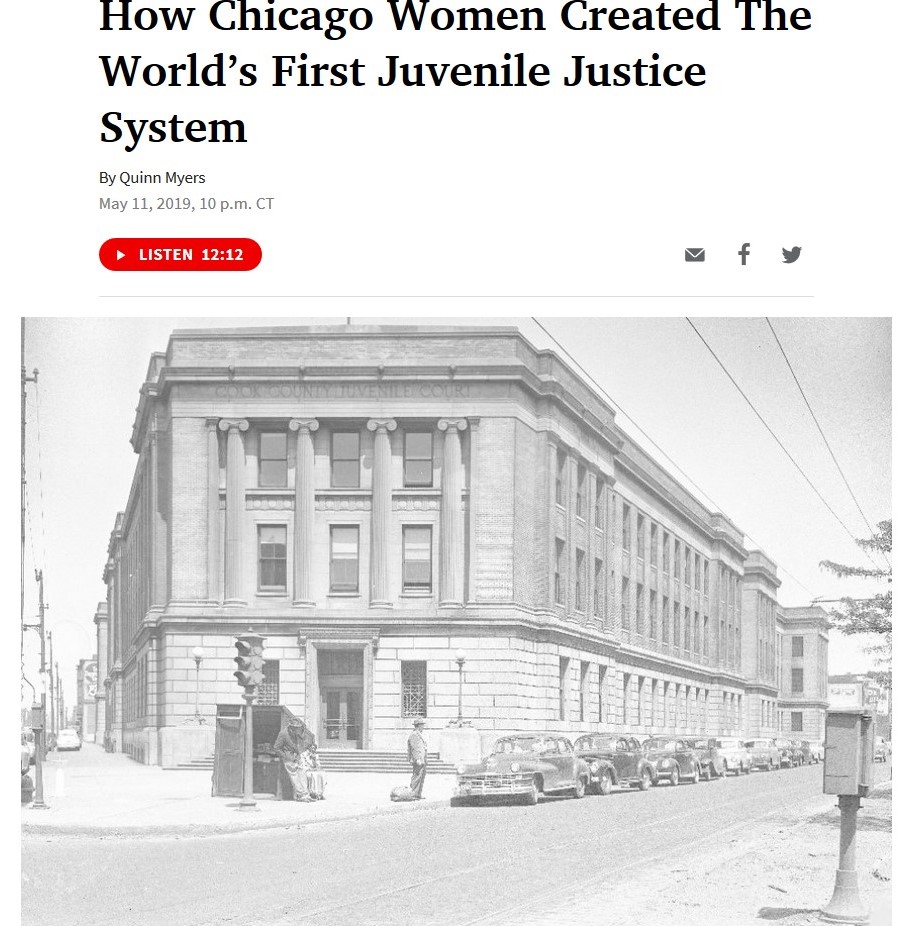
A recent WBEZ story highlighted the country’s first juvenile institution in Chicago. Here is the front of the building:
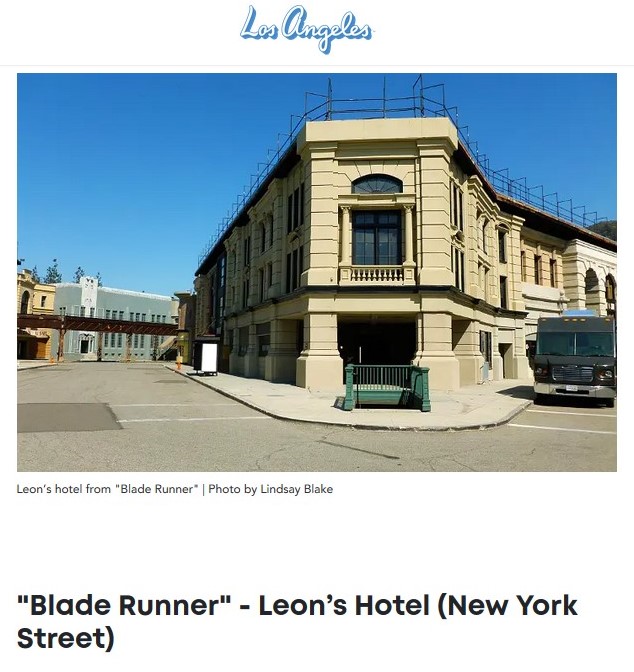
As soon as I saw this image, it reminded me of something I had seen on a tour years ago of the Warner Brothers backlot. Here is what I saw:
These buildings are not the same. But, their spirit is similar. They sit at an oddly-angled corner that gives the front entrance of the building a unique look. There are columns or pillars at the front. The buildings have a similar shape and set of materials even though they are slightly different. The backlot building has a subway entrance (from New York?) in front.
My experience with these structures hints at two larger processes at work:
My memory is not quite perfect yet it is grouping similar buildings together. How many buildings in major American cities have this kind of look on this kind of corner?
Linking to some of my research, how much do television and film depictions of place interact with our corporeal understandings of places? I can see a building on a screen, experience that same place or a similar place, and our brain and understandings then interact. Or, perhaps we may only know of a place through screen depictions and this backlot building in various forms stands in for all sorts of real settings.
I will keep looking for the Warner Brothers building on screen and continue to think through what it means for my understanding of Chicago, New York, and other places.
To go back to the beginning, how does Gill conclude her study of poetry and the suburbs? Here is the final paragraph:
Postwar suburbia has been understood and depicted as a place where little of significance can be said, where there is a profound absence of meaning, where communication is stylized, superficial, muted almost into silence. Yet as the poems discussed in this study indicate, suburbia is replete with meaning. Its poetry is bold, innovative, and engaging – both formally and thematically – in its evocation of this space and time. Indeed, the suburbs we know are known to us, in part, because of the ways in which poetry has constituted and mediated them. In turn, this poetry shows the signs of its own discursive, spatial, and historical contexts. As Doreen Massey has argued, “Social space is not an empty arena within which we conduct our lives; rather it is something we construct and which others construct about us” (49). For Roger Silverstone, suburbia is a “geographical, an architectural and a social space,” but it should also be understood as “an idea and ideology, as form and content of texts and images and as product of a multitude of social and cultural practices” (ix). Poetry, as this book has demonstrated, plays a vital – if until now overlooked – role in these processes. It offers a startling lens through which to view suburban landscape and architecture and to understand the nuances of the suburban everyday, and it demands of us that we read it with acuity and sensitivity. In its diversity and frequent ambiguity, poetry breaks the stranglehold of polarized thinking or, what Robert Beuka calls, “our continued cultural reliance on a restrictive binary system in defining the suburban milieu” (10). The Poetics of the American Suburbs has argued that the poetry of this time and place is critical, interrogative, evocative, expansive, and suggestive in turn. Most importantly, it is a poetry that is often skilful, occasionally luminous, always intriguing. The song it sings is sometimes familiar, sometimes subtle, sometimes discordant. As I hope this book has demosntrated, it deserves a hearing, and rewards attentive listening. (Gills 2013: 181)
This is a good description of what Gills does throughout the book, analyzing both popular and more literary poetry, showing how the constraints and possibilities of poetry help lead to insights about the suburbs, and how poetry reacted to and was shaped by suburbia. I recommend the book for those interested in studying the interaction of cultural works and the suburbs.
As I reviewed this academic work, it led to a few more thoughts on patterns within the work:
One idea that emerges from a number of these texts: understanding the suburbs requires analyzing what they mean and how narratives about them develop. Cultural narratives are influential and these cultural works contribute to an ongoing conversation about what the suburbs are and how they are to be regarded. For sociologists, both the facts about the suburbs – how did they arise, how are they changing, what social forces affect life there – and the interpretation of the suburbs – what are the processes of meaning-making around them – matter.
The academic literature addresses both works that praise or celebrate suburbia and works that critique suburbia. There are many works in this latter category, particularly in more recent years.
This is truly an interdisciplinary endeavor with scholars across a number of disciplines – Communications, English, Geography, Sociology, History, and more – contributing. These different perspectives help illuminate varied aspects of the cultural works and what they mean.
Related to #2, much of the work I have seen in this employs close readings or case studies of particular works or collections of works. There is less work that takes a quantitative approach to such cultural works.
In sum, I am grateful for all of this good academic work. It has helped me think more comprehensively about the suburbs and be more aware of how cultural works contribute to and/or challenge my and our perceptions of the suburbs. I am sure the academic conversation – and the public conversation about suburbs as well – will continue as suburbs change, new cultural works are produced, and the larger social context evolves.
With all of this academic study, I want to highlight the work of one scholar whose work I have found very helpful in my own research on suburbs on screens. After that, I will list several other books that cover similar ground from different angles.
A number of other scholars have also addressed screens and suburbs. Here is the bibliographic information for several recent texts I have cited multiple times in my work:
It makes sense that there is more academic work on television and movies and suburbs. As mass suburbanization picks up in the United States after World War II, television spreads rapidly and Americans quickly devote hours a day to watching the box in their living room. And television often had a particular angle on the suburbs, as the studies above suggest. While films had been around longer, the prosperous postwar era expanded their reach. Furthermore, while poetry or novels might appeal to a smaller slice of the American population, these mediums are clearly popular and accessible. Together, these dominant visual mediums in the twentieth century provided many images of the suburbs.
Tomorrow, I will come back to the question at the start of Gill’s book – “who sings the song of suburbia?” – and address studies of music about the suburbs.



 Legally Sociable