Chicago’s loss of nearly 3,000 residents in 2015 is an estimate

Chicago media were all over the story this week that Chicago was the only major American city to lose residents in 2015. The Chicago Tribune summed it up this way:

This city has distinguished itself as the only one among the nation’s 20 largest to actually lose population in the 12-month stretch that ended June 30.

Almost 3,000 fewer people live here compared with a year earlier, according to new figures from the U.S. Census Bureau, while there’s been a decline of more than 6,000 residents across the larger metropolitan area.

Chicago’s decline is a mere 0.1 percent, which is practically flat. But cities are like corporations in that even slow growth wins more investor confidence than no growth, and losses are no good at all.

The last paragraph cited above is a good one; 3,000 people either way is not very many and this is all about perceptions.

But, there is a larger issue at stake. These population figures are estimates. Estimates. They are not exact. In other words, the Census Bureau doesn’t measure every person moving in or leaving for good. They do the best the can with the data they have to work with.

For example, on May 19 the Census released the list of the fastest growing cities in America. Here is what they say about the population figures:

To produce population estimates for cities and towns, the Census Bureau first generates county population estimates using a component of population change method, which updates the latest census population using data on births, deaths, and domestic and international migration. This yields a county-level total of the population living in households. Next, updated housing unit estimates and rates of overall occupancy are used to distribute county household population into geographic areas within the county. Then, estimates of the population living in group quarters, such as college dormitories and prisons, are added to create estimates of the total resident population.

If you want to read the methodology behind producing the 2015 city population figures, read the two page document here.

So why doesn’t the Census and the media report the margin of error? What exactly is the margin of error? For a city of Chicago’s size – just over 2.7 million – couldn’t a loss of 3,000 residents actually be a small gain in population or a loss double the size? New York’s gain of 55,000 people in 2015 seems pretty sure to be positive regardless of the margin of error. But, small declines – as published here in USA Today – seem a bit misleading:

I know the media and others want hard numbers to work with but it should be made clear that these are the best estimates we can come up with and they may not be exact. I trust the Census Bureau is doing all it can to make such projections – but they are not perfect.
Chicago’s population decline masked by Mexican immigration

Amid news that the Chicago region led the country in population loss during 2015 comes this reminder of how Chicago has bolstered its population in recent decades:

More than any other city, Chicago has depended on Mexican immigrants to balance the sluggish growth of its native-born population, said Rob Paral, a Chicago-based demographer who advises nonprofits and community groups. During the 1990s, immigration accounted for most of Chicago’s population growth. The number of Mexican immigrants rose by 117,000 in Chicago that decade, making up 105 percent of all growth, according to data gathered by Paral’s firm, Rob Paral and Associates.

After 2007, falling Mexican-born populations became a trend across the country’s major metropolitan areas. But most of those cities were able to make up for the loss with the growth of their native populations, Paral said. Chicago couldn’t.

Chicago is often held up as a shining example of a Rust Belt city that survived and thrived – but this may have had less to do with grand building projects or powerful mayors or a prominent international presence and more with continuing to be a center for immigration.

Maine towns dissolve local governments amid budget issues

Many Americans want more local control but what if the local government can’t pay the bills? A number of towns in Maine have dissolved their local governments:

At a time of rising municipal costs, local governments around the country are looking for ways to rein in tax bills, pursuing privatization, the consolidation of services, mergers and even bankruptcy…

But in northern Maine, as operating costs have increased, the economy has stagnated and the population has aged and dwindled, a handful of struggling towns have pursued the unusual process of eliminating local government entirely…

Under state law, dismantling a local government takes 12 complex steps, often over at least two years, including legislative approval and a series of local votes. When a town deorganizes, state agencies and the county administer its services, like snow removal, policing and firefighting. Children are assigned to appropriate schools, often in a nearby district. Town-owned buildings and land are sold or held in trust by the state or the county. And every local government job is eliminated…

Other states have unorganized or unincorporated areas, but in Maine about half of the land is Unorganized Territory. The area predates the state itself — it was laid out when Maine was still part of Massachusetts and new settlers were expected to flock there. But the harsh climes of Maine’s wild lands, as they used to be known, never filled out with enough people to self-govern.

This last paragraph may be key: because of particular settlement patterns in Maine (which may be largely due to ecological factors), it is difficult to maintain municipal government. Wouldn’t this be a perfect situation for townships or county governments? For example, the township structure in Illinois is used as an illustration of an unnecessary layer of government in a state that has the most governmental bodies in the country. But, a local government serving a broader geography could be a helpful middle ground that allows residents to feel like they can have input while dispersing the costs over a broader area.

If the local government is officially dissolved, what marks the community? An understanding among local residents? Are there even any municipal boundaries or are these decisions then left to other bodies (like the Postal Service)?

More broadly, it would be interesting to see how many communities have “disappeared” in the United States in recent decades. I have found a few of these in my research on suburbs but it tended to happen prior to the 1970s through annexations and mergers.

Chicago keeps a low residential property tax rate to keep residents?

As the Chicago Tribune highlights the low residential property tax in Chicago compared to nearby communities, could this be a tactic to stem the population decline of the city?

Chicago homeowners pay less in property taxes than the vast majority of their suburban neighbors, even with Mayor Rahm Emanuel’s record property tax increase applied. But business properties are taxed differently in Cook County, resulting in higher tax rates on those parcels in Chicago than nearly all collar county suburbs. Those conclusions emerge from a Tribune analysis of tax rates applied on 2015 bills in 388 city and suburban locations in Cook and the five collar counties.

While housing owners pay less, the business owners of Chicago pay more than their counterparts in the suburbs:

The story is different, however, for those who own city manufacturing plants, offices and shopping centers. They already pay more in property taxes than their counterparts in most suburbs outside Cook County. That gap will only become wider after Emanuel’s tax hike, with Chicago business property owners being taxed at higher rates than those in all but seven collar county towns…

There are plenty of collar county suburbs with room for all types of business development that start to look even more attractive than Chicago, at least in terms of property taxes. In places like Joliet, Downers Grove and Naperville, tax bills on business properties would be half that of equally priced parcels in the city…Deputy Mayor Steve Koch dismissed the business tax differences found in the KPMG study, saying they were not enough to sway business location decisions. He noted recent decisions by Motorola Solutions to move to the city from Schaumburg and ConAgra Foods to move to Chicago from Omaha, Neb., when everyone knew the big property tax hike was coming.

The Tribune suggests one reason for the low residential property tax rates is to not anger voters:

“Because we didn’t have in our leadership the political will to actually tell taxpayers and voters that (more money was needed), frankly folks were sold some snake oil, and they got to believe they could have very low taxes and still have adequate service, and after a while that doesn’t really work,” Martire said. “They should have been (raising property taxes) for a long time, and the pain would have been significantly lower.”

Politicians do need votes. But, to return to the suggestion I made in the opening sentence, I wonder if this is also about keeping residents in Chicago. City leaders argue that businesses are not going to avoid Chicago just because of higher taxes. Chicago has other benefits including other notable businesses, lots of office space, lots of human capital, and numerous attractive cultural and entertainment options. In other words, enough businesses will pay these higher property tax rates in Chicago because there is still money to be made in the city.

Yet, homeowners also consider property tax rates as they look for housing. While Chicago doesn’t suffer from the kind of affordable housing issues as San Francisco or Manhattan, it is still quite expensive in some neighborhoods while suburbs throughout the region provide all sorts of additional housing options as well as jobs and other amenities. Why should many residents stay? Lower property tax rates may just help. And for its international prestige – the seventh-rated global city – Chicago has lost plenty of people in recent decades with a peak of just over 3.6 million in 1950 to just over 2.7 million people today.

Votes and people staying could go together: residents who think the politicians are on their side and then show it by not raising their residential property taxes may be more likely to stay in Chicago.

Increasing number of abandoned homes in Tokyo

As the population declines, Tokyo has more abandoned homes:

Despite a deeply rooted national aversion to waste, discarded homes are spreading across Japan like a blight in a garden. Long-term vacancy rates have climbed significantly higher than in the United States or Europe, and some eight million dwellings are now unoccupied, according to a government count. Nearly half of them have been forsaken completely – neither for sale nor for rent, they simply sit there, in varying states of disrepair.

These ghost homes are the most visible sign of human retreat in a country where the population peaked a half-decade ago and is forecast to fall by a third over the next 50 years. The demographic pressure has weighed on the Japanese economy, as a smaller workforce struggles to support a growing proportion of the old, and has prompted intense debate over long-term proposals to boost immigration or encourage women to have more children.

For now, though, after decades during which it struggled with overcrowding, Japan is confronting the opposite problem: When a society shrinks, what should be done with the buildings it no longer needs?…

Tokyo could end up being surrounded by Detroits,” said Tomohiko Makino, a real estate expert who has studied the vacant-house phenomenon. Once limited mostly to remote rural communities, it is now spreading through regional cities and the suburbs of major metropolises. Even in the bustling capital, the ratio of unoccupied houses is rising.

The population loss in Detroit and Tokyo are driven by different factors yet the Motor City could help other cities around the world think about what to do when the population decreases.

This particular article doesn’t talk much about negative consequences of having a lot of abandoned homes. Any problems with squatters? People tearing apart the buildings for scraps? Animals? Neighbors unhappy about the lack of upkeep? Bloated infrastructure costs that need to be reined in? Perhaps the consequences of abandoned homes are quite different across national contexts.

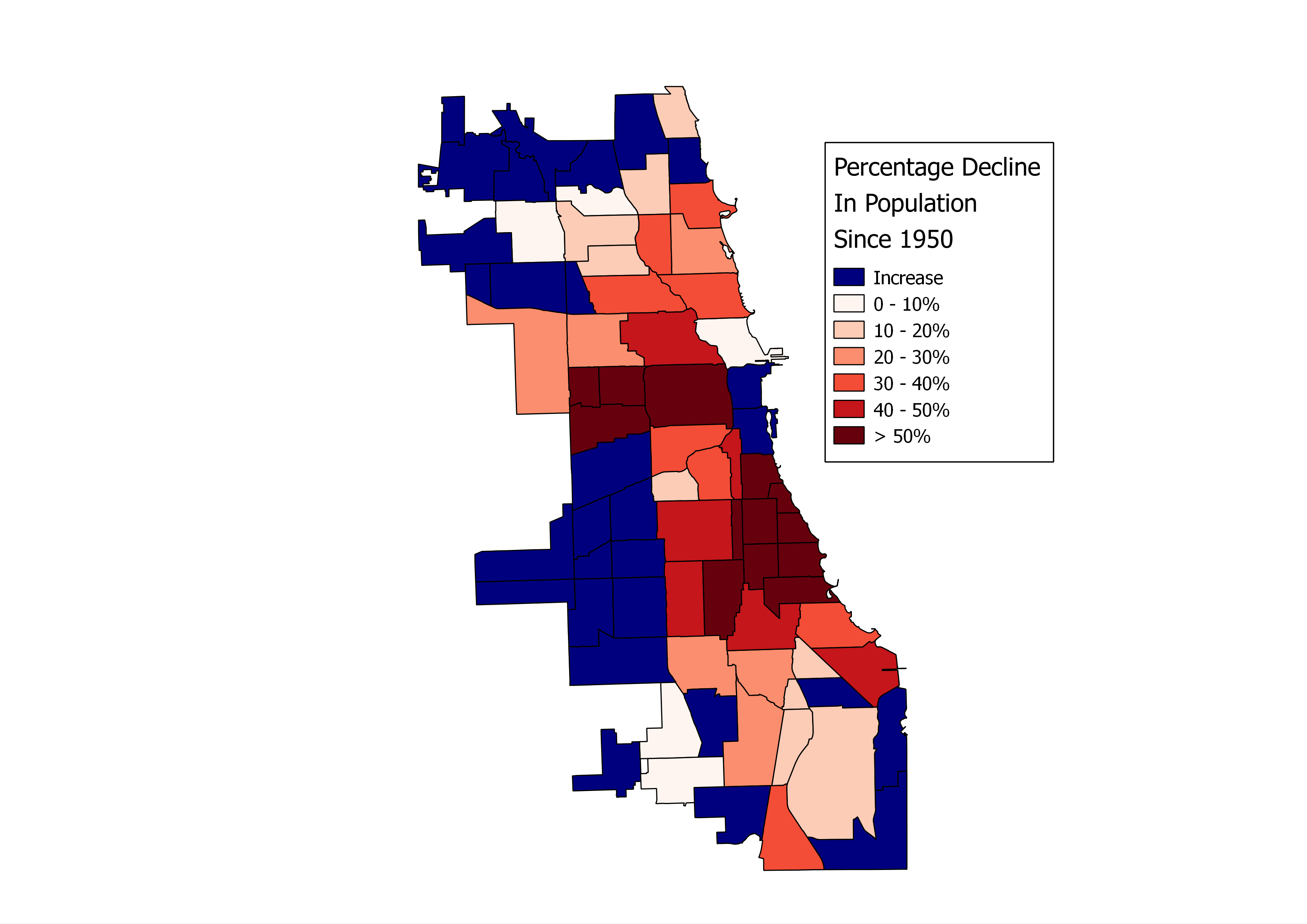
Even affluent Chicago neighborhoods, like Lincoln Park, have lost significant numbers of residents

Rust Belt cities like Chicago have declined in population since the mid-1900s and the population loss is not just limited to poorer neighborhoods:

For a long time, most accounts of Chicago’s lagging population have focused on parts of the South and West Sides where many residents, largely African-American, have decided to decamp for the suburbs or the South in search of better schools, less crime, and more jobs.But the under-appreciated flip side of population loss in those parts of the city is that places that ought to be growing like gangbusters are stagnant, often sitting 25% to 50% below their peak populations. Lakeview, for example, was once home to 124,000 people; its population is now 94,000. North Center is down from nearly 49,000 to under 32,000. West Town, which includes Wicker Park and Bucktown, has fallen from 187,000 to 81,000.

Decline5010

What explains the population loss in even popular neighborhoods? Here is one possible answer:

Since replacing a couple two-flats with a courtyard building is now illegal, developers make money by tearing down an old two-flat and building a luxury two-flat in its place. Or they build a mansion, and the neighborhood actually loses a housing unit. As a result, as a neighborhood becomes more attractive, the city encourages fewer people to live there.

Zoning (theoretically based on improving the neighborhood) plus chasing profits may just lead to population loss. This could be balanced out by approving more high-density housing in a particular area (like the Loop are in specific portions of popular neighborhoods as to limit their effect) but that leads to major changes in two places.

It is still worth noting that the areas that seen an increase in population are either (1) the Loop with a reemphasis on residential construction and (2) community areas on the edges of the city which other lower densities as well as potentially more open land since 1950.

Even if Northeastern states have lost 40% of their House seats, has the region lost that much influence?

Large-scale population shifts can have all sorts of effects including the loss of seats in Congress:

The Census Bureau reports that population growth has shifted to the South and the result is that the 11 states that make up the Northeast are being bled dry of representation in Washington…

Deep in a recent report, for example, the American Legislative Exchange Council tabulated how the drop in population relative to the rest of the nation cut the region’s power in Washington. While the states from Pennsylvania to Maine had 141 House members in 1950, they are down to 85 today, a drop of some 40 percent.

California and Texas combined have more House representatives..

“This result is one of the most dramatic demographic shifts in American history. This migration is shifting the power center of America right before our very eyes. The movement isn’t random or even about weather or resources. Economic freedom is the magnet and states ignore this force at their own peril,” said the report.

The last quote is particularly interesting as the population center of the United States has indeed kept moving further and further west (and a little south). Yet, even with the loss of seats from Northeastern states, New York City is still the #1 global city. Additionally, this region is close to the city of Washington D.C. which seems to be doing just fine in terms of wealthy counties and communities and a growing presence among large cities. Does having less seats in Congress necessarily mean the Northeast has lost 40% of its influence in American life? How many lobbyists are located in the Northeast compared to other places? Where are the institutions of higher learning from which many politicians and other elites come from? Where are the large media organizations?

It would also be interesting to see where these Northeast house seats have been lost. Is it primarily from large cities or more from mid-sized cities and more rural areas that have had steady population losses? Is this more of a Rust Belt phenomenon that affects cities like Buffalo, Rochester, and Worcester more than Boston, New York, and Philadelphia?

People leaving blue states tilting national elections?

An analysis of the “blue-state diaspora” suggests this has helped Democrats in presidential elections:

Over the last few decades, residents of many traditionally liberal states have moved to states that were once more conservative. And this pattern has played an important role in helping the Democratic Party win the last two presidential elections and four of the last six. The growth of the Latino population and the social liberalism of the millennial generation may receive more attention, but the growing diaspora of blue-state America matters as well.

The blue diaspora has helped offset the fact that many of the nation’s fastest-growing states are traditionally Republican. You can think of it as a kind of race: Population growth in these Republican states is reducing the share of the Electoral College held by traditionally Democratic states. But Democratic migration has been fast enough, so far, to allow the party to overcome the fact that the Northeast and industrial Midwest contain a smaller portion of the country’s population than they once did…

The spread of people born in New York State offers a particularly telling example: Of the 20 million Americans alive today who were born in New York, nearly one in six now live in the South. That would have been almost unthinkable 50 years ago, when the share was one in 25…

The first thing we noticed was a major blue-to-red shift: Since 2000, the blue-born population in red states has grown by almost a quarter, to 11.5 million, or 12 percent of the states’ total population.

The paradox here is that this trend could be positive or negative depending on the level of analysis. Typically, population loss is seen as a negative thing. If there are large numbers of people leaving New York City, we might ask whether something is wrong in NYC. Actually, New York City may not be a good example because it always tends to draw people but think instead of liberal Midwestern cities, places like Chicago or Detroit or Cleveland, that have lost population and this has been tied to problems within those cities. Yet, the spreading out of liberals could work well on a national scale if those places losing liberals aren’t filled up with conservatives and the liberals who move weaken the conservative advantages elsewhere.

It is hard to imagine that any of this could be planned but I could imagine some interesting future scenarios where political parties encourage enough people to move, perhaps temporarily, so they can vote in a different place to help swing an election.

Sociologist suggests three strategies for combating rural decline

A sociologist suggests rural communities can pursue three strategies to help them thrive in future decades:

Winchester, a sociologist and analyst of demographic changes, for years has battled against the narrative of rural decline. He argues although the percentage of Americans living in rural areas has been declining, contrary to some notions, the number of rural Americans has been rising, at least until very recently…

One is immigration. Any number of communities have seen school enrollments grow and Main Streets prosper and parks fill again with kids with the arrival of immigrants.

A second is to hang on to new retirees, particularly by paying attention to their housing needs.

Rural boomers want townhomes and condos and apartments just like urban counterparts. If those desires aren’t satisfied, they’ll move and take their Social Security payments out of the community. Those federal transfer payments amount to a fifth of the income in many rural communities, Winchester said, far surpassing the importance of agriculture.

And related to the boomers’ housing needs is an opportunity to appeal to the millennial generation. Winchester thinks housing will become more available in rural areas as boomers move, providing in turn affordable housing for young people priced out of the urban market.

This would seem to capitalize on three potential areas of growth. However, I imagine these factors are related to other factors that might be more difficult to find in rural areas:

1. A broad range of good-paying jobs.

2. A broad range of amenities and businesses.

3. A relative lack of social services.

4. A relative lack of walkability or public transportation options.

Yet, rural communities have the potential to try some new strategies. As Robert Wuthnow noted, small towns are not dead just yet.

Should Detroit focus on growth at all?

A recent overview of Detroit’s status raises an interesting question: should Detroit hope for any growth at all? Here is part of the story:

“What everyone wants is new neighbors,” said Khalil Ligon, project manager for the Lower East Side Action Plan (LEAP), a nonprofit focused on some 15 square miles of the city where 55,000 people live. “But where are you going to get them?”

The falling population is one of Detroit’s biggest problems. Detroit Future City, a planning blueprint, assumes just 600,000 residents. Launched by Mayor Dave Bing, the plan aims to revamp the economy and use empty space. The Kresge Foundation, started by the Detroit family behind retail giant Kmart, has promised $150 million toward the project.

“It’s certainly the most realistic plan the city has ever had,” said Margaret Dewar, a University of Michigan planning professor in Ann Arbor…

“We cannot cut our way of this situation,” Bing told Reuters. “We’ve got to talk about growth.”…

Bing’s revival plan will end up in the hands of the emergency manager, should one be appointed. “If the emergency manager buys into the long-term vision of the plan, it has a chance. But if their brief is just to cut costs and services, it doesn’t have a chance,” said Dewar, the University of Michigan professor.

Realistically, it is hard to imagine a major reversal in Detroit’s fortunes soon. The immediate question is whether the city can halt the population loss. However, the idea of growth is an interesting one as we think more broadly about American cities. We have a narrative that says successful cities grow. Cities that lose population, even ones that are not even close to Detroit’s population loss, are in trouble. Perhaps we can’t even have a realistic conversation about Detroit until the population plateaus…though this may not be for a while.