White flight starting in the 1910s, not after World War II

Two economists look at white flight as it occurred decades before the post-World War II era:

Economists Allison Shertzer and Randall P. Walsh at the University of Pittsburgh analyzed data from 10 large U.S. cities in the Northeast and the Midwest from 1900 to 1930 to isolate the role of white flight that occurred in that period—before the Federal Housing Authority, which instituted many of the discriminatory housing policies, was born. They found that the exodus of white people from a particular neighborhood following the arrival of black residents led to a 34 percent increase in segregation during the 1910s; In the 1920s, it resulted in a striking 50 percent increase…

They isolated demographic data for 10 U.S. cities—New York, Philadelphia, Pittsburgh, Boston, and Baltimore in the Northeast, and Cincinnati, Detroit, Chicago, Cleveland, and St. Louis in the Midwest—all of which had seen large influxes in black residents as a result of the Great Migration. They then designed a strategy to quantify the contribution of white flight to racial segregation…

One important thing to note: when white people left their neighborhoods in response to black arrivals in this period, they didn’t go to the suburbs—because suburbs didn’t really exist until the second half of the 20th century. They went to neighborhoods pretty similar to the ones they left—at least in terms of tax bases and public spending. That means that the measurements of white flight here “may thus provide a better gauge of racial distaste than those using postwar data,” the authors write in the paper.

When I’m asked about suburbanization, I often note that is start in the early 1900s, was derailed by the Great Depression, and then really took off after World War II. Many of the processes of post-war suburbia – including mass consumption, the construction of major roads and highways, more mass produced homes, the dominance of the automobile for daily life and planning, and changing racial and ethnic demographics in numerous urban neighborhoods – were already underway decades before. Perhaps it is convenient to blame the post-war era – and there were specific policy changes that happened then like federal funding for highways and changes to the mortgage industry to make homes accessible for more Americans – but these disliked features of 1950s suburbia have deeper roots.
Real estate agents and steering today

Many real estate agents today won’t answer certain questions but does this eliminate steering?

Agents such as Foster and Thakkar are hypersensitive because they don’t want to run afoul of the Fair Housing Act, which prohibits discrimination on the basis of race, color, religion, gender, national origin, familial status, disability or handicap. The law is administered by the Department of Housing and Urban Development. Penalties for violating fair housing rules can be costly, so many real estate brokerage firms train agents on what constitutes “steering” of homebuyer clients as well as what could be interpreted as showing any form of bias against any “protected class.”

What can agents do when clients ask certain questions? Here are several of the examples provided:

“We can’t answer,” Foster said. “It’s all too subjective.” Instead, she refers them to online information sources about whatever they’re asking — websites that rate schools, statistical compilations on crime rates and the like…

“It’s a very common question,” he says: “Can you tell us how many other Indian families live on this street?” Even though he thinks he understands the thrust of the question — are there people like us around? — he declines to answer directly. Instead, he supplies them a list of the names of current owners on the street, allowing his clients to decide for themselves whether the names indicate that they are Indian or not.

Referring people to other sources may lead to issues:

But some fair housing advocates are concerned that the online information available today may actually enable a subtle form of racial steering when agents name specific sites that offer highly localized racial and ethnic breakdowns and refer clients to them. Lisa Rice, executive vice president of the National Fair Housing Alliance, a nonprofit group that has fielded teams of white and minority “testers” to detect bias in homes sales, thinks that in the event of fair housing complaints against those agents, the fact that they made such specific referrals could be held against them.

It seems to me that one of the best ways to eliminate this issue is to educate homeowners about all the potential information they can access. Stop them from asking in the first place. Realtors could even make this clear at the beginning. The Internet certainly presents a lot of available information to possible home buyers ranging from the Census to other data aggregators to message boards to municipal websites. In other words, it is not hard to find out this sort of information. Yet, this would go against the argument that realtors make about why they are still necessary: they have inside information about the home and the entire process. Additionally, all the online information is not necessarily easy to interpret. Say a homeowner is interested in future property values: can they make a prediction based on what is online? Or, say that an online message board suggests one thing is happening while the local newspaper claim something else is taking place. How could someone unfamiliar with the area make a judgment regarding conflicting information?

In the long run, if people want to fight residential segregation and housing discrimination (which are legitimate concerns), would it be better to remove real estate agents from the process or not?

Exodus of black residents from Chicago’s South Side

A long-time resident of Chicago’s South Side discusses the movement of black residents to other locations:

For South Side residents, the writing has been on the wall. Starting as a slow trickle into the suburbs as industrial jobs began drying up in the 1970s, black flight increased in the 2000s, with blacks seeking the suburbs like never before — as well as places like Georgia, Florida or Texas, according to U.S. Census data.

The population shift has folks like myself, left behind on the South Side, feeling like life after the rapture, with relatives, good friends and classmates vanishing and their communities shattering. A recent study found that nearly half of the city’s African-American men between 20 and 24 were unemployed or not attending college…

Every senseless death, every random shooting and every bullet-riddled weekend means another family, another frightened parent must make the decision to stay or go.

Those of us left behind must deal with the aftershocks: lessening political clout, limited public services and the creep of poverty and crime into neighborhoods like South Shore and Auburn-Gresham.

Even as some trumpet the demographic inversion of metropolitan areas other research suggests poor neighborhoods, particularly in Rust Belt cities, can often slowly lose residents. On one side, there is a lot of attention paid to whiter and wealthier residents moving into urban cores and hip neighborhoods while on the other side, little attention is granted to disadvantaged neighborhoods. In some of these neighborhoods, it is remarkable just how much open space there can be as buildings decay and few people clamor to move in (think of Detroit and its urban prairies as an example).

Predicting resegregation in 35% of metro area neighborhoods

A new study looks at the possibility of numerous metropolitan neighborhoods becoming less diverse in the coming decades:

Neighborhood integration is a great goal, but just because a place is currently home to more than one race doesn’t mean it will retain this diversity in the decades to come. A new study published in Sociological Science explores this potential future for New York, Chicago, Los Angeles, and Houston. It finds that 35 percent of all neighborhoods in these cities—around 3,800 total—are likely to resegregate in the next two decades…

Bader’s analysis predicts that, in the next two decades, many of the neighborhoods in the pale green (“steady black succession”), navy blue (“Latino enclaves”), royal blue (“early Latino growth, white decline”), teal (“early Latino growth, black decline”), sky blue (“recent Latino growth”), and pink (Asian growth) categories are the ones where a single racial group will become dominant over time. Here’s Bader on that process, again via the study website:

“We were disappointed to learn that many integrated neighborhoods were actually experiencing slow, but steady resegregation — a process that we call “gradual succession.” The process tended to concentrate Blacks into small areas of cities and inner-ring suburbs while scattering many Latinos and Asians into segregating neighborhoods throughout the metropolitan area.

Meanwhile, the fuchsia “quadrivial” neighborhoods, located in the suburbs like Aliso Viejo, California, and Naperville, Illinois, are likely to retain their diversity for some time. (Of course, as my colleague Amanda Kolson Hurley has noted, in general, diverse suburbs aren’t immune to the threat of resegregation.) Despite fair housing and civil rights legislations, housing discrimination is an ongoing problem with multigenerational effects—and one of the possible reasons behind the trends Bader has highlighted in the study. Another is the tendency of white Americans to self-segregate.

Given the complexity of race and ethnicity in the United States plus its regular manifestation in residential patterns, this makes sense. Just because certain locations were once diverse doesn’t mean they will remain so in the future. City neighborhoods provide plenty of examples of this, whether looking at places that have had waves of immigrant groups or other locations where blacks moved in and whites never returned. And that these patterns will be reproduced across suburban areas has already been happening for decades.

What seems to be new here is the possibility of predicting these changes. If a suburban community knew that demographic change was likely, would they do things differently? Or, how about a city neighborhood that had a particular character and identity? Now that there are scholars out there working on this, might the research itself have an effect on future population changes?

New data on (a lack of) diversity in Hollywood and on TV

A new report on diversity in Hollywood and television was released yesterday:

The study, titled the Comprehensive Annenberg Report on Diversity, examined the 109 films released by major studios (including art-house divisions) in 2014 and 305 scripted, first-run TV and digital series across 31 networks and streaming services that aired from September 2014 to August 2015. More than 11,000 speaking characters were analyzed for gender, racial and ethnic representation and LGBT status. Some 10,000 directors, writers and show creators were examined, as was the gender of more than 1,500 executives.

The portrait is one of pervasive underrepresentation, no matter the media platform, from CEOs to minor characters. “Overall, the landscape of media content is still largely whitewashed,” the study concludes.

In the 414 studied films and series, only a third of speaking characters were female, and only 28.3 percent were from minority groups — about 10 percent less than the makeup of the U.S. population. Characters 40 years or older skew heavily male across film and TV: 74.3 percent male to 25.7 percent female.

Just 2 percent of speaking characters were LGBT-identified. Among the 11,306 speaking characters studied, only seven were transgendered (and four were from the same series).

These appear to be pretty consistent patterns. Given the racialized and gendered history of the United States, is it more surprising that white men still dominate in certain categories or that little has changed even with the discussions of recent decades?

One other thought: in No Logo, activist Naomi Klein recounts her own efforts to push for more diversity in advertisements. In a chapter titled “Patriarchy Gets Funky,” Klein says:

We thought we would find salvation in the reformation of MTV, CNN, and Calvin Klein. And why not? Since media seemed to be the source of so many of our problems, surely if we could only “subvert” them to better represent us, they could save us instead. With better collective mirrors, self-esteem would rise and prejudices would magically fall away, as society became suddenly inspired to live up to the beautiful and worthy reflection we had retouched in its image. (p.108-109)

And corporations bought into it:

That’s when we found out that our sworn enemies in the “mainstream” – to us a giant monolithic blob outside of our known university-affiliated enclaves – didn’t fear and loathe us but actually thought we were sort of interesting. Once we’d embarked on a search for new wells of cutting-edge imagery, our insistence on extreme sexual and racial identities made for great brand-content and niche-marketing strategies. If diversity is what we wanted, the brands seemed to be saying, then diversity was exactly what we would get. And with that, the marketers and media makers swooped down, airbrushes in hand, to touch up the colors and images in our culture. (p.111)

The real issue lay elsewhere:

But our criticism was focused on the representation of women and minorities within the structures of power, not on the economics behind those power structures…

The prospect of having to change a few pronouns and getting a handful of women and minorities on the board and on television posed no real threat to the guiding profit-making principles of Wall Street.

Maybe the issue is less one of representation on the screen and more about who controls the industry and resources.

Examining neighborhood diversity and cohesion in England

A study published in European Sociology Review examines the effect of ethnic diversity on community cohesion:

A 17 year study of over 10,000 people found Britons felt less attached to their neighbourhood when communities become more multi-cultural.

Yet those who moved out to areas where they were surrounded by their own kind were happier, the Manchester University research found.

But the same was not true for Britons moving into already mixed places as relocating there had no harmful effect on how people viewed their surroundings or levels of happiness.

More explanation from the article abstract:

This article provides strong evidence that the effect of community diversity is likely causal, but that prior preferences for/against out-group neighbours may condition diversity’s impact. It also demonstrates that multiple causal processes are in operation at the individual-level, occurring among both stayers and movers, which collectively contribute to the emergence of average cross-sectional differences in attitudes between communities.

It sounds like the attitudes of those moving and staying are important. I would guess that younger residents – more used to diversity – are more open to diverse neighborhoods compared to their elders. Could the effect of moving – which was more positive either way – be related to residents feeling like they have options as opposed to having to stay where they are at? It is one thing to choose a neighborhood that fits your preferences as opposed to feeling like your community is changing without you being able to do anything about it.

This reminds me of Putnam’s study about neighborhood diversity:

But a massive new study, based on detailed interviews of nearly 30,000 people across America, has concluded just the opposite. Harvard political scientist Robert Putnam — famous for “Bowling Alone,” his 2000 book on declining civic engagement — has found that the greater the diversity in a community, the fewer people vote and the less they volunteer, the less they give to charity and work on community projects. In the most diverse communities, neighbors trust one another about half as much as they do in the most homogenous settings. The study, the largest ever on civic engagement in America, found that virtually all measures of civic health are lower in more diverse settings.

Given the historic salience of race and ethnicity – centuries both within England and the United States – finding consistently positive feelings about increasing neighborhood diversity may just take more time.

Can’t ignore race when discussing poverty in America

Ta-Nehisi Coates cites several sociologists in making the argument that white and black poverty is different in the United States:

In its pervasiveness, concentration, and reach across class lines, black poverty proves itself to be “fundamentally distinct” from white poverty. It would be much more convenient for everyone on the left if this were not true—that is to say if neighborhood poverty, if systemic poverty, menaced all communities equally. In such a world, one would only need to craft universalist solutions for universal problems…This chart by sociologist Patrick Sharkey quantifies the degree to which neighborhood poverty afflicts black and white families. Sociologists like Sharkey typically define a neighborhood with a poverty rate greater than 20 percent as “high poverty.” The majority of black people in this country (56 percent) live in high-poverty neighborhoods. The vast majority of whites (94 percent) do not. The effects of this should concern anyone who believes in a universalist solution to a particular affliction…

But the “fundamental differences” between black communities and white communities do not end with poverty or social mobility.

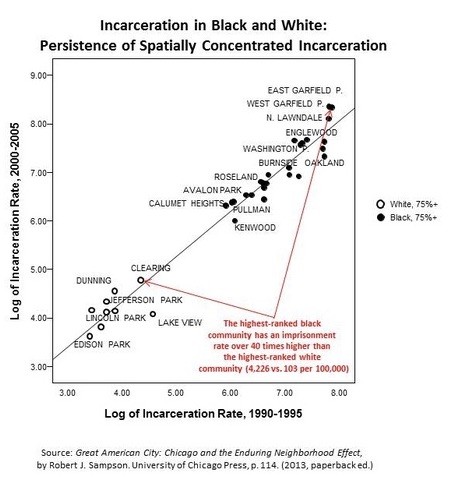
In the chart above, Sampson plotted the the incarceration rate in Chicago from the onset imprisonment boom to its height. As Sampson notes, the incarceration rate in the most afflicted black neighborhood is 40 times worse than the incarceration rate in the most afflicted white neighborhood. But more tellingly for our purposes, incarceration rates for white neighborhoods bunch at the lower end, while incarceration rates for black neighborhoods bunch at the higher end. There is no gradation, nor overlap between the two. It is almost as if, from the perspective of mass incarceration, black and white people—regardless of neighborhood—inhabit two “fundamentally distinct”worlds.

Coates might also cite Massey and Denton’s classic American Apartheid that convincingly shows residential segregation between whites and blacks is of a different magnitude than residential segregation between other groups. Additionally, there is evidence that whites and blacks with equal characteristics are not treated equally (see a number of audit studies involving mortgages, renting, car loans, and jobs) and even that blacks who are wealthier than whites do not have access to the same opportunities. Ultimately, Coates uses these sociological findings to argue policies intended to float all lower-class boats won’t really work because they ignore the fundamental differences between black and white poverty.

Put another way, given America’s history perhaps we should require scholars and policy makers to show that race doesn’t matter in the issue they are addressing rather than the other way around.

Comparing HMDA 2014 data to previous years

The Home Mortgage Disclosure Act requires lenders to report on mortgage applications. Here is what the 2014 data on over 9 million applications reveals about mortgages:

How difficult was it to obtain financing last year? “While mortgage credit stayed generally tight, conditions appeared to ease somewhat over the course of the year as the fraction of mortgage lending to lower-credit borrowers increased,” according to the Fed. “However, growth in new housing construction was slow throughout the year, suggesting some persistent softness in new housing demand.”

What percentage of the nearly 10 million applications in 2014 actually became mortgages? About 6 million. The dollar volume of those loans totaled almost $1.4 trillion, which is lower than 2013’s volume, but somewhat higher than most industry pundits predicted…

Of the $2.5 trillion in applications made to lenders last year, about 59 percent came from whites, and just over 20 percent came from minorities (blacks, Latinos, Asians, American Indians, native Hawaiians or people of mixed race). More than 1 in 5 applications were in the “unknown” or “N/A” categories, because many people do not fill in the “race” blank. But with minorities now around 38 percent of the American population, it appears that they continue to be underserved…

Beyond those figures, HMDA also offers a wide-angle snapshot of the country’s appetites for home loans. Of the 10 million applications, 89 percent were for owner-occupied units, with just 10 percent non-owner-occupied. Applications to purchase homes were just slightly more popular (51 percent) than those to refinance loans (41 percent), with just seven percent seeking home-improvement lending.

This data can be very interesting in itself but it helps to be able to take a longitudinal view to know how 2014 compares to prior years. This sort of data is available in a Federal Reserve report:


HMDAData2014

As this table shows, the number of applications is still down dramatically. Also note the number of refinance loans in the late 2000s compared to today – much of the mortgage activity in the last decade has actually involved refinancing.

Here is a table regarding the applicants:

HMDAData2014Borrower

As noted above, the data on race/ethnicity suggests small declines among non-white groups and an increase for whites. Borrower income has not changed much though the neighborhood income has increased a bit compared to 2004.

Urban residential segregation continues to decline

Analysis of recent Census data suggests residential segregation is decreasing in many cities:

Between 2000 and 2014, segregation between blacks and whites declined in almost all of the nation’s 53 metropolitan areas with a population of over a million, the analysis shows.

Some of the biggest declines occurred in cities long divided by race, including Detroit and Chicago, but the progress was more modest in New York and Los Angeles, the nation’s two largest metropolitan areas…

But the migration into suburbs isn’t the whole story. Detroit and Kansas City, Mo., for instance, had the two biggest gains in integration, but while the change in Kansas City came from a large movement of blacks from the central city to the suburbs, the drop in Detroit’s segregation level reflected many blacks leaving the region entirely, said John Logan, a sociologist at Brown University who studies residential diversity.

Logan attributed most of the decline in segregation to what he called the phenomenon of “global neighborhoods” — areas that were once all white where blacks have moved into, typically after Latinos, sometimes along with Asians, had integrated the neighborhood.

Three quick thoughts:

  1. This is a reminder that the effects of race and ethnicity on neighborhoods and communities has changed in recent decades from a strong white-black divide to a more mixed movement of people.
  2. On the other side, even with the spreading out of Latinos and Asians, there are persistent divides between blacks and whites. In other words, we cannot point to many (any?) neighborhoods that have gone from black to white though some black neighborhoods have become less black.
  3. It is interesting to monitor these changes over time but I would be interested to know what the “desirable” desegregation numbers are. For example, the dissimilarity index suggests what percent of the minority group would need to move to be spread out throughout a region. Do sociologists expect the dissimilarity index to hit 0 or is there a threshold that would be good for society and the groups involved?

A need to better measure financial support and wealth passed to Millennials

A look at how race affects the financial support given by parents to Millennials includes this bit about measurement:

Shapiro said the numbers of Millennials receiving support from family are “absolutely underestimated” because many survey questions are not as methodical and specific as those a sociologist might ask. “As much as 90 percent of what you’ll hear isn’t picked up in the survey,” he said.

Shapiro’s more careful research found this:

Shapiro’s work pays special attention to the role of intergenerational family support in wealth building. He coined the term “transformative assets” to refer to any money acquired through family that facilitates social mobility beyond what one’s current income level would allow for. And it’s not that parents and other family members are exceptionally altruistic, either. “It’s how we all operate,” Shapiro said. “Resources tend to flow to people who are more needy.”

Racial disparity in transformative assets became especially striking to Shapiro during interviews with middle-class black Americans. “They almost always talk about financial help they give family members. People come to them,” Shapiro said. But when he asked white interviewees if they were lending financial support to family members, he said, “I almost always get laughter. They’re still getting subsidized.”…

To many Millennials, the small influxes of cash from parents are a lifeline, a financial relief they’re hard pressed to find elsewhere. To researchers, however, it’s both a symptom and an exacerbating factor of wealth inequality. In a 2004 CommonWealth magazine interview, Shapiro explained that gifts like this are “often not a lot of money, but it’s really important money. It’s a kind of money that allows families to obtain something for themselves and for their children that they couldn’t do on their own.”

Two quick thoughts:

  1. Americans tend not to like to talk about passing down wealth but decades of sociological research (as well as research from others) shows that it happens frequently and is quite advantageous for those who have wealth passed to them. I recommend looking at Shapiro and Oliver’s book Black Wealth/White Wealth.
  2. Polls like those cited here from USA Today could lead to lots of problems just because the measurement is not great. Why not ask better poll questions in the first place? I understand there are likely limits to how many questions can be asked (it is costly to ask more and longer questions) but I’d rather have sociologists and other social scientists handling this rather than the media.