How do suburbs know if their mass market radio ads are successful?

In the span of a few minutes the other day, I heard radio commercials for two suburbs. One was aimed more at businesses and residents moving to the community, the second was about visiting and enjoying the amenities there. Do these advertisements work?

Photo by Jean Balzan on Pexels.com

There are multiple ways organizations could measure this. The most common one I have seen in today’s age is the online or email survey question: “how did you hear about us/this?” Then the respondent can select among many options, including radio ads.

But if someone were moving to a suburb, starting a business in a suburb, or visiting a suburb, how likely would it be that they would receive such a survey? What would trigger this survey?

There are, of course, other techniques. We could rely on anecdotes and the occasional story people tell. Perhaps focus groups of recent movers or visitors could explore this. Maybe someone contacts the community directly and describes hearing the advertisement. Maybe seeing an uptick in population or visitors or business activity in the community after airing the ad could lead to people saying the ad worked.

None of these are likely great options. Getting people to participate in research studies is hard. The commercial is one out of many people will hear or encounter each day.

It is hard to brand a suburb when there are many – over 300 – in the Chicago area and in a media saturated landscape. What can reflect the community well and stand out to people (and then hopefully prompt them to act)?

“Music for the ‘burbs” = what music genre or format?

If a radio station near you said they featured “music for the ‘burbs,” what do you think they would play?

Photo by Anthony ud83dude42 on Pexels.com

I do not know of a genre of music that would exclusively identify with the suburbs. As Americans moved to the suburbs in large numbers in the twentieth century for numerous reasons, music changed in the United States as well. This included new genres, new methods for playing and hearing music, and new audiences. And all of this happened on a mass scale; music could be produced, played, and listened to for and by millions of people.

Turning back to this particular station, would it be a surprise that they are a hot adult contemporary station? Here is how Wikipedia describes this subset of adult contemporary:

Hot adult contemporary (hot AC) radio stations play a wide range of popular music that appeals towards the 18–54 age group;[43] it serves as a middle ground between the youth-oriented contemporary hit radio (CHR) format, and adult contemporary formats (such as “mainstream” and soft AC) that are typically targeted towards a more mature demographic. They generally feature uptempo hit music from the last 25 years with wide appeal, such as pop and pop rock songs, while excluding more youth-oriented music such as hip-hop.[42][41] Older music featured on hot AC stations usually reflects familiar and youthful music that adults had grown up with.[44][41] Likewise, material from legacy pop acts such as the Backstreet Boys, Jason Mraz, John Mayer, and Pink is prominent within the format.[41][40]f

Pop music of the last few decades for 18 to 54 year olds is suburban music? Maybe more so than some other formats.

(The other part of this station’s tag line is that they broadcast from the ‘burbs. This contrasts with the majority of the radio stations in the area that identify with the big city.)

Midwest cities lead the way in % of AM radio listeners

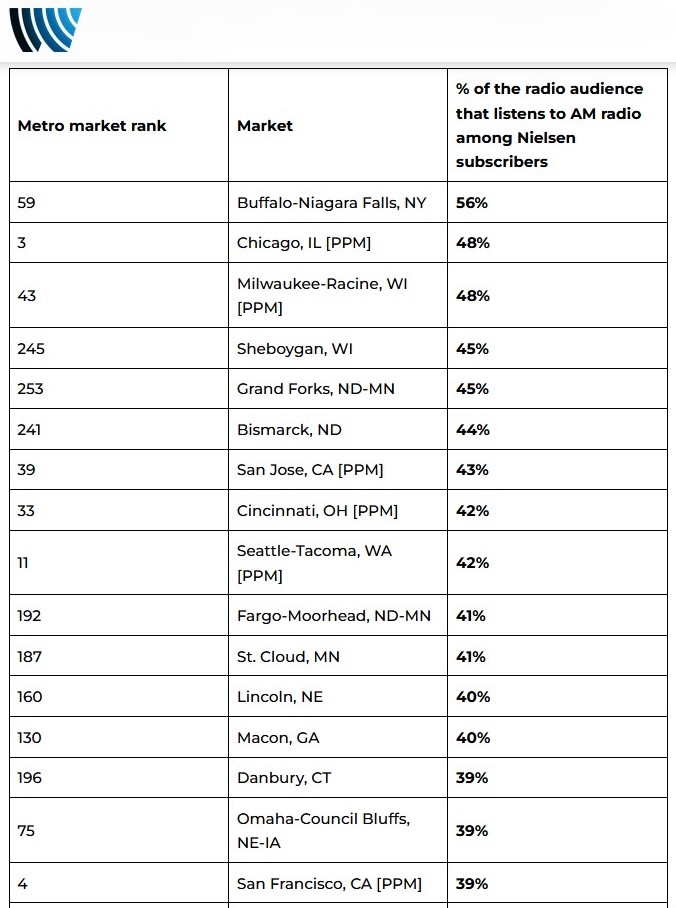
A recent look at “the % of the metro radio audience that listens to AM radio in a month” shows these cities at the top:

The top six cities on the list are Midwest cities (including Buffalo on the western edge of New York). In this list, the first city in the West is San Jose at #7, the first city in the South is Macon, Georgia at #13, and the first Northeast city is Danbury, Connecticut at #14.

I do not know if these differences are statistically significant but it is interesting to consider why Midwest metropolitan areas might lean toward AM radio. A few possibilities:

-A long history of important AM stations.

-Is the Midwest less dense compared to some other parts of the country or Midwest people do further drives and AM’s longer signal keeps them connected?

-Radio stations on FM or AM in different areas provide different content. Is this linked to more or less interest in music, news, sports, talk, or other content?

-Are there are other lifestyle markers of Midwesterners that are somehow linked to AM radio?

Of the top 20 radio markets in the country, I think only the Washington, D.C. area is not on this list with at least 20% of listeners tuning into AM radio. What are people in DC listening to?

Play Christmas music all day starting November 1 and ratings go up

The Chicago radio station WLIT starts their 24 hour a day Christmas music today because people and the ratings like it:

Photo by Dzenina Lukac on Pexels.com

WLIT-FM 93.9 will play only Christmas music round-the-clock beginning at 4 p.m. Tuesday.

It is the earliest date in the station’s 22 years of hosting the format that it is making the switch.

Why? Listeners love it…

“The reason stations switch in early November is so they can get a ratings boost for the final few weeks of the survey,” he wrote in an email.

Which comes first: the audience demand for the Christmas music or the supply of Christmas music? Would anyone play Christmas music this early if there was not such a direct payoff?

Such a question could be asked in all sorts of domains, ranging from other Christmas material – do stores put Christmas decorations and displays up right after Halloween to drive demand or is that demand already there? – to products of the culture industries. If such a question could be answered more predictably, there might be more hits – records, films, TV shows, etc. – and fewer flops.

In the meantime, Chicago radio listeners will later today have the option to hear Christmas music all the time. Even in an age of music streamable on demand plus all sorts of other music formats, at least a few will turn to WLIT because predictable Christmas music is available.

If every life event was sponsored, baseball edition

I enjoy listening to baseball games on the radio. The pace of the game, the voices of the announcers, and the ability to do other things while listening add up to an enjoyable experience.

Photo by Anthony on Pexels.com

Except for one growing trend: the number of commercial reads throughout the game. At this point, it seems like almost every baseball event has a sponsor. Strikeouts, walks, doubles, home runs, the fifth inning, the seventh inning…you get the idea. Baseball has a lot of small events and apparently they can be attached to an advertiser for the right price.

I am aware of multiple factors behind this. Radio is a dying business. Live sports is one of the few shining spots where there are certain to be listeners (or viewers). Commercialization is alive and well. There is money to be made here.

But, I can only imagine how this might spread to all areas of life. Go beyond the Internet and social media ads tied to your browsing and shopping habits. You tie your shoes; brought to you by [blank]. You run the dishwasher; brought to you by [blank]. You read a book; brought to you by [blank].

At this point, there do not seem to be any officials guardrails against more and more of this happening. People can push back but this has consequences. If I do not like the baseball ads, I can stop listening. But, if we move to more immersive devices – Google Glass, virtual reality headsets, a house full of Internet equipped objects – this will be very hard to push against or escape.

If Schaumburg is advertising business opportunities and a central location, this means…

I heard again a radio ad recently from the suburb of Schaumburg extolling the benefits for businesses, including a central location, if they relocate there. I thought about this in January 2021 and I wonder now if this ad hints at three patterns:

Photo by Nicholas Githiri on Pexels.com
  1. Schaumburg is an edge city with a lot of office and retail space. The suburb grew rapidly between 1960 and 1980, going from under 1,000 residents to over 50,000 residents. It is home to Woodfield Mall and numerous sizable office buildings. It is featured in Joel Garreau’s book Edge City. If Schaumburg has a lot of vacant space and is struggling to find businesses to sell goods and services or to set up operations, what hope is there for other suburbs that do not have these concentrations that were successful in the past? Brick and mortar operations are declining and COVID-19 has encouraged working from home and this has particular effects on communities highly dependent on both.
  2. This may be less about the troubles of Schaumburg and more about the game that suburbs have to play today. Suburbs market themselves and attempt to differentiate themselves from other suburban communities. The Chicago area has a number of these, including Elk Grove Village hoping to attract makers and Bedford Park touting its industrial space and resources. It is less clear how successful these efforts are but more communities seem to think they need a media presence.
  3. Is there something preferable in advertising a place on the radio? Are people listening in the car more likely to be mobile and/or move? Communities have other options but I do not how attractive they might be. Television is a very broad audience. Targeted Internet or social media ads could be worthwhile if particular categories could be identified. Print may only work in certain outlets. Would billboards catch people’s attention? This may be an emerging branding landscape for which I have not yet found an overview.

If these trends continue, I can imagine a media landscape where ads for suburbs and cities play back to back or near each other, directly juxtaposing their different perceived advantages and trying to chase the elusive businesses and residents who might move.

The Limbaugh soundtrack to suburban life

For decades, the suburbs were said to be more politically conservative. One writer describes hearing Rush Limbaugh in his suburban childhood:

Photo by rikka ameboshi on Pexels.com

As a kid growing up in Sacramento, I had a few friends I liked, but dreaded going to their houses to play. I suggested riding bikes, playing tag or hide and seek — anything to avoid their homes. I avoided their houses because their families usually had the radio tuned to KFBK, listening to a guy who was always furious about nothing, as though he was pleasant background noise — elevator music for single family, one story homes in the suburbs.

To my young ears, there was an uncanny vibe about his voice. He sounded like Santa Claus if Santa swallowed another Santa whole, but that Santa got stuck in his throat. Boots, beard, and furry coat, all jammed against his larynx as he croaked on and on, complaining about “illegal” elf workers wanting fair pay, health care and for him to stop grabbing their tiny butts.

My friends’ “nice” families had him on, all the time, stinking up their homes with hate the way others baked to make homes smell like cookies.

I wondered what that did to us, constantly breathing in his vitriol — for non-white people, for women, for gay people, especially if they were richer, smarter or more powerful than him. I wondered what he’d think of me, what they all think me — a Black kid with a working mom and absent dad — skin so light it sometimes camouflaged me from their sight.

The main contrast here is between the “nice” suburban families and the constant sounds of Rush Limbaugh. On the whole, the suburbs are often pitched as idyllic: single-family homes for families, middle-class people who have made it, green lawns and a quieter life compared to cities. The suburbs are supposed to be the retreat from the difficulties of the world.

Yet, from the beginning, whether the suburbs have delivered on these claims is debatable. Who could make it to these locations? How idyllic was it really or was it perceived to always be under threat? Did the gloss of suburbia cover up darker truths involving race, class, gender, broken families, and more?

It would be interesting to back and see if there is evidence of suburban talk radio listening patterns. Or, to mirror current political patterns, was Limbaugh more popular in exurbs and the outer suburbs and his listernship dwindled closer to the big city?

The power of talk radio to connect with an audience

The death of Rush Limbaugh yesterday provides a reminder of the power of mass media. Limbaugh was popular and he had a devoted set of listeners. My own experience in radio plus ongoing listening makes me wonder why radio has a special ability to connect with an audience compared to other mediums. Here are some of pieces that might be involved:

Photo by Anthony on Pexels.com

-Daily mass media can connect more than more episodic mass media. Many radio shows take place at the same time each weekday. People know where it is and when to listen. Some television shows have this but many other regular cultural products occur less frequently (think television shows that used to be weekly for part of the year or now released a season at a time on streaming platforms). Daily newspapers and columnists can also do some of this.

-The radio involves a voice but no images. It is a different interaction than with television or the Internet and social media. Listening only can require a certain amount of attention to focus and at the same time allows for the possibility of doing many other things while listening.

-Talk radio in particular provides an opportunity for broadcasters to share a persona or their personality. And they often get to do this over an extended amount of time. The show might have particular content – sports talk, political talk, religious talk, etc. – but the people behind the mic might be more important than the actual topics. Today, podcasts offer some of this as does social media.

-Radios are relatively cheap, portable, and available. At least for some decades, you could take a radio almost everywhere. No Internet connection needed (though there are some features of listening to the radio via Internet). And do not underestimate the ability to listen to the radio while driving; many other forms of mass media cannot be consumed in vehicles and Americans like driving.

Of course, the era of giants in talk radio may only be a thing of the past with fewer listeners and so many other options for consumers of media. Yet, these different platforms may appeal to different people in different ways. Radio was effective for decades – and it is worth noting how much of its early development including networks, sitcoms, and detective shows became part of television – and will likely continue in some form for quite a while.

Bringing a cultural production perspective to the industry of Christian worship music

The Christian worship charts are dominated by relatively few artists. Why might this be the case?

“If a song is going up the charts, there’s pressure on the worship leader to play that song,” said John J. Thompson, who worked with Christian artists as creative director for Capitol CMG Publishing and now runs the website truetunes.com.

Because songs must be catchy, they focus on simplified melodic structures, fewer words, and limited emotional range, with the goal that the congregation can catch on to new songs by the second verse, said Thompson, now the associate dean of the Trevecca School of Music and Worship Arts and the author of Jesus, Bread, and Chocolate; Crafting a Hand Made Faith in a Mass Market World

Most of the songs on the list were written by Caucasians. Thematically, the songs tend to stay in the realm of praise and adoration without venturing too far into more complex themes like confession, doubt, and suffering.

Sandra Van Opstal, pastor, liturgist, and author of The Next Worship: Glorifying God in a Diverse World previously told CT, “…The worship industrial complex has become so influential that millions of people around the world are being discipled via iTunes. The narrative of God and faith is in the hands of a few worship movements who aren’t talking about how their social location, cultural values, and racial privilege shape their faith.”

In many culture industries, it can be difficult to predict what will become hits. There are hundreds, likely thousands, of worship tracks produced each year. There are ways that all industries try to hedge their bets. One route is to promote and support stars. In the list provided of popular songs, this means Chris Tomlin or Hillsong are better bets for hits compared to lesser-known artists. Another route is to try to cross-promote across platforms. Radio, even as a dying medium, can help drive traffic to streaming music and use of music in churches. Performing the songs in church can help drive congregants to the music and radio.

But, there are more factors at play. How does an artist become popular in the first place? At one point, Chris Tomlin was an unknown and the Hillsong movement had a limited reach. Stars can put out average or bad music. New artists can arise. The cross-promotion can fail to produce. Tastes and trends in music can change. Technology can change in both how music is made and delivered, boosting some and hurting others. How congregations view and utilize worship music could change. And so on.

More broadly, how culture and cultural objects come about is a complex process involving multiple social forces and institutions. In other words, this is not necessarily the way the Christian worship industry works at the moment or into the future. It is hard to know what kind of worship music will dominate ten or fifty years from now. Certain artists may be the music du jour today and be gone tomorrow.

Sociologists hosts campus radio show to help students review

I like sociology and I like radio but I never have thought of hosting a radio show that offers opportunities for students to review class material:

Social Sounds airs every Thursday from 7-8 p.m. on the campus radio station, KXUA 88.3 FM. Students are invited to send text messages with questions regarding class material to a Google Voice number and he calls out to students. This allows Adams to have a record of messages and to keep track of participation rates. He has also tracked student listeners through mentioning a secret word on air. During an exam, he had students write the secret word on the back of their scantron and found that 30 percent, or about 110 students, were listening to his show.

“I started the show at the end of the fall 2014 semester when students wanted a review session for the final exam,” Adams said. “Now that it’s on weekly, we cover one chapter per week and stay ahead of what other professors are teaching in their sociology classes. This way students in other general sociology classes can also follow along with the show.”

All of the content is student generated and gives students in Adams’ class the opportunity to earn extra credit for the course. Adams plans to continue Social Sounds as long as it’s successful. While he has encouraged other professors to be involved with the show, none have so far.

Students like having innovative ways to learn and review the material though it is a bit humorous that this innovative way involves a medium with nearly a century of mass use. (Listening for a secret word? Can’t that word be shared on social media with those who don’t listen?) I would want to know how much this improves learning – outside of the extra credit, does the radio review work as well as other review methods?