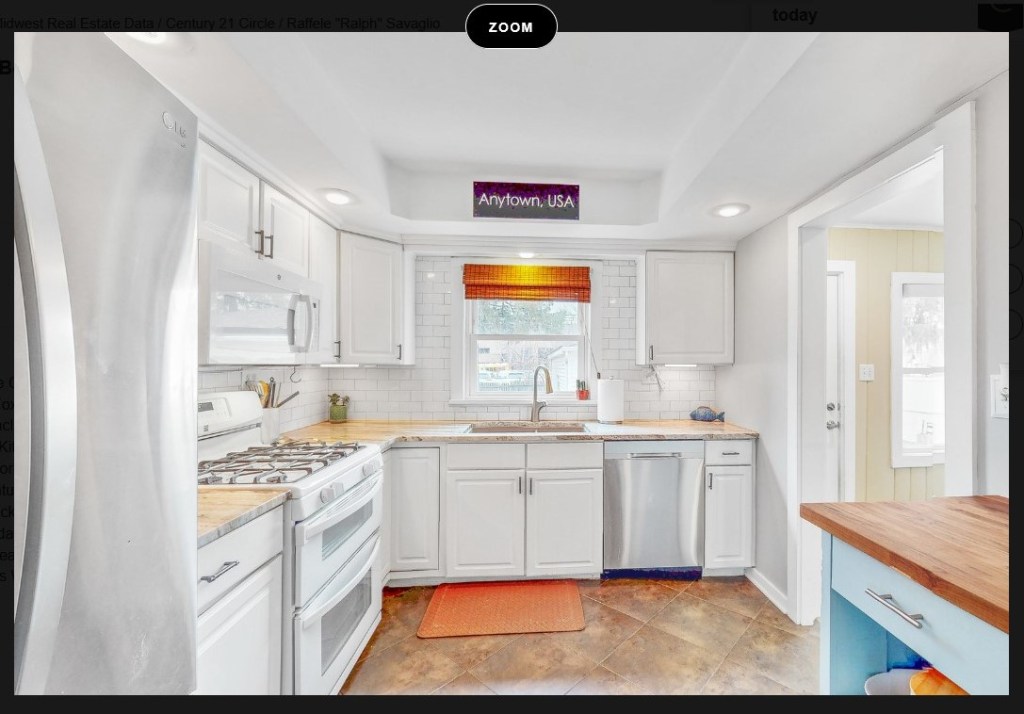
I recently saw a real estate listing for a suburban house that had an interesting sign in the kitchen. Above the sink was a sign for “Anytown, USA.”
It is a nice enough kitchen but why have such a sign? Is it meant to appeal to buyers from anywhere? Is it a comment on the placelessness of the suburbs? Was it a gift to the resident and they needed to display it somewhere?
In contrast, a homeowner might display markers of their local community. Instead of “Anytown,” there could be hints of the specific place in which the home is located. Perhaps a map or a poster for a local event or group or an object that could only be acquired or experienced in that community.
Another option: the sign is an AI generated image to provide some decoration for the home.
Now I am intrigued: how many people display “Anytown, USA” signs in their homes? Where can I buy home? Can someone outfit an entire home with a phrase used as a placeholder?
Completed in 2011, the Angelo Drive estate is accessed by a long, steep driveway flanked by landscaped hedges, according to documents filed with the city. Surrounding a central courtyard, the main house has a large, high-ceilinged atrium lighted by a skylight. Fronted by a fence up to 8 feet high in places, the estate also has a tennis court, guesthouse, staff quarters and a detached recreation room and home theater.
The property has at least 12 to 15 bedrooms, said local real-estate agent Rayni Williams, who has attended events at the Pritzker estate. Its view is one of the best in Los Angeles. “You feel like you’re floating in the view,” she said. The vista is especially remarkable given the home’s massive size, she said. Most houses of comparable square footage are located in flatter areas rather than in the hills.
From this description, several traits of the home stand out:
It has particular features, including a large atrium, additional buildings, and lots of bedrooms.
It is large. It has at least 12 bedrooms and it is “massive.”
It has a special setting, particularly compared to other big houses, with a long driveway and an impressive view.
These strike me as pretty standard descriptors of homes. What features does it have? How big is it (measured by some standard traits like square footage and number of bedrooms and bathrooms)? What is its location (because it is all about location, location, location)? Real estate listings tend to have a particular format and this description fits with those.
This description does give me some sense of what the home is like. But I wonder if a different approach is needed for such a uniquely large home. A few other possible options:
What is it like to walk through a home and property this big? It has at least 12 bedrooms; what is it like to visit them all? What does it feel like to walk up to a house this size and walk around it? This helps fill out the experience of a home this size beyond certain measurements.
What is the view comparable to? What can I see from the house that I cannot see elsewhere? Roughly how many other homes have a similar view? This helps describe the location of the home.
Are these features found in other places or is this a unique combination or is there a particular sense of style with all of these features? What makes these features stand out from other large homes? This helps get at what helps the house stand apart from others.
All of these involve an experience of the home that goes beyond what can be ascertained by plans and pictures. Without this experiential information, it is just a big house and hard to imagine.
You may be amazed that this still happens, but here and there I see this pop up in property descriptions. Perhaps worse is when a specific church is mentioned as a local landmark since it suggests not only that the prospective buyer should be church-going, but that they should be from a specific denomination.
In general, much of the advice in this piece asks sellers to broaden their categories about who might purchase the home. Why mention “near churches” if there are plenty of potential buyers who are of a different faith or of no faith? With “religious nones” as the fastest growing religious tradition, to paraphrase Michael Jordan, “non-religious people buy houses too.”
At the same time, there may be unique locations where “near churches” or “near houses of worship” might make more sense. Perhaps it is a neighborhood or community known for religious activity. Perhaps there really is an important site that people might want to live near. (One less positive possibility: could such a phrase signal the amount of traffic and activity around churches? Since real estate listings do not often dwell on negative features of the property, this may be unrealistic.)
I also suspect the “near churches” information is found much more frequently in some places than other. How about the Bible Belt or Midwest much more so than the Seattle area or the Northeast?
A new Seattle real-estate brokerage called Surefield hopes to improve the home-shopping experience by harnessing the power of video-game engines and computer-vision technology. Its service includes an online, 3-D, photorealistic model of the home which potential buyers can move through virtually…
“We want to give the homebuyer the ability to inspect down to the millimeter,” said Surefield CEO David Eraker, who in 2002 co-founded the real-estate website Redfin…
And by helping buyers become more selective about which homes they physically tour, home sellers “don’t have to live on eggshells to keep it looking like a hotel every day,” said Surefield COO and broker Rob McGarty, who led Redfin’s real-estate operations before he left in 2010…
Surefield’s technology actually uses a video-game engine similar to one used in modern games like Halo, where a character moves through a space in “first-person shooter mode.”
The company’s chief technology officer is Aravind Kalaiah, a Bay Area visual-computing engineer who led Nvidia’s development of a breakthrough technology in graphic processing.
Sounds like an interesting product that hopefully goes far beyond the picture slideshows available now, especially if a viewer could pan or zoom in and really see what the space was like. This also acts as an elaborate screening device for home listings. With this, potential buyers can get even more information about available properties and do more work on their own without middlemen. Yet, the buyer still needs a real estate agent or broker to get into the homes they are really interested in and relatively few buyers will want to buy a home without seeing it in person.
I wonder how this also relates to research on consumers having more choices. Imagine you could take these virtual tours of dozens of available homes. The consumer gets to see lots of options and can do so very quickly. However, the research on choice suggests giving people more choices tends to reduce their satisfaction as they are more aware of making the “perfect” choice. They might find the home choosing process more to their liking but does it lead to more satisfaction with their home in the long run?
I occasionally see Craigslist ads that include the term McMansion, including two from this past week that appear intended to make their homes seem bigger:
-This “Gorgeous McMansion” outside of San Antonio. The home is 1,653 square feet, far short of the national average for new homes. The home looks like nothing special outside or inside, let alone an ostentatious McMansion.
-This “MASTERFUL 3BR/2BATH McMANSION!” in the East Village, New York City. It is a 3 bedroom apartment and while the description suggests it has “soaring ceilings” and “spacious sunsplashed rooms,” the pictures don’t look special beyond the outdoor patio space.
I understand the interest in having their housing unit sound bigger than it is. Real estate agents and others have a whole set of words intended to talk up smaller spaces. Invoking the idea of a spacious McMansion might sounds good but it also serves to invoke a whole range of negative stereotypes. Neither of these advertised units are anywhere near McMansions in size, amenities, or design so this could end up being a losing strategy.
In the end, does this suggest there are enough people searching Craigslist who positively respond to the descriptor McMansion?