Draw a five mile circle around Chicago area shopping malls and do you find the ingredients for a successful mall?

In an era when many shopping malls are struggling, what distinguishes mall properties from each other? One suburban community with a failed mall and stalled redevelopment efforts, Charlestowne in St. Charles, examines what you find if you look what is around a mall:

Photo by Pat Whelen on Pexels.com

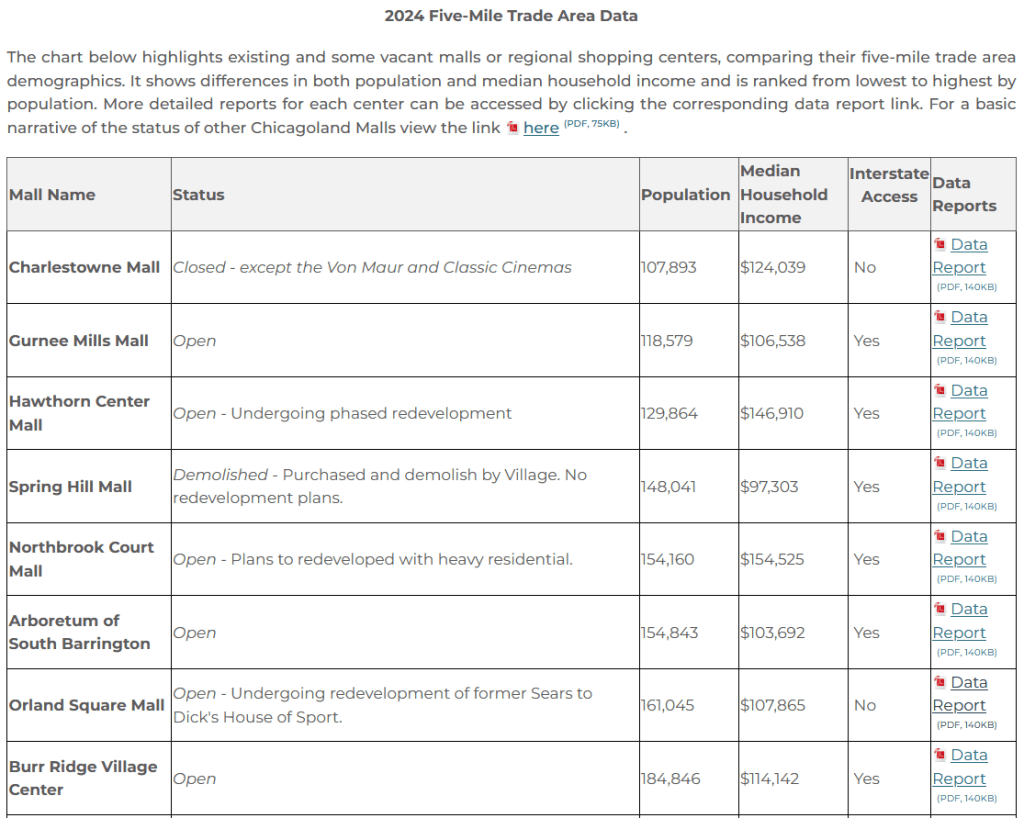
Commercial businesses such as retail stores, restaurants, and entertainment venues depend on a strong local population to generate steady sales and foot traffic. The more households that surround a shopping center, the greater the built-in customer base to support those businesses and the more attractive the redevelopment is for a developer. For Charlestowne Mall, the surrounding area has relatively low population density compared to other successful shopping corridors in the region. With fewer nearby residents, there is less day-to-day demand to sustain large-scale retail, making it harder to attract and retain major tenants. The graphic below provides the basic demographic and market data within a five-mile radius of the Charlestowne Mall site. Developers and businesses rely on this data to evaluate the market feasibility of proposed commercial uses and to understand the strength of the local customer base.

From this analysis (which continues for about 10 more malls in addition to the chart above), several features of Charlestowne stand out: the nearby population is relatively small and the mall has no interstate access. It does have a higher median household income than some malls, including the two others on the list that were demolished (but had more residents nearby with one having interstate access and another not).

So is the real story about this property about mall overdevelopment? As the number of shopping malls expanded in the growing suburbs of the end of the twentieth century, how many were doomed from the beginning? Or perhaps developers and communities were too optimistic about how many people malls might draw or projected more nearby residents than ended up living nearby. Did anyone foresee the rise of online shopping or the shifts in consumption habits?

The trend in recent years is to try to save malls with new features that will continue to pull people to the property. But the malls that are already closed – such as Charlestowne – can struggle to replace them with something local residents and leaders want. This property still has fewer people nearby and no interstate. Even if the mall building is closed, it is hard to lose the dream of the mall and all that went with it including local revenue and a local gathering spot.

Suburban moratoriums on data centers and warehouses; what might be built instead?

The suburb of Aurora has put a temporary hold on approving data centers and warehouses in the community:

Photo by Field Engineer on Pexels.com

Such concerns led Aurora’s city council to enact a temporary zoning moratorium on data centers as well as warehouses. Mayor John Laesch made clear officials are not against data centers as a whole.

“It’s just trying to give us time to make sure that we have the proper guardrails in place,” he said.

In neighboring Naperville, at least one city council member said he’s exploring the idea of a similar pause.

My longer-term question for Aurora, Naperville, and suburbs with similar concerns: what will they approve for the land that might be used by data centers and warehouses? Several options they could pursue:

  1. Green or open space on this land. This might be hard to do with land zoned for commercial and industrial use as suburbs hope such land will generate tax revenue and jobs. But residents might like this option if the alternative is something that generates noise and traffic.
  2. Pursuing office space or industrial uses with limited noise and pollution. The problem with this could be whether there is demand for such structures. How much vacant office space is there already in office parks and buildings along I-88? How long could a community pursue these options if the market is not favorable?
  3. Approving housing. There is a need for housing in the Chicago area and both Aurora and Naperville have experienced population growth in recent decades. But what kind of housing – expensive units without too many kids (so as to not burden local school systems)? Housing for seniors or young professionals? Affordable housing? Would neighbors like more housing – noise, traffic, potential water issues, etc. – near them?

Perhaps some suburbs can wait this all out. Will the boom in warehouses and data centers end at some point? If some suburbs say no to data centers and warehouses, they will end up somewhere. Will the warehouses end up not being in wealthier suburbs?

Memorializing shopping malls that are demolished

Thinking about two suburban shopping malls recently demolished in the western suburbs of Chicago (here and here), how might a suburb go about marking – if at all – where the shopping mall once stood?

Photo by Felipe Jimu00e9nez on Pexels.com

Both malls operated for over four decades. People from the suburb in which they were located and nearby suburbs shopped and gathered there. The communities in which they were located gathered and used the tax revenue generated by the mall.

As redevelopment plans get underway, is it worth marking where the mall once stood? Imagine a roadside marker that says “Former site of the Stratford Square Mall.” Or within the new development some indication on the ground of the footprint of the mall. Or naming some part of the new development after the mall that was once there.

Perhaps marking the former mall site in some way is going too far. Plenty of suburban redevelopment happens without much concern with what was there before. Historic preservation groups and efforts can save or identify properties worth holding on to. But it takes money and local will to remember past land uses and buildings. Would there be enough interest in remembering these shopping malls?

One feature I like about Google Streetview is that with over a decade of streetscape images, you can go back and see what an address looked like years ago. This might be possible to do with other mediums, such as overlaying older photographs or drawings over current images, but it can be difficult to track down such images. The malls will live on in Streetview, even as the sites are transformed.

Dead shopping malls and empty sound stages

Enough shopping malls are dead that other vacant properties can be compared to them. Take this question: “L.A. Sound Stages: The New Dead Mall?

Photo by tyler hendy on Pexels.com

So: When was the last time you were on a sound stage for a film or TV series? Even if you work in production, the answer is likely “not lately.” One well-known director recently told me that the last time they worked on the 15-stage Fox lot, their production was the only one active that day. And FilmLA’s recent sound stage report was bleak: Average stage occupancy plunged to 63 percent in 2024, down six points even from a strike-ridden 2023.

Compare that to 2016, when stages hummed along at 96 percent occupancy level, or the we-all-agree-it-was-a-bubble Peak TV year of 2022 when levels bounced back up to 90 percent during the post-pandemic recovery. Investors from Blackstone to TPG have stakes in sound stage properties, so it’s not just Hollywood worried about production. Just days ago, sound stage titan Hudson Pacific Properties — the Blackstone-backed owner of Sunset Bronson Studios, which is leased to Netflix — got hit with a credit rating cut. S&P Global called out the company’s “weakened studio business performance” and declining leased studio space, which dipped to 73.8 percent from 76.9 percent the year prior…

On a macro level, sound stages are in trouble — a reflection of the times. Production continues to be offshored to states and countries with more appealing tax incentives and cost structures, the correction from Peak TV means fewer series are being made, and the post-strike job market is still sluggish. While Gov. Gavin Newsom and others are pushing for a big new California tax credit plus other legislative moves to make filming here more accessible (#StayinLA), the industry is still reeling from a few years of blows, and some entertainment workers have left L.A. behind.

While the empty sound stages may be the result of specific issues in the TV and film industry, the comparison to shopping malls is particular interesting. Do we now just assume shopping malls are past their peak? That many of them are dead? That they are the exemplar of buildings that were once thriving but are empty now?

Vacant buildings are a problem for a number of industries and communities (see examples here and here). Empty buildings mean less work or activity is taking place. Empty buildings can lead to perception issues and ne’er-do-wells possibly causing problems. Empty buildings could lead to reduced tax revenues.

If shopping malls are the best comparison for these particular empty buildings, one lesson we might take: it will take years to figure out what to do with these properties. Will activity pick up in production again? Could there be temporary uses for these structures? If redevelopment is pursued by developers, do neighbors and communities want what might be there next?

Dead shopping malls could turn into zombie shopping malls: ones that slightly change form but stick around for years with limited activity and change. Whether sound stages follow a similar path remains to be seen.

Offices along I-88 helped Naperville become a boomburb; current mayor says they are ripe for redevelopment

What might the parts of Naperville along I-88 look like in the future? The current mayor has some thoughts:

Photo by Markus Spiske on Pexels.com

“There is no doubt that the I-88 corridor will be the largest and most significant redevelopment opportunity in our city’s history,” Wehrli said.

A new study calls the corridor the only “opportunity area” of its scale left in the city. Much of the corridor in Naperville — once known as its “Innovation Corridor” — was developed with single-use, low-density office space and is underused and “underperforming relative to its potential,” according to the report by AECOM, a consultant hired by the Naperville Development Partnership.

“Nearly half of the city’s existing jobs are located in the corridor, which the report noted was an ideal location for certain high-growth industries,” Wehrli said. “Sectors like: ag and food tech, biotech, pharma, life science, energy, fintech, quantum and advanced computing, tourism, sports and hospitality.”…

Among its recommendations, the study suggests developing a new corridor brand identity and creating a special zoning district along I-88 that would allow for a more dense, mixed-use, pedestrian- and transit-friendly environment.

“The study sets aspirational goals that add 15,000 high-paying jobs in the corridor by 2045 if we target these industries,” Wehrli told a business-friendly audience.

Three features of this report strike me:

  1. The emphasis on quality jobs is not a surprise. The jobs that came in the 1960s with Bell Labs and then other companies helped provide Naperville with a solid jobs base and a higher status. For a community that is used to having these jobs, it sounds like they want more of the same.
  2. The mention of mixed-use development is intriguing. Naperville has limited the amount of housing in this corridor in the past. How much housing would they allow? What residents are they hoping to attract? How many large-scale mixed-use developments do they think the corridor can handle?
  3. There is mention of zoning and branding unity that would be more “pedestrian- and transit-friendly.” Could this become a kind of linear neighborhood linked by mass transit and walking/biking paths? For decades the corridor was marked by proximity to a busy interstate that grew from two lanes in each direction in the late 1950s to four or more lanes each direction today. Could these new developments have significant connections to each other that go beyond cars and driving?

Filling empty big box stores with pickleball

I have tried to track the problems created by vacant big box stores in the suburbs, including having empty former grocery stores and putting COVID vaccine centers in those spaces. Some communities now find pickleball can make use of big box spaces and possibly generate revenue:

Photo by Frank Schrader on Pexels.com

When big-box stores like Toys R Us or Buy Buy Baby close, they leave behind tens of thousands of empty square feet — spaces that can be difficult to fill.

Finding new tenants for these massive spaces is no small task. But one unlikely contender, pickleball — among the nation’s fastest-growing sports — is breathing new life into these cavernous retail spaces.

From Vernon Hills to Batavia, commercial indoor courts are opening at a steady clip, bringing renewed energy, foot traffic, and consumer spending to shopping centers facing an uncertain future…

Retail market experts believe repurposing vacant big-box stores as indoor pickleball facilities is a smart business move. These spaces offer high ceilings, ample parking, and central locations. For pickleball chains seeking an affordable 40,000- to 50,000-square-foot space, these vacant stores provide an ideal solution…

One key concern is tax revenue. Unless the facility also sells equipment, apparel, or food and beverages, the host municipality won’t see much financial benefit from sales tax, leaving a gap that traditional retail stores typically fill.

Vacancies are bad for multiple reasons. They sit empty, suggesting there is no demand for space in the community. They may attract undesirable activities. They are not generating revenue. The buildings and parking lots may not be kept up to the same level of open stores.

Filling vacancies, therefore, is important. Anything using the space broadcasts activity and suggests a more vibrant community.

But also important is the need for revenue. Spaces in suburbs designated for commercial use are intended to help provide tax dollars to be spent on local priorities. If these spaces are not generating revenue, might they be better used for housing or community spaces or recreation use?

From the article, it is less clear about whether pickleball facilities can provide the tax revenues suburbs might hope for. Is there a point where suburbs might be unhappy with pickleball there, even if they do address the vacancy issues?

What suburban leaders need from denser developments in their downtowns

One suburban political candidate describes what the community hopes for when they build residences in the downtown:

Photo by Pixabay on Pexels.com

 “We need for people to be in it. We need for them to, do as our plan: get out of the building, walk around town, eat in the restaurants, drink in the coffee shops, drink in the bars, that kind of thing.”

Once a development is built, it takes time for the suburb to consider the impact on the community. If suburbs are going to pursue more density in their downtowns, which can often contrast with lower density homes throughout the rest of the community, they want certain things from the high-density development. They want those residents to patronize downtown businesses and restaurants. They want money to flow within the downtown. They want a particular downtown atmosphere where people are out and about (and not too noisy).

What happens if this does not come to fruition? What if the new development does not fill up quickly or if the residents do not spend much time downtown? Perhaps the municipality will seek a critical mass of downtown development to be able to provide enough downtown residents. Or perhaps they will seek the right mix of downtown attractions with certain kinds of shops and eateries.

And how much development will a suburb seek in its downtown? It might depend on whether it is “successful” in the eyes of the community.

Record high office vacancies in Chicago suburbs

More suburban Chicago office buildings were empty in 2024:

Photo by Burak The Weekender on Pexels.com

Meanwhile, 2024 brought an increase in suburban office vacancies — an all-time high of 26.3%, up from 25.4% a year earlier.

The suburbs are job centers. For example, the article notes, “Schaumburg is Illinois’ largest hub of economic activity outside of Chicago.” So to have a lot of empty office space is not a good thing. Owners of these buildings would prefer to have full offices as would municipalities who gain tax revenues.

Will upgrades to the buildings make a big difference? That is what the rest of the article suggests as workers and companies seek certain amenities to enhance the workspace and compete well against work from home options.

Also interesting to note is the redevelopment options if there is too much office space. For example:

Schaumburg officials hope to assist the office market by reducing its obsolete properties. This includes buying a 204,000-square-foot building to demolish for the village’s next police station and nearing approval to convert a 45-year-old Class B office building across from Woodfield into a 98-unit high-end apartment complex.

How many suburban communities would be willing to pull the plug on decent office space and go through all the effort it takes to redevelop the same land? If there is not demand for high quality office space, will other land uses bring in similar revenues and have similar levels of prestige? I would guess edge cities are not interested in losing that status but finding the right balance of offices, residences, and other uses could take time.

Naming a new apartment complex on top of former mall parking lot a “reserve”

Redeveloping shopping mall space into apartments is happening across the United States. Reading about a local mall adding a 271 apartment building on the former site of the parking lot outside a department store led to some reflection on the name of this new development:

Photo by Markus Spiske on Pexels.com

A crop of new restaurants and a Dave & Buster’s have been added to the mix. A grocery store is slated to open next year. In the clearest sign of the mall’s resurgence, a developer has kicked off the first phase of a luxury apartment project called “Yorktown Reserve.”

The old Carson’s department store will be dismantled to pave the way for public green space between the mall and the apartments. Inward-facing mall spaces will be turned outward. Facing the park will be a new, two-story entrance directly into the center of the mall.

What does “Reserve” refer to? The first thought that came to mind: wine. Quoting a possible definition of reserve in the Merriam-Webster Dictionary:

9: a wine made from select grapes, bottled on the maker’s premises, and aged differently from the maker’s other wines of the same vintage

Upon further thought, this does not strike me as the meaning. Apartments tasting like a fine wine? How about a different definition of reserve:

1: something reserved or set aside for a particular purpose, use, or reason: such as…

b: a tract (as of public land) set apart : reservation

A reserve as in a set apart piece of land? This seems more like the meaning with the apartments next to a new “public green space” and the mall.

Once the apartments are constructed, I would be interested to hear residents and neighbors reflect on this name. Does it feel like a reserve? Does the name imply a certain price point and residential experience?

Converting suburban houses into group homes – but they cannot look like group homes

Multiple suburbs in the Chicago region allow for the conversion of suburban single-family houses into group homes for seniors or adults with disabilities. However, they generally agree that the conversion cannot alter the appearance of the home:

Photo by Dave Frisch on Pexels.com

A 2021 Northwest Municipal Conference survey of its members identified 14 suburbs permitting group homes for particular populations, largely those with disabilities.

However, the conversion of homes into assisted living centers for seniors is becoming increasingly prevalent. Schaumburg has seen two proposals in the past year alone. There are also online seminars offered to entrepreneurs looking to flip homes and turn them into assisted living centers, aimed at the nation’s aging population.

Regulations vary in towns that allow such conversions. Some require approval from a village board or city council, while other towns don’t require such approval because these uses are already allowed in its residential code. But all enforce rules against external changes to the houses that would identify them as group homes…

“You’ll be driving down a neighborhood and never know we’re there apart from a van picking people up or dropping them off,” said Little City Foundation CEO Rich Bobby…

While the intention of the homes is to blend in, a degree of engagement with neighbors is sought in advance to paint an accurate picture of those who are going to live there.

A common suburban story regarding proposed changes to houses might go like this: neighbors get wind of a possible change in a subdivision or residential area. They express concerns about such changes altering the character of the community. Perhaps there might be increased traffic, noise, and lights? They share that they moved into this location because it was a quiet, residential space. Changes to that format threaten their day-to-day experiences and their property values.

But what if the changes to that house or residence were minimal in nature? Or, as the regulations above suggest, the exterior of the home does not look any different and there is not a noticeable change in day-to-day life around the home? Would this allay all the concerns?

From this article, it sounds like concerns have been at a minimum thus far. The number of conversions is small. Perhaps there is a tipping point where multiple proposals in the same neighborhood or on the same straight might draw more attention. But if neighbors do not see significant changes on the outside, they might not have many issues.

Given the needs of the suburban population, I suspect more suburbs will face this particular issue in the coming years. Building large facilities can be difficult and costly. If converting homes to group homes can help serve residents and neighbors are okay with it, perhaps this will happen in a lot of places.

(This reminds of a 2013 book looking at affordable housing built in New Jersey where one of the goals was to design the multi-family housing units in a way that people passing by would not identify them as affordable housing. With some design work, this was largely accomplished and relatively few neighbors opposed the project.)