The mostly Christian US House and Senate

How does the religious affiliation of the members of Congress compare to the religious affiliation of Americans as a whole? This came up recently in a conversation about religiosity and government so I tracked down some data.
Photo by Kendall Hoopes on Pexels.com

For the religious affiliation of Americans as a whole, here are figures from the Pew Religious Landscape Survey with data collected in 2023-24 from more than 35,000 respondents. With 62% of American adults identifying as Christian, here are the percentages for particular religious traditions:

-23% evangelical Protestant

-11% mainline Protestant

-5% Black Protestant

-19% Catholic

-2% Latter-day Saint

-2% Jewish

-1% Orthodox Christian

-1% Muslim

-1% Buddhist

-1% Hindu

-29% religiously unaffiliated

For the religious affiliations of members of Congress, here is a summary of what Wikipedia has for House members and Senate members. The categories are not the same as the religious traditions for the Pew Religious Landscape Survey but there are points to compare. Starting with members of the House of Representatives:

-375 of the 435 (86%) are Christian. Of these Christians, 236 are Protestants in specified traditions (including 63 Baptists, 22 Methodists, 16 Episcopalians, 15 Presbyterians, 13 Lutherans, 10 non-denominationals) and 88 are unspecified Protestants. Of the 375 Christians, 126 are Catholics, 7 are Eastern Orthodox, and 6 are Latter-day Saints.

-24 of the 435 (6%) are Jewish.

-4 of the 435 (1%) are Muslim

-4 of the 435 (1%) are Hindus

-2 of the 435 (0.5%) are Buddhist

-18 (4%) are unknown or refused to state.

-4 (1%) are unaffiliated.

And here is the religious affiliation for members of the Senate:

-86 of the 100 (86%) are Christian. Of these Christians, 59 are Protestants in specified traditions (including 12 Baptists, 5 Methodists, 5 Episcopalians, 12 Presbyterians, 6 Lutherans, 6 non-denominationals) and 5 are unspecified Protestants. Of the 86 Christians, 24 are Catholics, 7 are Eastern Orthodox, and 3 are Latter-day Saints.

-9 of the 100 (9%) are Jewish.

-1 of the 100 (1%) are Buddhist

-4 (4%) are unknown or refused to state.

How does the religiosity of Congress compare to the country as a whole? Pew sums up:

Christians will make up 87% of voting members in the Senate and House of Representatives, combined, in the 2025-27 congressional session. That’s down from 88% in the last session and 92% a decade ago...

And yet, at 87%, Christians still make up the lion’s share of the Congress, far exceeding the Christian share of all U.S. adults, which stands at 62% after several decades of decline…

The new Congress is also more religious than the general population by another, related measure: Nearly three-in-ten Americans (28%) are religiously unaffiliated, meaning they are atheist or agnostic or say their religion is “nothing in particular.” But less than 1% of Congress falls into this category…

In a country where a majority of adults identify as Christian, Congress is roughly 25% more Christian than the population as a whole. This may change in the coming years as more American adults do not identify with any religious tradition or group.
Interesting framing: American faith beliefs and practices down “despite a megachurch surge”

Here is a summary of recent data on religiosity in the United States:

Photo by Luis Quintero on Pexels.com

Church membership, church attendance and belief in God all declined during the pandemic years, survey data suggest, accelerating decadeslong trends away from organized worship.   

At least one-fifth of Americans today embrace no religion at all. Researchers call them “nones.”  

A similar share tell pollsters they do not believe in God, an all-time high.

The lone, striking countertrend is a steep rise in nondenominational Protestants, who attend churches outside the “mainline” denominations — the once-ubiquitous Baptists, Methodists and Lutherans.

The story is set up this way: religion is on the decline and the only phenomena standing out are megachurches. This is an interesting set of evidence to put together. Do religion and megachurches go together or cause each other? Here are just a few ways they might be related:

  1. Religion is down and megachurches are up. (This is what the article suggests in the headline and later in the story.)
  2. Religion is down and megachurches are a last gasp of religion.
  3. Religion is down and megachurches helped contribute to this decline.
  4. Religion is down. And megachurches are not related to this overall pattern.

Which of these options is most accurate? What is the causal link between overall American religiosity and the presence of sizable religious congregations?

Measuring religious affiliation at the county level and the variation within counties

I was looking at the methodology for the “Where Should You Live?” interactive feature in the New York Times from November 2021 and noticed this section on religion and place:

Photo by Ricardo Esquivel on Pexels.com

Why isn’t there a checkbox for ____?

There are many metrics that we wanted to include but for which we couldn’t find data.

Religion was at the top of that list. The Public Religion Research Institute sent us breakdowns of religious affiliation by county. But some counties contain dozens of places. Cook County, for instance, includes Chicago and is home to a large number of Black Protestants. The county also includes Chicago’s northern suburbs, where very few Black people live. Assigning the same statistics to every place within Cook County would have been misleading.

(We did use county- or metropolitan-level statistics for a handful of metrics — but only when we thought values were unlikely to vary significantly within those areas.)

This explanation makes some sense given the data available. Counties can have significant variation within them, particularly when they are large counties and/or have a lot of different municipalities. The example of Cook County illustrates the possible variation within one county: not only does the county contain Chicago, there are scores of other suburbs with a variety of histories and demographics.

On the other hand, it is a shame to not be able to include any measure of religion. People do not necessarily gather with similar religious adherents in their own community. People regularly travel for religious worship and community. There are Black Protestant congregations in Cook County outside of Chicago even as they may not be evenly distributed across the county. Because this religion data is at the county level, perhaps it could be weighted less in the selection of places to live and still included as a potential factor.

This also speaks to a need for more systematic data on religious affiliation on a smaller scale than counties. This requires a tremendous amount of work and data but it would be a useful research tool.

The transmission of religious faith from parents to children and individual faith choices

A sociology book published in 2021 emphasizes the role of parents in religiosity in the United States. From an excerpt:

Photo by Feedyourvision on Pexels.com

Parents define for their children the role that religious faith and practice ought to play in life, whether important or not, which most children roughly adopt. Parents set a “glass ceiling” of religious commitment above which their children rarely rise. Parental religious investment and involvement is in almost all cases the necessary and even sometimes sufficient condition for children’s religious investment and involvement.

This parental primacy in religious transmission is significant because, even though most parents do realize it when they think about it, their crucial role often runs in the background of their busy lives; it is not a conscious, daily, strategic matter. Furthermore, many children do not recognize the power that their parents have in shaping their religious lives but instead view themselves as autonomous information processors making independent, self-directing decisions. Widespread cultural scripts also consistently say that the influence of parents over their children recedes starting with the onset of puberty, while the influence of peers, music, and social media takes over.

Other common and influential cultural scripts operate to disempower parents by telling them that they are not qualified to care for their children in many ways, so they should turn their children over to experts. Further, the perceptions of at least some (frustrated) staff at religious congregations is that more than a few parents assume that others besides themselves (the staff) are responsible for forming their children religiously (in Sunday school, youth group, confirmation, catechism, etc.).

Yet all empirical data tell us that for intergenerational religious transmission today, the key agents are parents, not clergy or other religious professionals. The key location is the home, not religious congregations. And the key mechanisms of socialization are the formation of ordinary life practices and identities, not programs, preaching, or formal rites of passage.

There are multiple implications of these findings. I’ll briefly consider one hinted at above. In the United States, religion is often considered an individual matter. A believer is one who has consciously made a choice in their religious beliefs, behaviors, and belonging. In the American religious system, there is plenty of freedom to make such choices, whether one is identifying with a different religious tradition, putting together multiple pieces from different traditions, or citing no religiosity at all.

But, sociology as a discipline suggests no one is a complete free agent. This applies in all areas of life, including religion. We are pressured – a negative connotation often in the American context but social pressure can be positive or negative – by society and its parts.

If a religious tradition then emphasizes agency and authenticity regarding faith, it has the possibility of ignoring or downplaying social forces at work. Take evangelicals. According to the Bebbington Quadrilateral, one feature of this group is conversionism. This emphasis on a religious conversion often refers to an individual moment when a believer made a decision and/or had a definable conversion experience. This helps establish that this is a true and authentic faith, in comparison to being a cultural Christian or adopting the faith of one’s family or people.

The excerpt above does not suggest that the actions of a parent – or other social actors or institutions – always leads to a certain outcome but rather that how parents interact with religion increases or decreases the likelihood of religious faith of their kids. It is not deterministic but it is a demonstrable pattern where social forces – parents – influence individuals regarding religiosity.

If parents influence the faith of a teenager, is that teenager’s faith less real? Or, is this how human life works: we are influenced by social forces around us and we have the ability to exercise some agency?

The role of religious buildings in the decline in religiosity in the US during COVID-19

New data from Pew Research suggests religiosity declined during COVID-19:

Photo by Nikko Tan on Pexels.com

The percentage of Americans who identify as Christians now stands at 63%, down from 65% in 2019 and from 78% in 2007. Meanwhile, 29% of Americans now identify as having no religion, up from 26% in 2019 and 16% in 2007, when Pew began tracking religious identity.

Many places of worship closed during the pandemic—some voluntarily, others as a result of state and local social-distancing rules—and in-person church attendance is roughly 30% to 50% lower than it was before the pandemic, estimates Barna Group, a research firm that studies faith in the U.S. Millions of Americans moved to worshiping online, and questions linger about how many will come back in person.

A previous Pew survey, in January, found that a third of Americans said their faith had grown stronger during the pandemic—the highest share of any developed country. But overall, religious engagement trended downward at roughly the same rate as before the pandemic, according to the new Pew survey.

These findings are likely part of a longer trend away from religion that was already underway before COVID-19 hit. Sociologists and others have noted the rise of “religious nones,” particularly among younger Americans. Religion in the United States can often be individualistic and anchored less in religious traditions or denominations.

Yet, I wonder if COVID-19 presented a unique disruption to religiosity as it limited interaction with religious buildings. Sociologist Robert Brenneman and I discuss the impact of religious buildings on worship and community in Building Faith. We argue that the religious building and the ways that exterior and interior features are designed influence people who interact with them. The buildings do not just reflect religious values or doctrine; they help shape religious experiences.

When COVID-19 stopped people from being in buildings that influenced their faith, did this register as a loss and/or lead to a decline in religious engagement? With today’s technology and the ways that many congregations pivoted to online options, people can still engage with faith communities. Yet, that experience through Zoom or other video options is not the same as being in a physical structure that reinforces faith experiences. Even in congregations that tend to downplay the role of space, they still try to shape the religious building space in ways that encourages particular emotions and experiences.

Can religious faith in the United States survive as an enterprise free from the confines of a religious building? I have my doubts. While buildings themselves are unlikely to reverse the decline in religiosity in the last decade or so, they have a role in shaping communal and individual faith.

Divine Programming and the last two seasons of a critically acclaimed TV show that takes religion seriously

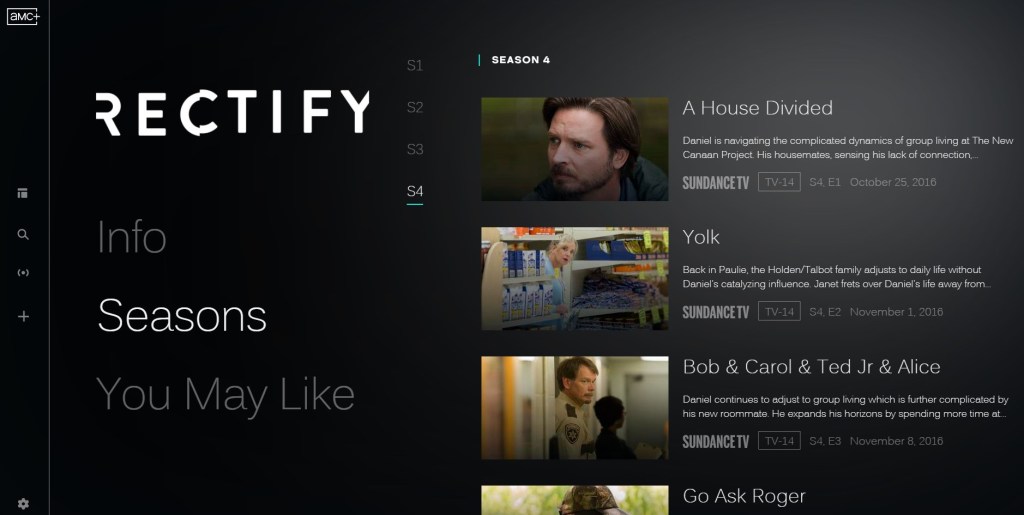
In September, I wrote about reading the academic study Divine Programming and watching seasons one and two of the TV show Rectify. I have now watched the final two seasons of the show, seasons three and four, and was interested to see the role religion played. Here are some thoughts.

  1. Religion is certainly not as important to the plot as it was in the first season. The number of times it is mentioned decreases. There is no presence of organized or institutional religion; it is all personal or individual.
  2. The primary religious character has a return to their faith in the final season. This does not mean everything turns out correctly for them or religion helps solve big issues. It appears that their privatized faith emerges again after going through some personal trials.
  3. The final episodes interact with the themes of hope and disappointment. Arguably, these themes run throughout the entire series; when Daniel is released from prison at the beginning, this does not necessarily lead to long-term consequences for the characters as they engage with what happened in the past and their current circumstances. These are themes that certainly fit with a religious theme. Why do bad things happen? Why are we disappointed? What gives us hope? In the end, the themes of hope and disappointment are left more to the individual characters and immediate family to address, not to religion.

Considering the full show, religion did matter in the narrative arc of the show but it was not a primary force, one that even a majority of the characters engaged with, and did not provide hope or disappointment in the end. Other forces and actors were more influential and the show, like many American narratives, puts a lot of hope in individuals and close relationships among family.

The consequences of losing the physical dimensions of religious and spiritual rituals

A psychologist encouraging people to adopt religious rituals – though not necessarily the religion associated with them – highlights the physical dimension of these rituals:

Photo by Ivan Samkov on Pexels.com

One thing that does worry me is a move toward doing these things online. We had to do it remotely because of covid-19. But these rituals are designed to happen and work best in the presence of other individuals. When we’re together, our heart rate synchronizes our breath. These mechanisms are leveraging our minds and bodies. Why do people kneel in church? There’s research showing that if you show people information on a screen above them, they place more emphasis and believe more on the higher screen because they’re looking up at it. Physiologically, we interpret something higher verticality as more authoritative. If you’re sitting on your computer or watching on your phone, I worry that we’re going to lose a lot of the power and majesty of certain rituals because we’re doing them remotely. That’s not how they were designed to work.

It is hard to overstate the communal factor of physical rituals. As sociologist Randall Collins describes in Interaction Ritual Chains, the bodily presence of others enhances the individual and collective experience.

This train of thought is also part of the reason sociologist Robert Brenneman and I wrote Building Faith. A recent trend is that people interested in religion or spirituality do it on their own and in secular settings. But, this is not what numerous religious traditions have highlighted for thousands of years. They have buildings that are intended to enhance the experience of the transcendent as well as enhance fellowship among believers. They may structure this space in different ways – whether to emphasize the preached Word, music, prayer, viewing other attendees, etc. – but they generally agree that buildings shape religious faith. Move those beliefs and practices to other spaces or to no spaces and it is something different.

Could people eventually have a faith or set of spiritual beliefs and practices and no common rituals whatsoever? Remove the physical structures and a group of people around them doing something similar and it is easier to imagine.

Divine Programming and watching two seasons of a critically acclaimed TV show that treats religion seriously

This summer I read the book Divine Programming: Negotiating Christianity in American Dramatic Television Production 1996-2016. Charlotte Howell argues that television often utilizes two techniques when portraying Christian faith: keeping it at a critical distance or depicting it a cultural feature of Southern life. However, not all television shows do this. One critically-acclaimed show Howell highlighted, Rectify, sounded interesting.

Photo by Nicola Barts on Pexels.com

I have now watched the first two seasons of the show. And it is indeed interesting to see how religion in incorporated as part of the plot. The main character in the drama, a man who has been released from death row even as law enforcement and legal actors are interested in putting him back in prison, finds religion in the middle of the opening season. He has a conversion and a baptism. He is attracted to this faith through the example of his sister-in-law who attends church regularly, encourages her husband to be more faithful, attends a small group, and has a gentle spirit.

Yet, at least through two seasons, the reassurances faith provides have difficulty matching up the problems the characters face. The released prisoner finds that his conversion is perhaps less important to his thriving than interacting with his sister-in-law. The sister-in-law confronts new problems and her faith no longer provides all the answers. The other main characters do not seem to interact with faith much at all and their own self-interest and hurt drives their decisions. Outside of several individual characters engaging religion (a common approach in American religiosity) , it is not present for the other characters or the community.

The faith of this show is not simple or does not always provide an answer or does not even matter to many of them. The characters have religious highs and lows and wrestle with how faith matters in real situations. The faith on the show is not front and center in the way it is in Seventh Heaven (also a case study in Howell’s book) nor is it derided or just a cultural artifact.

At the same time, it is clear that faith or religion is not driving the plot: human desires are. I will keep watching and see whether this is ultimately commentary about the ability or inability for religious faith to intercede in human affairs.

Facebook as the home for religious congregations?

Facebook is interested in partnering more with religious congregations and becoming the online home for their activity:

Photo by Luca Sammarco on Pexels.com

Facebook, which recently passed $1 trillion in market capitalization, may seem like an unusual partner for a church whose primary goal is to share the message of Jesus. But the company has been cultivating partnerships with a wide range of faith communities over the past few years, from individual congregations to large denominations, like the Assemblies of God and the Church of God in Christ.

Now, after the coronavirus pandemic pushed religious groups to explore new ways to operate, Facebook sees even greater strategic opportunity to draw highly engaged users onto its platform. The company aims to become the virtual home for religious community, and wants churches, mosques, synagogues and others to embed their religious life into its platform, from hosting worship services and socializing more casually to soliciting money. It is developing new products, including audio and prayer sharing, aimed at faith groups…

Many of Facebook’s partnerships involve asking religious organizations to test or brainstorm new products, and those groups seem undeterred by Facebook’s larger controversies. This year Facebook tested a prayer feature, where members of some Facebook groups can post prayer requests and others can respond. The creator of YouVersion, the popular Bible app, worked with the company to test it…

They decided to try two Facebook tools: subscriptions where users pay, for example, $9.99 per month and receive exclusive content, like messages from the bishop; and another tool for worshipers watching services online to send donations in real time. Leaders decided against a third feature: advertisements during video streams…

“Consumer isn’t the right word,” he said, correcting himself. “Reach the parishioner better.”

Doing church and religion online is well established and not going away. Yet, as the article notes, this raises a whole host of issues. Here are a few of my thoughts in response:

  1. I first noticed the importance of Facebook for multiple congregations when working with data based on congregational websites. Many congregations have websites, of varying degrees of sophistication and presentation, but not all. Some of those same congregations with websites also have Facebook pages and some without websites have Facebook pages. Do congregations really need both? Do they serve different audiences? The advantage of being on a social media platform is that people are already there (as opposed to searching for or typing in a website) and it offers the opportunity for interaction (usually not possible on a website).
  2. This makes sense from Facebook’s end as religious congregations tend to be durable social groups. If there are particular services Facebook can offer (such as helping congregations gather funds), they can gain a sizable market share of religious interaction and gathering.
  3. The religious people interviewed for the story suggested social media was really good for evangelism or reaching out to people. Yet, it is then easy to slip into a particular approach to people – see the conflation of “consumer” and “parishioner” above – and possibly difficult to transition from online interaction to embodied interaction. Worshiping online fits with many American religious features such as individualism and voluntary association but long-standing concerns about helping people move from an individualistic or response-to-evangelism faith to something deeper will continue in this model.
  4. I have lots of possible thoughts on how online religious gatherings function compared to meeting in a physical building shaped by the congregation. While my co-author and I did not address this directly in our book Building Faith, we argue buildings are very important for worship and fellowship.