What it took for a successful suburban musician to push against their suburb’s push to go to college

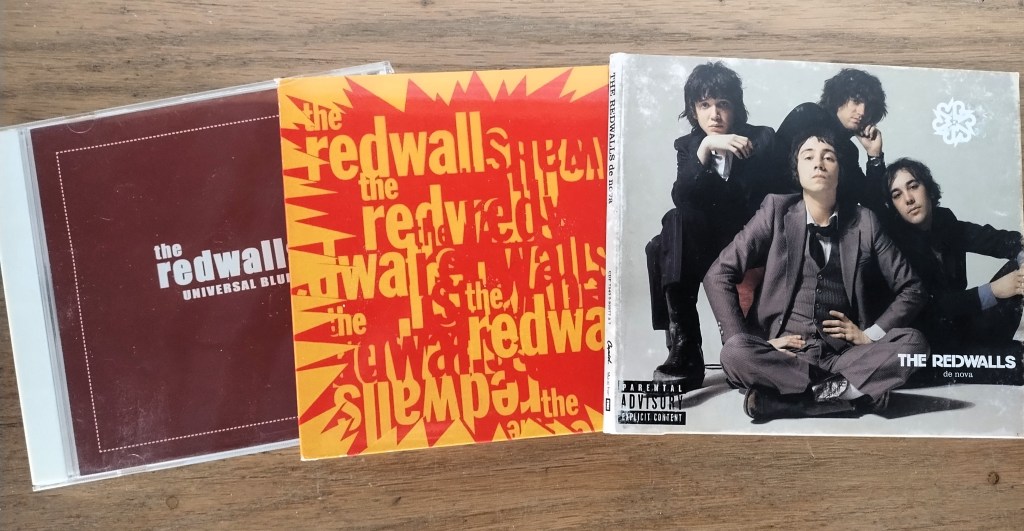
A look back at the life of musician Justin Baren, member of The Redwalls, highlights how they forged a path to music success from their suburban upbringing:

Along with his older brother, Logan, Baren was an obsessive fan of the British Invasion sound of the 1960s, which he channeled into the band the brothers formed while students at Deerfield High School. Jordan Kozer, the band’s first drummer, recounted how the brothers studied Beatles albums like holy scripture; Justin would record rehearsals and require the others to spend hours listening to their mistakes to get their parts right the next time.

“He didn’t know anything else. He didn’t try anything else. Deerfield was pushing people to go to college. He and Logan didn’t care anything at all about that. They were laser focused on making this happen. There was no backup plan,” Kozer said.

The perseverance worked. On the same day of their high school graduation, the band was in Los Angeles signing a contract with Capitol Records, the U.S. label of the Beatles. Two years later, the Redwalls opened shows for Oasis in U.K. soccer stadiums…

“From a very early age, we knew the kids in high school weren’t going to be our scene,” Justin told this writer in 2005. “We wanted to get into the real music scene and not be limited by what other kids were saying or doing. We wanted to be Downtown where it was happening.”…

Despite their age, their hard work, sophisticated musical sensibilities, confidence and charisma impressed the network of music professionals in the city. The Redwalls, which included guitarist Andrew Langer, solicited the help of Mitch Marlow, then the talent buyer for a music club in Evanston, by blindly handing him a cassette tape of their music. “What nerve, they put Beatles outtakes on a cassette and are saying it’s their band,” Marlow first thought, until realizing days later the recordings were contemporary…

Marlow ended up managing the group. He booked headlining shows for them at Double Door, the Hideout and Metro. He recorded them, encouraged them to keep writing original songs and introduced them to Bob Andrews, co-founder of Champaign indie label Undertow Music, a collaboration that resulted in “Universal Blues,” the band’s 2003 debut. They were high school seniors.

To become a professional in many fields requires focus and practice. To do this by the end of high school is impressive.

It is interesting to hear that Baren and the band did this while pushing against what was expected of them in their suburban high school. Deerfield High School is a highly rated institution and like many such schools encourages students to go to college. What would parents say to students in similar schools who say they want to pursue music rather than going to college? How many high school musicians are able to secure a record deal and open for a major rock group? Is this a good life path?

And then the path toward music success moved away from their suburban community to Chicago. They played in music venues utilized by numerous music groups, small and big. They got into the music networks of promoters and venues and labels that are based in big cities.

Was there anything in their music or performances that would belie their suburban roots? Maybe not. But the story of suburban high school to major record label is rare even as there must be plenty of suburbanites among successful music artists in the United States.

Musician raised in the suburbs “grateful for the thousands of hours of sitting in my room playing guitar”

How might being raised in a quiet suburban community affect a musician’s career?

Photo by billy Lopez on Pexels.com

You grew up in Wheaton. What was that like?

Quiet. It’s a nice suburb, I enjoyed it. I was homeschooled, so I had a very different experience than probably a lot of people did. My mom kept our world very big — we traveled a lot. Wheaton is where I fell in love with music. I’m grateful for the thousands of hours of sitting in my room playing guitar.

Practice is required to become skilled at many tasks. Having the time, space, and skills to practice well is helpful.

Suburban bedrooms are a private space in the American suburban home. It is a place to get away from the world. One can be alone with their thoughts. In the case of practicing music, playing guitar in a bedroom isolates the activity and noise from the rest of the house. The practicing goes unobserved.

Add to this that suburbs are sometimes portrayed as being creative wastelands. Suburbs are said to be conformist, conservative, cookie-cutter. Many narratives suggest there is a suburban facade of success and attainment – happy families, polite interactions – but just below the surface are problems and divisions.

Can suburban bedrooms produce artistic talent and creativity? The majority of Americans live in the suburbs and multiple generations have grown up in the suburbs. Presumably at least a few artists, novelists, filmmakers, playwrights, and musicians have honed their craft in the suburbs, and perhaps even in their bedrooms.

The rise of youth and rock music

A look back at one influential rock album highlights the connection between age and rock music:

Photo by cottonbro studio on Pexels.com

In the mid-1950s, the idea that the cutting edge of pop would come to be dominated by relatively young people writing songs for and about people even younger was a revolutionary notion, one that in the next decade would come to be taken for granted.

How much did the music help encourage youth culture or the youth culture encourage the music? This was a period with a growing number of children and teenagers and a different sense of what youths could do and contribute to society.

It would be interesting to compare that time period to today regarding music. Some of those original influential youths from the 1950s and 1960s music scene are still alive. They continue to make new music as well as play their old hits. They are no longer young; but do they continue to carry on a youthful spark or the youth culture of that time? Or do they not matter much as younger people continue to make, remake, and innovate music.

It is hard to imagine otherwise but imagine the purveyors of rock music in the 1950s and 1960s were not young – not Elvis, Chuck Berry, the Beatles, etc. – but rather musicians in their 30s and 40s. What might be different – the sound? The lyrics? The scene? Would rock music be different today based on those changes back then?

Finding the American Dream through the music liked by teenagers

Where can the American Dream be found? How about at a Jonas Brother convention at a large suburban mall:

Photo by Clem Onojeghuo on Pexels.com

When JonasCon, an all-day special event celebrating the 20 years since the debut of the hit boy band the Jonas Brothers, was first announced in mid-February, anyone who still cared about the JoBros (myself included) thought it would be a disaster. After all, the announcement came less than two months before the event; information about what was actually going to happen during the convention was nowhere to be found, even mere weeks away; and it didn’t help matters that there were last-minute reports that the Jonas Brothers were struggling to find sponsors for what would likely be a “complete and chaotic mess.” Hints of an impending trainwreck angered fans; not only were they financially invested in traveling to the event, but they were also feeling protective over (and worried about) the reputation of the once-popular band of brothers, who have been left behind in an era short on boy bands and heavy on “popgirlies.”

But what actually happened on that Sunday in March, at the behemoth that is the American Dream mall in East Rutherford, New Jersey, wasn’t the reincarnation of Fyre Fest that everyone was expecting. It was something else entirely…

Being inside of the bubble of the teenage dream—while literally ensconced in the American Dream—makes you forget that the real world is still happening.

Four things seem to be converging here that add up to the American Dream:

  1. A shopping mall/attraction site that calls itself American Dream. The large thriving shopping mall is a great embodiment of the postwar suburban American Dream. (In terms of spaces, it might only trail the single-family home and yard as the epitome of the American Dream for a certain era.
  2. The teenager experience is a unique one in American society. The mix of independence and growing up and testing out adult things can come together into a heady time where experiences and patterns can prove influential for the rest of life.
  3. Music gets wrapped up in #2 as an important narrative element. Certain artists or genres can speak to teenagers in ways they might not to adults The music and the memories that go along with the music are powerful.
  4. The American Dream is not just an idea; it can be experienced. The setting here is a fan convention that brings together in a suburban setting people who enjoy particular music. They get to enjoy the music, the energy, and meeting people at one time. There are other experiences that can be the American Dream – perhaps a backyard cookout, perhaps driving fast down a road – but the fans at this event seem to get to experience something that helps them ignore what else may be happening.

Three thoughts on pop/rock music about the suburbs

I enjoyed thinking this week about pop and rock music about the suburbs. As I considered the music of Malvina Reynolds, the Beatles, Ben Folds, Arcade Fire, and Olivia Rodrigo, several thoughts come to mind:

Photo by Edward Eyer on Pexels.com
  1. These genres do not often write directly about the suburbs. They may tell stories about people and situations based in suburbia but the role of suburban places is minimized. Many popular songs do not say anything about where they take place geographically.
  2. Finding songs that portray suburbia in a positive light is difficult. Surely they exist. Perhaps they do not become as well-known? Perhaps music artists tend to associate suburbia with negative traits? Perhaps other genres do this differently?
  3. At the same time, there is plenty about suburban life that could make for compelling music. Millions of Americans, including many musicians, have experience this life. The songs profiled this week included looks at houses, daily routines, remembering childhood, listening to music, driving, and relationships. For all the reasons Americans love suburbs, why not tackle those themes? (I realize it might be hard to write about suburban local government but I am guessing it could be – and probably already has – been done.)

I will keep listening for music that references and is about specific places. This includes the suburbs but also cities and rural areas as place could be a fascinating topic for a new single or album or bonus track.

McMansion as a symbol of a lot of something and more

A ranking of every Weezer song includes using the term “McMansion” for the second-worst song on the list:

Photo by freestocks.org on Pexels.com

204. “Beverly Hills,” Make Believe

To this day, Weezer’s highest charting single – which makes sense, as it’s about as close to the lowest common denominator as the band has ever sunk. A lumbering monument to the pursuit of wealth and luxury, “Beverly Hills” matches its vapidity of message with a McMansion’s worth of painful musical ideas: the clumsy half-rapping of the verses, the annoying “gimme, gimme” rejoinder of the chorus, the talkbox solo of the bridge. Even louder than the caveman thud of Pat Wilson’s opening drum salvo was the sound of dyed-in-the-wool diehards stampeding for the exit, finally ready to accept that the glorydays of Pinkerton weren’t coming back.

The most obvious use of the word here is to suggest the song has a lot of bad ideas. McMansions are criticized for their size and their poor architectural ideas.

But, there could be more here in this paragraph. A few quick ideas:

  1. Beverly Hills is a wealthy neighborhood with a lot of big houses. Are some of them McMansions? McMansions are connected to displays of wealth and excessive consumption.
  2. The reference to “the lowest common denominator” could be linked to the critique that McMansions are vapid and mass produced. They are not real mansions; they are attempts to mimic higher quality construction and more architecturally pure mansions.

All together, the use of the term McMansion here does not refer directly to the actual homes. Rather, it highlights how familiar the term is in order for its use in a music review to highlight abstract ideas.

“Who sings the song of suburbia?” Part Four on music

Parts One, Two, and Three of this series have summarized academic work on how poetry, novels, and screens (television and film) have engaged and depicted suburbs. What about popular music? While I have not comprehensively looked for academic sources regarding music in the ways I have for the other cultural mediums, I do not know of as much work in this area. At the same time, this does not mean music has not addressed the suburbs.

Photo by Milada Vigerova on Pexels.com

Starting with a broad view, the rise of mass suburbia coincides with the spread of pop and rock music in the twentieth century. Rock music arose amid the development of teenagerdom as a life stage (now in suburbs that privileged children and family life), as music that borrowed from blues music (now heard in largely white suburbs and from many white performers), and broadcast through mass media like radio and television (now in many suburban homes).

Here are some of my own ideas on this connection between suburbs and music:

-Popular music offered another means for protesting and reflecting on the suburbs. This could take many forms. Malvina Reynolds’ 1962 song “Little Boxes” criticized the tract homes arising outside many American cities. Ben Folds’ 2001 album Rockin’ the Suburbs profiled sad and angry suburban lives. The 2010 album The Suburbs from Arcade Fire built on the experiences of two band members in a suburb outside Houston. Numerous other songs and albums addressed suburban life.

-All popular music from the 1950s onward was created by some artists who had spent formative years in the suburbs. The postwar Baby Boomers and subsequent generations wrote about what they knew. For example, the Beatles song “Penny Lane” highlights the suburban nature of communities the group knew. Or, see this 2014 post about a band from the Chicago suburbs that was trying to make it big.

-Another aspect of this possible connection is how music is produced and consumed in the suburbs. The reputation of suburbs is that they are not exactly hotspots of culture, notwithstanding the occasional community that serves as an entertainment center. Music is occasionally performed in restaurants, bars, and festivals (with a heavy emphasis around here on rock/pop cover bands at community festivals). The stereotypical garage band of teenagers working out their music would benefit from the surfeit of suburban garages. Compared to the music ecosystem in larger cities including performance spaces of various sizes, the presence of music labels, and the mixing of musical groups and settings, the suburbs may not be the liveliest music scene.

-The connection between poetry about the suburbs and music about the suburbs would be worth exploring further. If singer/songwriters or popular artists are writing for the masses, how do their words and products compare? Furthermore, the role of music in all those television shows and films about suburbs could be worth considering. Is there a stereotypical “suburban soundtrack”?

-Certain genres of music have connections to particular places. Country, as its name implies, is connected to more rural areas and the South. Hip-hop and rap music emerged from urban settings. Is there a genre or type of music closely connected to suburbs? Middle-of-the-road (MOR) pop music?

Tomorrow, I will sum up this series on cultural works and the suburbs.

When a pie chart works for analyzing the lyrics of a song, Hey Jude edition

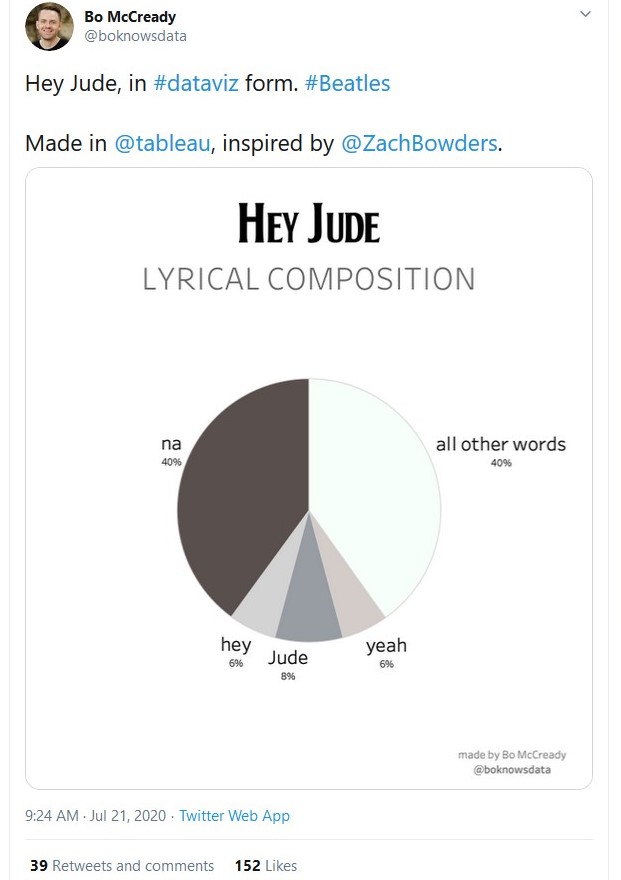
Earlier this week, a data visualization expert presented a pie chart for the lyrics of The Beatles’ hit “Hey Jude”:

HeyJudeLyricsPieChart

Pie charts are very effective when you want to show the readers that a large percentage of what you are examining is made of one or two categories. In contrast, too many categories or not a clear larger category can render a pie chart less useful. In this case, the word/lyrics “na” makes up 40% of the song “Hey Jude.” In contrast, the words in the song’s title – “hey” and “Jude” – comprise 14% of the song and “all other words” – the song has three verses (the fourth one repeats the first verse) and two bridges – account for 40%.

This should lead to questions about what made this song such a hit. Singing “na” over and over again leads to a number one hit and a song played countless time on radio? The lyrics Paul McCartney wrote out in the studio sold for over $900,000 though there are no written “na”s on that piece of paper. Of course, the song was written and performed by the Beatles, a musical and sociological phenomena if there ever was one, and the song is a hopeful as Paul aimed to reassure John Lennon’s son Julian. Could the song stand on its own as a 3 minute single (and these first minutes contain few “na”s)? These words are still hopeful and the way the Beatles stack instruments and harmonies from a relatively quiet first verse through the second bridge is interesting. Yet, the “na”s at the end make the song unique, not just for the number of them (roughly minutes before fading out) but the spirit in which they are offered (big sound plus Paul improvising over the top).

Thus, the pie graph above does a good job. It points out the lyrical peculiarities of this hit song and hints at deeper questions about the Beatles, music, and what makes songs and cultural products popular.

Song invoking filling potholes with cement (which the gov’t is not doing)

Potholes are problems in many places but it isn’t often that the issue makes it into a popular song. Here is part of the bridge for Twenty One Pilots’ “Tear In My Heart”:

You fell asleep in my car I drove the whole time
But that’s okay I’ll just avoid the holes so you sleep fine
I’m driving here I sit
Cursing my government
For not using my taxes to fill holes with more cement

Potholes are costly to the average driver but who knew that they can be detrimental to romantic relationships? Yet another reason for spending more upfront on infrastructure to keep the later potholes at bay. Plus, the artist is convinced that the government is misallocating his tax monies. Seems to be a popular American sentiment these days.

These failed romance/anti-government themes may just be popular together: at the time of writing, the song was #67 on iTunes and is #2 on the alternative radio charts. Or, maybe the reference to filling potholes with cement is the real secret…

Some band had to eventually take the name “Mcmansions”

If you can play lead guitar, you can join the band with the great name “Mcmansions.”

Mcmansions seek lead guitarist (Marietta Ga.)

We are primarily an original band based out of Marietta,Ga. We sing about Love, Loss, sadness, insanity and yes redemption. all of us are over the age of 40 and prefer the same.We are acoustic guitarists/lead singer,bass/backup vocals, and drums. We enjoy live performance and recording,mostly on weekends.We are actively seeking you electric guitarist to make our music even better. We all have obligations but nonetheless we live to write sing and play and will quit when we are dead. Our arrangements are not difficult we just need an energetic new friend to fill in all the blanks with stylistic embellishments to whip the band up into a frenzy of rock n roll bliss.

And the style or ethos of the band?

We are proudly playing a distinct original blend of lightly salted alternative Rock/Americana self styled tunage The music speaks for itself We have a 60s garage sound in our music that draws from the Rock, soul, pop ,punk,country and gospel that we have all come to love Actually we have a lost Identity covered with kudzu, rust and condemned asbestos habitations with chipped lead paint…

Given the criticism the McMansion has taken in the last 15 years, there is a lot of sadness and insanity to explore here with this particular band name. However, I’m not sure audiences would be ready for love and redemption stories regarding McMansions…

Two other thoughts:

1. Even with their many problems of the suburbs according to critics (including a lack of community and poor design), there are a good number of music artists who have emerged from this social space in last half century. Perhaps it provides teenagers lots of time, space, and social connections for putting together a group? Perhaps it is because people in the suburbs get some decent music training as kids or have access to instruments and time? Perhaps suburban ills push people toward music as a way to escape?

2. McMansions may not be appealing to some but they offer a lot of space for music equipment and practice space. Imagine how much sound it takes to fill that two-story great room. Or the way that the loud noise of a rock band might just rattle the poorly constructed abode.