Filming in a real place but not calling it that place in the movie

A new streaming romantic comedy features a Chicago suburb:

Photo by Ron Lach on Pexels.com

“Libertyville will be featured quite a bit,” he said. All the business names were kept as is and some of the shopkeepers appear in the film, he added.

The village was to have been one of the locations for another of his holiday films, Charles said. That was delayed but filming for “Christmas at the Zoo” has been approved by the village and is planned for December.

“Libertyville has been on our radar for some time,” he said. “Having had a great experience shooting ‘Exes’ there, we’re happy to be coming back.”…

Local actors will be used in the film and Libertyville will be listed as an official filming location on the IMDb website.

With all these real shots of Libertyville, it appears the film does not say it takes place in Libertyville. From one Facebook post and a brief shot in the movie trailer, it appears the community in the film is named “Mill Creek.” According to Wikipedia, there are at least a few communities in the United States named “Mill Creek.”

I have wondered about whether filming in real locations matters for those watching a film or TV show. Couldn’t they just have found some establishing shots or used a studio to film? This is commonly done so how much does it matter that this was set in a real place that the film’s creators were familiar with? Perhaps the residents of Libertyville can watch and discuss and then compare what people who watch from elsewhere think.

A show set in a Detroit suburb filmed in Atlanta

The recently-cancelled TV show Grosse Pointe Garden Society was set in the Detroit suburb Grosse point but it was filmed elsewhere:

Photo by u041eu043bu044cu0433u0430 u041fu0443u0441u0442u043eu0432u0441u0438u043au0445 on Pexels.com

NBC’s recent cancellation of the quirky, stylish mystery made it official that the bloom was off the primetime show set in suburban Detroit. Premiering in late February, “Grosse Pointe Garden Society” wrapped its first season in mid-May, leaving behind 13 episodes about four members of the green-thumbs club with secrets buried amidst the greenery…

Although “Grosse Pointe Garden Society” looked convincing in its stately affluence, the actually series was filmed in Atlanta because of Georgia’s film tax incentives.

Can one wealthy suburb or neighborhood be easily swapped for another? I have not seen the TV show but I can imagine some of the ways this could be done. Establishing shots from one place while close-up action filmed elsewhere. A limited number of views of the community or neighborhoods or exteriors. Using studios or back lots.

I wonder if there are signs on the show that it is not actually filmed in Grosse Pointe. Differences in architecture? How about local trees? A lack of wear and tear on vehicles from winter that would be present in Michigan but not in Georgia?

This happens all the time on TV shows and in films: they are said to be set in one place but are filmed in other places. Perhaps the average viewer cannot tell the difference between the two or does not notice. Maybe it does not matter in many cases as the primary action follows a set of characters and the setting is just in the background. But if a show is named after a specific place, might it help a little to film it in that place?

Will a new Bewitched TV show be set in a similar looking suburbia?

A new Bewitched show is in the works:

Photo by Burak The Weekender on Pexels.com

The Bewitched update would focus on Tabitha Stevens, the 13-year-old daughter of witch Samantha and human Darrin. She juggles two lives attending middle school while also being secretly enrolled in a magical academy run by her grandmother, Endora — D’Ambrosia describes the premise as “Hannah Montana meets Harry Potter.”

The only mention of the setting of the show involves school settings: a middle school and a magical academy. The original Bewitched, a very popular show in the 1960s, was set in the suburbs of New York City. Samantha stayed at home while Darrin worked in the city. They live in a single-family home. They had a nosy neighbor. They have children.

Will the new Bewitched also include any of suburbia or will it primarily focus on schools? Interestingly, the two comparison TV shows mentioned above also include suburban settings. Hannah Montana was primarily set in Malibu, California while Harry Potter included scenes in and around the Dursley’s house on Privet Drive.

If the new version does include the suburbs, there is an opportunity for the suburbia depicted to look quite different than that of the 1960s. The suburbia often depicted on television then often portrayed nuclear family life in single-family homes on quiet streets. The suburbs today are more complex, diverse, and varied. There is an opportunity here to depict not only updated characters and storylines but also settings.

Three backlot settings I cannot forget

Vacationing in southern California a few years back, we decided to go on some tours of Hollywood studios. After doing these tours, I started looking more into the different backlots for different studios. Then it hit me: I have seen these settings at least dozens of times. In commercials, television shows, and films. Over and over again. Here are a few of these backlot settings I cannot forget:

1. Colonial Street on the Universal Studios lot. There are so many houses here that have been used. Plus it served as Wisteria Lane in Desperate Housewives. (And also an Ace Hardware advertisement.)

2. The city streets on the Warner Bros. lot, particularly the New York Street set. The street corner featuring a storefront with a subway entrance right in front that is used all the time.

3. Wall Street at the Universal Studios lot. The key is seeing the large building with columns at the end of a shot down a long street.

Once you know what these settings look like, it is easy to recognize them.

Did Central Perk make Friends or did Friends make Central Perk?

Amidst the 25th anniversary of the start of Friends, numerous commentators pointed out the iconic Central Perk coffee shop and hinted at how it helped make the show. Architectural Digest called it an “iconic TV interior.”

But, this raises a chicken and egg problem for television shows: do the settings help make shows popular or critically acclaimed or do people celebrate the settings because other parts of the show are good?

In the case of Friends, much is made of its setting in New York. With six young adults living in apartments, Friends helped make urban living look fun. Would the show have worked if it had been set in San Francisco or Chicago or less dense locations? More specifically, does the coffee shop truly make it feel like New York or more homey?

Or, on the other hand, did the show really not need to involve New York because what really mattered were the interesting relationships between the six young adults plus the situations they got themselves into. If the characters and writing are good enough, could the show succeed even with a lousy or less interesting setting?

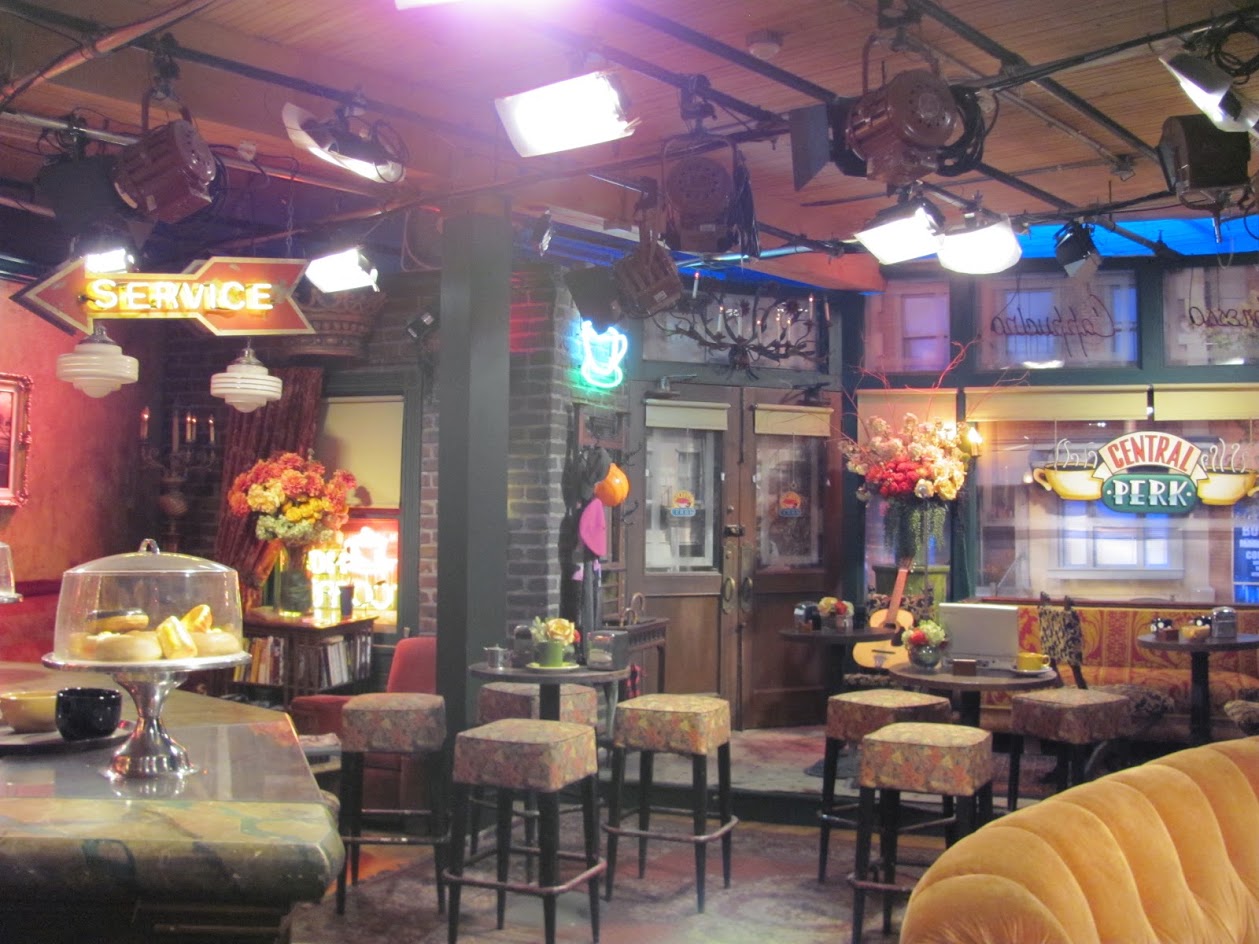
For the record, I saw the Central Perk set with my own eyes on a tour of a Hollywood backlot some years ago.

CentralPerk2

Seeing iconic settings like this is an interesting experience: they are both recognizable and not. Because you can see all that is right around the set but hidden on TV (such as the lights, the fake facades) the scenes seem very sterile. On the other hand, it looks like a very familiar place.

Argument: the star of Downton Abbey is the house

All television shows have settings and locations but few are as important as the large home on Downton Abbey:

The main character in Downton Abbey is not a person at all. It’s a building. Downton Abbey.

There it is in the opening credits of the new film and, despite a whole raft of new changes that I am trying not to give away, there it stands at the end, towering over all of the humans who enter and exit its doors, more custodians than owners, really.
The domestic edifice is this hugely successful franchise’s reason for being, the explanation for the movie, the lodestar for the show’s fans. Individual characters can die — and, God knows, they have. But if “Downtown Abbey” itself were ever to fall, then the story would be over.

This is unusual. Most long-running TV shows are centered on either an individual or a family. “Mad Men” could not survive past the death of Don Draper. “Dexter” needed Dexter. “Breaking Bad” tells the story of Walter White. “Game of Thrones” (73 episodes!) had numerous story arcs, heaven knows, but it still remained the story of communities, not unlike “The Wire” or “The Deuce.” “Star Wars” is a generational saga at its core. And, of course, superhero franchises need their superheroes. (Or their close relations.)

In many television shows, the setting functions more as a backdrop than anything else. The opening credits may show a city and/or home. The show itself may feature a few main sets, typically a place of residence and a workplace. But, swap one city or suburb for another or home for another home and the show could go on.

Would the same be true for Downton Abbey? If the show took place in a different English manor – which are occasionally seen on the show and in the movie – would it be a different show or a weaker show? Is the show popular because of the house or is the house popular because of the show?

It seems like a step too far to suggest that a bad or mediocre television show could be rescued by or solely built on a unique and interesting setting. Good characters encountering interesting situations is a necessary ingredient, even in a show that depends on an unusual and/or popular location. Yet, we could study the degree to which a setting or location or building figures in the plot and popularity of a show. For example, would The Sopranos be the same show without the suburban McMansion the family lives in?