Watching the planes in style at SeaTac

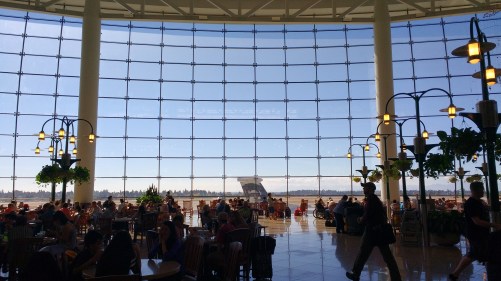
After walking through security at SeaTac, I entered the central food court and shopping area. I was greeted with this view:
IMG_20160823_155444200

From this gallery, you can watch the main runways as planes takeoff and land and you can do so seated in wooden rocking chairs (close to the windows). I assume many airports are designed with providing sufficient gates and access to planes in mind. Think of O’Hare or Atlanta where the concourses are long. Yet, this view took the mall court airport plan – common across many newer airports including ones I’ve seen in Tampa, Orlando, and Las Vegas – to another level: providing a large view of the most interesting work of the airport as planes travel at high speed.

An overview of the airport feature from when it opened in 2005:

The feature attraction, however, is the 60-by-350-foot glass wall that overlooks the runways and, in amenable weather, the Olympic Mountains. It’s more than just a big picture window. The panes are wrenched into a compound curve, convex in the vertical plane and concave in the horizontal. It looks more like a portal to a space warp than a mere window. The web of steel cables, struts and attachment spiders that allow the curtain wall to flex up to 11 inches in a worst-case windstorm or earthquake is all exposed to view, a celebration of virtuoso building technology…

Architect Curtis Fentress, the terminal’s principal designer, is convinced that people want to feel the excitement of travel again, and that it touches a deeper place than momentarily marveling at the apparent miracle of 400-ton cigars storming into the sky. He recalls a boyhood visit to the airport to see his uncle off to the Korean War. “We watched him wave to us from the plane,” Fentress recalls — an impression half a century old, burned indelibly into his mind.

Bonus: this area seemed to particularly fascinate small children. This is no small feat in the harried realm of traveling.

Deadmalls.com

The site has not been updated for a year or so but there is a lot of interesting retail information at Deadmalls.com. You can even purchase your own memorabilia (though I was hoping for something more ghastly)!

Four quick thoughts:

  1. The shopping mall was a marvel of the post-World War II suburban era. Today, there are still thriving malls – even in urban locations as they figured out that they needed to play in this game – but plenty of dead ones (27 listed in Illinois alone). The wonder of having all of those stores in one location that is easy to reach by car.
  2. Have the shopping malls been replaced by anything? Shopping online is not the same visceral experience. Perhaps it is big box stores: occasionally when I wander into a Home Depot or Costco or Walmart, I am astounded by the vast size, the number of products, and the relatively low prices.
  3. There are a lot of efforts to renovate or revitalize shopping malls including turning them into lifestyle centers, adding housing, and incorporating new features like skating rinks. Such efforts will probably succeed in a number of malls..
  4. I’m reminded of the portrayal of a dead mall in the book Gone Girl which portrayed it as a suburban wasteland (along with the McMansions). It would be worthwhile to go back to these dead malls sites in a decade or two to see what has become of them. Urban/suburban ruins? New uses?

Should we take joy in photos of a dying suburban shopping mall?

One photographer has been chronicling the last days of a mall in the Chicago suburbs:

It can be a tough thing to see a historic building being demolished, but what about when a suburban mall meets the wrecking ball? After a 63-year run, The Plaza shopping mall in suburban Evergreen Park has been demolished to make way for a newer, more modern outdoor mall. While there are many like it, The Plaza was notable for being one of the early indoor shopping malls in the Chicago area, and despite its staying power, the mall had become underutilized over the last several years. So called “dead malls” are nothing new, and if anything, they’re becoming more and more common. With the age of internet shopping and the massive reverse migration of residents leaving the suburbs for the city, many suburban malls have fallen into disrepair and have few, if any, major anchor stores left. One photographer, Martin Gonzalez, has been keeping up with the demolition of The Plaza and has been posting photos over the last several months. Here’s a quick look at some of his images of the fallen Plaza mall.

The pictures suggest ruin and decay, images Americans might more commonly associate with places like Detroit rather than the suburbs. But, the question that starts this article gets at this issue: should we take pleasure in seeing the suburban shopping mall – example of American consumerism, tacky architecture, and the social lives of teenagers with nowhere else to go – destroyed? That this mall failed could be used as evidence that critics of the suburbs were right: the whole system was not sustainable. Yet, there is fallout from this: how will the land get used? What happens to those jobs? Where is the local money that used to be spent here now going? Does the demise of the suburban shopping mall lead to more concentrated and authentic spaces (perhaps the New Urbanist dream) or increased fragmentation (big box stores and online shopping)?

See posts from the last year or so – here, here, and here – about the struggles of suburban shopping malls.

Shopping malls adapting with new purposes and targeted groups

Joel Kotkin argues shopping malls aren’t dead – they’re changing their purpose and targeting wealthier and ethnic consumers.

To be sure, there are hundreds of outmoded malls, long-in-the-tooth complexes most commonly found in working-class suburbs and inner-ring city neighborhoods. Some will never come back. By some estimates, something close to 10 to 15 percent of the country’s estimated 1,000 malls will go out of business over the next decade; many of them are located in areas where budgets have been very tight, with locals tending to shop at “power centers” built around low-end discounters such as Target or Walmart.

But the notion that Americans don’t like malls anymore is misleading. The roughly 400 malls that service more-affluent communities—like those typically anchored by a Bloomingdale’s or Nordstrom—recovered most quickly from the recession, and now appear to be doing quite well.

To suggest malls are dead based on failure in failed places would be like suggesting that the manifest shortcomings of Baltimore or Buffalo means urban centers are not doing well. Like cities, not all malls are alike.

Looking across the entire landscape, it’s clear the mall is transforming itself to meet the needs of a changing society but is hardly in its death throes. Last year, vacancy rates in malls flattened for the first time since the recession. The gains from e-commerce—6.5 percent of sales last year, up from 3.5 percent in 2010—has had an effect, but bricks and mortar still constitutes upwards of 90 percent of sales. There’s still little new construction, roughly one-seventh what it was in 2006, but that’s roughly twice that in 2010.

In other words, shopping malls today can’t afford to try to target everyone at once. Rather, the retail market has both exploded with opportunities and fragmented, meaning that malls and other retailers have to target particular groups. This is going to be easier in areas that have money or lack other retailers or have growing populations.

Of course, Kotkin isn’t particularly worried that shopping malls are taking over the Main Street function for suburbs and other communities. There are issues with this: this is privatized space that often requires a car to get to and its primary activity is consumerism. Indeed, if people focused on activities other than shopping (which remains a very popular activity), our version of  capitalism might ground to a halt:

9da4e7c0ca220132db3c005056a9545d

Still, many communities will be happy if shopping malls continue as they are economic boons through sales taxes and jobs.

Wheaton’s walkable shopping center…surrounded by parking lots

Renovations are coming to the Town Square Wheaton shopping center yet the picture of the complex shows it may just be as auto dependent as any shopping center:

It features 160,000 square feet of retail space, much of it filled with chain stores such as Banana Republic, Gap, Joseph A. Bank, Starbucks, Yankee Candle and Talbot’s. The property also includes two professional buildings that house medical offices.

Tucker Development plans to enhance the seven buildings arranged in a walkable loop primarily through signage and facade improvements.

Town Square Wheaton, a shopping center on the south side of the city, recently was sold for nearly $57.3 million. The new owner, Tucker Development, has plans for $1 million in renovations.

This shopping center embodies a lot of the features of newer lifestyle centers or New Urbanism-inspired shopping centers: it features a central plaza with a walkable loop around it, the scale is not huge, there are office spaces on the second floor plus numerous eateries (mixed uses), and it borrows from a local architectural style (Prairie School).

Yet, the overhead view highlights one of the problems that plagues numerous New Urbanist developments: they are often plopped right into car-dependent areas so that even if they are pleasantly walkable, one needs to drive there first. Walking or biking there is not easy; there are apartments adjacent to the center but there is not a permeable boundary between the spaces. You could walk or bike to the center from several nearby single-family home subdivisions (I was just biking near here recently) but that typically requires traveling along and/or crossing busy Naperville Road which funnels a lot of commuter traffic through south Wheaton (the primary path to Naperville and I-88) and isn’t exactly lined with beautiful structures.

Hence, just another shopping center surrounded by parking lots…

Suburban communities add business district taxes but what are developers doing with the money?

A number of Chicago suburbs have instituted business district taxes that partially funnel money to developers:

The business district tax is becoming more common as municipalities struggle to recover from the Great Recession and loss of shoppers to the Internet. Leaders in both Roselle and Villa Park initiated 1 percent business district taxes within the past year, the maximum rate on districts that cannot exceed 1 square mile. In some suburban locations, the additional business district tax can raise the sales tax to 9.25 percent, equal to the sales tax in Chicago…

Bloomingdale has two such districts. One adds a 1 percent sales tax to purchases inside Stratford Square and another adds the same percentage at Indian Lakes Resort, where it’s used to help pay off $4.8 million in village-issued debt that went to the resort for improvements…

Last year, the village paid the owners of the mall $1,199,151, which is more than 95 percent of all the money generated by the business district tax. Since the tax was implemented, the village has paid the mall owner more than $8 million. According to village finance records, the mall owner still is owed more than $11 million…

Lombard has a similar deal with its mall owner. The village instituted a 1 percent business district tax almost a decade ago. It helps push the sales tax rate at Yorktown Center mall to 9.25 percent.

Lombard’s deal allows up to $25 million in business district taxes to be rebated to Yorktown’s owner through 2024, in exchange for an addition that was built onto the mall where an abandoned Montgomery Ward once stood. So far, the mall’s owner has received almost $4.2 million from the business tax…

Taxpayers in Oakbrook Terrace are the ones with skin in the game. The city borrowed nearly $8.2 million to spur development of the Oakbrook Terrace Square Shopping Center. City officials did not return calls seeking comment about the city’s stake in the shopping center. However, according to the city’s budget documents, the investment has yet to pay off.

Given the problems facing the American shopping mall as well as the financial difficulties facing many suburbs, perhaps these suburbs think such taxes are necessary to help keep sales tax generators in the community. Yet, if the extra money generated is given to developers who then line their own pockets, how much is the local taxpayer helped? This raises similar questions to giving corporations tax breaks to locate their headquarters or facilities in suburban communities. Few politicians or residents want to lose a potential tax revenue generator – especially a large shopping mall, even if they are relatively ugly and detract from local businesses given their reliance on chain stores – but there is often little public discussion of the trade-offs involved with the tax breaks.

Are there suburban shopping centers that don’t have such a tax and if not, do they advertise to this effect?

“Are Americans falling out of love with the shopping mall?”

The shopping mall era may be slowly ebbing away:

While high-end malls thrive, many others have been unable to keep up with changing shopping demands of American consumers, leading to obituaries in the US press with headlines such as “A dying breed – the American shopping mall” and “shopping malls in crisis”.

About 80 per cent of the country’s 1,200 malls are considered healthy, which means store vacancy rates of 10 per cent or less, according to CoStar Group data published in The New York Times.

That is down from 94 per cent in 2006, and there is even a website dedicated to documenting what some are calling the death of the shopping centre, deadmalls.com, keeping tabs on the latest closures across the country. Ms Dorsey remembers the old-style mall with nostalgia. “The first time my mum allowed me to go out by myself, it was in a mall,” says Ms Dorsey, a saleswoman at a natural products shop in Fairfax, outside the US capital. “I do have fond memories.”

Most of America’s malls were built in the 1950s and 1960s, as a growing network of highways connected suburban homes to futuristic urban shopping centres…

“It’s not that consumption is going down – consumption is going up, but we’re consuming differently in different places,” says the sociologist George Ritzer, the author of a book on consumption, Enchanting a Disenchanted World. “They are becoming more entertainment complexes.”

There are some competing trends contributing to this:

1. The rise of the suburbs helped lead to this as centralized locations for shopping became more important than communities where needs could be met within walking or mass transit distances (like in cities). But, that decentralization can now be moved increasingly online.

2. Suburbs didn’t have as many public places – and if they did, they were more difficult to access since they often required driving. Malls filled this void, particularly for teenagers who became a prominent social group right around this time (and their collective life was encouraged in the suburbs which was largely centered around child-rearing).

3. Americans still like consuming. See the fate of higher-end shopping experiences. However, shoppers now have more options including big box stores and online retailers. Additionally, the shift in malls toward experiences rather than consumer goods is still consumption. In fact, prioritizing experiences might even increase consumption because people can have a variety of experiences.

While malls won’t disappear anytime soon, perhaps they will be seen at some point as the result of a particular historical and social convergence.

Shopping malls have to renovate and adapt in order to survive

Even successful shopping malls like Woodfield Mall in Schaumburg have to innovate in order to stay relevant:

With shopping habits having been permanently reshaped by memories of the recession and the availability of new technology, traditional malls like Schaumburg’s must find new reasons for people to make the trip, said Phyllis Ezop, president of Ezop and Associates, a business strategy and marketing information firm in La Grange Park…

The factors that seem to separate the two categories are location, demographics, the strength of tenants and the availability of other amenities, such as restaurants and movie theaters, that can make the mall more of a destination, Stern said…

With the rising popularity of the largely outdoor lifestyle center, Woodfield’s 44-year-old indoor structure is especially challenged, Stern said.

One Woodfield’s negatives that a cosmetic renovation is unlikely to fix is its split-level nature. This makes the mall harder to navigate for the shopper and causes some spaces to be better than others for the tenant, he said…

“They need to have destinations there,” Aron said. “I really see it going in that direction. You can order things online, but you can’t have a great dinner online.

I’ve seen this idea in numerous discussions of planning, whether thinking about reviving a downtown or a shopping mall or a tourist locale: potential visitors need a destination, something unique to get them there. In this sense, Woodfield already is ahead of the game: it is one of the largest malls in the United States, has over 2 million square feet of retail space, and companies located there treat it as an important location (flagship stores, special concepts, etc.). But, it is not guaranteed that people will continue to visit shopping malls. These days, the hook seems to be entertainment. Sure, the mall has shopping but eating, movies, special events, and unique spaces offer entertaining experiences.

Reminder: shopping malls are clearly not public spaces

An effort to hold a protest at the Mall of America this Saturday was met with a predictable response: the mall is not a public space and the protest is not welcome.

The organizers, who are calling for a protest as part of the national “Black Lives Matter” movement responding to recent police shootings of unarmed black men, vow they will carry on as planned in the mall’s rotunda.

The protest had drawn 2,000 confirmations on its Facebook page as of Wednesday afternoon. Saturday also is one of the busiest shopping days of the holiday season.

Mall representatives have said that a demonstration at the mall would violate policy, and protesters could be removed, arrested and banned…

“Mall of America is a commercial retail and entertainment center. We respect the right to free speech, but Mall of America is private property and not a forum for protests, demonstrations or public debates,” mall management said in a statement.

As an alternative, the mall and the city of Bloomington urged protesters to use the former Alpha Business Center lot, which is public property adjacent to the mall, according to a letter from the mall posted on the Black Lives Matter Minneapolis Facebook page.

The number one function of a shopping mall is to make money and protests can distract from that. Yet, shopping malls are one of the rare spaces in American suburban sprawl that you can find large numbers of people. One of the downsides of sprawl is that there are few public gathering places in centralized locations surrounded by population density. Sure, there are parks, public parking lots, and other public facilities but they tend to be spread out, often require driving, and don’t necessarily attract the attention of many other people.

Given the spread of protests along highways, I wonder if protestors could move instead to the public roads leading into the mall. There are likely restrictions on using these spaces as well but at least the protestors would be on public property.

The reasons behind a collection of dead shopping malls in the Chicago suburbs

Another shopping mall in the Chicago suburbs closes, joining several other “dead” malls:

Last week, it was announced that Lincoln Mall in suburban Matteson would close after the holiday season, due to its operator’s inability to keep the mall properly maintained and staffed. However, the 700,000 square foot shopping center is not alone, as it joins a growing list of dead malls in the greater Chicagoland area. Chicago photographer Katherine Hodges has been documenting so-called dead malls and other abandoned sites for several years, and has visited numerous shopping centers throughout the Midwest that have either completely shuttered, or are on the verge of closing for good.

Hodges shoots many other sites beyond malls that are on death row, however the images of humungous vacant shopping centers speak for themselves. One mall that Hodges has highlighted — The Plaza in Evergreen Park — was the first modern shopping mall in the Chicago area, having originally opened in 1952. It closed last summer. The Charlestowne Mall in St. Charles, another mall featured in Hodges’ series, is currently the focus of a major redevelopment effort that could potentially revive the shopping center.

With big empty spaces comes big problems. Some shopping centers have been successful in turning things around, and others — not so much (Lincoln Mall for example). However, with these vacant spaces come new opportunities, and in the case of Lincoln Mall, there have already been some ideas floated for a possible redevelopment of the property. It’s still a bit early to speculate exactly what will happen to the site, but at least for now, it’s certain that the mall will join the area’s growing shopping center dead pool.

There are a variety of forces at work with these shopping malls – and I’ll throw out some speculative ideas as well:

1. The economic crisis of recent years did not help: consumer spending slowed and stores simply couldn’t have locations all over the place.

2. Population shifts can contribute. Malls are often built in thriving suburban areas but there are no guarantees that the communities around the malls will continue to thrive.

3. Big box stores can locate right next to malls but probably compete for customers. Outside of department stores, malls feature a variety of smaller, niche stores. But, a Walmart or a Target can sell a bunch of goods in one location.

4. How much has the Internet hurt malls? This would include actual sales but might also include less need for a physical social gathering spot (which can now happen online).

5. Malls themselves have changed design over the years. The old model was to construct a large facility of stores with lots of surrounding parking lots. More malls today have added other uses, particularly sit-down restaurants, in order to attract people to the mall and keep them there longer. Malls are not just for shopping; they are now often lifestyle centers.

It may be difficult to imagine but suburban shopping malls don’t have to exist in the future.