In the last few years, license plate cameras have popped up across suburbs near where I live. It took me a while to recognize what they were, but now that I know what they look like, I see they are in many locations. Why has there been little resistance to the presence of these cameras? I find it hard to imagine suburbanites would have liked this happening several decades ago. Why so little discussion or opposition today?
Two conjectures (with no evidence for either outside of my own knowledge of suburbs):
Fear of crime. They see and hear many stories about crime and the role of cars in those crimes. If license plate cameras can track people who commit crimes and do so quickly, that may be a small price to pay to keep their suburban community safe. (See also use of doorbell cameras in efforts to combat suburban crime.)
The surveillance state is already here, whether there are license plate cameras or not. People can be tracked by their phones, their credit card activity, their social media use, through cameras mounted inside and outside buildings. Why fight a system that is already in place and to which we already assented (by using smartphones, social media, etc.)? (See the term “surveillance capitalism” first used in 2014.)
There could be other factors at play. Companies and organizations have pushed these cameras as opportunities and solutions? People haven’t noticed them or don’t know what they are? This is just part of technological and social change?
I will be looking to see if there is more public discussion of their presence and how much information is available about how often they are used.
Today’s generation is desperately trying to make some sense out of their lives and out of the world. Most of them are products of the middle class. They have rejected their materialistic backgrounds, the goal of a well-paid job, suburban home, automobile, country club membership, first-class travel, status, security, and everything that meant success to their parents. They have had it. They watched it lead their parents to tranquilizers, alcohol, long-term endurance marriages, or divorces, high blood pressure, ulcers, frustration, and the disillusionment of “the good life.” (xiv)
By this point, the American suburbs of the postwar era had existed for roughly two decades. The growing communities outside major cities had typically catered to middle-class white residents who sought a particular vision of the good life with a home, some space, and opportunities for their children to succeed (plus multiple reasons for leaving cities).
But Alinsky is hinting at how some who lived in these suburbs or grew up in him did not find them to be the good life. Their experiences suggested the suburbs were found wanting. The answers the suburbs supposedly had did not materialize or they were not the right answers. The suburban life could not address particular and/or difficult social issues.
On the other hand, many Americans continued to move to the suburbs even as some suburbanites were disillusioned. The percentage of Americans living in suburbs continued for multiple decades after Alinsky wrote the book. How many young adults rejected this suburban way of life and turned to something else? The percentage might have been small compared to the mass of suburbanites, even as Alinsky’s work proved influential.
According to her calculations, in 2020, American husbands and wives shared the same broad level of education in 44.5 percent of heterosexual marriages, down from more than 47 percent in the early 2000s. Of the educationally mixed marriages, the majority—62 percent—were hypogamous, up from 39 percent in 1980. Crunching the numbers slightly differently, Benjamin Goldman, an economics professor at Cornell University, found that among Americans born in 1930, 2.3 percent ended up in a marriage where the woman had a four-year degree and the man did not. Among the cohort of those born in 1980, that figure was 9.6 percent. (This trend is hardly unique to the United States; hypogamy is becoming more common all over the globe.)
It’s a fragile time for gender relations in the United States. Young women and men appear to be diverging politically. Fewer people are dating, marrying, or having kids. Some commentators argue that there aren’t enough suitable bachelors to meet the standards of accomplished modern women. Meanwhile, a growing “manosphere” claims that women’s advancement is to blame for all manner of struggles experienced by lonely, unmoored men. Yet for all the worry that a chasm is opening between men and women, the rise in the number of hypogamous couples suggests that some men and women are doing what men and women have always done: coupling up regardless of differences and figuring out a way to get along. “It’s clear,” Goldman told me, “that understanding the dynamics of these couples is key to understanding the future of marriage.”
This reminds me of two sociology books I’ve used in classes that use the concept of cultural toolkits to help explain how people in the United States address love and relationships. One describes how Americans draw upon ideas of romantic love and covenantal love at different points of marriage. The second considers how evangelicals seek pragmatic solutions to everyday family life amid their commitments to Christian perspectives and a changing society around them.
The description of the article above sounds similar: social, political, and economic conditions are changing. Ideas about relationships are changing. More women are getting college degrees. Yet a good number of Americans still desire to be part of relationships and marriages. “Making it work” might require applying different tools in their toolkits about relationships and life or developing new toolkits.
In other words, marriage continues in the United States with some changes and how Americans approach it and the toolkits they have regarding it changes.
Two recent examples reminded me of a difficulty in assessing change: how much can we see in a short time period versus looking back and seeing significant change over time?
First, getting better at teaching. I have read books, heard talks, and participated in groups to help facilitate this. The emphasis is often on small and incremental change. This is all good but it can be hard to see change in action in a subsequent class session. It takes time to develop new skills and habits. Efforts to implement something may go well in one class and not another. Assessing the results requires additional work and reflection.
But, I can more easily see teaching change over the course of several years. I could have a better sense of how to approach a topic or what I need to emphasize to help students grasp a concept or have a better activity to apply the learning for the day. Pointing back to one particular moment when the pedagogy changed is hard but thinking about how I used to approach it years ago compared to now more easily reveals shifts.
Second, large scale social change. Years ago, I found the 2006 book Century of Differenceby Fischer and Hout. Each chapter looks at a different part of American life and details the changes between 1900 and 2000. The differences are often startling, whether considering education or family life or urbanization. At the scale of a century, contrasts are clear.
However, evaluating change at a daily or weekly level is hard. How do we know if a new policy or event marks something noteworthy? The amount of information we have is tremendous and news and social media today can amplify their magnitude. In the moment, we can compare to the past. We ask others and experts. And it can still be difficult to know.
I am sure there are other examples where it can be hard to tell if much is changing. At other points it is clear. Something so shocking and noteworthy happens – thinking of 9/11, as one example – that it is known to everyone as significant. For now, we can continue to ask whether our current moment contains big changes or the continuation of existing patterns.
If observers in the United States in the late nineteenth century had to predict the geography of American evangelicals in the year 2000, what would they have said? Would they have foreseen an evangelical presence in the biggest cities? Important evangelical congregations, organizations, and institutions resided in New York City, Philadelphia, and Chicago. From these population centers (and ones that emerged in the twentieth century like Los Angeles or Dallas), evangelicals could reach the masses. Or would they have selected small towns and more rural areas? Perhaps they would have thought of evangelicals living in particular regions, in the kinds of places that would be called “the heartland” or “flyover country” or “the Bible Belt.” These places with a slower pace of life and traditional values may have aligned with everyday evangelical life.
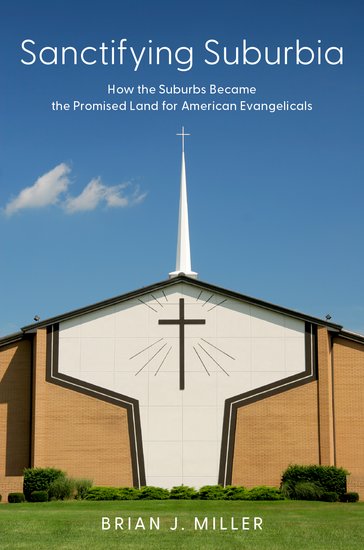
I argue in Sanctifying Suburbia (out in paperback today!) that by the turn of the twenty-first century American evangelicals were firmly suburban. Evangelicals did not simply follow many other Americans to the suburbs (the country was majority suburban in the 2000 Census); evangelicals actively chose to locate in the suburbs.
Why? Multiple factors led to this and different chapters in the book discuss the components that contributed to the evangelical embrace of the growing American suburbs. The story includes:
Racial and ethnic change in cities and evangelicals moving to whiter suburbs.
The National Association of Evangelicals operating from suburban settings for much of its existence after its founding in the 1940s
Locating in some evangelical clusters – like Wheaton and Carol Stream, Illinois and Colorado Springs, Colorado – that offered particular amenities and synergy between evangelical congregations and organizations.
Seeing cities as incompatible with evangelical lifestyles and goals.
An individualized view of engaging with places and society while also holding up heaven as the ultimate city/place.
And this is not just a story of the twentieth century; some of the seeds were sown prior to mass suburbanization and developed over decades.
Where does this leave American evangelicals in the third decade of the twenty-first century? As a whole, they may feel most comfortable in suburban settings where day-to-day life focuses on families in single-family homes, middle-class and populist activities and values rule the day, and attracting attendees and gathering resources from growing suburban populations occupies their organizational efforts.
Over the past decade and a half, however, the dynamic has dramatically shifted. In 2008, the top fifth of earners favored Democrats by just a few percentage points; by 2020, they were the group most likely to vote for Democrats and did so by a nearly 15-point margin. (Democrats won the poorest fifth of voters by a similarly large margin.) Democrats now represent 24 of the 25 highest-income congressional districts and 43 of the top 50 counties by economic output. A similarly stark shift has occurred if you look at college education rather than income. Perhaps most dramatic of all has been the change among wealthy white people. Among white voters, in every presidential election from 1948 until 2012, the richest 5 percent were the group most likely to vote Republican, according to analysis by the political scientist Thomas Wood. In 2016 and 2020, this dynamic reversed itself: The top 5 percent became the group most likely to vote Democratic…
That realignment leaves both parties in a strange place heading into November. Voters consistently say that the economy is the most important issue of the 2024 election. And yet the affluent overwhelmingly support Kamala Harris, whose administration favored bold redistribution and big government spending, while a critical mass of working-class voters favor Donald Trump, whose economic agenda consisted largely of cutting taxes for the rich and trying to kill the Affordable Care Act.
This is not the only political shift in recent years but an interesting one nonetheless. Are these political shifts enduring? Such a shift disrupts short-term activity but there could also be long-term consequences. With the resources and connections elites have, does a shift like this lead to other consequential changes?
While the article focuses on whether these voters are voting in their material best interests, another part is intriguing: how then does this fit with the American obsession on the middle-class and the political rhetoric and activity that goes along with this? Does the composition of who comprises the electorate for a political party than affect how much the party talks about the middle-class or pursues policy aimed to help that group?
And since I think about the suburbs a lot, how does this affect how the two parties view suburbs in the United States? Traditionally viewed as middle-class places with powerful local control, does this shift with new political bases at play?
When I was writing The Anxious Generation, I thought of it as a tragedy in two acts: In Act I, we took away the play-based childhood (1990-2010), and in Act II, we gave kids the phone-based childhood (2010-2015). Teen mental health plunged in the middle of Act II.
This is an argument about historical change and processes emerging from existing conditions. Put in other words, the United States had close-knit local communities and many local organizations which then declined which led parents and communities to pull back on children playing which created a vacuum into which smartphones and social media stepped into.
In Bowling Alone, Putnam describes multiple factors at work in the decline of community and local organizations. This includes the expansion of suburbs and the spread of television. And in The Upswing, Putnam argues civic participation and community life of the mid-twentieth century arose from lower levels earlier in the twentieth century.
All this suggests social capital and community life can rise and fall over longer periods with numerous social forces at work. What is going on now may not be what is happening in 20 years or 50 years and these future permutations may not look like the past. With smartphones, the emergence of artificial intelligence, and all the other social conditions of today, what kind of community life might emerge?
Researchers interviewed by The Times said rising costs, rampant crime and changing racial demographics have made it harder to sustain worship spaces in large cities…
As more urban neighborhoods become secularized, demographers say religious families increasingly prefer to settle in suburban enclaves up to 20 miles outside of city centers…
“Over the last 10 years, the 100 fastest-growing churches in America are primarily in the growing inner and outer ring suburbs of major cities,” said Ryan Burge, an Eastern Illinois University political scientist and religious demographer. “They’re almost always non-denominational Christian churches near cities like Charlotte, Charleston and Atlanta. They are the fastest because that’s where people are moving.”…
In New Orleans and several Midwest and Northeast cities, gentrification has pushed more Black Christians into the suburbs than other groups…
Rather than start in the city and expand to the suburbs, most new churches now move in the opposite direction. For example, Elevation Church in Matthews, North Carolina, started 12 miles southeast of downtown Charlotte. It later planted a satellite church in the city center.
On the other hand, these could include new and different patterns:
-Which churches are closing and which religious groups are moving to the suburbs. If it was largely white congregations in the postwar era, it now includes more groups.
-The number of congregations closing. Are there now more closing than decades before?
-The relative power and influence of suburban megachurches compared to the past. If congregational influence decades ago tended to reside in older, urban congregations, this may have shifted today.
-Are cities more secular than they were in the past? Significant percentages of urban residents are religious and cities contain numerous religious congregations and organizations. Or, has the perception of cities and religion changed?
I suspect there is more to say on the connection between religion and suburbs.
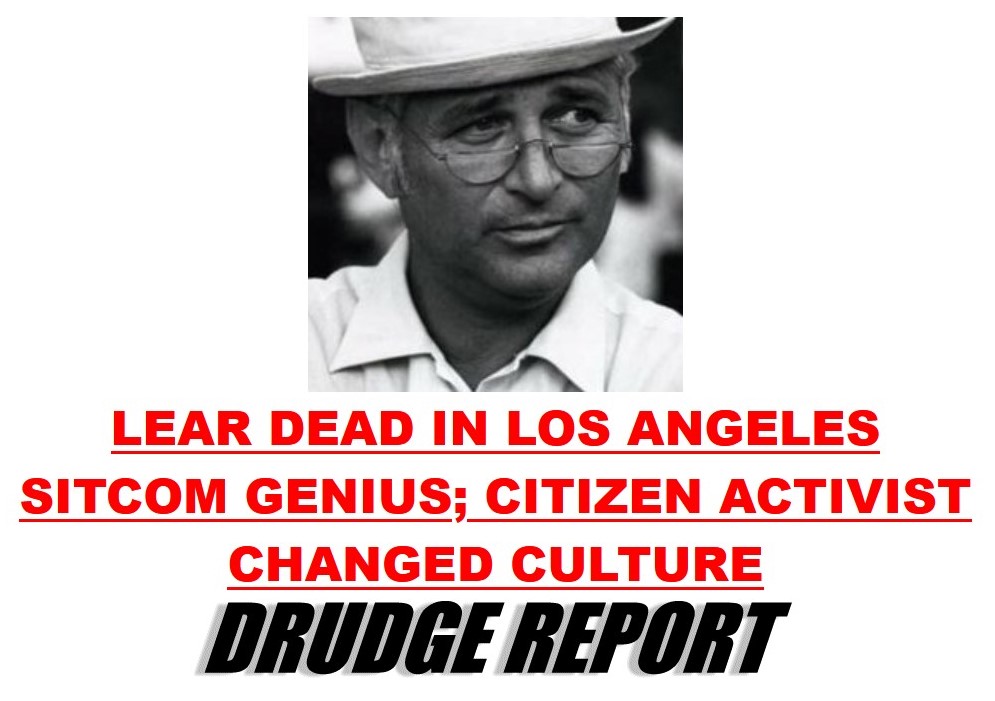
Lear had already established himself as a top comedy writer and captured a 1968 Oscar nomination for his screenplay for “Divorce American Style” when he concocted the idea for a new sitcom, based on a popular British show, about a conservative, outspokenly bigoted working-class man and his fractious Queens family. “All in the Family” became an immediate hit, seemingly with viewers of all political persuasions.
Lear’s shows were the first to address the serious political, cultural and social flashpoints of the day – racism, abortion, homosexuality, the Vietnam war — by working pointed new wrinkles into the standard domestic comedy formula. No subject was taboo: Two 1977 episodes of “All in the Family” revolved around the attempted rape of lead character Archie Bunker’s wife Edith.
Their fresh outrageousness turned them into huge ratings successes: For a time, “Family” and “Sanford,” based around a Los Angeles Black family, ranked No. 1 and No. 2 in the country. “All in the Family” itself accounted for no less than six spin-offs. “Family” was also honored with four Emmys in 1971-73 and a 1977 Peabody Award for Lear, “for giving us comedy with a social conscience.” (He received a second Peabody in 2016 for his career achievements.)
Some of Lear’s other creations played with TV conventions. “One Day at a Time” (1975-84) featured a single mother of two young girls as its protagonist, a new concept for a sitcom. Similarly, “Diff’rent Strokes” (1978-86) followed the growing pains of two Black kids adopted by a wealthy white businessman.
Other series developed by Lear were meta before the term ever existed. “Mary Hartman, Mary Hartman” (1976-77) spoofed the contorted drama of daytime soaps; while the show couldn’t land a network slot, it became a beloved off-the-wall entry in syndication. “Hartman” had its own oddball spinoff, “Fernwood 2 Night,” a parody talk show set in a small Ohio town; the show was later retooled as “America 2-Night,” with its setting relocated to Los Angeles…
One of Hollywood’s most outspoken liberals and progressive philanthropists, Lear founded the advocacy group People for the American Way in 1981 to counteract the activities of the conservative Moral Majority.
The emphasis here is on both television and politics. Lear created different kinds of shows that proved popular as they promoted particular ideas. He also was politically active for progressive causes.
How might we know that these TV shows created cultural change? Just a few ways this could be established:
-How influential were these shows to later shows and cultural products? How did television shows look before and after Lear’s work?
-Ratings: how many people watched?
-Critical acclaim: what did critics think? What did his peers within the industry think? How do these shows stand up over time?
But, the question I might want to ask is whether we know how the people who watched these shows – millions of Americans – were or were not changed by these minutes and hours spent in front of the television. Americans take in a lot of television and media over their lifetime. This certainly has an influence in the aggregate. Do we have data and/or evidence that can link these shows to changed attitudes and actions? My sense is that is easier to see broad changes over time but harder to show more directly that specific media products led to particular outcomes at the individual (and sometimes also at the social) level.
These are research methodology questions that could involve lots of cultural products. The headline above might be supportable but it could require putting together multiple pieces of evidence and not having all the data we could have.
But the grocery landscape in 2022 is vastly different. Dominick’s has been gone for nearly a decade, while Jewel and 21st-century rival Mariano’s face increased competition from major retailers such as Walmart, Costco and Amazon Fresh as well as specialty grocers, including Trader Joe’s and the Amazon-owned Whole Foods.
Jewel is still the most-commonly cited grocery-shopping destination for Chicago-area families, according to Nielsen data, but Aldi is nipping at its heels, having transformed itself from the stock-up store of the 1990s. Throw in a handful of online delivery startups that popped up during the pandemic and shoppers have more options than ever, squeezing Jewel from all sides.
The Whole Foods that opened in Englewood six years ago to live music, TV-ready politicians and out-the-door lines will close Sunday with little fanfare…
The city spent $10.7 million to subsidize the construction of the shopping center in which the store is located. When Whole Foods announced the 832 W. 63rd St. location’s closure in April, local activists said they felt betrayed, adding that the shuttering would limit access to fresh and healthy food in the neighborhood.
The company closed five other stores across the country “to position Whole Foods Market for long-term success” at the time, including a location near DePaul. It also opened an almost 66,000-square foot location in the Near North neighborhood the same week.
Few grocery options remain in the neighborhood. The handful of grocery stores remaining include a location for low-budget grocer Aldi close by and the smaller “Go Green Community Fresh Market” run by the nonprofit Inner-City Muslim Action Network. Another nearby Aldi in Auburn Gresham abruptly closed in June.
This highlights how much change can come to an essential market in a relatively short amount of time. New actors, new methods, new contexts.
The issue of food deserts was commonly discussed not too long ago but is not mentioned in this second article. However, these two articles highlight ongoing patterns even as the stores and brands change: some places have plenty of grocery stores (with Jewel and Mariano’s locations nearby) while others are not attractive to companies and residents have to search harder and further for food options.
Does this rapid pace of change suggest grocery stores will be quite different still in a few years? Can we imagine delivery only or virtual reality grocery shopping?








 Legally Sociable