The possibility that downsizing housing may now cost more

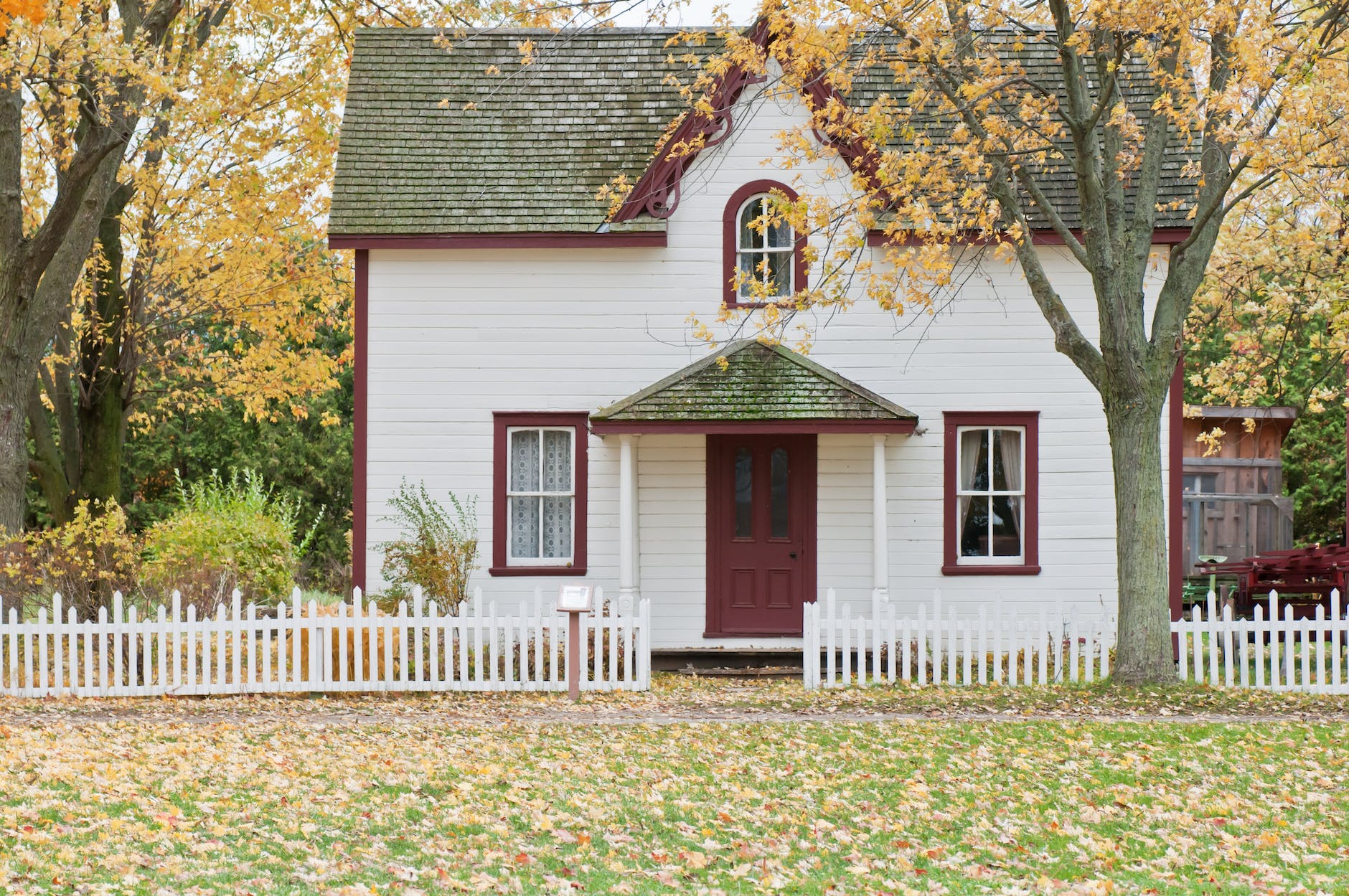
Moving to smaller housing units may not be cheaper at this point in time:

Photo by Lewis Burrows on Pexels.com

The average 30-year fixed-rate mortgage has soared to 7.49 percent, according to latest data from lender Freddie Mac, while many homeowners are locked into much cheaper 2 or 3 percent deals on their current homes. 

Meanwhile the number of smaller houses for sale has diminished in recent years, according to listing website Realtor.com – pushing up the price of the limited inventory on the market.

The number of properties for sale that measure 750 to 1,750 square feet – the size range people who are downsizing tend to purchase – has dropped by more than 50 percent since 2016, according to Realtor.com…

Hannah Jones, Senior Economic Research Analyst at Realtor.com, said: ‘Home prices for smaller homes fell 0.4 percent year-over-year in September, but remained more than 50 percent higher than pre-pandemic.

On one hand, this is about a particular moment where demand is high for small houses, few are available, and selling and buying means acquiring a higher interest rate.

But, there are also larger forces at work contributing to this moment. The United States has the largest houses in the world. This contributes to the lack of smaller homes for sale; fewer small units have been constructed in recent decades. There are also a lot of older Americans who have larger homes and may not want to keep them as they age. Are there enough units to accommodate their changing housing needs and/or enough buyers who want the homes they previously owned?

In many ways, the housing stock in the United States does not change quickly. Builders, developers, municipalities, buyers, and others interested actors need time to assess conditions and change course. Coordinated planning across different interested actors could help as housing conditions and needs change in the coming years.

The Chicago suburbs have 99 million square feet of office space

The suburbs are not just places where people live. The Chicago suburbs have a lot of office space:

Photo by 500photos.com on Pexels.com

While higher-end properties are outperforming less expensive options among the suburbs’ 99 million square feet of office space, they still saw a decline in the year’s second quarter, ending a yearlong run of gains, according to data collected by the Chicago-based firm.

The Pentagon has 6,500,000 square feet of space so the suburban office space is over 15 times that of the Pentagon. The Willis Tower in Chicago has roughly 4,000,000 square feet of space so the suburbs have roughly 25 times more space. A football field is 57,600 square feet is the office space covers over 1,718 football fields. If the average new American home is about 2,500 square feet, this office space is nearly 40,000 new average homes.

Note: another website suggests the Chicago suburbs have 162 million square feet of office space, putting the Chicago suburbs behind the Washington D.C. suburbs, the Dallas-Forth Worth suburbs, the Bay Area suburbs, and the New Jersey suburbs.

Whichever number is correct, it is hard to put this much space in perspective. The suburbs may be primarily about single-family homes but they have plenty of space for business.

Can McMansions be made suitable for aging residents?

As I have studied McMansions, I found numerous suggestions that aging residents may not want such homes given their current needs. This recent explanation sums up some of the possible issues older residents face:

Photo by RODNAE Productions on Pexels.com

The McMansion purchased years ago with its acres of ground might now seem too much to handle. With younger family members gone, there may not seem to be so much motivation for larger space. Homes with high balconies and difficult to maneuver staircases present safety challenges. Communities that maintain the grounds can be attractive.

Do the issues older residents face necessarily preclude having a McMansion? In the paragraph above, here are the issues mentioned and the ways McMansions might actually help address these issues:

  1. Too much property. Could the McMansion be expanded to take up even more of the property? Or, convert that two-story McMansion into a more sprawling McMansion ranch. While McMansions are sometimes criticized for their size compared to their neighbors, having loss property to maintain could be a plus.
  2. Fewer family members in the house so less space is needed. But, Americans love buying more stuff and instead of paying for self-storage a McMansion owner can make use of the extra interior space. They can age in place with all of their stuff.
  3. High balconies and interesting staircases could pose problems. Yet, with the space inside a McMansion, could not all of these areas be addressed by renovations? Instead of a twisting staircase, make use of some of that grand foyer to build a straight staircase with a lift.
  4. How about more McMansion neighborhoods with HOAs? Millions of Americans already live with HOAs so why not put them to work here making sure grounds and housing exteriors are kept up as residents age?

Sure, smaller spaces might be attractive for seniors but it can be hard to give up space once one has lived with it. There may be plenty of opportunities for older Americans to remain in McMansions if they want to and there are models for how this can be done.

Do not dream of McMansions; picture really large houses and properties

Architectural Digest features images of 12 “extra-large properties.” Here is the introduction:

Photo by Ingo Joseph on Pexels.com

There are few fantasies more persuasive or alluring than that of the expansive estate. When you think of big houses, your mind may immediately jump to the McMansions of yore, those garish homes you’d expect to see on an episode of MTV Cribs. The ones we can’t stop daydreaming about more closely resemble graceful, though still boldly luxurious, homes like the central property of Downton Abbey or the setting of Bodies, Bodies, Bodies before the horror film took a dark turn. Below we highlight 12 properties featured in AD that contain enviable amenities, from indoor tennis courts and home spas to guest houses and verdant gardens. 

Three features of this that struck me:

  1. Dreaming of McMansions exhibits poor taste. Dream bigger, more refined. Do not settle for the garish cookie-cutter version of a big house.
  2. The scale of these homes goes beyond the McMansion in numerous key ways. They are often far beyond the 3,000-5,000 square feet of a suburban McMansion. Some have much more square footage, others have numerous buildings. The properties are often much larger than the typical city or suburban lot. And the amenities are more plentiful and higher-end. Think special pools, gardens, and gathering spaces.
  3. The McMansion is much more attainable for people than the extra-large property. Does the McMansion offer enough of a taste of the high-end property?

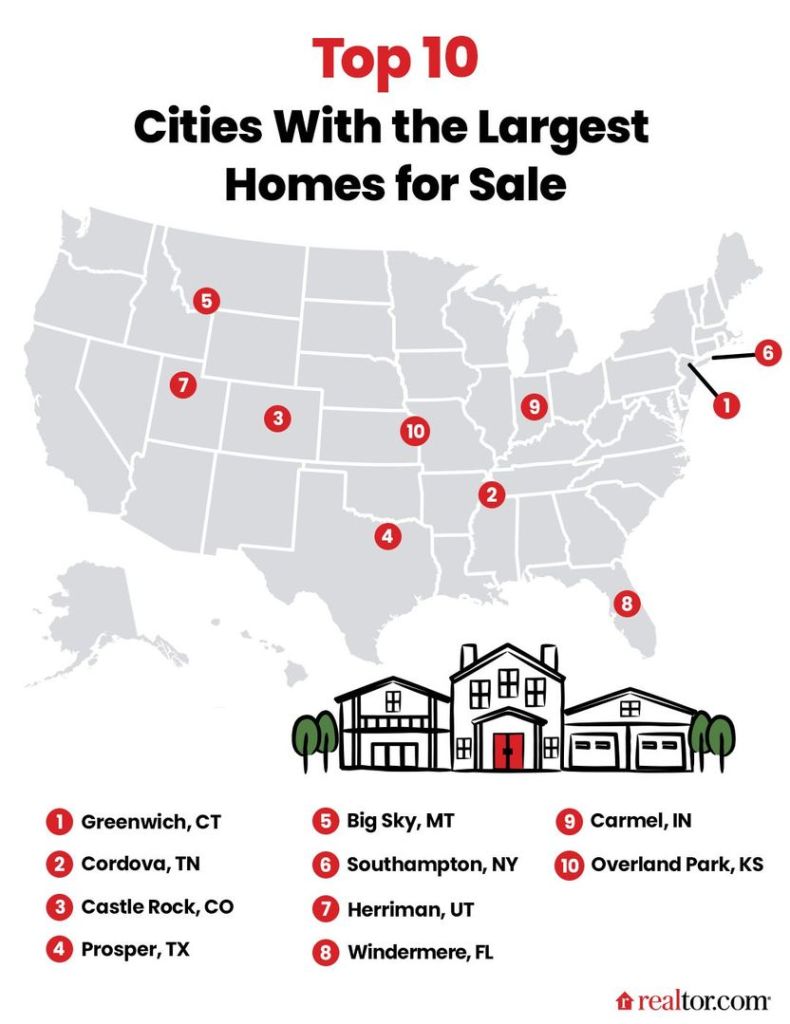
“Top 10 Cities with the Largest Homes for Sale”

Analysis of available properties at Realtor.com leads to this:

Why these places and not others?

“The places that boast the country’s largest average homes tend to be clustered in higher-priced communities either near bigger economic centers or in outdoors destinations,” says George Ratiu, senior economist and manager of economic research for Realtor.com. “On the flip side of the coin, cities [with] average home sizes [that] skew toward the smaller end are located in geographically constrained locations, where natural boundaries meet high-density development.”

But that’s not all that goes into the equation. Many older communities, such as in the Northeast, that were developed for blue-collar workers tend to be filled with smaller homes. Meanwhile, newer developments geared toward white-collar commuters often offer abodes with more square footage and amenities like open kitchens, which were not popular in the 1950s. You’re more likely to find McMansions in these areas.

In other words, larger homes are in wealthier and more sprawling communities.

I imagine zoning might also play a part in this; what kind of single-family homes are possible and/or encouraged? This is tied to historical patterns and policy decisions.

How do land and housing prices factor into this? Most of the communities listed above are not in the most expensive housing markets.

Multiple factors behind the decline in starter homes in the United States

The starter home has disappeared from many housing markets:

Photo by Scott Webb on Pexels.com

The affordable end of the market has been squeezed from every side. Land costs have risen steeply in booming parts of the country. Construction materials and government fees have become more expensive. And communities nationwide are far more prescriptive today than decades ago about what housing should look like and how big it must be. Some ban vinyl siding. Others require two-car garages. Nearly all make it difficult to build the kind of home that could sell for $200,000 today…

Nationwide, the small detached house has all but vanished from new construction. Only about 8 percent of new single-family homes today are 1,400 square feet or less. In the 1940s, according to CoreLogic, nearly 70 percent of new houses were that small…

But the economics of the housing market — and the local rules that shape it — have dictated today that many small homes are replaced by McMansions, or that their moderate-income residents are replaced by wealthier ones. (A little 1948 Levittown house on Long Island, the prototypical postwar suburban starter home, now goes with a few updates for $550,000.)…

The simplest way to put entry-level housing on increasingly expensive land is to build a lot of it — to put two, three, four or more units on lots that for decades have been reserved for one home.

The costs – financial, regulatory – are too high for the construction of lots of starter homes. The proposed solution is to try to reduce those costs by placing multiple residents on one lot and/or increasing density in communities and developments.

How to change all of this is difficult given the difficulties of addressing housing in the United States. The need is great, particularly when affordable housing is not aimed at a larger percentage of the population who would benefit from a cheaper residence.

I wonder if the best path forward is for certain communities to pursue starter homes successfully and show that it is possible. Of course, one danger is that even if it works well in some communities, other communities might leave the burden of such housing to a small number of communities. However, if starter homes can be constructed in such a way that they are perceived as an asset to the community and not a threat to property values, they might catch on. Are there several communities that would fit the bill?

Set up the millennials in a McMansion for a horror film

The recently released film Bodies Bodies Bodies takes place in a McMansion:

Photo by Elu012bna Aru0101ja on Pexels.com

What happens to a group of vapid, bored, rich gen Z-ers/millennials holed up in a McMansion during hurricane season when the wi-fi goes out?

If the film Bodies Bodies Bodies is anything to go by, they’ll probably end up killing each other — unless someone else does it first.

While some might say the McMansion itself is a horror, McMansions are no stranger to horror stories. How exactly might a horror film involve a McMansion? A few ideas:

-This particular film follows 7 friends. This means plenty of space for people to sleep, live, and interact. A McMansion provides plenty of space.

-The tackiness or gaudiness or lack of authenticity of a McMansion can provide a creepy or unsettling backdrop.

-The McMansion falls apart at a key moment or the limited architectural quality lets the characters down.

-The extra interior square footage a McMansion offers provides more space for nefarious actors to operate.

-The McMansion could be set in a neighborhood of McMansions, perhaps unfinished, that are all creepy and ominous.

A horror film set in suburbia can play off a common idea that suburban life is not as happy or successful as it seems. How much more so could this be true in a McMansion, a home that tries to broadcast its success in obvious ways.

Combine a horror film with the negative traits of a McMansion and there are plenty of options!

It cannot be a McMansion if it is valued at over $30 million and has mansion features

Actor Chris Hemsworth has turned a big home into an even bigger and more luxurious home in recent years. Is it a McMansion?

Photo by Lex Photography on Pexels.com

After buying his Byron Bay family home for $7million back in 2014, Chris, 37, transformed the sprawling property into a compound that has been valued at between $30million and $60million.

The actor carried out extensive renovations on the six-bedroom home, and it now boasts a steam room, gym, media room and games room.

There’s also a stunning outdoor living area, play areas for his three young kids and a 50-metre rooftop infinity pool, which overlooks the ocean…

Angry neighbours were quick to say the rebuild reminded them of a suburban shopping centre, a refurbished RSL club or a regional airport terminal.

Others compared the home, which sits on 4.2 hectares, to a multi-storey car park and a ‘McMansion’.

While there is no mention of the square footage of the home, this description suggests this home is a mansion. Here are several reasons why: it likely has more space that a spacious McMansion (imagine 3,000-6,000 square feet there); it is not a mass-produced, cookie cutter home; it has numerous luxury features; it is not owned or renovated by a regular wealthy person but rather a global film star.

So why would a neighbor call it a McMansion instead of a mansion? I would guess that this was done to link the home to a pejorative term and to critique the architectural style of the home. A “mansion” could still be critiqued but the negative connotations are implied in McMansion. The other descriptions by neighbors have to do with the architectural style of the home, whether they are viewed as ugly or not consistent with the surroundings.

Is there a lesson in this? Here is one option: to fight the big home in the neighborhood, call it a McMansion. Label it a mansion and it might just justify the size, features, and architecture.

Separating McMansions from luxury homes

What is the difference between a McMansion and a luxury home? Here is one viewpoint:

Photo by Frans Van Heerden on Pexels.com

So, what exactly is a luxury home, Michael, you ask? Some people classify it by the style of the house, or perhaps by its finishes, or by the product brands in the home. So, how do we define a luxury home from a price standpoint? I know different brokerages and different real estate firms define luxury real estate differently. Many define a “luxury home” as a property that is priced at $1,000,000 or higher.  For the purposes of this article, we’re going to define a luxury home as a home that is listed for sale at at least three times the average sales price for that market. (There are four primary price points in most markets: starter-/entry-level, average, high-end and luxury pricing. I define high-end homes as homes that are two times the average sales price for that given area.)

Luxury is relative to that specific market. Most markets have luxury homes based on our definition; it’s all relative, however, because when people think of luxury, they often think of McMansions or estate homes, and that’s not always the case. To take action, you need to develop graphs and other visuals that can articulate the data for luxury and high-end real estate for/in your marketplace: Are you in a buyer’s market or a seller’s market? High-end and luxury homes start at what price point for your market?

I am interested in the ways the dimensions of a luxury home are different than those of McMansions. This is based on my four traits of McMansions.

  1. The absolute square feet of the home is not mentioned above. Presumably, both McMansions and luxury homes are large.
  2. The relative square footage is also not mentioned above. Perhaps luxury homes are generally larger than McMansions?
  3. The architecture and design is mentioned as luxury homes may have particular features and/or finishes. While McMansions are often criticized for mass produced features and/or poor architectural choices, luxury homes stand apart from this.
  4. The luxury home is more expensive, whether over $1,000,000 in price or some multiplier above the market or in a tier above others. McMansions are more expensive than small homes or starter homes but they are not as pricey as luxury homes. The luxury home is then a true luxury good available only to a few while McMansions are meant to appeal to a broader audience.

If the description above is correct, luxury homes are mostly different because of their price at the top end of the market. McMansions are not that; they may aspire to be luxury homes but they are for a different price point and have different features that have less to do with square feet and more to do with design elements or features.

(The next step might then be to provide advice for real estate agents and others who want to appeal to McMansion buyers and owners. How to stay away from luxury home territory and above more typical homes?)

Numbers on the reduced inventory of starter homes in the United States

I have noted the decline of starter homes in multiple posts (examples here and here). Here is recent data from the National Association of Home Builders and the National Association of Realtors about this decline:

Photo by REX WAY on Pexels.com

Homes ranging in price from $100,000 to $250,000, the typical cost for an entry-level home, have seen nearly a 28% decrease in inventory from a year ago, says the National Association of Realtors.

And smaller homes are also in short supply. In 1999, 37% of newly-built single-family homes were smaller than 1,800 square feet. By 2020, that share had fallen to 25%, Dietz said.

In comparison, in 1999, 66% of newly-built single-family homes were smaller than 2,400 square feet while in 2020, that share had fallen to 57%.

These are two very important factors for getting into purchasing a home. A lower price means a smaller down payment and mortgage is needed. Smaller homes are cheaper because they have fewer square feet and cost less to construct.

And without this ability to enter the housing market, it will take potential homebuyers longer to enter, if they can enter at all. This precludes them from building housing equity and stepping up to larger or more expensive residences in the future. It limits the ability of people to pursue homeownership, a goal many Americans have.

Tackling both price and housing size will be difficult in many markets where developers, builders, and those in the real estate industry can get more. Yet, here is an opportunity to appeal to an important sector of potential homeowners if solutions can be put into practice.