Living with a distant view of a big city’s skyscrapers

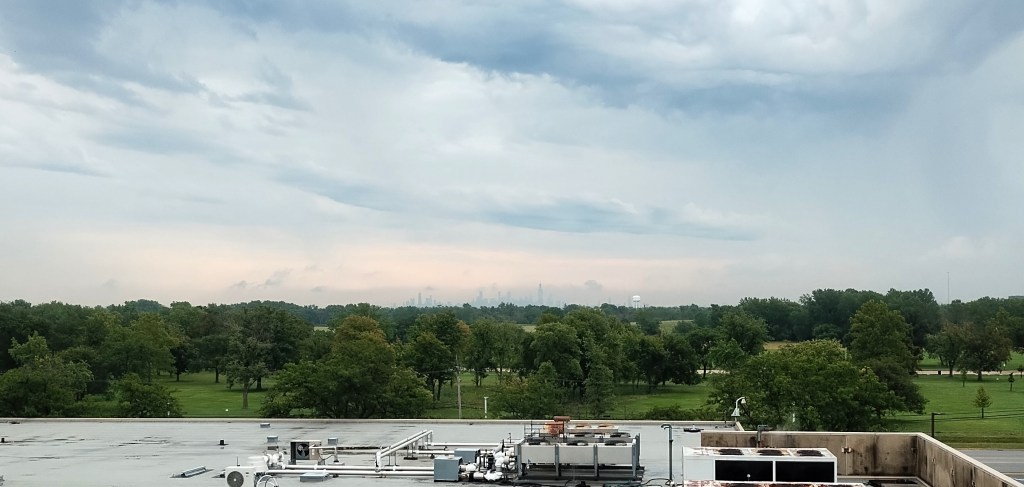
My daily life in the suburbs does not provide views of the Chicago skyline. But I do not have to go far to find such views. Here is one recent example looking east from a four story building:

Given the importance of skyscrapers for cities, how do these skylines affect suburbanites? They may provide a reminder of the big city. They may be a landmark or anchor in looking in a particular direction. They could be interesting to view amid changing weather conditions (as I was watching the image above, rain was coming down off and on in between my location and the skyline). They could provide space where a suburban resident works.

Such buildings are relatively rare in the suburbs. There are collections of taller buildings in suburbs, particularly in communities with office parks. This can occur in edge cities where buildings provide hundreds of thousands of square foot of office and retail space near major roadways. But this buildings are rarely 50+ stories and they cannot be seen from as far away as a skyline like Chicago’s.

I think I would enjoy seeing a distant skyline on a regular basis. It might feel less like a looming structure and more like a reminder of the population center nearby. To see multiple tall skyscrapers in one view provides a reminder of the large scale of human activity in the early 21st century.

Christian faith and the banality of suburbia

Theologian William Cavanaugh considers his childhood and what drew him to faith:

Photo by Huu1ef3nh u0110u1ea1t on Pexels.com

While his parents grew up in a “thick” immigrant culture surrounded by other Catholic families, practices and symbols, Cavanaugh feels that his own upbringing in an assimilating American Church revealed a “thinned” bond. One might hear his future mentor Stanley Hauerwas’ judgment in this appraisal: The Church went out to convert America, but America converted the Church. Devotional objects adorned the Cavanaughs’ suburban Chicago home (until, as teens, William and his sister secretly discarded many of them), but his family’s “practice of the faith was primarily going to church on Sunday.”

Still, he felt Catholicism held out the hope of something “less banal than suburban life filled with Wonder Bread and Gilligan’s Island.” It captured his interest, he says, “precisely for the way in which it was indigestible to mainstream American culture. So, it became my little way of being outside of the mainstream.”

Cavanaugh is not alone in these sentiments. For example, Catholic priest and sociologist Andrew Greeley wondered about the compatibility of Catholic faith and suburban life in his 1959 book The Church and the Suburbs. Protestants of different traditions have echoed similar themes; is it possible to live the American suburban good life and have a vibrant faith?

The particular examples Cavanaugh cites are interesting. “Wonder Bread” began in the 1920s and became a symbol of a booming consumerist economy. Gilligan’s Island was a comedy that ran three seasons on television, another key part of an emerging suburban society. Food and entertainment are pretty central to life today. Did religion in suburbia become another consumable? Cavanaugh suggests Catholicism was “indigestible” for this way of life even as millions found ways to pursue religious beliefs, belonging, and behaviors in the American suburbs.

Three thoughts on pop/rock music about the suburbs

I enjoyed thinking this week about pop and rock music about the suburbs. As I considered the music of Malvina Reynolds, the Beatles, Ben Folds, Arcade Fire, and Olivia Rodrigo, several thoughts come to mind:

Photo by Edward Eyer on Pexels.com
  1. These genres do not often write directly about the suburbs. They may tell stories about people and situations based in suburbia but the role of suburban places is minimized. Many popular songs do not say anything about where they take place geographically.
  2. Finding songs that portray suburbia in a positive light is difficult. Surely they exist. Perhaps they do not become as well-known? Perhaps music artists tend to associate suburbia with negative traits? Perhaps other genres do this differently?
  3. At the same time, there is plenty about suburban life that could make for compelling music. Millions of Americans, including many musicians, have experience this life. The songs profiled this week included looks at houses, daily routines, remembering childhood, listening to music, driving, and relationships. For all the reasons Americans love suburbs, why not tackle those themes? (I realize it might be hard to write about suburban local government but I am guessing it could be – and probably already has – been done.)

I will keep listening for music that references and is about specific places. This includes the suburbs but also cities and rural areas as place could be a fascinating topic for a new single or album or bonus track.

Ben Folds and “Rockin’ the Suburbs”

In 2001, Ben Folds released an album and song with the same name critiquing suburban life. From the chorus of “Rockin’ the Suburbs“:

Photo by Njukeng George Njukeng on Pexels.com

I’m rockin’ the suburbs
Just like Michael Jackson did
I’m rockin’ the suburbs
Except that he was talented

The song pokes fun at “being male, middle-class, and white” as the protagonist angrily goes through life. Folds highlights one group of suburbanites – what would he do with the increasingly complex suburbia?

Folds suggested the song was done in the style of two groups popular at the time:

The song parodies Korn and Rage Against the Machine. Folds stated of the song “I am taking the piss out of the whole scene, especially the followers.”[1]

This reminds me of a sidewalk square nearby in suburbia that immortalizes “Korn.” Both groups provided music and lyrics that could be used to express discontent about a suburban America.

Arcade Fire and recalling growing up in the suburbs

In 2010, Arcade Fire released the single “The Suburbs” which shared the same name as their third album. This song references growing up in the suburbs – here is what is in verse two:

Photo by KoolShooters on Pexels.com

The kids want to be so hard
But in my dreams, we’re still screaming
And running through the yard
And all of the walls that they built in the seventies finally fall
And all of the houses they built in the seventies finally fall
Meant nothing at all
Meant nothing at all, it meant nothing

By the early 2000s, millions of Americans had grown up in suburbs. What was that childhood like? How could it be put into music?

Whether related to their artistry or their view of the suburbs decades later, The Suburbs may be the most decorated music album about suburbia:

The album debuted at No. 1 on the Irish Albums Chart, the UK Albums Chart, the US Billboard 200 chart,[4] and the Canadian Albums Chart.[5] It won Album of the Year at the 2011 Grammy Awards, Best International Album at the 2011 BRIT Awards, Album of the Year at the 2011 Juno Awards, and the 2011 Polaris Music Prize for best Canadian album. Two weeks after winning Grammy’s Album of the Year, the album jumped from No. 52 to No. 12 on the Billboard 200, the album’s highest ranking since August 2010.[6]

One interesting note: the group is Canadian but The Suburbs is based on growing up outside of Houston. How does this mixing of experiences change their interpretation of suburbia?

Folk music about the “little boxes” of suburbia

The folk song “Little Boxes” written by Malvina Reynolds in 1962 and popularized by a Pete Seeger recording released in 1963 captured some of the concerns about growing suburbs in the United States. The first verse speaks to the song’s message:

Photo by Andy Vuknic on Pexels.com

Little boxes on the hillside
Little boxes made of ticky tacky
Little boxes on the hillside
Little boxes all the same

The rest of the song then describes the people who live in these homes and the ways they follow the same paths.

This song borrows the imagery of new suburban construction – a lot of similar looking homes (“little boxes”) emerging out of open spaces outside cities – to argue the communities and people within are falling into patterns of conformity. This was a common argument in the 1950s and 1960s: suburbanites thought they were achieving the American Dream but they were really getting a dull and common life. Instead of becoming individuals or households that had made it, they were sold a bill of goods.

Even as Seeger’s song became a hit (reaching #70 on the charts), many Americans did not appear to be swayed by this song. They continued to move to the suburbs in large numbers for subsequent decades. Perhaps they might even admit there is conformity in the suburbs in the houses and social life – and they might be okay with that.

Suburban downtown apartments for empty nesters and young professionals

When suburbs build apartments or condos in their downtowns, who do they envision living there? A quote from suburban leader provides a hint as I have seen similar sentiments across suburban downtowns:

Photo by Gotta Be Worth It on Pexels.com

Suess said there’s a high demand for apartment space in the downtown areas and the suburbs in particular.

“The attraction of this I think is very much towards empty nesters,” Suess said. “I think it’s towards young professionals starting out and, again, folks who want to be in the downtown area.”

That is a very specific set of people. Presumably, these are people with the resources available to live in nicer apartments near a lot of suburban amenities.

At the same time, highlighting these groups also reinforces the importance of single-family homes in suburban communities. Empty nesters are ones who might have owned a home for years and raised kids there but now are looking for a change from maintaining a home. Young professionals are just starting out and perhaps they do not yet have the resources to be homeowners for the first time.

Often, suburbanites do not like apartments and/or the people who might live there. But the right apartments in a downtown setting can attract certain residents – the ones named above – and contribute to a denser, walkable, thriving downtown.

All the birds flying over suburban homes in the Chicago region

Suburban homes are all over the American landscape. Above and around them fly lots of birds, particularly at this time of year in certain parts of the country:

Photo by Fahad AlAni on Pexels.com

This week, millions of birds will fly through the night skies above the Chicago area as they travel from their winter homes down South to their summer breeding grounds in Canada and northern states like Wisconsin and Minnesota.

With spring migration in full swing, hundreds of species such as the Baltimore Oriole and Nashville Warbler are following Illinois’ rivers and Lake Michigan to find their way. Free of daytime temperatures, the birds are further aided by the stars, moon and stable night atmosphere…

Spring migration is long and it comes in waves, starting in late February and March with waterfowl and goose migration. Next, short-distance migrants like Robins and Red-wing Blackbirds make their way up…

To combat the threat, bird lovers and environmental organizations are promoting Audubon’s Lights Out program, which encourages home and building owners to turn off or dim their lights as much as possible during spring and fall migration seasons…

“You can bring birds to your own yard if you own property, or even if you don’t and you just have a balcony or something similar,” he said. “Planting native shrubs or perennials or trees if you’re able to is a huge, huge benefit to birds. They’ll seek out native species as they’re migrating because native species provide insects for them and they’re aligned to match when these native species are in their blooming period.”

I would guess many suburbanites appreciate birds in their yards. People like to feed birds. They enjoy hearing them early in the morning (or later in the day, depending on one’s sleep schedule). They like to watch them and see who is present.

How exactly the birds get there and the ways suburbanites can help birds get to where they want to go might be less known. In the paragraph above, it might be easy to see birds as an adornment to suburban life. Have a home and yard and the birds are icing on the cake. They come and they go.

But suburban yards sit in the middle of bigger ecosystems. Some birds do well in this setting and others do not. While a lot of attention is paid to tall glass buildings, houses and other assorted suburban development can mess with pathways bids have used for a long time.

Can birds and suburbanites coexist in the long run? Are American suburbanites more likely to believe that birds aren’t real? I wonder how many would be willing to do the two things suggested above – dim their lights and have native plants – to further the well-being of birds on the move.

Turning down a big proposed warehouse, thinking about affordable housing for certain members of the community

The spread of warehouses in suburban areas can meet opposition:

Photo by Thijs van der Weide on Pexels.com

For the second time in less than a year, the Geneva Planning and Zoning Commission is recommending the denial of a request to allow a 719,200-square-foot warehouse on the northeast corner of Kirk Road and Fabyan Parkway.

The commission voted 4-1 Thursday against Venture One Acquisitions LLC of Rosemont’s requests to amend the city’s comprehensive plan for the 55.62-acre site, changing it from rural single-family residential to light industrial, and approving a site plan.

If not warehouses at a site of suburban open space, what else could go there?

Walendziak said the east-side residents do not want more diesel pollution and truck noise.

“What the residents do want is residential,” Walendziak said. “We need affordable housing in Geneva. This is one of the last big sites left. … Housing for starting families, for seniors that they can afford to stay living here in Geneva.”

Commissioner Mim Evans also suggested that housing is the best use for the site.

“We need housing in this town, even if it isn’t technically affordable housing,” Evans said. “Housing is needed everywhere at every price point, at every level of density.”

If warehouses are the enemy – traffic, noise, out of character for a community due to their scale and industrial aspects – then housing may be more desirable. And housing for certain people groups, including families or young professionals starting out and older residents of the community who want to downsize and stay.

It may be helpful to look at the longer trends. Suburban residents and leaders have had heated debates about land use since at least the beginning of the postwar era. Big proposals could generate conversations about what the community could become. Community needs shift over time as social and economic conditions change.

At the same time, I wonder if there is extra urgency these days due to two factors. First, many suburbs have few large parcels left. This means that decisions like those above feel extra consequential. Second, housing prices are high enough in many places that people want to protect their housing values and extend housing opportunities to certain people.

Figuring what happens with this particular property might take years from additional discussions to planning to actual construction.

A common suburban playbook: zone for big lots, oppose apartments

A new book about Southlake, Texas discusses some of the mechanisms used to keep the community white:

These approaches are found across American suburbs. Start with zoning for larger residential lots which has several effects. It keeps houses further apart. It maintains a more rural image. It avoids having dense housing. It raises the price of homes as each lot is bigger and costs more and the houses can be bigger since there is more space to build.

Next, take apartments and why a good number of suburbanites do not like them. They are denser housing. Suburbanites prefer homeowners, who they think have more commitment to the community and to the property in which they live. They are cheaper and this may drive property values down.

Put these two together and suburbs can keep housing values up and limit who can live in a community. This is not an accident; suburbs often have particular residents in mind when they think about development and the future of their community.