Tax breaks and Chicago suburban locations standing in for other locations in films and TV shows

The state of Illinois offers tax breaks for filming in the state. This means the Chicago suburbs can stand in for numerous other locations:

Photo by Stephan Mu00fcller on Pexels.com

The state’s film production tax credit allows qualified productions to receive a 30% transferable tax break on most production costs and certain salaries. Producers can also receive 15% more for hiring workers living in “economically disadvantaged areas.” In return, these productions generate jobs and draw business from outside the region.

According to a new report commissioned by Dudley’s group, the state’s film incentive is the biggest box office draw for Hollywood. A survey of producers included in the report indicates more than 90% of the productions shot in Illinois would not have occurred without the incentive…

Producers of the television series “Fargo” used Elgin and other suburban locales as a stand-in for Kansas City a few years ago. Acclaimed director David Fincher turned downtown St. Charles into upstate New York for his recent Netflix film, “The Killer.” And parts of Warrenville and Lockport are used as substitutes for Manhattan, Kansas, in the HBO series “Somebody, Somewhere.”…

This commonly happens in movies and television shows: a filming location stands in for another place. This could include filming on a backlot or in another city or community.

Yet, it still is a strange experience to see a location you recognize on-screen that is supposed to be somewhere else. Imagine you live in a suburb listed above. These communities have their own history roughly 30-40 miles outside of Chicago. They exist alongside dozens of other suburbs. But, you could be watching what is supposed to be Kansas City and you recognize this suburb. Or, Manhattan, Kansas is on-screen and it happens to look like Lockport. Do these geographic switches make the on-screen presentation less real? How many people notice the disconnects?

The article also emphasizes the role of finances: tax breaks help drive where filming takes place. I assume there are also efforts to try to make sure the stand-in location looks similar to what is supposed to be depicted. Do certain suburbs make good stand-ins for all suburbs or are particular metropolitan regions good to offering the variety of locations studios might want?
When you can build a suburban warehouse where an office building used to stand

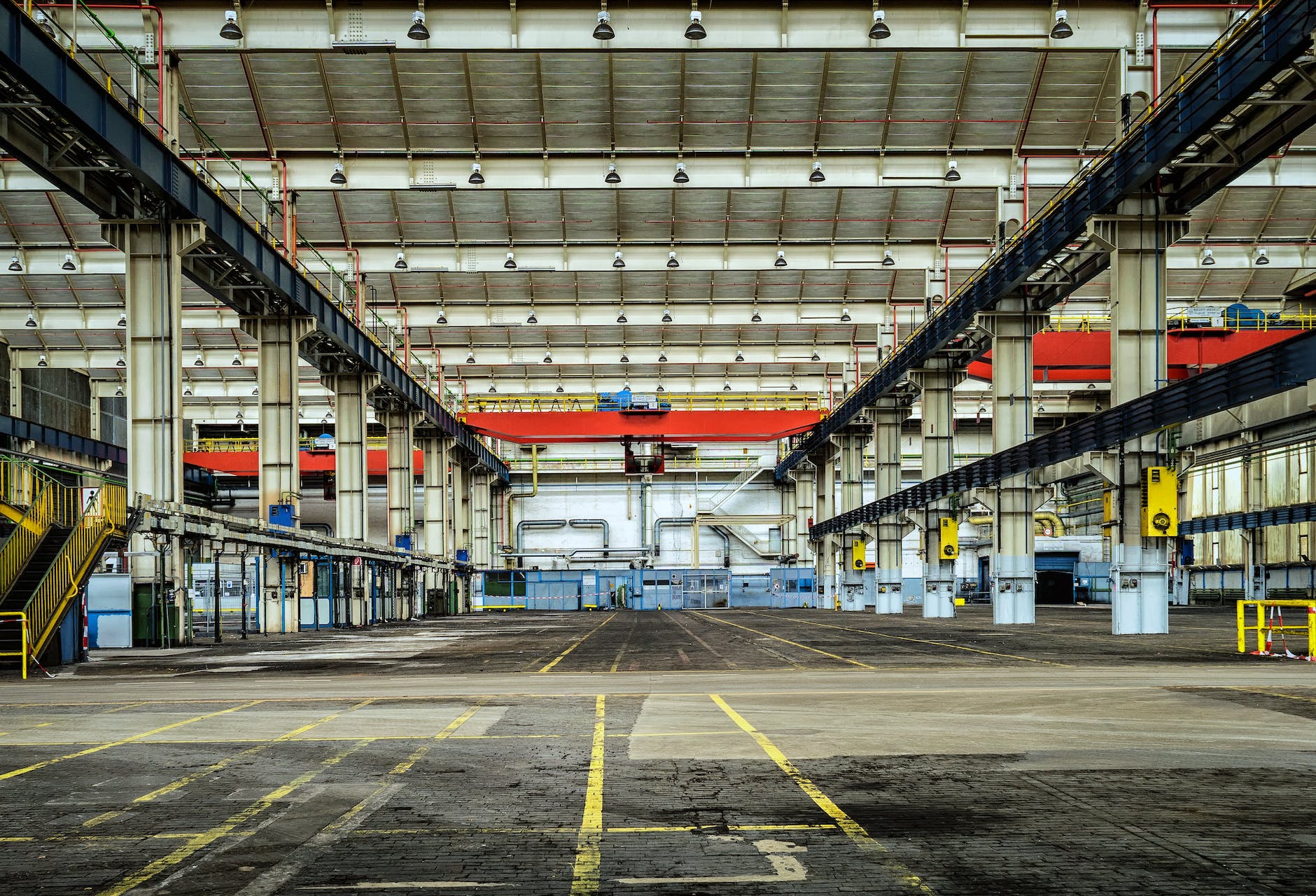
With less demand for suburban office buildings, the void is being filled with warehouses. One example from the northern suburbs of Chicago:

Photo by Pixabay on Pexels.com

The old Allstate campus was a traditional suburban office environment with lush landscaping, reflecting ponds and thousands of workers. That property now is called the Logistics Campus, a massive industrial development underway in Glenview…

“The ability to put modern industrial in the middle of an established community — it’s unique in the sense that there will be very few other sites of this size that can replicate what we’re doing,” said Neal Driscoll, Dermody’s Midwest region partner.

Development of big-box industrial space in the Chicago region set a record in 2023 with construction of 70 buildings totaling nearly 33 million square feet, according to a recent report by commercial real estate company Colliers International.

The shift to warehouses in the suburbs has been going on for a while. What I noticed in this story was this thought: the unique opportunity to put warehouses (“modern industrial”) in “an established community.” Translation: many upscale suburbs would not chose to put in warehouses. They might generate noise and traffic. They do not provide many white-collar jobs. They are not attractive buildings.

But, empty office parks are also not desirable. Suburban offices or headquarters for Fortune 500 companies are attractive: quality jobs, status, most likely a glass building. No one working in these buildings and companies leaving these spaces leads to issues.

Thus, warehouses might now be found in communities that would not necessarily select them if they had such options. A set of warehouses might be preferable to vacant office buildings or unwanted office buildings. Figuring out the best land use or zoning in a suburb can be less about the most ideal use of land but rather about the possible alternatives at that moment.

Ongoing movement of religious people from American cities to suburbs

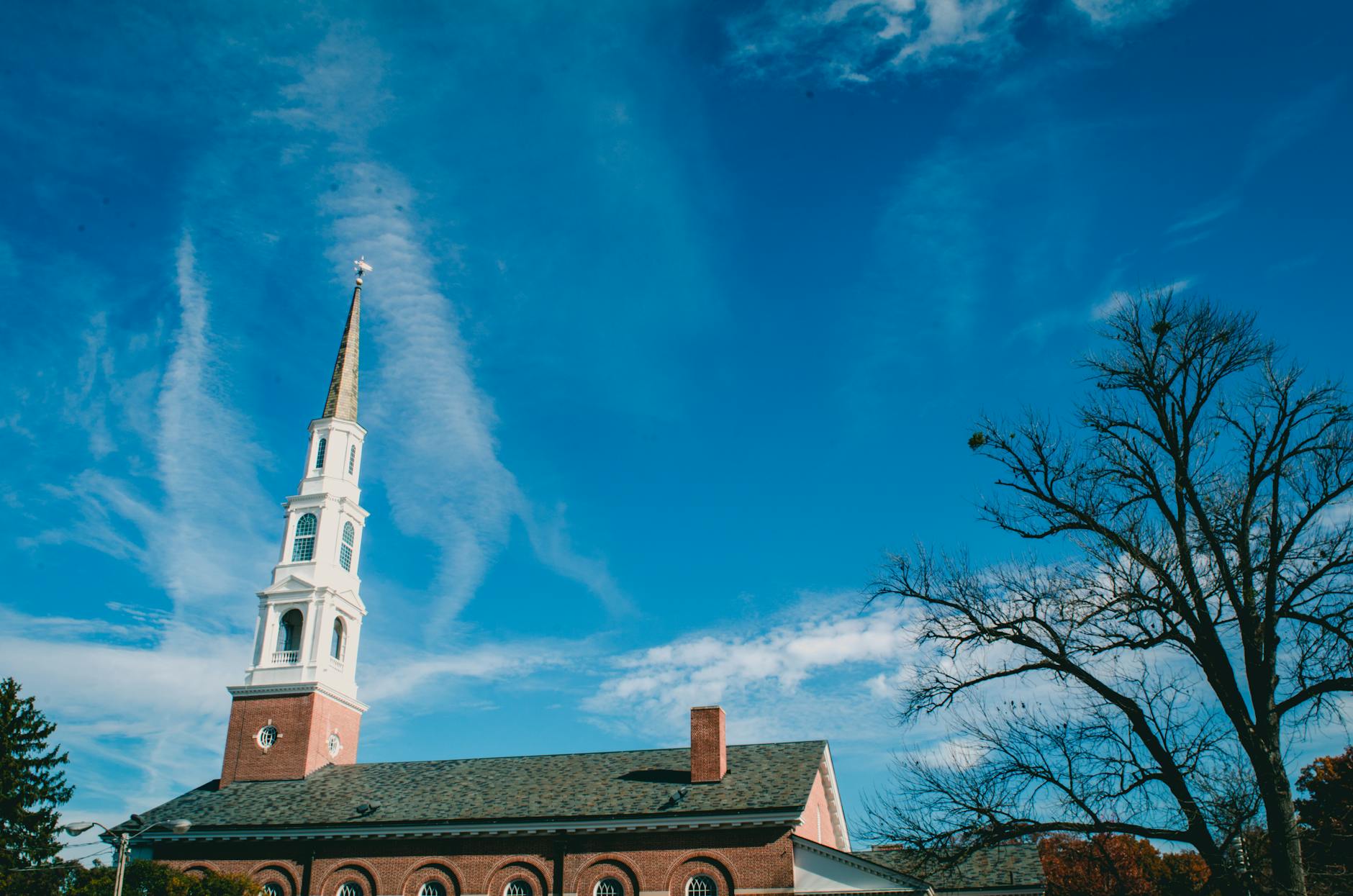
More religious people in cities are moving to suburbs:

Photo by Jonathan Meyer on Pexels.com

Researchers interviewed by The Times said rising costs, rampant crime and changing racial demographics have made it harder to sustain worship spaces in large cities…

As more urban neighborhoods become secularized, demographers say religious families increasingly prefer to settle in suburban enclaves up to 20 miles outside of city centers…

“Over the last 10 years, the 100 fastest-growing churches in America are primarily in the growing inner and outer ring suburbs of major cities,” said Ryan Burge, an Eastern Illinois University political scientist and religious demographer. “They’re almost always non-denominational Christian churches near cities like Charlotte, Charleston and Atlanta. They are the fastest because that’s where people are moving.”…

In New Orleans and several Midwest and Northeast cities, gentrification has pushed more Black Christians into the suburbs than other groups…

Rather than start in the city and expand to the suburbs, most new churches now move in the opposite direction. For example, Elevation Church in Matthews, North Carolina, started 12 miles southeast of downtown Charlotte. It later planted a satellite church in the city center.

In some ways, these are continuations of existing trends. The United States is a majority suburban country and more people have lived in suburbs than cities since the 1960s. White flight from cities included congregations. Increasing racial and ethnic diversity in suburbs has occurred alongside increasing religious diversity in suburbs.

On the other hand, these could include new and different patterns:

-Which churches are closing and which religious groups are moving to the suburbs. If it was largely white congregations in the postwar era, it now includes more groups.

-The number of congregations closing. Are there now more closing than decades before?

-The relative power and influence of suburban megachurches compared to the past. If congregational influence decades ago tended to reside in older, urban congregations, this may have shifted today.

-Are cities more secular than they were in the past? Significant percentages of urban residents are religious and cities contain numerous religious congregations and organizations. Or, has the perception of cities and religion changed?

I suspect there is more to say on the connection between religion and suburbs.

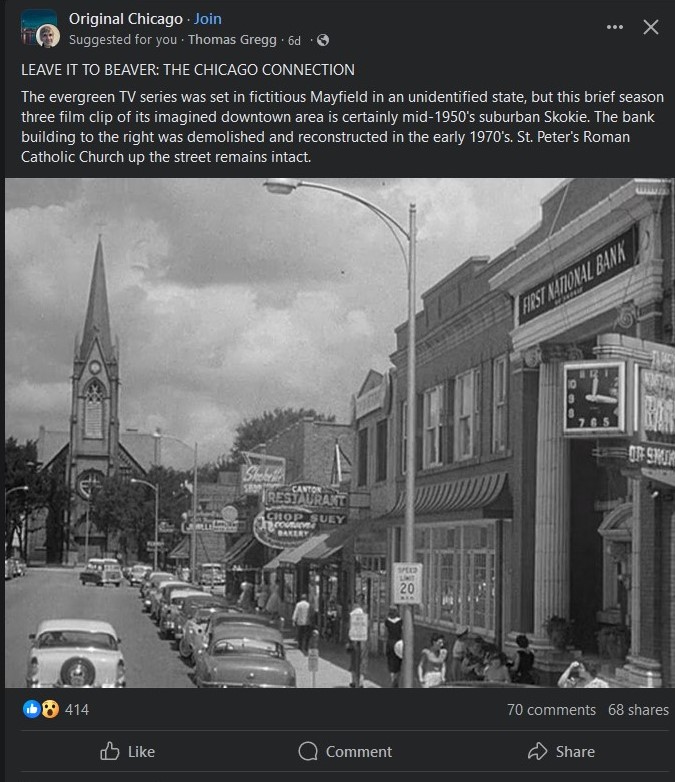
Leave It to Beaver’s downtown and Skokie, Illinois

Television shows may use a variety of settings to film scenes. Given my research on suburbs depicted on television, this example struck me as it combines a famous suburban show and a Chicago suburb:

A variety of websites back up this claim (IMDB, blog). The first home in the show, what I describe as having “two stories, a one-car garage, three bedrooms, and at least two bathrooms (Bennett 1996),” was on a Universal Studios backlot. The show is often held up as an exemplar of suburban-set TV shows in the postwar era yet I noted that it “ran six seasons but never cracked the top 30” most popular TV shows.

As a fictitious show set in an unnamed community, it is interesting to consider why Skokie might have been chosen. Was there existing footage that could be used? Did someone connected to the show or studio have a personal connection to Skokie? Did Skokie represent the experiences of American suburbs at this time? Would someone watching the show then or now see this scene and connect to particular places?

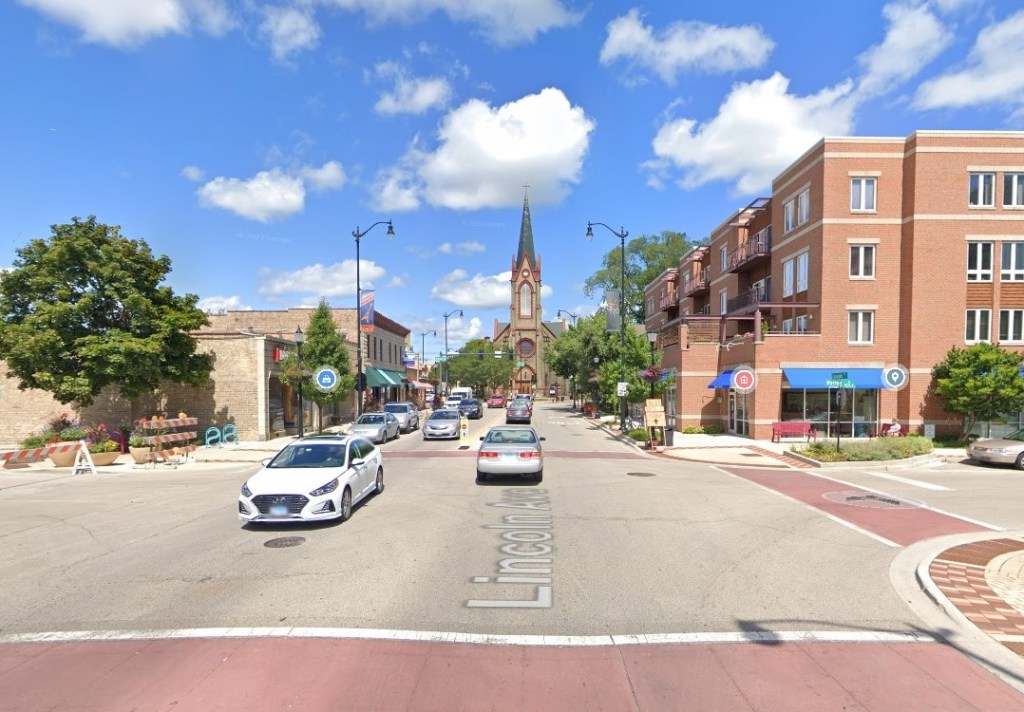
Here is a similar view from Google Street View in August 2019:

The sort of construction on the right – what looks like mixed-use four-story buildings – is common in suburban downtowns where they hope that increased numbers of downtown residents will patronize local businesses and restaurants in addition to those who want to visit such locations. These streetscapes have often replaced one- to two-story structures such as those in the top image.

Seeing teardowns and infill homes throughout DuPage County

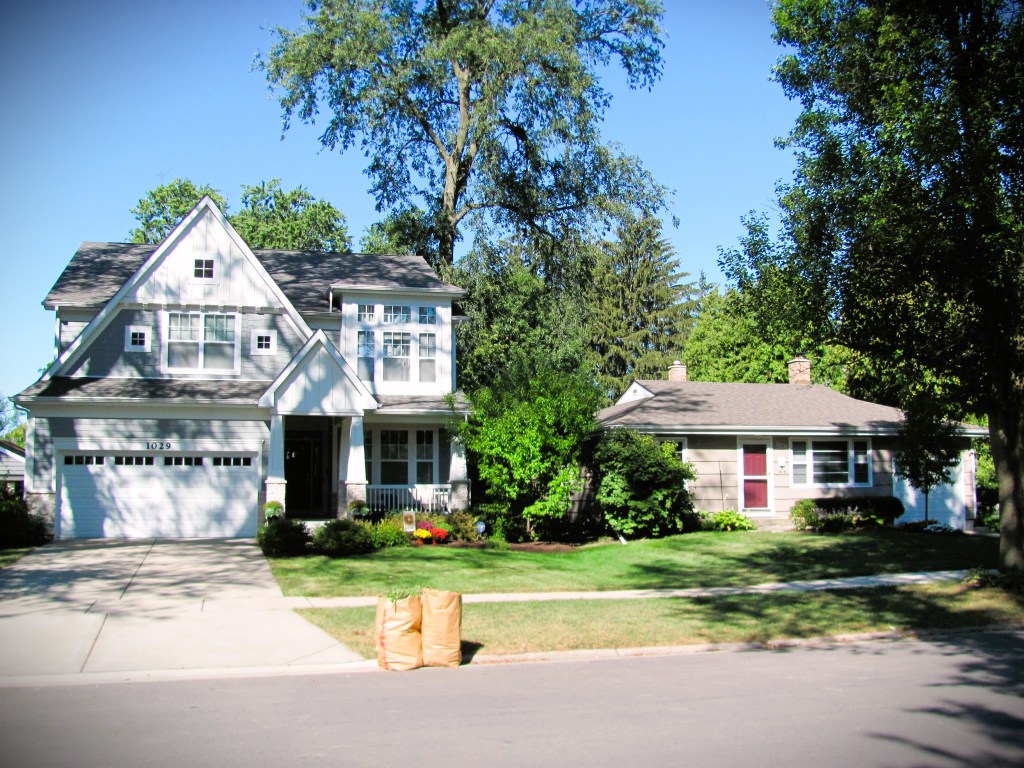
While working on a project, I noticed something while driving through a number of DuPage County communities: there are teardown homes everywhere. They are not just limited to desirable downtowns; they are spread throughout numerous residential neighborhoods. They are often easy to spot: much larger than adjacent homes and with a particular architectural style with stone or fake stone bases, lots of roof peaks, and plentiful garage space. Some could be categorized as teardown McMansions. (Some of these homes might be infill homes where homes were constructed on empty land.)

These teardowns follow some of the patterns I found in over 300 teardowns in Naperville. The architecture and design is similar. The homes are often located next to older homes, often from the postwar era, from the twentieth century.

One difference is that these teardowns are spread throughout communities. In Naperville, teardowns tended to cluster near the desirable downtown area. In some of the communities I drove through, teardowns and/or infill homes are all over the place. Some of these communities do not have downtowns like Naperville and have housing stocks of different ages. It was not unusual to see a teardown suddenly in a neighborhood on the edge of a community when in Naperville the teardowns tend to cluster in particular neighborhoods.

In a county that is largely built out and with suburbs now 50-170+ years old, there will be more opportunities for property owners, builders, and developers to tear down old homes and construct new ones. My sense is that while communities may have regulations about what can be rebuilt, the general atmosphere is in favor of these new homes as long as there is interest and resources to make it happen.

Updating a water tower, painting a smiley face on a water tower

What is involved in upgrading a water tower? Here is one suburban example:

Photo by Kindel Media on Pexels.com

The project will include sandblasting the exterior and interior of the tower and applying new coatings inside and out. There also will be some landscaping work with new perimeter fencing.

The assessment also recommended foundation repairs, replacing the original valves, and installing new hatches, gaskets and a submersible mixer.

In addition to removing the tower’s outdated ladder system, workers will install new safety railing and fall protection equipment.

“We’re kind of excited for the face-lift that’s coming to the tower,” Patel said. “It does its job, but the paint job will make it more appealing for pedestrians downtown.”

Sounds good?

This did remind me of part of James Howard Kunstler’s TED Talk “The Ghastly Tragedy of Suburbia” where he discusses a unique water tower within American sprawl:

He says:

By the way, this doesn’t help. Nobody’s having a better day down here because of that.

We have at least a few water towers in the area that include the logo or motto of a suburban community. Why not use them as advertising? This is a different approach than painting a smiley face to presumably attempt to improve people’s days or help them feel better about infrastructure.

What used to be in suburban downtowns: banks, grocery stores, churches, and more

I recently read about redevelopment plans in part of a suburban downtown in the Chicago area: a shift from banks to other land uses. Here is what would be built in the future:

Photo by John Guccione http://www.advergroup.com on Pexels.com

Hundreds of apartments, a 600-vehicle parking garage and new retail and entertainment space are among an array of possibilities for the redevelopment of a key area of downtown Mundelein known as the “Bank Triangle.”

Suburban downtowns served different purposes in the past. They were economic and social centers in the midst of less developed suburban territories. Businesses located there sold more everyday goods including food and clothing. Banks and churches were there.

Now, suburban downtowns want mixed-use properties that match up downtown residents with restaurants, particular kinds of retailers, and entertainment and cultural options. These land uses bring in residents and money. They are perceived to be vibrant land uses. The other land uses have moved elsewhere or have downsized; banks have consolidated and have fewer branches, retailers are in strip malls and shopping malls, and more people moved to sprawling subdivisions further removed from downtowns.

This shift highlights a new version of suburban downtowns. They are now places to live and go to, not necessarily centers of community life. They have particular land uses and not others. And these will likely to continue to change in the future.

Suburbanites, sacred Target, and popular Stanley Quenchers

Suburbanites are willing to “scuffle” for the latest consumer items. Consider these descriptions:

Photo by Emily Duncan on Pexels.com

That’s why, for the past two weeks, a huge chunk of the internet’s attention has been focused on one baffling phenomenon in particular: What, exactly, is a Stanley cup, and why are suburbanites willing to scuffle over it in their most sacred space (their local Target)?

Let’s recap. As the new year began, Stanley, a century-old company that for much of its history made reinforced lunch boxes and drinking vessels for outdoorsmen and blue-collar workers, launched three pink, limited-edition Valentine’s Day versions of its jumbo-size Quencher cups, all in different shades of pink and only available at Target. The third of these cups, which came out a few days after the first two, was the grandaddy of them all—a new addition to the brand’s ongoing partnership with Starbucks, glazed in a shimmer finish instead of Stanley’s standard matte. All three flew off the shelves. Fans lined up in parking lots in the predawn hours to increase their chances of snagging one. In at least one instance captured in a now-viral video, an argument erupted over who was cutting whom in line, fingers were pointed, and a store manager was summoned to referee. A few videos of rushing shoppers and tepid interpersonal conflicts, plus one that appears to show store patrons trying to tackle a man who had grabbed a box full of tumblers and made a run for it, did the rounds on TikTok before jumping to local news broadcasts and the generalized zeitgeist.

As the internet watched this extraordinarily mild suburban chaos unfold, people understandably had some questions.

In a consumer-driven economy, trends come and go. What is more interesting to me here are the descriptions of how this fits with and/or upsets suburban life. The implication is that suburbanites at Target do not typically act this way. One study suggested suburbanites tend to avoid open conflict. Additionally, Target might be sacred space where a customer can savor the shopping experience. This kind of behavior does not fit within a calm setting. The suburbs are not typically about chaos; residents want to achieve the American Dream and have stability and predictability.

So far, I have not heard of anything involving Stanley that has seriously affected the suburban lifestyle. These are momentary interruptions to everyday life. Of course, they will likely be repeated for another desired item at some point.

“There are no known organized efforts in the suburbs for residents to take in asylum-seekers.”

As municipalities in the Chicago region develop regulations to limit migrants from staying in their communities, one local leader wonders if residents would house migrants in their homes:

Photo by khairul nizam on Pexels.com

McBroom said Naperville has provided migrants safe passage to Chicago without spending taxpayer dollars to house or aid them.

But with more migrants arriving in the area, McBroom says the city should look into whether any residents or organizations are willing to help.

“My idea would be let’s find out … let’s find out who’s willing to help,” he said, adding that Naperville is an affluent community with many large homes. “If there are people who would do that, God bless them.”

There are no known organized efforts in the suburbs for residents to take in asylum-seekers…

Meanwhile, McBroom acknowledges there are many unanswered questions about his idea to have Naperville residents voluntarily house migrants. Some of those include the impact the proposal may have on local schools and what role the city would play in managing a list of volunteer hosts.

Thus far, few communities have indicated much interest in helping migrants find opportunities in the suburbs. I have only seen efforts in this direction from Oak Park. Most communities in the news have been developing regulations so that migrants do not stay and/or they are making sure migrants dropped at suburban train stations make their way to Chicago.

This idea has the potential to bypass community-level initiatives and instead coordinate efforts of residents and property owners. How much space might be available in homes and buildings in a suburb with nearly 150,000 residents? How many people would volunteer?

I could only imagine what might happen among (1) neighbors of people who are willing to house migrants and (2) if names and addresses of individual hosts became known to the public.

We will see where this goes, but I imagine it would not go too far if there is the possibility of state money available to communities in the near future.

Highlighting “suburbanites” at a Bulls game

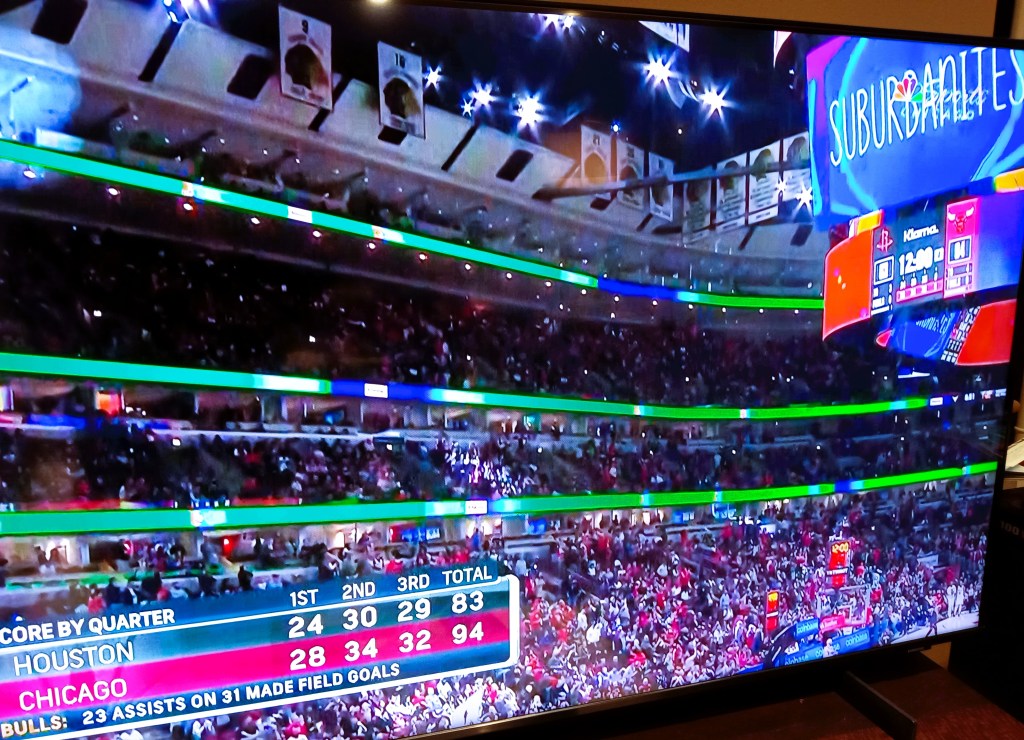
I could not tell exactly what was happening because I caught this recently on TV but I was still interested to see what was on the scoreboard at the United Center during a Bulls game:

Was this a cheering contest between Chicago residents and suburbanites? Some camera shots on the big screen? A trivia contest?

Given the population of the Chicago region, there were probably a lot of suburbanites at the game. In 2020, Chicago had 2.74 million residents and the region had 9.61 million residents. This puts the suburban population at 6.87 million. This means over 71% of people in the region live in the suburbs.

The Chicago Bulls tend to have good attendance, even if the team is not doing great. This year, the team is under .500 and the team is second in the league in home attendance. (They also have one of the largest arenas.)

Suburbanites have ideas about Chicago and its residents and vice versa. Does identifying the two groups at a Bulls game exacerbate these differences or help bring them together around their common Bulls fandom? (I am guessing it is the second as Bulls games usually are good experiences, even if the home team is not great.)