When two suburban residential developments border each other and have clear differences

A typical suburban single-family home, the symbol of the American Dream, is often in the middle of a subdivision surrounded by similar homes. Yet, some of these homes are on the edges of developments. This boundaries can be interesting: what do the homes back up to? What is nearby? Three local examples that I see regularly highlight how adjacent suburban residential developments can lead to some sharp contrasts.

Photo by Pixabay on Pexels.com

First, I know of a 1970s neighborhood of primarily raised ranches and split-levels of roughly 1,500-2,000 square feet. One side of this neighborhood borders a late 1980s development of larger homes built more in the style of 3,000 square foot McMansions with brick or Tudor facades. These two sets of homes back up to each other and the line of homes that do this are quite different: there is a significant size difference, the style of the homes – siding versus different materials – varies, and the newer development is slightly uphill so the larger, newer homes loom over the older, smaller homes.

Second, there are numerous single-family home neighborhoods where houses are across a residential street or next to a small apartment building. Or, next to a townhouse development. The scale of the buildings is not that different but the density and size are clearly contrasting.

Third, I know of one location where there are two neighborhoods that could have been constructed separately as they both have outlets to the neighboring arterial roads. But, there is a connecting road between the neighborhoods and there are houses of each neighborhood type, again different size and style side by side, on this connector.

Single-use zoning in the United States is intended to protect single-family homes from other less desirable land uses. But, this zoning system does not necessarily buffer certain residential neighborhoods from each other. Many suburbanites would object to significant changes in their nearby surroundings if the new residences were quite different. I ran into this in my suburban research where new small homes nearby or apartments were not welcomed, particularly if they were replacing open space. Yet, today many suburbs have different developments side by side, sometimes with a buffer – nature, a berm, a walkway, etc. – but sometimes not.

These neighboring dwellings could signal some significant differences. A larger home suggests a different social class. Residents of apartments are not always regarded fondly by homeowners. Densities and lot sizes can be different. The exteriors imply different status.

These boundaries are symbolic and clearly marked in physical space. What are the consequences: are the residences on these boundaries less desirable or go for a reduced price? How many people care about the clear boundaries? Do the people from the two or more sides interact within these boundary zones?

The boundaries between suburbia and other types of communities is often clear to see and experience but the internal boundaries are also fascinating.

Considering Jane Jacobs’ advice for parks when planning a major suburban park

Jane Jacobs is famous for her observations regarding sidewalks in the opening chapters of The Death and Life of Great American Cities. Right after this is a chapter on parks. In summary, she suggests are not automatically good as they can easily become problem areas if there is not regular foot traffic in and through the park.

Photo by Felix Mittermeier on Pexels.com

I thought of this when seeing a plan of how the former Motorola Campus in Schaumburg might be turned into “a Millennium Park for suburbs”:

Schaumburg trustees Tuesday will consider approving a $1.1 million bid for construction of the first phase of a 12-acre, urban-style park ultimately envisioned as a sort of Millennium Park for the suburbs.

Planned for the former Motorola Solutions campus, the park when completed could house such amenities as a large outdoor performance venue, a sculpture garden, a dog park and a winter ice rink.

Phase one, however, will focus on the basic outline of the park and providing passive recreation opportunities to serve residents of the area, before the next set of upgrades are budgeted and built.

A suburban park, no matter how beautiful it is or how many amenities it has, could easily fall prey to the issues that Jane Jacobs describes. Do people live around the park? Will there be people regularly walking through the park? Will it have the same kind of lively pedestrian activity and interaction that she recommends for sidewalks?

A park built on a former office park campus might not have any of these. Located in a sprawling suburb, would the majority of users have to drive here? Would people be there just for the park and its particular amenities or are there nearby activities that would keep them in the area such as shops or restaurants? Are there enough residents within walking distance who can informally help keep an eye on the park and those who use it?

This could all be in the eventual plans. In the Chicago suburbs it is currently popular to suggest mixed-use developments to replace office parks, shopping malls, and other large properties. But, it takes time for such developments to happen and for community to arise. Parks do not automatically work like they do in Simcity where placing a park next to commercial or residential property boosts property values. Just because there is a pristine park in the plans does not mean that the park becomes the kind of asset Jacobs suggests they can be in the right conditions.

Starchitect Jahn’s buildings in the Chicago suburbs

World famous architect Helmut Jahn died over the weekend. He built iconic buildings in major global cities and several notable buildings in the western suburbs of Chicago.

A native of Germany, Jahn won international recognition and awards for projects around the globe, including United Airlines Terminal 1 at O’Hare International Airport, the former Citigroup Center (the main entrance to the Richard B. Ogilvie Transportation Center) in Chicago, and the Sony Center in Berlin.

Besides MetroWest in Naperville, his suburban work includes the Oakbrook Terrace Tower in Oakbrook Terrace.

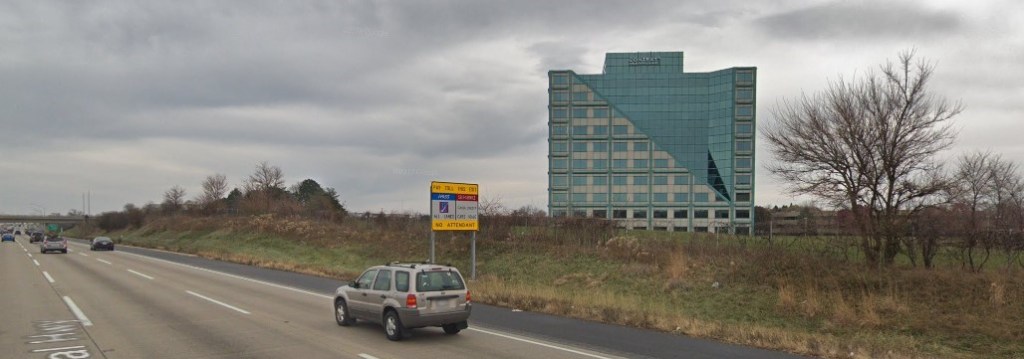
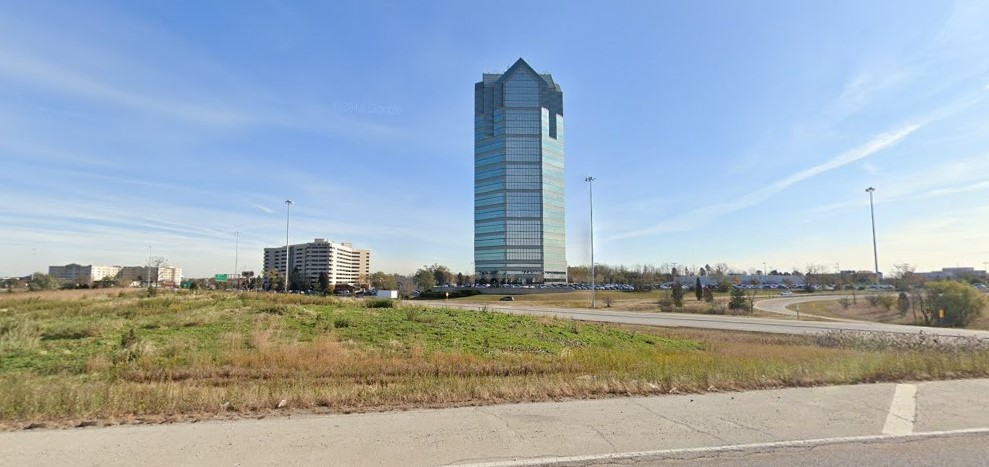
Here are images of the two buildings referenced:

Both buildings are interesting structures to see in their suburban settings. They would not be out of place in a major city. They are full of steel and glass. They have sharp angles. They can be seen from a distance and are of a height beyond most suburban buildings.

But, they also stick out. They are right next to major highways. They are not surrounded by other tall buildings; the size of the Oakbrook Terrace Tower is particularly notable. Instead, they are surrounded by parking lots and smaller suburban office parks. They are in the suburbs but they are not of the suburbs; few residents would want these structures anywhere near their single-family homes.

In other words, a starchitect can build in the suburbs. In many parts of the United States, they are growing and a majority of Americans live in suburban settings. Interesting buildings help add to the status of certain suburbs as job centers. Yet, the interesting buildings by a famous architect can only go so far in sprawling settings: they do not really fit in even as they provide something different to view at 70 miles per hour.

Americans celebrate moving away from their small home town

An excerpt from a new book presents an American conundrum: many Americans like the idea of small towns yet celebrate moving away from them.

Photo by Syed Andrabi on Pexels.com

I was humiliated, not just because I’d left school, but because I’d glaringly stumbled off the traditional path everyone I knew had taken: If you move away from home, you don’t move back. That’s not how young adults do it. We leave. We find our way.…

So there’s this push and pull, where fulfilling this Americanized ideal of being out on one’s own and forging one’s own life comes at the real cost of contributing to families and communities in tangible ways, Katsiaficas explained. “For so many young people that I’ve talked to, they’ve narrated that hyperindividualism as a real sense of loss,” she said. Rarely, if ever, had I heard that sense of loss, or even homesickness, described as anything other than something we’re supposed to grow out of…

Because moving is so ingrained in how we think about this time of life, even though not everyone can “achieve” that milestone, staying seems like it is rarely celebrated. With going-away parties to celebrate new adventures and graduation parties to mark the close of one chapter and the beginning of another, staying in one place can feel boring…

In our conversation, Warnick pointed out that there is a stigma in America against not only small towns, but staying in the same place at all. We tend to think of it as representing “the abandonment of our big dreams,” Warnick said, a feeling of escape that some young people feel acutely. I felt called out, and with good reason: I’d clung to the belief that life would really begin once I left wherever I was. It kept dreams I was too scared to say aloud at arm’s length; it allowed me to imagine, and reimagine, the “best life” I’d finally find with a new zip code, conveniently forgetting that my real life was happening wherever I happened to be. I could participate, or I could wait. And for years, I waited.

There is a lot to consider here: the particular stage of life in the discussion here (from roughly college to settling down as an adult), mobility, frontiers, cities versus other settings, and larger American narratives about success. A few quick thoughts in response:

  1. I wonder how much these narratives differ across places. Is this more prevalent in rural areas where the allure of trying the big city is strong or is it also present in big cities where young people want to experience other places, including other appealing big cities? This could help untangle whether this is more about small towns or a general theme that emerging adults need to strike out on their own somewhere else.
  2. This reminds of some marriage advice I once read that suggested newlyweds should move hundreds of miles away from both families to establish themselves as a couple before moving back near family. Does such a narrative go against most of human history?
  3. Could all of this help explain the enduring appeal of the suburbs? They are not quite small towns but they are not cities. Americans can feel better about returning to suburban municipalities and making a home there because it feels in between.
  4. This all seems to beg for a more robust theology of place in the United States.
  5. It would be interesting to know how social media and the Internet either help connect people to home towns from afar or present just a poor and ultimately unsatisfactory substitute.
  6. Plenty of Americans do stay in the community in which they grew up or stay nearby. What is different about their stories? What are the factors that help explain why some commit to staying and others leave?
  7. How do Americans process their experiences with and understandings of place? If the emphasis is largely on mobility or making do where you are, this might discourage positive memories or investing too much in a particular place.

Reactions to suburban yards filled with dandelions

Is a mark of a suburbanite who cares about their property values and yard a lawn free of dandelions? In a recent walk, I saw this yard:

On a corner lot, this yard was filled with dandelions all around. And to compound the issue, two of the next three yards adjacent to this home looked similar.

What does this all mean? Is this a set of households devoted to eco-friendly lawn care? Or, is it a sign that the owners do not care about their property and/or their neighbors?

Remarkably, many of the nearby lots have no dandelions whatsoever. Even as these three lots have helped spread thousands of dandelion seeds, the weed killers used nearby have done their job. The whole neighborhood is not overrun with dandelions. The damage – mostly visual? – is contained to three lots.

At the same time, I could imagine some of the neighbors might not be happy about the situation. The optics of yards given over to dandelions might not play well in a middle-class neighborhood where green manicured lawns are an expectation. What kind of neighbors are these to subject others to this blight? What if someone was trying to sell their home nearby?

Soon enough, the most visible signs of these dandelions will be gone. The seeds will have scattered, contributing to windy days where the air is visibly full of plant matter. Will the neighbors forget the dandelions? Will they be back next year? Is all of this a matter of overwrought suburbanites policing their artificial nature known as a lawn? The grass and the weeds may be more than just that; they are markers of social class and social norms in suburbia.

Where will the new work from home people in suburbs and other places want to settle and spend their money?

Now that we have more clarity on where remote workers have moved, another question arises: what do they want to do in their new communities?

Photo by Kaique Rocha on Pexels.com

“People who are working from home still want to go out, either during the day or after work, and they still want to spend their money on interesting things and interesting places,” says Bill Fulton, who directs Rice University’s Kinder Institute for Urban Research. “If you move from San Francisco, you’re not going to want to spend all your money at Applebee’s, right?”

Tracy Hadden Loh, a fellow at the Brookings Institution who studies real estate development, puts it another way: “I think annoying people with laptops are going to be everywhere. They’re coming for your favorite spot.”

The changes have elected officials, city planners, and developers mulling how to plan for this still-hazy future—and asking plenty of questions. Who will live here? Who will work here? Who will drive or take transit here, and when? Most essentially: What kinds of housing should we be building and for what sorts of people?…

City planners and economic development officials recognize that there’s an opening here. But most say that the work so far has been the equivalent of building the plane while it’s in the air. Work has been quick, a little harried, and focused on helping businesses just make it to the next day. Longer-term economic development—planning for places that might host new stores, restaurants, and housing—is more time consuming. It also demands more information on post-pandemic life.

Another way to think about it: how much risk are these communities with new residents willing to take? The pandemic brought changes but it is less clear how long-lasting these changes will be. Will people move back to cities or are there in these new places to stay? Is work from home going to continue at higher rates or not? Is this part of longer trends – retrofitting, “surban” development, etc. – or a blip? Certain development decisions could require multiple sources of capital: financial commitments, political moves, and significant changes to the character of particular communities.

Unfortunately, there may be no guarantees on these choices. Some suburbs and cities could do well, others may not. There may not even be fairly consistent success or failure within the same region. There could be some benefits to moving quickly and showing momentum; or not if trends go another direction or hasty planning fails to take everything into account.

At the same time, this is unique opportunity for communities. As noted in the title of the post, it could lead to new revenues, an issue facing many communities during COVID-19. Population growth is also seen as good. This could be a turning point to a different future.

Considering whether a $300,000 home is affordable or attainable, Naperville edition

The approval of a new development in Naperville touches on a broader topic in the suburb in recent months: affordable housing. Who would be able to purchase a residence in the 200+ units?

Photo by Karolina Grabowska on Pexels.com

Councilman Patrick Kelly, the lone dissenting vote, objected to the lack of affordable housing in the 227-unit development, a “missed opportunity” that could have helped efforts to diversify the city’s housing stock.

State law requires 10% of a town’s housing supply to qualify as affordable. Naperville falls shorts at an estimated 7.5%…

The townhouses will be priced from the $300,000s. While the project doesn’t provide, by definition, affordable housing, Councilwoman Judith Brodhead said it “does fit the category of attainable housing.”

“Certainly, there’s not new construction, anything that you can find in north Naperville, in that kind of price range,” Whitaker said.

Much of the opposition to the proposal for an empty piece of land has centered on the possible environmental impacts. The property in question backs up to a Forest Preserve and there are bird and animal habitats nearby.

But, the affordable housing question is an interesting one. In wealthier suburbs, affordable housing does not necessarily mean housing for poorer residents. Such communities could not like affordable reasons for a number of reasons including who might live there and how smaller and/or cheaper homes might affect other homes in the community.

And there are ways to push off affordable housing. For example, zoning in particular ways can limit the number of residences that are cheaper. Another way is to recast what affordable housing is. Remarks, like the one above in the quoted section, are not unknown in Naperville. See this example from last July. Naperville is a desirable community: it is wealthy, has good schools, has an exciting suburban downtown, has lots of parks. Even as a large suburb, it has a lofty status. According to 2019 Census estimates, the median home value is over $416,000.

With all of this, a townhouse at $300,000 is a lower price. Units on this kind of land in a community like Naperville could go for a lot more. Yet, is $300,000 attainable for all the people who want to live in Naperville? Or, the people who work in Naperville? It is cheaper – but is it affordable?

There are limited ways to force suburbs like Naperville to construct housing that is affordable. President Biden wants to offer more carrots in this area. Public pressure from residents and organizations could push Naperville leaders to address this more fully. Naperville has served as a center of suburban protests before. But, there will always be questions of how such units would fit with the character of the existing community, what it means for existing units and residents, and who might live in such housing.

More obnoxious in the suburbs: Prius with Coexist sticker, oversized pickup with Blue Lives Matter flag in the bed, or car with super-loud muffler?

Cars are not just cars; they are an embodiment of who Americans are. Even as suburbanites like cars, here is a quick description of three noteworthy vehicles that might raise some suburban hackles:

Photo by Khunkorn Laowisit on Pexels.com

-The Prius driver with the Coexist sticker on the back. Not only are they already signalling their green bona fides with their car choice, they accentuate their tolerance for different religious groups. Prius drivers are not thought of as being aggressive but the bumper sticker suggests they are interested in trumpeting tolerance or pluralism.

-The large pickup truck with the American flag and Blue Lives Matter flag proudly waving from the truck bed. These are not usually small trucks; they tend to be big versions that tower over other vehicles and can afford the loss of fuel efficiency to show their pride in country and police.

-The vehicle that makes itself heard through an intentionally loud muffler. This is not the occasional car that needs a muffler repair; this is a vehicle that added the sound so that it could be heard a mile away on a quiet night. Seeing the green light at a traffic light is an aural experience with these vehicles.

Other options for vehicles that might irritate suburbanites:

-The cool Tesla drivers. They can’t show off their autopilot features in stop and go suburban traffic but the quiet, sleek vehicles make their own statement.

-The upgraded SUV drivers. They do not just have a CRV or Rav4; they have the latest Lexus version or the Porsche Cayenne or a luxury Escalade.

-The person who lives on a nice street who drives the rusting clunker. I know many of your below-the-radar American millionaires drive their Toyota Camrys or Honda Odysseys into the ground but there are expectations about what a vehicle should look like paired with particular residences.

-Anyone who drives strictly slightly below the speed limit. This has less to do with the vehicle and more with the driver but the cool factor of the car isn’t going to save someone from the ire of drivers.

Become suburban village president by 2 votes in the era of low local election turnout

Local election turnout in 2021 was low in the Chicago area. And the final results of the village president race in one Chicago suburb illustrates one of the consequences of low turnout:

Photo by cottonbro on Pexels.com

On Wednesday, Khokhar was claiming victory in the village president race after unofficial results show him with 475 votes and Ontiveroz with 473.

A two vote margin of victory would be interesting in many elections, local or otherwise. Yet, the vote totals here are striking. The top two candidates received less than 500 votes each, fewer than 1,000 total.

Here is more information on the community in question: the Village of Glendale Heights. According to 2019 Census estimates, the community has 33,617 residents. Nearly a quarter of the population is under the age of 18. I do not know how many people are registered to vote. But, let’s say that roughly half of the adults (18+ years old) are registered to vote. This means the winning candidate for village president had roughly 3.9% of possible voters elect him (475/12,000 possible voters). If we take local turnout to be in the 15-20% range, 16.9% of voters elected the President (475/2,800 possible voters). The numbers suggest that not a whole lot of local residents cast a vote for village president.

The village president of Glendale Heights may not be able to, on their own, to make much change. On the other hand, communities elect such leaders for a reason. And Americans tend to like suburban local government and the ability of local citizens to help determine their own fate. So why don’t they turn out in greater numbers to vote for such officials? The fate of many suburbs and communities could hinge on this question.

Brooklyn Center, MN and the Fergusonization of suburbs

Suburbs like Brooklyn Center, Minnesota and Ferguson, Missouri are places that have undergone significant changes in recent decades:

Photo by Josh Hild on Pexels.com

U.S. Census Bureau data indicate that Brooklyn Center is the most rapidly segregating community in Minnesota. In 1990, the city was 90 percent white; its poverty rate was low, at 5 percent. Three decades later, the city is 38 percent white and its poverty rate has tripled, to 15 percent. It is now the poorest major suburb in the Twin Cities region, and it has a higher percentage of residents of color than any other major municipality in the area. Ferguson underwent nearly identical changes in the years before a police officer shot Michael Brown to death in 2014; the city transitioned from 85 percent white in 1980 to 29 percent white in 2010. Over the same period, its poverty rate almost quadrupled…

Suburbs usually remain vibrant and thriving as they become more racially integrated. But eventually a tipping point is reached, and the corrosive effects of racial isolation and segregation begin to be felt. When this happens, middle-class residents—mostly white, but not entirely—begin to leave in large numbers. Since 2000, Brooklyn Center has lost 42 percent of its white population; Ferguson has lost 49 percent. Economic opportunity has vanished too. Adjusted for inflation, the median income in Brooklyn Center has fallen by about $9,000 since 2000, and the city has lost a sixth of its middle- and upper-income residents. In Ferguson, median incomes have dropped by nearly $15,000 during the same period…

The suburbs that these dynamics leave behind replicate many of the same conditions that existed in segregated center-city neighborhoods in the 20th century. As in those enclaves, certain aspects of the relationship between residents and the powerful institutions with which they interact—police, elected officials, school systems, landlords, employers—appear colonial in nature. At the time of Brown’s killing, Ferguson’s mayor and almost all of its city council were white. Many police forces in resegregated suburbs are staffed with a large number of nonresidents, who also may be disproportionately white. Even private economic arrangements in segregated places can be extractive in nature. Before the 2008 financial crisis, Brooklyn Center was the largest suburban hub of subprime lending in the Twin Cities area. Tragically, the residents of resegregated suburbs face the same obstacles that many had attempted to escape by leaving major cities: struggling schools, unemployment, poverty, and police violence…

The Fergusonization of suburbs is a nationwide problem, uniting many far-flung communities whose residents and leaders may not even realize they have anything in common. Census data show that in 2010, more than 20 percent of the suburban population in major American metros lived in a predominantly nonwhite suburb reminiscent of Brooklyn Center or Ferguson, and that share has grown every year since. Because the forces causing resegregation are larger than any one municipality, individual suburbs are unable to solve this problem by acting alone. But solutions do exist.

The demographics of many suburban communities have changed in recent decades with more racial and ethnic minorities moving to and living in suburbs, including Ferguson, and more people in poverty in the suburbs. Yet, as the piece above notes, this does not necessarily mean new suburban residents are evenly spread throughout suburban regions. When new residents show up, white residents and wealthier residents tend to leave for other locations.

Sociologist Samuel Kye has research that looks at ongoing white flight in the suburbs. Here is the abstract for a published article from 2018 titled “The Persistence of White Flight in Middle-Class Suburbia”:

Scholars have continued to debate the extent to which white flight remains racially motivated or, in contrast, the result of socioeconomic concerns that proxy locations of minority residence. Using 1990–2010 census data, this study contributes to this debate by re-examining white flight in a sample of both poor and middle-class suburban neighborhoods. Findings fail to provide evidence in support of the racial proxy hypothesis. To the contrary, for neighborhoods with a larger non-white presence, white flight is instead more likely in middle-class as opposed to poorer neighborhoods. These results not only confirm the continued salience of race for white flight, but also suggest that racial white flight may be motivated to an even greater extent in middle-class, suburban neighborhoods. Theoretically, these findings point to the decoupling of economic and racial residential integration, as white flight may persist for groups even despite higher levels of socioeconomic attainment.

In the past, a move to the suburbs would have been positive for numerous groups. It represented success and finding the American Dream. This is not necessarily the case today; residential segregation patterns plus inequality in the suburbs means just living in the suburbs is not necessarily a step up.