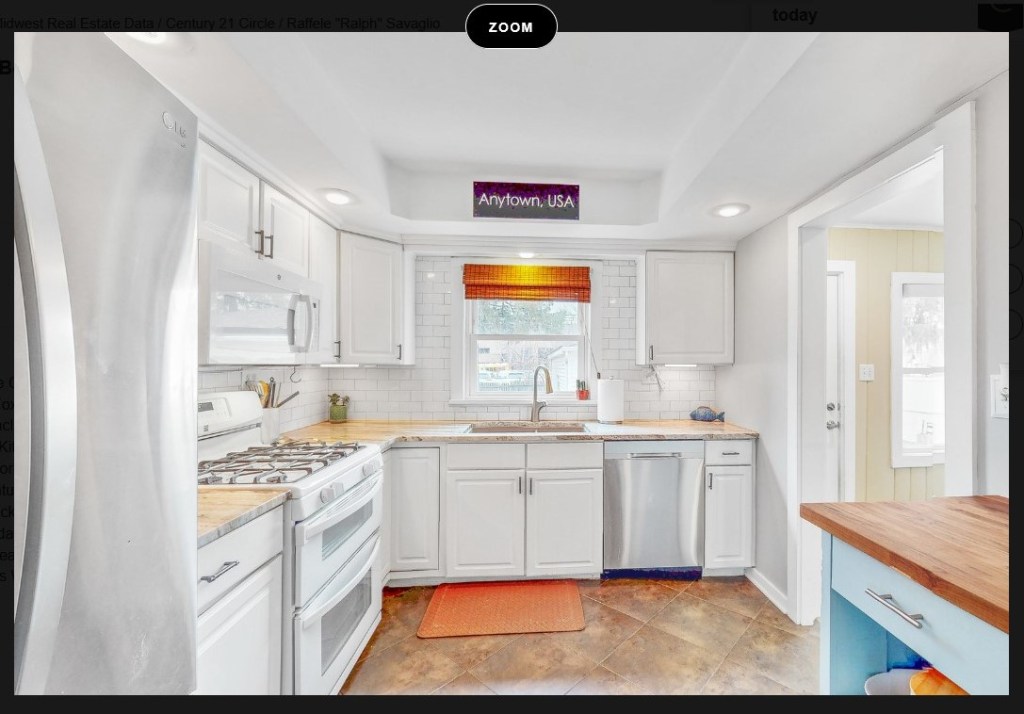
A home with an “Anytown, USA” sign

I recently saw a real estate listing for a suburban house that had an interesting sign in the kitchen. Above the sink was a sign for “Anytown, USA.”

It is a nice enough kitchen but why have such a sign? Is it meant to appeal to buyers from anywhere? Is it a comment on the placelessness of the suburbs? Was it a gift to the resident and they needed to display it somewhere?

In contrast, a homeowner might display markers of their local community. Instead of “Anytown,” there could be hints of the specific place in which the home is located. Perhaps a map or a poster for a local event or group or an object that could only be acquired or experienced in that community.

Perhaps the sign is in reference to some cultural work? Maybe there is a connection to a 2005 documentary about a New Jersey community or a 2009 film about the Iraq War or a 2021 children’s music album.

Another option: the sign is an AI generated image to provide some decoration for the home.

Now I am intrigued: how many people display “Anytown, USA” signs in their homes? Where can I buy home? Can someone outfit an entire home with a phrase used as a placeholder?

Two Chicago suburbs: one reinforcing its “welcoming city” status, one “reaffirmed…it is not a sanctuary city” and would work with ICE

How will different suburbs respond to the current situation in the United States regarding immigration? Two Chicago area suburbs are pursuing different approaches. Start with Skokie:

Photo by Matt Barnard on Pexels.com

Village of Skokie officials indicated at last week’s Village Board meeting that they will strengthen the village’s “Welcoming City” ordinance.

Trustee Khem Khoeun asked Mayor George Van Dusen if the village needed to update its welcoming village ordinance given recent immigration enforcement raids and the anxiety that some people in Skokie’s immigrant community are dealing with…

Van Dusen said Skokie’s existing ordinance was established during Trump’s first term in office, when the administration attempted enacting a travel ban for seven Muslim majority countries. The ban was ultimately blocked, but the effort apparently impacted Skokie residents.

Van Dusen recalled an incident in 2017 when a personal friend of his said her daughter in grade school was concerned she could be deported because she was Muslim, despite being born in the United States.

And then Orland Park:

Orland Park says its police will work with federal immigration agents on cases involving undocumented immigrants charged with or convicted of criminal offenses.

The Village Board recently adopted a resolution that also supports Senate Bill 1313 that would undo provisions of existing state law concerning law enforcement coordination with federal agencies such as Immigration and Customs Enforcement.

Trustees also reaffirmed Orland Park is not a sanctuary city, citing an ordinance approved by the board in January 2024…

The village said copies of the approved resolution would be sent to Gov. JB Pritzker and leaders in the Illinois General Assembly as well as Orland Park’s representatives in Springfield.

These suburbs could represent two opposite ends of a spectrum. They are different places with different locations in comparison to Chicago, different histories, and different residents. It is hard to know how many suburbs would have views similar to either one. There are hundreds of suburbs in the Chicago area and thousands across the United States. There will likely be a wide range of municipal reactions to immigration, including not making any resolution at all for a variety of reasons.

Will these resolutions be influential in the suburbs and in the state? Would businesses and residents make decisions to move to or stay in these suburbs when they pass these resolutions?

Another factor to consider: many immigrants to the United States move to and live in suburbs. They move to these two suburbs and suburbs like them. How much do these resolutions affect long-term patterns in the character of these suburbs?

An NFL team owner living in a suburban subdivision

Virginia McCaskey, long-time owner of the Chicago Bears, lived for many years in a suburban subdivision:

Photo by IVProduced MUSIC|MOODS|MEDIA on Pexels.com

She and her husband raised a family of 11 — the logical number for a huddle in the home — in a modest house in Des Plaines. Tim, a Bears vice president, died in 2011 and Michael died in 2020, both of cancer. In 1994, the McCaskeys moved to a ranch home one block away. Daughter Anne Catron moved into the old house.

“I probably live in the smallest house of any NFL executive, but that’s what Ed and I were comfortable doing,” McCaskey said. “That was our lifestyle and now I’m able to stay in that house by myself with wonderful neighbors and Anne is a block away.”

Imagine you are moving into a suburban neighborhood. As you meet the neighbors over time, you get a sense of what they do. One neighbor says they “own an NFL team.” Wait, what? What are the odds of this happening? There are only 32 NFL teams so there are a limited number of owners. And how many owners live in a “modest house” in the suburbs?

Two additional thoughts:

  1. This may point to a different era of ownership of pro sports teams. Franchises today are worth billions. This was not always the case. McCaskey’s father helped found the NFL when college football was more popular. Even in 1979, when McCaskey took over ownership, the Bears were not worth over $6 billion (their value now).
  2. The owner of the Chicago Bears, a team associated with the third largest city in the country, lives in the suburbs. How many pro sports team owners live in the suburbs (where a majority of Americans live)? (See this earlier post on how many baseball teams have stadiums in downtowns.)

The Chicago Tribune on the side of suburban commuters

An editorial in the Chicago Tribune details some of the issues commuters to Chicago face:

Photo by Cameron Casey on Pexels.com

But hope and optimism have their limits, even among the heartiest suburbanite, who likely saw the news about the Kennedy construction delay debacle and felt put upon and frustrated — but not surprised. After all, suburban commuters are just supposed to take it. Still, this one stings…

It’s not just the roads where suburban commuters get a rough deal — they’re constantly on guard against Metra fare hikes. Fares increased last year, and now Metra is threatening fare hikes again — plus service cuts — as the agency stares down the proverbial fiscal cliff. 

So the suburban commuter faces tortuous traffic on the highways, higher prices and worse service on the trains — yet the city wants them back downtown to buy their $20 lunches and restore the Loop’s economy. Businesses want the suburban commuter back downtown to occupy vast commercial office spaces to justify the rent. And everyone wants them to boost foot traffic, creating safety in numbers and making everyone feel a little safer walking to the office…

But the city often lacks warmth for the people trekking downtown. Not too long ago, the mayor of Chicago floated weaponizing taxes on suburbanites to extract more tax revenue via a Metra “city surcharge” and a “commuter tax” as a way to “make the suburbs … pay their fair share.” See above — they’re already paying a lot to get downtown. 

A hostile relationship between the city and the suburbs is no good. Suburban willingness to come to work downtown is a direct reflection on the city’s health. Is it safe? Is it clean? Is the restaurant scene thriving? If so, people will hop on the Metra and gladly make the trip. The more suburbanites, the better.

Four thoughts in response:

  1. What exactly would “warmth” for suburbanites look like?
  2. What about the many commuters in the region who go suburb to suburb? Are their trips easier?
  3. Do suburbanites need the city more or does the city need suburbanites more?
  4. Contrary to the zero-sum game assumption in #2 above, would it be better to think of suburban commuters and city residents as part of a larger metropolitan area? Better transportation options could be good for city and suburbs as could economic opportunities for both cities and suburbs.

Record high office vacancies in Chicago suburbs

More suburban Chicago office buildings were empty in 2024:

Photo by Burak The Weekender on Pexels.com

Meanwhile, 2024 brought an increase in suburban office vacancies — an all-time high of 26.3%, up from 25.4% a year earlier.

The suburbs are job centers. For example, the article notes, “Schaumburg is Illinois’ largest hub of economic activity outside of Chicago.” So to have a lot of empty office space is not a good thing. Owners of these buildings would prefer to have full offices as would municipalities who gain tax revenues.

Will upgrades to the buildings make a big difference? That is what the rest of the article suggests as workers and companies seek certain amenities to enhance the workspace and compete well against work from home options.

Also interesting to note is the redevelopment options if there is too much office space. For example:

Schaumburg officials hope to assist the office market by reducing its obsolete properties. This includes buying a 204,000-square-foot building to demolish for the village’s next police station and nearing approval to convert a 45-year-old Class B office building across from Woodfield into a 98-unit high-end apartment complex.

How many suburban communities would be willing to pull the plug on decent office space and go through all the effort it takes to redevelop the same land? If there is not demand for high quality office space, will other land uses bring in similar revenues and have similar levels of prestige? I would guess edge cities are not interested in losing that status but finding the right balance of offices, residences, and other uses could take time.

“Music for the ‘burbs” = what music genre or format?

If a radio station near you said they featured “music for the ‘burbs,” what do you think they would play?

Photo by Anthony ud83dude42 on Pexels.com

I do not know of a genre of music that would exclusively identify with the suburbs. As Americans moved to the suburbs in large numbers in the twentieth century for numerous reasons, music changed in the United States as well. This included new genres, new methods for playing and hearing music, and new audiences. And all of this happened on a mass scale; music could be produced, played, and listened to for and by millions of people.

Turning back to this particular station, would it be a surprise that they are a hot adult contemporary station? Here is how Wikipedia describes this subset of adult contemporary:

Hot adult contemporary (hot AC) radio stations play a wide range of popular music that appeals towards the 18–54 age group;[43] it serves as a middle ground between the youth-oriented contemporary hit radio (CHR) format, and adult contemporary formats (such as “mainstream” and soft AC) that are typically targeted towards a more mature demographic. They generally feature uptempo hit music from the last 25 years with wide appeal, such as pop and pop rock songs, while excluding more youth-oriented music such as hip-hop.[42][41] Older music featured on hot AC stations usually reflects familiar and youthful music that adults had grown up with.[44][41] Likewise, material from legacy pop acts such as the Backstreet Boys, Jason Mraz, John Mayer, and Pink is prominent within the format.[41][40]f

Pop music of the last few decades for 18 to 54 year olds is suburban music? Maybe more so than some other formats.

(The other part of this station’s tag line is that they broadcast from the ‘burbs. This contrasts with the majority of the radio stations in the area that identify with the big city.)

Immigration enforcement operations taking place in cities – and suburbs

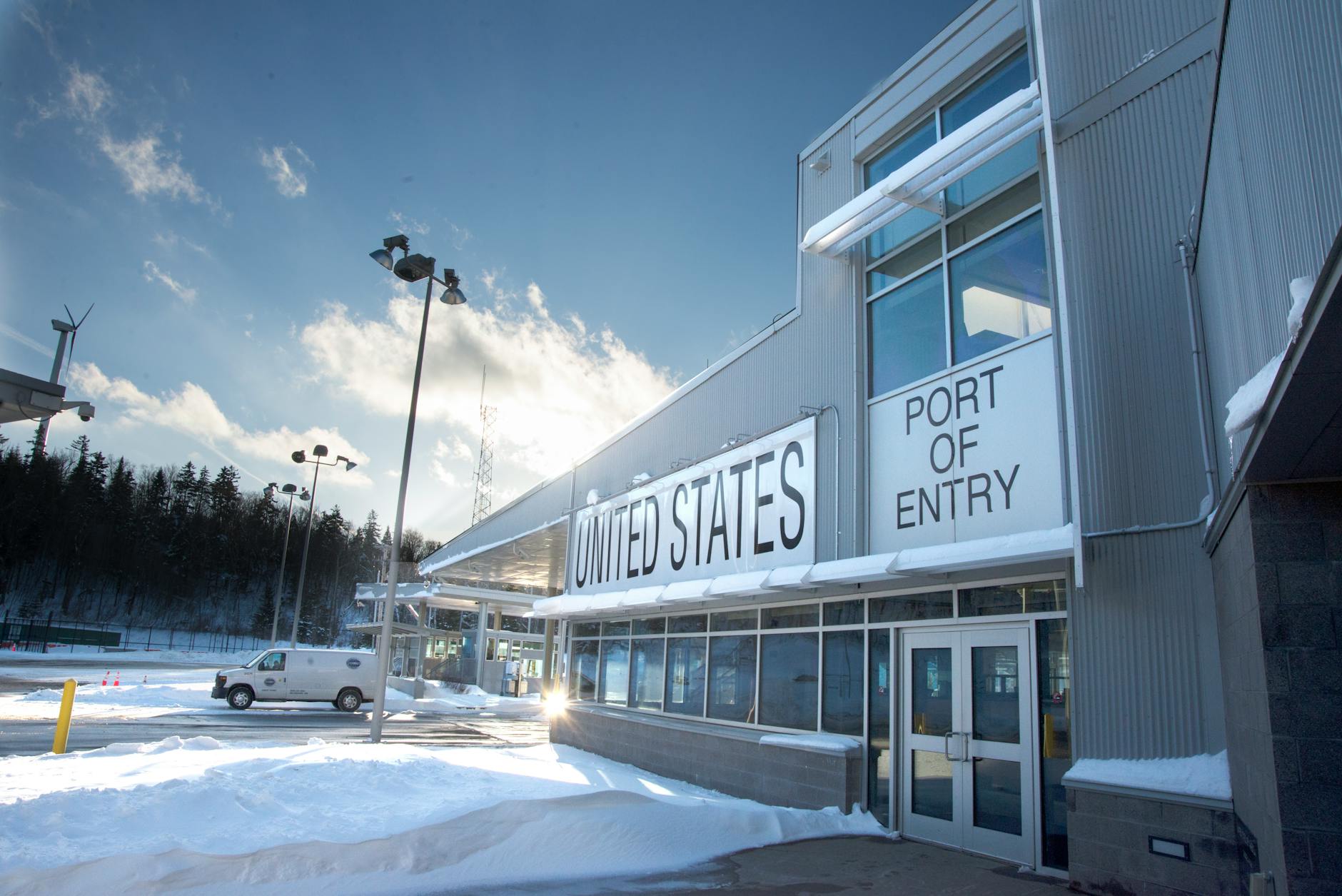
It is easy to find headlines regarding cities and U.S. Immigration and Customs Enforcement raids. But, reading a number of these stories shows these are also happening in suburbs. This one story detailing locations across the United States includes these suburbs:

Dallas, Texas, its eastern suburbs, and Lake Ray Hubbard by NASA Johnson is licensed under CC-BY-NC-ND 2.0

-Tucker, Georgia

-Irving, Arlington, and Collin County in Texas

-Federal Way, Washington

-Wilsonville, Oregon

Or see this story of operations in Chicago area suburbs.

These are suburbs of major metropolitan areas. Cities may be the target of particular political ire but there is less recognition that many people who come to the United States live in suburbs (or rural areas).

And how will suburbs respond to these federal efforts? When migrants were sent to suburbs of Chicago in 2023 from other locations in the United States, few suburban communities were interested in having them stay (see posts here, here, and here). A number of big cities have announced how they will respond but there are thousands of suburbs in the United States.

The normal suburban buildings where the National of Association of Evangelicals operated from for decades

In Sanctifying Suburbia, I look more closely at the locations of the National Association of Evangelicals in Chapter 4. As a group that purported to represent the interests of a growing evangelical movement from the 1940s onward, where did they locate their headquarters?

For decades, their headquarters were in two adjacent suburban communities roughly 25 miles from Chicago: Wheaton and Carol Stream. These two suburbs contain a cluster of evangelical organizations (discussed further in Chapter 5 and 6 of the book). In the late 1950s and early 1960s, the NAE had multiple locations in downtown Wheaton. According to the local phone books, their location in 1957 was 108 N Main. Here is a Google Streetview image of that address from June 2019:

This is the same block that was briefly shown in a Walmart Super Bowl ad a few years ago. When I walked past the location earlier this week, the building is undergoing a massive renovation.

In the 1960s, the NAE moved a few miles north to Carol Stream. They concluded their time in the suburb in an office building within an office and light industrial area. Here is what the property looked like a few years ago (a Google Streetview image from October 2016):

The organization was there until 1999 when they had a short sojourn to suburban southern California before moving the headquarters to Washington, D.C. in 2002.

These headquarters fit in a suburban landscape, the first in a two story brick building in an older suburban downtown with the second looking like many other small office buildings dotting suburbia, with little more than a sign marking them as spaces occupied by a religious organization. And from these suburban locations, the National Association of Evangelicals supported a growing evangelical movement across the United States.

A list of the 30 fastest growing wealthy suburbs includes two suburbs with population declines

I recently found a list of wealthy American with the most population growth. But I noticed that the list ends with two suburbs that lost population during the time period of interest (2018-2023). I suspect this might be because how they selected the communities on the list.

Photo by Altaf Shah on Pexels.com

Methodology: For this study, GOBankingRates analyzed suburbs to find the fastest-growing wealthy suburbs in America. First GOBankingRates found the places with a population between 25,000 and 100,000 according to the U.S. Census American Community Survey. The metro area for each location was found and only the metro areas with a population of 1 million or more were kept. With these suburbs isolated, the numerical and percentage change in population from 2018 to 2023 were found for each city using data from the American Community Survey Census from 2018 and 2023. For each location, GOBankingRates found total population, population ages 65 and over, total households, and household median income all sourced from the American Community Survey. Only places with a median household income of $150,000 or more were kept for this study. Using this data the percentage of the population ages 65 and over were calculated. The cost-of-living indexes were sourced from Sperling’s BestPlaces and include the grocery, healthcare, housing, utilities, transportation, and miscellaneous cost of living indexes. Using the cost-of-living indexes and the national average expenditure costs, as sourced from the Bureau of Labor Statistics Consumer Expenditure Survey, the average expenditure cost for each location were calculated. The livability index was sourced from AreaVibes for each location and included as supplemental information. The average single-family home value was sourced from Zillow Home Value Index for November 2024. Using the average single-family home value, assuming a 10% down payment, and using the most recent national average 30-year fixed mortgage rate, as sourced from the Federal Reserve Economic Data, the average mortgage can be calculated. Using the average mortgage and average expenditure costs, the average total monthly and annual cost of living were calculated. The cities were sorted to show the highest percentage population increase first to show the places with the fastest-growing wealthy suburbs in America. All data was collected on and is up to date as of Jan. 6, 2025.

The bigger question is this: how many suburbs in the United States of population 25,000 to 100,000 have median household incomes over $150,000? I suspect this is not a huge list. Hence, there are only 28 suburbs who meet this criteria and grew between 2018 and 2023.

But it may not take much to change the parameters to include more suburban communities on the list. For example:

  1. What if the median household income was $140,000? Is there a strong reason for leaving the cutoff at $150,000?
  2. Why limit the population to communities between 25,000 and 100,000? If the list could includ communities between 10,000 and 100,000, are there now more growing wealthy suburbs?
  3. Limiting the analysis to metropolitan areas with 1 million people reduces the number of possible regions and suburbs. If the cutoff is 1 million people in an MSA, this means a little over 50 regions are included. Lower the region’s population and you would have more suburbs that might meet the criteria.
  4. Change the list from 30 suburbs to 20 and then the last one on the list would have 5% population growth.

Who the nice new apartments in Chicago’s northwest suburbs are for

Multiple suburbs northwest of Chicago have constructed apartments in their downtowns and/or along transportation options. Who lives in these new residences? A VP for a real estate development firm answers:

Photo by Pixabay on Pexels.com

Suburbs such as Niles, Des Plaines, Buffalo Grove, Palatine, Wheeling, Elk Grove Village and Rolling Meadows no longer are flying under the radar. And based on strong supply-demand fundamentals as well as greater municipality support, the future looks even brighter for new rental options in the Northwest suburbs…

While those starting their careers continue to make up the bulk of renters, Gen Xers and baby boomers also are drawn to the maintenance-free and resort-like lifestyle renting offers them at a time when they are looking to downsize and enjoy retirement.

And with high interest rates and low for-sale housing inventory, even 30- and 40-year-olds who are in the thick of raising children and typically gravitate to single-family homes have turned toward renting in recent years — both out of necessity and choice.

The city of Chicago’s uncertain political environment and higher taxes also have increased the suburbs’ draw for some people, with rental communities near Metra stops or major expressways providing an appealing alternative for professionals who prefer the slower pace of the suburbs while still enjoying an easy commute.

And while there are suburbs hesitant to embrace rental housing, a growing number of municipalities understand the many economic benefits of new, high-quality rental options — such as increased foot traffic in their downtowns and activating underutilized sites.

If there is demand for housing, developers will want to build but suburbs often want housing that fits their particular goals and character. How will apartments fit into communities often full of single-family homes? What might apartments do to daily life in downtowns and around transportation corridors? Who will live in these apartments?

In my research on suburban development, I have seen discussion and debate involving all three of these questions. Focusing on the last one, the description above highlights the ideal apartment dwellers in suburbs. The first group is young professionals. These residents might be coming off finishing their education and are looking to establish themselves. They may have smaller households. They may not have the financial resources yet to purchase a home or they like the idea of living in a more vibrant location. Then there are those looking to downsize. They want an easier life. They may have owned homes in the past but do not need all that space or the trouble of maintaining a home and property. And “even” those who families may want to rent.

And these are not necessarily cheap or affordable rentals. These are places that are “high-quality” and “resort-like.” Their location near walkable amenities and transportation likely drives up demand and cost.

If the goals were to provide more units at prices accessible to more residents and prospective resident, the apartments might meet with more concern from local residents and leaders who could view them as threats to a particular quality of life and to their property values.