Changes in “countrypolitan,” exurban counties more than just political

The analysis of the 2020 election includes many analyses of suburban voters. But, there is more at stake here than just voting patterns as this look at Union County, North Carolina suggests:

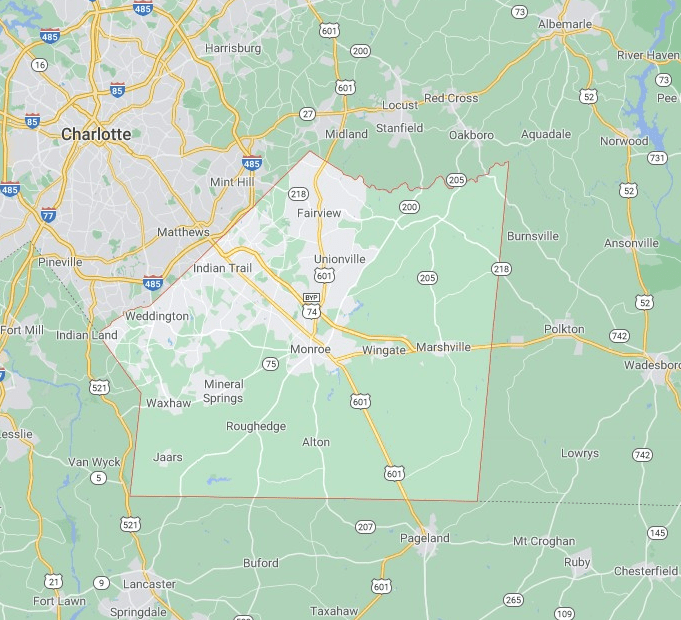
Google Maps – Union County, North Carolina

Union County is what one scholar terms a “countrypolitan” place: Under federal government designations, it lies within a metropolitan area, but it also has a strong rural and agricultural history. For the most part, it doesn’t look like a cookie-cutter suburb, nor is it impoverished. In fact, Union is North Carolina’s wealthiest county, according to the Census Bureau. There are places like it around the United States. They are distinct from rural areas, which are mostly Republican, and cities, which are heavily Democratic; many voters in these places are neither die-hard Trump fans nor urban liberals. That makes them pivotal counties, in 2020 and in the future.

Everyone agrees that Union County is changing. The question is how it’s changing, and how fast. There’s no doubt that Republicans will carry the county up and down the ticket this year—Carter, ensconced at East Frank, was the last Democratic presidential candidate to win here, back in 1980—but the GOP’s overall success in the state will hinge largely on how big a margin it is able to run up in exurban counties such as this one. Democrats’ control of inner-ring suburbs continues to strengthen, and the future of the Republican Party nationally depends on keeping firm control over places like Union County…

The reason Union County is changing is simple math. When Helms was born, about 4,000 people lived in Monroe. Today, nearly 36,000 do. Since 1990, the overall county population has almost tripled, from about 84,000 to roughly 240,000. As I traveled around the county, I began to notice something peculiar: Virtually everyone I talked with was a transplant. Some of them had moved only recently, and others had been around for 10 years, or 20…

“Union County when Jesse was in the Senate was a very rural county,” Wrenn says. “Now it’s got a big chunk of suburban in it. If the long-term trends continue, the Republicans are going to have to find a way to compete in the suburbs. It can be done, but you just have to change your whole way of thinking.”

The temptation in such stories about suburban voters is to look at counties and communities and just see political change. And it sounds like Union County has had its share comparing before the Civil Rights Era, after, and today.

The basic explanation for this recent change is new residents. The population has grown and new residents, not as familiar with the ways of Union County, have moved in. What was once a small population with low density is now much larger and in bigger cities and towns.

But, is this all that has changed: new people moved in and they came with some new political views? I suspect there is more going on here that both contributes to the political change and also exists outside of it. Here are a few possible factors at play:

  1. The suburbs and the spread of metropolitan areas are not just about increasing populations and higher population densities. The suburbs come with a particular way of life. People who seek out such locations want single-family homes, middle-class opportunities and peace for their family, responsive local government, and the ability to live in a place they chose with people who look more like them. This is different than a more rural or working-class character in communities. This desire for the American suburbs does not easily line up with either political party on all the issues but it certainly is a different way of life.
  2. The decline of agriculture, particularly family-owned farms and opportunities, could be at play here. As farming becomes more difficult or less desirable for subsequent generations, the land can be sold off and be turned into subdivisions. This is a significant change in land use as well as who lives there: farmers and those connected to agriculture versus middle-class suburbanites.
  3. Connected to #2, the economic landscape has changed tremendously in the last half-century or so, moving away not just from agriculture but also manufacturing and moving more toward retail, services, and a knowledge economy. Union County and many other locations in the United States are still trying to adapt to these large shifts that affect employment, tax bases, and local businesses.
  4. Numerous local institutions have likely had to adjust in light of growing populations. Schools need more space for kids. Local governments need to provide more services (and they might now have larger tax bases to draw on) and local officials are addressing new issues. Established churches now compete with new congregations. In sum, the civic and social institutions that may have existed for decades in roughly the same form now need to adapt. This can present challenges in any community.

In sum, this is not just about politics. A shift toward a suburban lifestyle in Union County has many consequences and politics may just be one of them.

Population density as a factor in deciding suburban votes

An AP story highlights how “Democrats march deeper into suburbia” and discusses the role of density:

https://apnews.com/article/election-2020-virus-outbreak-phoenix-suburbs-health-care-reform-76dea954e5f5dc13b3ad65fd29ac678c

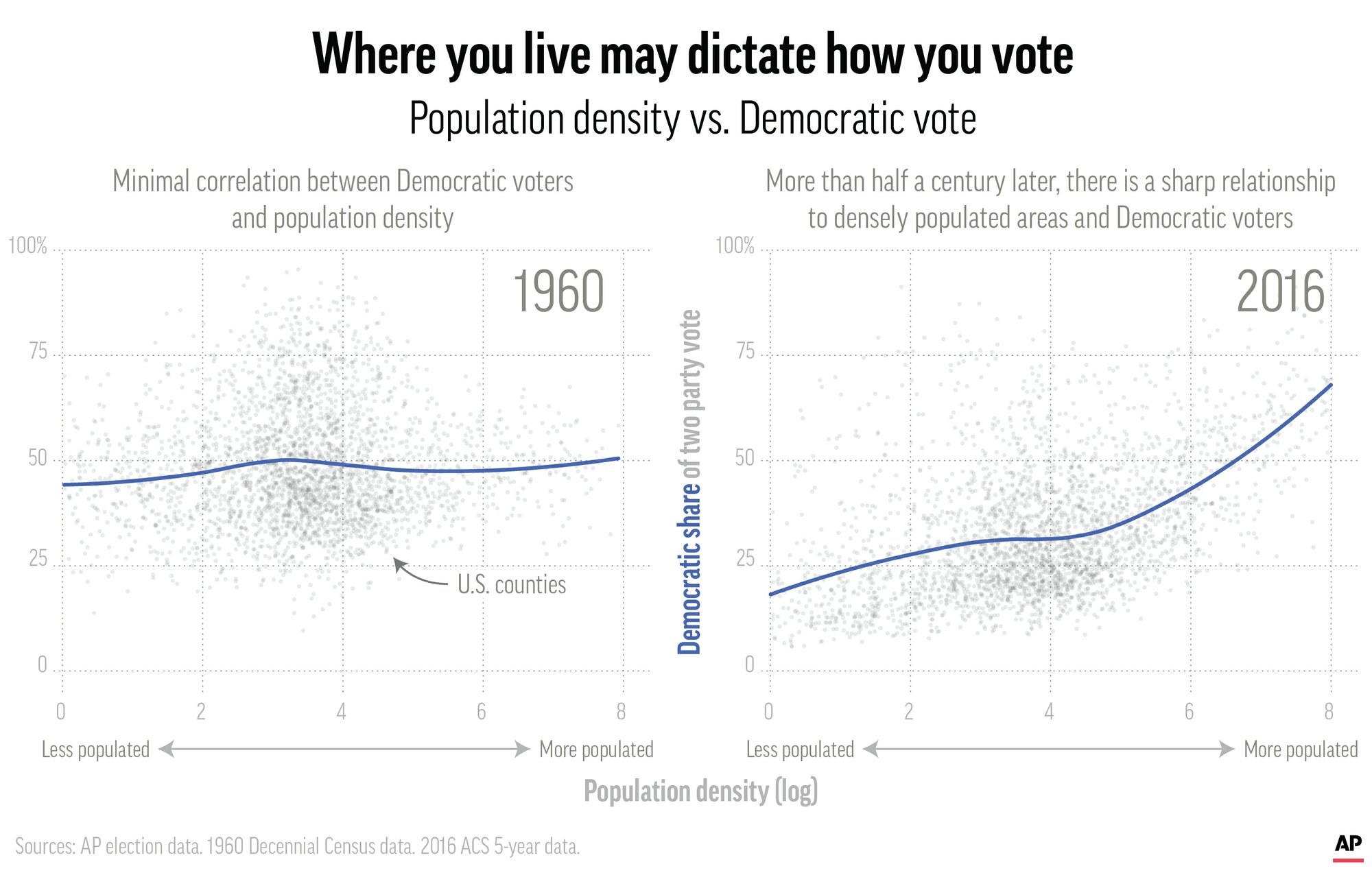
For decades, an area’s population per square mile has been a reliable indicator of its political tilt. Denser areas vote Democratic, less dense areas vote Republican. The correlation between density and voting has been getting stronger, as people began to sort themselves by ethnicity, education, personality, income and lifestyle.

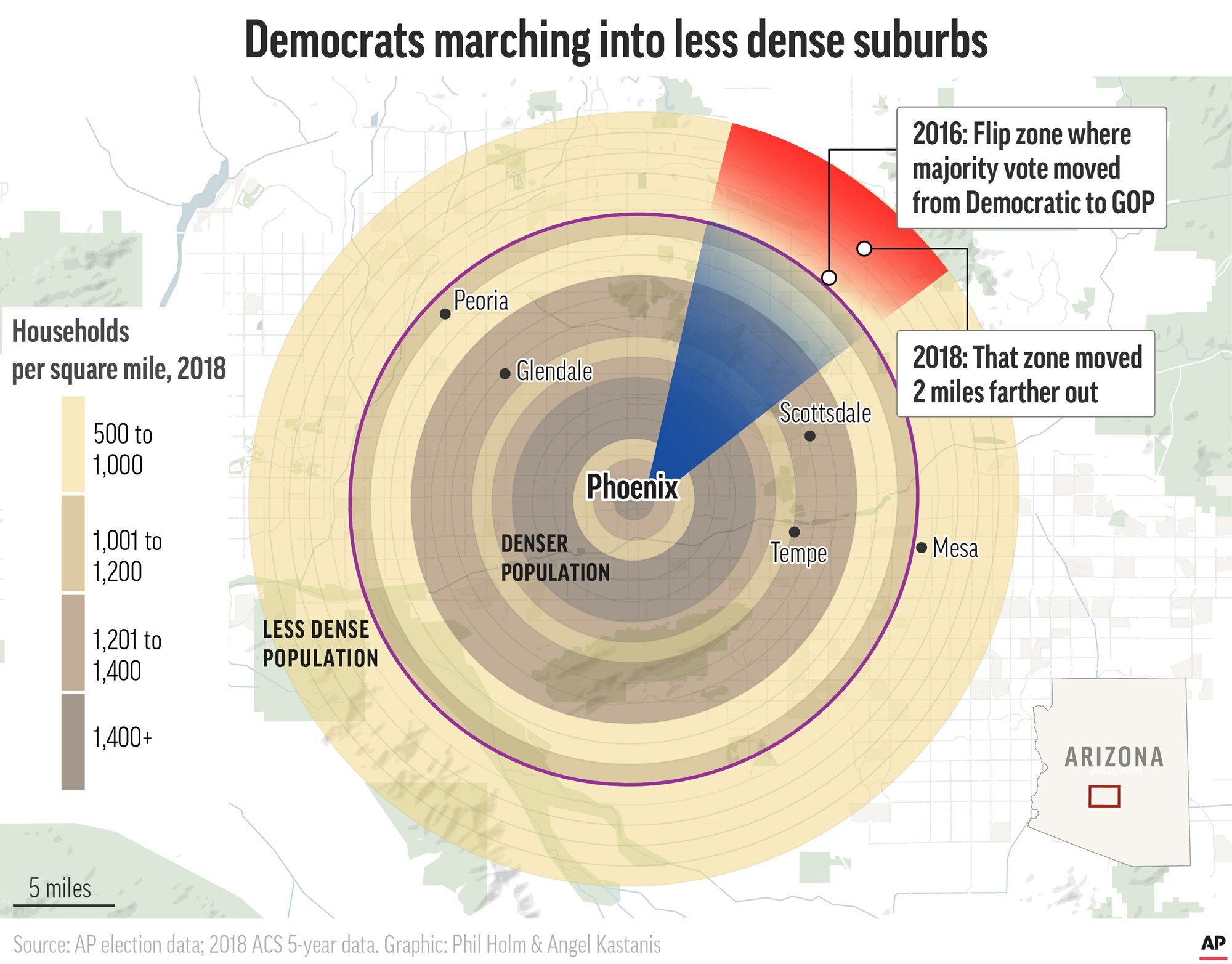
The pattern is so reliable it can quantified, averaged and applied to most American cities. At around 800 households per square mile, the blue of Democratic areas starts to bleed into red Republican neighborhoods.

A purple ring — call it the flip zone — emerges through the suburbs…

In Dallas, the purple ring through the suburbs was 18.7 miles in 2016 out from city hall, at an average of 714 households per square mile. The border runs close to AT&T Stadium in Arlington, where the Dallas Cowboys play. Arlington is a so-called boomburb that morphed through new construction from a suburb to a city of 400,000.

A few thoughts on the potential role of density. First, an additional graphic (see below) works with the last paragraph cited above to draw concentric circles a city. This, however, suggests density is linear as one moves further out from the city. In general, this may be true but it would be interesting to see how pockets of higher density suburbs at different distances from the city affect these patterns.

https://apnews.com/article/election-2020-virus-outbreak-phoenix-suburbs-health-care-reform-76dea954e5f5dc13b3ad65fd29ac678c

Second, Is it density that predicts these outcomes or factors related to density? A third chart in the story looks at the population demographics at different densities and shows differences. Does the density come first or the population changes? The analysis here suggests a relationship or correlation but it is not clear whether this analysis accounts for other possible factors.

In the larger picture, what do Americans think about having these “flip zones” or middle suburbs be the current political battleground? For example, one current argument about getting rid of the electoral college suggests certain parts of the country should not a disproportionate sway over other more populous parts of the country. Right now, these middle suburbanites, particularly in swing states, have the influence and both parties want their votes. Are the interests of these suburban voters the interests of the entire country?

What vision of the suburbs do President Trump and other Americans have?

With recent words, President Trump has suggested Joe Biden and Democrats want to destroy suburbs. To Trump, what are the suburbs? One columnist puts it this way:

frontyard at the village

Photo by Lisa Fotios on Pexels.com

Trump seems to have a suburb in his imagination, one that’s a remnant of the 1950s and 1960s. It’s populated entirely by white people, who came there to escape diversifying neighborhoods and are terrified that people of color might move in next door. These suburbanites can be pulled to the Republican Party with a proper dose of racialized fear.

Yet, the suburbs as a whole today do not look like this:

Trump seems to think it’s still 1973. But here’s his problem: The suburbs of today are very different than they were then. The suburbs are still majority white, but they’re more diverse than they were when Trump was refusing to rent to people of color. They have more immigrants, more people of color, more people with higher education — and critically, the white people who live there are rejecting Trump.

Suburbs have indeed changed – see this earlier post on complex suburbia. In multiple ways, suburban areas are now different. They have more nonwhite residents and more residents who are lower-class and working-class (as well as more who live under the poverty line). Some suburbs are classic bedroom suburbs populated by whiter and wealthier residents but there are also numerous suburbs that are more diverse and less well-off. Suburbs are now full of jobs, from manual labor and production jobs to elite white-collar positions.

While this story casts the issue in terms of voters and winning the 2020 election – and suburban voters are indeed crucial – there is a bigger issue at stake: what vision of American suburbs will win out? Here are three competing options:

1. The suburbs are the American Dream where anyone who works hard can purchase a single-family home, live with their family, and expect to live a relatively comfortable life and expect good things for their children. This is often tied to the mass suburbanization of the 1950s and 1960s – and this vision may have fully flowered at this point – but this ideology stretches back at least a few decades earlier.

2. The suburbs are the American Dream as they offer opportunities to all Americans who want to find the good life as defined by a decent job, a place to live, and peace and quiet. This would be a more multicultural vision of suburbs where the movement of minorities and those with fewer resources to suburbs in the last few decades represents progress and success as they too can enjoy a suburban lifestyle (and the dream of #1 was restricted largely to whites).

3. The suburbs are a dead-end for all Americans. According to critics of the suburbs, the emphasis on sprawling land use and driving, individual lives and private homes, and exclusion are not sustainable or desirable for future generations. While some people may want to live this lifestyle, we should encourage more Americans to live in denser communities.

No presidential election is a referendum on just one issue. At this point, the issue of suburbs is still not a front-burner issue: housing received limited attention at the Democratic debates and arguably Trump is more interested in discussing race and cities in ways to attract voters than he is in considering suburban life and its ongoing role in American life. Yet, this is an opportunity for Americans to think about what kind of spaces they want to encourage and inhabit in the future.

Some suburbanites do not like more explicit divisiveness or racism

With the 2020 presidential election riding on the suburbs, some suburban voters do not like the rhetoric and policies of President Trump:

young frustrated woman screaming with closed eyes

Photo by Andrea Piacquadio on Pexels.com

From North Carolina to Pennsylvania to Arizona, interviews this week with more than two dozen suburban voters in critical swing states revealed abhorrence for Trump’s growing efforts to fuel white resentment with inflammatory rhetoric on race and cultural heritage. The discomfort was palpable even among voters who also dislike the recent toppling of Confederate statues or who say they agree with some of Trump’s policies.

As the president increasingly stakes his candidacy on a message of “law and order,” casting himself as a bulwark against “angry mobs” and “thugs,‘’ there are signs that he is alienating voters in bedroom communities who approach the debate over racial justice with a far more nuanced perspective than the president does.

The disconnect is especially pronounced in the swing state suburbs like Cornelius — traditionally a conservative-leaning area — and along the Main Line outside Philadelphia, where some educated white voters, including some former Trump supporters, are repelled by the president’s divisive rhetoric…

While Trump won suburban areas overall by 4 percentage points in 2016, according to exit polls, white college-educated suburban women have rapidly moved away from his Republican Party, and they helped deliver the House of Representatives to the Democrats in 2018. And now, as some polling shows Trump facing competitive races even in deep-red states, he cannot afford to lose all of those voters again.

What could be behind this discomfort among some suburban voters? A few possible answers:

  1. Suburbanites do not often like open conflict or confrontation in their personal interactions with fellow suburbanites. This could also apply to contentious social issues. If a candidate, party, or figure is openly combative, this may be too much for suburbanites who prefer more polite, refined discourse. Suburbanites have a particular status to protect, particularly those with education, good jobs, and homes.
  2. Suburbia has changed quite a bit in recent decades. Suburbanites themselves, particularly in middle suburbs (stuck between the exurban Republican voters and the inner-ring suburb Democratic votersthe exurban Republican voters and the inner-ring suburb Democratic voters), may have changed views of the world. Perhaps more well-off suburbanites than before do now care about race.
  3. Perhaps this is all still unclear or undecided months out from the election. Some suburbanites are caught in the middle and right now do not like Trump’s approach. If the economy picks up and COVID-19 winds down, will these same voters show less concern about polarizing views? If social movements, which are now in the suburbs too, wane, will this make it easier to support Trump?

Which way these voters go could indeed help decide the 2020 election. Among other things, it will be interesting to see how the candidates pitch themselves to middle suburbia (even as they balance pitches to other groups).

Remember the suburban voters in 2020

As COVID-19 and police brutality pushed the 2020 presidential election off the front pages for months, recent poll data suggests suburban voters are breaking one way in national polls:

And while Trump has an edge with rural voters, Biden crushes him in the suburbs – which often decide how swing states swing.

Fifty per cent of suburban registered voters told the pollster they planned to vote for Biden, while 36 per cent said they’d vote for Trump.

And in Texas metropolitan areas:

A Quinnipiac University survey released last week found Trump leading Biden by 1 point in Texas. Trump leads by 2.2 points in the RealClearPolitics average.

Texas Republicans are primarily worried about their standing in the suburbs, where women and independents have steadily gravitated away from the GOP since Trump took office.

Republican support has eroded in the areas surrounding Houston, Dallas, Austin and San Antonio, four of the nation’s largest and fastest growing metro areas. Democrats defeated longtime GOP incumbents in Houston and Dallas in 2018.

More background on trying to find a suburban “silent majority”:

The suburbs — not the red, but sparsely populated rural areas of the country most often associated with Trump — are where Trump found the majority of his support in 2016. Yet it was in the suburbs that Democrats built their House majority two years ago in a dramatic midterm repudiation of the Republican president.

Now, Trump’s approach to the violence and unrest that have gripped the nation’s big cities seems calibrated toward winning back those places, in the hopes that voters will recoil at the current images of chaos and looting — as they did in the late 1960s — and look to the White House for stability…

Five months before the general election, according to national polls, the political landscape for Trump is bleak. But there is a clear window of opportunity: Trump remains popular in rural America, and he won the suburbs by 4 percentage points in 2016 — largely on the backs of non-college-educated whites.

There are millions more potential voters where those came from — people who fit in Trump’s demographic sweet spot but did not vote. They live in rural and exurban areas, but also in working class suburbs like Macomb County, outside Detroit. They are who Republicans are referring to when they talk about a new “silent majority” — the kind of potential voters who, even if disgusted by police violence, are not joining in protest.

This probably bears repeating: the American suburbs of today are not solely populated by wealthy, white, conservative voters. This is the era of complex suburbia where different racial and ethnic groups as well as varied social classes live throughout metropolitan regions.

Relatively little media coverage has examined how COVID-19 or police brutality has affected suburbs or how suburbanites feel about all the change. While just over 50% of Americans live in suburbs, coverage emphasized urban areas. And what do suburbanites think when they see these images of urban life, policing, and protest that they may or not understand on an experiential or deeper level?

Looking at a single suburban district to hint at 2020 elections

The quest to read the suburban political tea leaves for 2020 is on with eyes focused on a Texas legislature race outside of Houston:

The legislative stakes of Tuesday’s election in House District 28, a rapidly-diversifying suburb of Houston, are relatively low. Whoever wins likely will not even cast a single vote before they have to face re-election in November, as the Legislature does not meet this year. And even if Markowitz wins, Texas Republicans would still control the House by eight seats.

But Democrats are itching to demonstrate on Tuesday that Texas is a competitive state that will be up for grabs in 2020. Texas has 38 votes in the Electoral College; only California has more, with 55. Many say that the district, which is part of the ethnically diverse Fort Bend County, is representative of the demographic changes happening in suburbs around the Lone Star state — trends that could shift electoral results in Democrats’ favor.

“Fort Bend County is representative of what is happening in Texas writ large. There are a lot of immigrants,” said Brendan Steinhauser, a Texas-based Republican strategist who ran GOP Sen. John Cornyn’s 2014 campaign. “Republicans want to hold this and need to hold this to say: ‘Look, we can stem the tide of the Blue Wave that everyone is talking about.’”…

Former Vice President Joe Biden, Sen. Elizabeth Warren, D-Mass., and former New York City Mayor Michael Bloomberg, have all endorsed Markowitz. Former Secretary of Housing and Urban Development Julián Castro, a native of San Antonio and a former 2020 candidate, has campaigned for her in the district. And O’Rourke, fresh off his failed presidential bid, has spent days at a time in the district, energizing the Democratic base and personally going door to door urging people turn out for Markowitz.

With suburban voters in the balance, both parties plus observers are looking for signs of how suburban voters as a whole will fall in the November 2020 elections. Is demographic change enough to lead to a shift in party affiliation? Will national issues, particularly with the president, dominate or will more local concerns prove influential? How much do individual candidates in such districts matter versus broader patterns and influences?

From a Houston news source:

“Fort Bend County is one of the most diverse counties in the nation. Now we have Indians, Asians, Mexican, Hispanic background, Cuban, Latin American, from all over the world,” Cantu said….

But Republicans, like Jason and Elizabeth Walker, have been relocating to the district too. The couple moved to Katy from San Francisco 10 years ago. Jason works in human resources and is a GOP precinct chair. He said the region may have gotten bigger, but people still care about the same issues, “which are keeping taxes low, having good schools…and keeping Fort Bend a place that is a great place to live for families.”

While both political parties would want to secure districts like these for their side, it looks like a number of suburban districts will be contestable in the near future. And suburbs will continue to change, pushing both parties to look for messages and platforms that resonate with suburban voters.

Win the suburbs, win 2020; patterns in news stories that make this argument

More than a year away from the 2020 presidential election, one narrative is firmly established: the path to victory runs through suburban voters. One such story:

Westerville is perhaps best known locally as the place the former Ohio state governor and Republican presidential candidate John Kasich calls home. But it – and suburbs like it – is also, Democrats say, “ground zero” in the battle for the White House in 2020…

In 2018, Democrats won the House majority in a “suburban revolt” led by women and powered by a disgust of Donald Trump’s race-based attacks, hardline policy agenda and chaotic leadership style. From the heartland of Ronald Reagan conservatism in Orange county, California, to a coastal South Carolina district that had not elected a Democrat to the seat in 40 years, Democrats swept once reliably Republican suburban strongholds…

“There is no way Democrats win without doing really well in suburbs,” said Lanae Erickson, a senior vice-president at Third Way, a centrist Democratic thinktank…

“There are short-term political gains for Democrats in winning over suburban voters but that doesn’t necessarily lead to progressive policies,” she said. In her research, Geismer found that many suburban Democrats supported a national liberal agenda while opposing measures that challenged economic inequality in their own neighborhoods.

Four quick thoughts on such news reports:

1. They often emphasize the changing nature of suburbs. This is true: the suburbs are becoming more racially, ethnically, and economically diverse. At the same time, this does not mean this is happening evenly across suburbs.

2. They often use a representative suburb as a case study to try to illustrate broader trends in the suburbs. Here, it is Westerville, Ohio, home to the Tuesday night Democratic debate. Can one suburb illustrate the broader trends in all suburbs? Maybe.

3. They stress that the swing voters are in the suburbs since city residents are more likely to vote for Democrats while rural residents are more likely to vote for Republicans. It will be interesting to see how Democratic candidates continue to tour through urban areas; will they spend more time in denser population areas or branch out to middle suburbs that straddle the line between solid Republican bases further away from the city and solid Democratic bases closer to the city?

4. Even with the claim that the suburbs are key to the next election, this often sheds little light on long-term trends. As an exception, the last paragraph in the quotation above stands out: suburban voters may turn one way nationally but this does not necessarily translate into more local political action or preferences.

Democrats want suburban voters!

(And so do Republicans but this ABC News story details the efforts of Democrats🙂

The effort, which will target areas that will likely define the 2020 presidential contest, kicks off on Thursday with a roundtable event, hosted by Democratic National Committee Chair Tom Perez, alongside local Texas residents in the suburbs of Harris County…

“Suburban voters sharply rejected Republicans in 2018 and they’re ready to hold Trump accountable in 2020,” said David Bergstein, DNC Director of Battleground State Communications. “They’re fed up with his toxic health care agenda, failure to support commonsense gun safety measures and endless string of broken promises on a number of issues.”…

Exit poll analysis following the 2018 midterms completed by Langer Associates for ABC News shows that the suburban voters comprised half of the American electorate. While Democrats won over urban residents and Republicans won over small cities — the suburbs were split evenly, 49-49%…

“The theory is that former Republicans in the suburbs were content with Republican policies on the economy, maybe even immigration to an extent,” she continued. “But some of the rhetoric that the president uses and some of the policies that Republicans have embraced, are maybe not in line with the Republican Party of George Bush.”

A few responses to this article (and similar ones):

  1. That suburbanites are monolithic in their political views (and in other parts of their lives). I assume campaigns know this but this generally does not come out in the media much. The stereotype of white wealthy families living in the suburbs does not always hold.
  2. Everyone is looking for trends among suburban voters. It can often be difficult to see trends when we are in the middle of changes. For example, the article wonders if the trend away from Republican suburban voters is a trend that is here to stay or could be reversed. Either could be true? (Though we can make educated predictions; but see #1 above for the ongoing changing population composition of American suburbs.)
  3. A relatively clear pattern in suburban voters seems to be a divide between suburbanites living closer to cities who lean toward Democrats and suburbanites closer to the metropolitan edges who lean toward Republicans. This leaves a middle suburbia that can go either way. But, again, see #1 above regarding a much more diverse and unevenly settled suburbia.
  4. The American electorate should be slightly more than half of the voters since the percentage of Americans living in suburbs is roughly 52%.

Analysis suggesting suburban women could decide 2020 election

The suburbs continue to be a key geographic battleground in national politics. Analysts suggest suburban women may decide the 2020 presidential election:

Many professional, suburban women — a critical voting bloc in the 2020 election — recoil at the abrasive, divisive rhetoric, exposing the president to a potential wave of opposition in key battlegrounds across the country.

In more than three dozen interviews by The Associated Press with women in critical suburbs, nearly all expressed dismay — or worse — at Trump’s racially polarizing insults and what was often described as unpresidential treatment of people. Even some who gave Trump credit for the economy or backed his crackdown on immigration acknowledged they were troubled or uncomfortable lining up behind the president.

The interviews in suburbs outside Philadelphia, Milwaukee, Detroit and Denver are a warning light for the Republican president’s reelection campaign. Trump did not win a majority of female voters in 2016, but he won enough — notably winning white women by a roughly 10 percentage-point margin, according to the American National Election Studies survey — to help him eke out victories across the Rust Belt and take the White House…

The affluent, largely white and politically divided suburbs across the Rust Belt are widely viewed as a top battleground, the places where Trump needs to hold his voters and Democrats are hoping to improve their showing over 2016.

If large numbers of suburban women are turned off by the action and rhetoric of the current president, it will then be interesting to see if his opponents craft messages to specifically target these same voters. If parties and candidates generally think they know what urban and rural voters want to hear, how will they adjust to suburbanites who are living in fairly complex and varied settings?

For example, the concerns of residents in more affluent suburbs may not match that well with larger political and cultural issues parties and candidates want to address. What if these voters are more akin to “dream hoarders” who want to secure their own positions more than they care about larger issues?

Chicago area voter turnout around 13-15%

The Daily Herald describes the low turnout in municipal elections in the Chicago area a week ago.

Only 13 percent of the suburb’s registered voters cast ballots in Tuesday’s election, the lowest rate for any election since at least 2006…

With hundreds of races in each county, some drew more voters than others. The Hinsdale High School District 86 tax hike question in DuPage County brought more than 40 percent of the district’s voters to the ballot box, with the looming threat of massive extracurricular cuts if the request didn’t pass. It did.

But scores of other races had less than 5 percent turnout, according to vote totals available on some election websites, mainly because they weren’t contested…

The growth in actual voters is little comfort to political scientists, local politicians and suburban election officials, who worry low voter turnout shows a dangerous level of apathy by the electorate.

While the article tries to bring out the positive news – there are more registered voters compared to the last set of municipal elections and some races had higher turnout races – it is hard to sugarcoat these figures. The Chicago suburb in which I live had low turnout for the first mayoral race in years. These local elections can have a significant impact as local leaders react to external pressures as well as have internal discussions. Not every local official makes significant changes and many local officials may run to make small improvements and preserve the nature of their community. At the same time, many communities have key moments in their past to which they could point to as sending the community down a different route and altering the community’s character.

Again, if Americans claim to like local government and local control in suburban settings, why do they not vote in larger numbers for the officials who will help guide their communities and local governments?