What does “going full sociology professor” mean to conservatives?

One recent eventful flight may just confirm all the conservative stereotypes of sociology professors:

“The United States has declared war on Venezuela!” a woman aboard a plane says repeatedly in the video.

The Miami New Times identified the woman as 52-year-old Karen Halnon, an associate professor of sociology at Pennsylvania State University-Abington…

“In a democracy one must speak up and against injustice,” Halnon said in an e-mail to The Post on Tuesday after saying in another email that she was mistreated during her arrest. “To be tortured is not democracy!”…

According to “Inside Edition,” Halnon said she was not intoxicated. “Anyone who is speaking out for social justice, it is the usual situation that most people will think they’re crazy,” she said, according to the show’s news release…

The release noted that Halnon said she lit a cigarette on the plane “to show solidarity with her idol, Cuban dictator, Fidel Castro.”

Airplanes are not the best places to light up and loudly espouse political views. (I do wonder, however, if certain topics might be viewed more favorably by other passengers. What if the airline service was bad and a passenger got up to deliver a populist rant?) Here we have a sociology professor who wants to be deviant (political views, smoking, rant on a plane) in order to promote social justice as well as defend left-wing or Marxist regimes. According to conservatives, isn’t this what all sociology professors do or would secretly like to do?

This is one of those times that it would be interesting to gather a large group of sociologists to see how they would respond…

Financial problems at the FHA: homeownership for many vs. the private sector

The Federal Housing Administration may be helping the lower ends of the housing market but it is also running into some financial difficulties:

The House Financial Services Committee heard testimony from Housing and Urban Development Secretary Julian Castro on Feb. 11 and the Housing and Insurance Subcommittee heard from several witnesses on Feb. 26…

Historically, the FHA has controlled about 10 to 20 percent of the mortgage market. But after Congress increased the size of mortgages the agency could insure from $360,000 to $625,000, the FHA controlled about 60 percent of the low down-payment mortgage market from 2008 to 2010. That means the income eligible for FHA mortgage insurance went from the national average of about $64,000 to $110,000. Put another way, more than twice as many people can get FHA insurance than they could before the limit was raised.

At the same time that eligibility has exploded, FHA has faced serious solvency problems, culminating in a $1.7 billion bailout from the U.S. Treasury at the end of 2013. The Congressional Budget Office estimated that FHA insurance cost taxpayers $15 billion from 2009 to 2012. Nonetheless, the agency’s website falsely claims it “is the only government agency that operates entirely from its self-generated income and costs the taxpayers nothing.”

Even with all of the taxpayer money that has been thrown at the agency, the FHA is seriously undercapitalized. The law says FHA needs to keep 2 percent cash on hand, which would be about $18 to $20 billion, but as of the beginning of 2015, it had only less than half of 1 percent, or $4.7 billion.

This piece was written by an activist against government waste yet it highlights the contrast of priorities: homeownership for many versus letting the market sort this out. Americans, including politicians and presidents, have pushed homeownership for decades. We assume this is a positive outcome as people will take better care of their property if they own as well as enjoy the status and privacy of their own home. Yet, if homeownership were entirely left to the private sector, the lower end of the housing market may not do very well. Even with the efforts of the FHA in recent years, we can see some of this in action: luxury building is booming in places like New York and Miami as cheaper and smaller homes don’t generate as much profit. In the recent past, the private sector resorted to tricks to help lower-income borrowers but we saw how those subprime loans worked out for everyone.

In other words, if Americans want homeownership as a social good available to many, it still needs to be worked out how this can be done effectively.

Perhaps the drop in property values in Ferguson could prompt change

The fallout from last year’s events in Ferguson, Missouri continues including this look at the changes in property values:

For the city’s 2014 budget, approximately 20 percent of the city’s revenue came from the city’s courts, and 17 percent came through property taxes. But after a Department of Justice report found the courts were profiting off racial discrimination, the State of Missouri took over to implement reforms. Couple that with rapidly falling property values (which are used to calculate owed taxes) and it seems like key parts of the city’s business plan are falling out from under it…

The average selling price of a home in the city has been on a steady decline since the shooting of Brown last August, according to housing data compiled from MARIS, an information and statistics service for real estate agents. Prior to Brown’s death, the average home sold in 2014 was selling for $66,764. For the last three and a half months of the year, the average home sold for $36,168, a 46 percent decrease.

The trend has continued on through this year, with the average home selling for only $22,951 so far in 2015. Another negative indicator: in the eight and a half months leading up to Brown’s death, the average residential square foot in 2014 was selling for $45.82. In the eight and a half months since Brown’s passing, the average residential square foot in the city has sold for $24.11. That’s about a 47 percent downtick in one of real estate’s core indicators.

In the suburbs, where quality of life (including factors like crime, the quality of the houses, performance of the local schools) is paramount in (1) influencing housing values and buying and selling real estate and (2) building a tax base through attracting businesses and organizations, infamy is not a good thing. But, given the patterns of local treatment of people by police in the area, it is hard to see how this wouldn’t affect housing values and the tax base. When given options across the suburbs of St. Louis, how many homeowners or companies would choose to move to Ferguson? And, if we’re honest, hitting suburbanites where it really matters – property values and their tax base (the double whammy of housing and land values going down while property taxes may need to increase to close the gap) – may be what is needed to prompt change.

Even affluent Chicago neighborhoods, like Lincoln Park, have lost significant numbers of residents

Rust Belt cities like Chicago have declined in population since the mid-1900s and the population loss is not just limited to poorer neighborhoods:

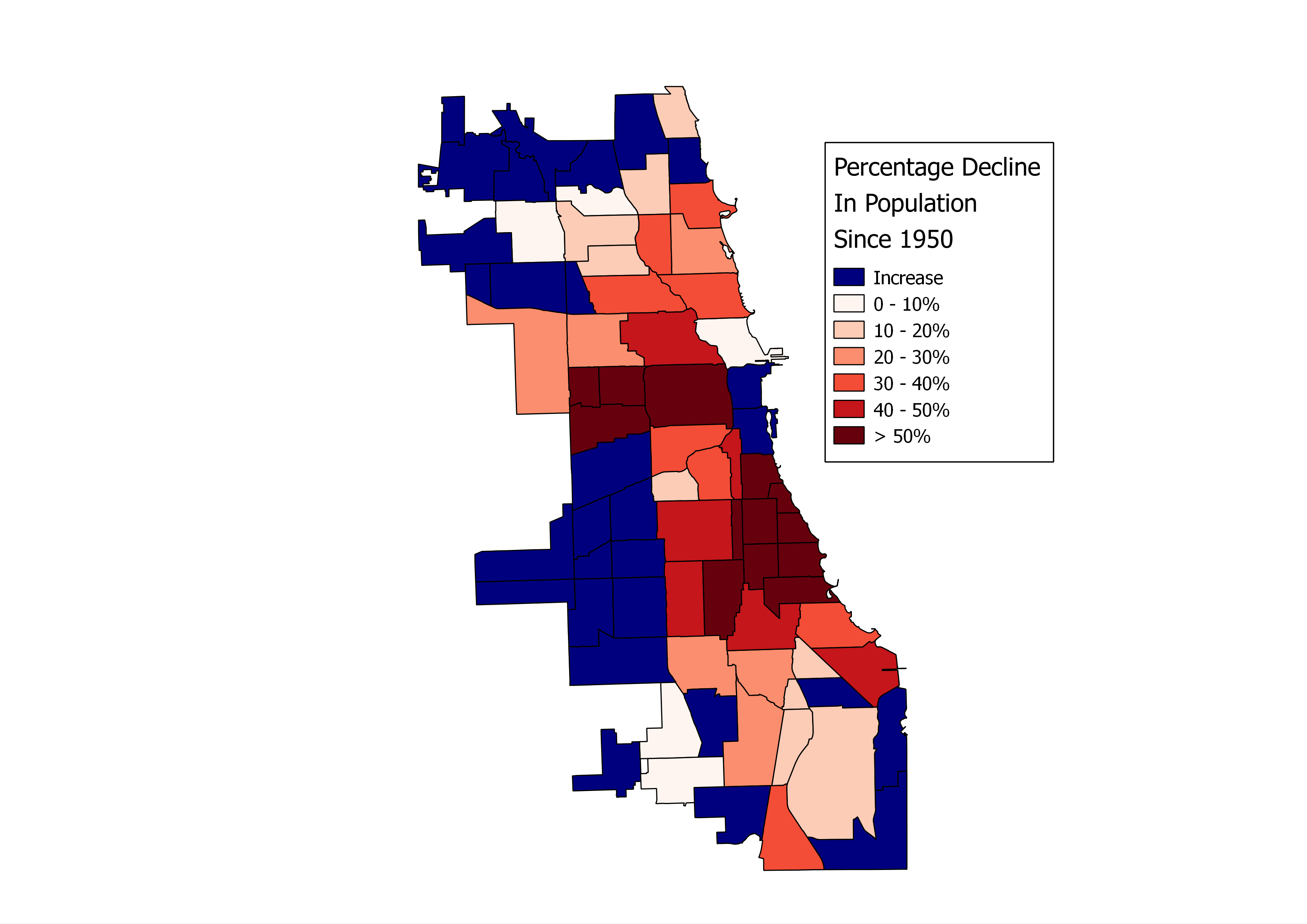
For a long time, most accounts of Chicago’s lagging population have focused on parts of the South and West Sides where many residents, largely African-American, have decided to decamp for the suburbs or the South in search of better schools, less crime, and more jobs.But the under-appreciated flip side of population loss in those parts of the city is that places that ought to be growing like gangbusters are stagnant, often sitting 25% to 50% below their peak populations. Lakeview, for example, was once home to 124,000 people; its population is now 94,000. North Center is down from nearly 49,000 to under 32,000. West Town, which includes Wicker Park and Bucktown, has fallen from 187,000 to 81,000.

Decline5010

What explains the population loss in even popular neighborhoods? Here is one possible answer:

Since replacing a couple two-flats with a courtyard building is now illegal, developers make money by tearing down an old two-flat and building a luxury two-flat in its place. Or they build a mansion, and the neighborhood actually loses a housing unit. As a result, as a neighborhood becomes more attractive, the city encourages fewer people to live there.

Zoning (theoretically based on improving the neighborhood) plus chasing profits may just lead to population loss. This could be balanced out by approving more high-density housing in a particular area (like the Loop are in specific portions of popular neighborhoods as to limit their effect) but that leads to major changes in two places.

It is still worth noting that the areas that seen an increase in population are either (1) the Loop with a reemphasis on residential construction and (2) community areas on the edges of the city which other lower densities as well as potentially more open land since 1950.

McKinsey predicts drop in car ownership (after 2040) due to self-driving cars

McKinsey suggests one side effect of self-driving cars will be less need for owning one:

But it’s in Phase 3, after 2040, that the fun begins. This is the point where autonomous cars become our primary means of transport, and all the rules are up for debate. Just as car design will fundamentally change once things like forward-facing seats, mirrors, and pedals are no longer necessary, the way we structure physical space could evolve: McKinsey predicts that by 2050, we might need just 75 percent of the space we now reserve for parking our cars. Because this is America, that means we get back 5.7 billion square meters of space—enough to hold the Grand Canyon and then some. That’s because autonomous cars can pack themselves together tightly (no need to allow space for human to exit).

More than that though, our entire idea of car ownership could change. Currently, cars sit unused about 95 percent of the time. That leaves a lot of room for improvement in terms of how we allocate resources.

We won’t stop buying cars altogether—people will still want the option to “independently drive and use the vehicle, and have fun doing so,” says Kaas— but we will buy fewer cars. Without the need for a human at the helm, one autonomous vehicle could take the place of two conventional vehicles: If Joan is going golfing and Joe needs to go shopping, a single car could drop Joan off at the club, swing back to the house to take Joe to the supermarket and back, then return to the club and get Joan. Kaas also predicts you could see the rise of private commuting services, shuttling customers around for a fee.

The recurring theme in the McKinsey report is that the consumer wins. Yes, cars crammed full of high-end technology will likely cost several thousand dollars more than they do today. But “drivers” will save money in the form of regained time (spend your commute working instead of driving!) and many fewer accidents: McKinsey pegs the savings on repair and health care bills alone at $180 billion in the US, predicting a 90 percent drop in crashes.

Cars are expensive so this could theoretically save money (as long as the new autonomous cars have reasonable price tags) and offer more convenience. Yet, it could take a lot to overcome the American love of cars. They aren’t simply about convenience or getting from Point A to Point B (and Americans would always choose mass transit if it were more convenient and effective). It is about other ideas in the American Dream, about freedom and independence and having a status symbol and being mobile. Perhaps by 2040, these things won’t matter as much as we all adjust to autonomous vehicles (and perhaps legislation that makes them the norm for safety’s sake). But, this isn’t just a technological change; this requires some big cultural changes as well.

Cracking down on massive hide-and-seek games in Ikea stores

Ikea in the Netherlands has banned viral hide-and-seek games inside its stores:

Ikea has quashed the dreams and shortened the bucket lists of tens of thousands people, saying it won’t allow several guerrilla hide-and-seek games to take place in its stores in the Netherlands. “It’s hard to control,” an Ikea spokeswoman told Bloomberg. “We need to make sure people are safe in our stores and that’s hard to do if we don’t even know where they are.”

More than 57,000 people were invited to participate in a May 16 game of hide-and-seek at the Ikea in Eindhoven, Netherlands, according to a Facebook page for the event, with about 32,000 people RSVPing. Twelve thousand were invited to a similar event at an Ikea in the Netherlands’ Breda on May 9. Had either game moved forward, it could easily have broken Guinness’ record for the world’s largest game of hide-and-seek, which was set in January 2014 in China and involved a mere 1,437 participants.

While this isn’t the first time Ikea has contended with plans for massive hide-and-seek outings in its stores, it may be the first time the company has banned them outright. A game that took place in 2009 at an Ikea in Sweden reportedly attracted about 150 people and forced organizers to apologize for the “whooping and cheering” that scared customers straight out of the store. And when thousands of people in Melbourne, Australia, signed up to play hide-and-seek at an Ikea the following year, the company said it would “discourage” customers from participating in the event but would not “go so far as to ban them.”

At any rate, the more interesting question here is how many people an Ikea store could reasonably host for a game of hide-and-seek, were the company’s management to get on board. The Eindhoven store, which opened in 1992, is 28,600 square meters, according to Ikea’s website. That’s about the same as four standard soccer pitches, or 5? American football fields. Let’s stipulate that for a really good game of hide-and-seek, you need at least 20 square meters (about 225 square feet, or a 15-foot-by-15-foot spot to stand in). Less than that and you might as well play sardines or blob tag instead. Also, presumably not all 28,600 square meters in the Eindhoven store are usable space, or even accessible to customers looking for hiding spots.

Think of all the hiding places! I’m not surprised that safety was the primary reason for banning the games though I assume the real reason was that this could be bad for business. (Yet, how many of the game players would purchase something – from meatballs to another Billy bookcase) on the way out?) If you think about it, a lot of businesses could be overwhelmed by such viral efforts. (Maybe all those extra parking spots mandated in American parking lots would then be filled.) How far away are we from outright bans on indoor games in multiple countries or from other stores and businesses as well?

At the same time, why doesn’t Ikea turn the tables on this and host some special hide-and-seek events with a lottery system for participants. This could generate good publicity and reestablish the brand’s cool factor.

The cities where the super-rich live

Richard Florida has the rankings of where the super-rich around the world live:

London is the world’s top location for the super-rich, with 4,364 people with $30 million or more in assets. Tokyo is second with 3,575, followed by Singapore (3,227), New York (3,008) and Hong Kong (2,690). The table below shows the top 20 cities with the most ultra-high-net-worth individuals.

Rank

City

Number of Super-Rich

Percentage of Total

Global Super-Rich

1

London

4,364

2.5%

2

Tokyo

3,575

2.1%

3

Singapore

3,227

1.9%

4

New York

3,008

1.7%

5

Hong Kong

2,690

1.6%

6

Frankfurt

1,909

1.1%

7

Paris

1,521

0.9%

8

Osaka

1,471

0.9%

9

Beijing

1,408

0.8%

10

Zurich

1,362

0.8%

11

Seoul

1,356

0.8%

12

Sao Paulo

1,344

0.8%

13

Taipei

1,317

0.8%

14

Toronto

1,216

0.7%

15

Geneva

1,198

0.7%

16

Istanbul

1,153

0.7%

17

Munich

1,138

0.7%

18

Mexico City

1,116

0.6%

19

Shanghai

1,095

0.6%

20

Los Angeles

969

0.6%

And if you control for population size, the list changes:

Rank

City

Super-Rich per

100k Population

1

Geneva

143.7

2

Zurich

70.8

3

Singapore

60.0

4

Frankfurt

42.9

5

Hong Kong

37.0

6

Auckland

35.7

7

Oslo

34.4

8

London

29.9

9

Munich

29.1

10

Hamburg

26.6

11

Rome

22.3

12

Dublin

21.0

13

Toronto

20.1

14

Edinburgh

20.0

15

Stockholm

18.9

16

Taipei

18.6

17

Sydney

15.9

18

Monaco

15.8

19

New York

15.0

20

Tel Aviv-Yafo

14.3

These lists have some overlap with the top global cities but there are some differences. For example, on the first list: Chicago and Los Angeles are typically in the top 10 for global cities but they don’t rate highly here. In other words, there are some different social forces at work as to where the rich live versus which cities are most influential. Some possible forces at work:

1. Perhaps the super-rich in a single country tend to all go to one place. In the United States, perhaps this is New York City which is heads and shoulders above anyone else. Super-rich people want to be where all the other super-rich people are.

2. Certain industries might be important here, particularly ones like global banks or the oil industry.

3. Certain cities have amenities that appeal to the super-rich. This could range from certain cultural opportunities or tax breaks or high-status (and expensive) properties.

The per capita list has even more differences. Auckland? Hamburg? Edinburgh? I’m guessing there are some interesting stories behind these conglomerations.

How should the 1995 Chicago heat wave deaths be commemorated?

An arts critics think about how Chicago might remember the deaths of hundreds in the 1995 heat wave:

After all, events that caused far fewer deaths have been the subject of remembrances, designed to honor those who died. July 1995 has yet to make into that civic category, but it deserves a spot. Perchance someone may convene a discussion between those who were involved in that crisis and ponder what was learned (I should note that Klinenberg also charges the media, including the management of this newspaper, with some culpability in the tardiness of the connecting of the dots, while acknowledging some formidable reportage).

More useful, though, might be an artistic response.

A commissioned symphonic piece, perhaps played outdoors. A concert honoring those who died. A dance work. Some stirring poetic words. Some deep collective thoughts from city leaders as to if, or how, the city has changed since then and where there still is work to be done. Some consideration of whether we now do a better job of taking care of each other, whatever the weather outside. It is worth the attention of the city’s artists. And politicians.

“Marking it as a historic event is important,” Egdorf said. “If only to remind people to look after their neighbors.”

Three quick thoughts:

1. Given the demographics of those who died, such a commemoration could also go a long ways toward addressing social divisions such as those involving age, class, and race. Important figures are often commemorated but what about a mass number of average residents?

2. For the social forces that contributed to who died in this particular heat wave, I recommend Heat Wave by sociologist Eric Klinenberg.

3. The idea of having an artistic response to this disaster is an interesting one. We often have solemn commemorations but this presents an opportunity to create something new of tragedy.

Don’t be the Realtor that supports McMansions

In the arguments against McMansions and mansionization, even real estate agents can get caught up in the issue:

Of course, Reni Rose was not the only Arcadia dwelling Realtor to sign a petition designed to promote predatory McMansionization in the Arcadia Highlands. Here are the others:

Song Liem    1141 Oakwood Dr.
Jeffrey Bowen  1919 Wilson Ave.
Darlene Bowen  1919 Wilson Ave.
Ash Rizk   1204 Oakwood Dr.
Nivine Rizk  1204 Oakwood Dr.
Mark Cheng  1741  Oakwood Ave.
Alan Black  238 Hillgreen Place
Ruth Black  238 Hillgreen Place

You might want to consider their support for the mansionization of the Arcadia Highlands when looking for your next Realtor. We have scans of their petition signatures as well. If you would like copies for your own files pop me an email and I’ll send them your way…

The bad news here is that the Henry A. Darling home (we will persist in calling it that despite the sanitized language used in the latest listing), is once agains in the hands of a real estate agent who obviously does not have a problem with McMansions.

I don’t know how often those in real estate are asked about their stances toward particular properties or planned developments. Would it be good for business to publicly support one side or another? It might if there is a large business base at play but I feel like I don’t often see such public statements. Instead, wouldn’t real estate agents want to be “neutral” toward clients as any business is good business? Getting too involved in local politics could end up being problematic if the tide turns or if it limits future business opportunities. So, perhaps these realtors shouldn’t have signed a public petition at all, even if they felt it was promoting the rights of property owners which could be perceived as good for business.

This is another example of how politicized McMansions can be. Discussions don’t just involve local policymakers who could place restrictions on teardowns or new developments but can also come to pit neighbors against each other as well as involve local businesspeople.

SimCity set path for games about systems, not about characters

In contrast to video games about characters, SimCity made the gameplay about the complex system at work in cities:

Such was the payload of SimCity: not a game about people, even though its residents, the Sims, would later get their own spin-off. Nor is it a game about particular cities, for it is difficult to recreate one with the game’s brittle, indirect tools. Rather, SimCity is a game about urban societies, about the relationship between land value, pollution, industry, taxation, growth, and other factors. It’s not really a simulation, despite its name, nor is it an educational game. Nobody would want a SimCity expert running their town’s urban planning office. But the game got us all to think about the relationships that make a city run, succeed, and decay, and in so doing to rise above our individual interests, even if only for a moment…

The best games model the systems in our world—or the ones of imagination—by means of systems running in software. Just as photography offers a way of seeing aspects of the world we often look past, game design becomes an exercise in operating that world, of manipulating the weird mechanisms that turn its gears when we’re not looking. The amplifying effect of natural disaster and global unrest on oil futures. The relationship between serving size consistency and profitability in an ice cream parlor. The relative unlikelihood of global influenza pandemic absent a perfect storm of rapid, transcontinental transmission.

And system dynamics are not just a feature of non-fictional games or serious games. The most popular abstract games seem to have much in common with titles like SimCity than they do with Super Mario. Tetris is a game about manipulating the mathematical abstractions of four orthogonally connected squares, known as tetrominoes, when subjected to gravity and time. Words With Friends is a game about arranging letters into valid words, given one’s own knowledge merged with the availability and willingness of one’s stable of friends. A game, it turns out, is a lens onto the sublime in the ordinary. An emulsion that captured behavior rather than light…

There’s another way to think about games. What if games’ role in representation and identity lies not in offering familiar characters for us to embody, but in helping wrest us from the temptation of personal identification entirely? What if the real fight against monocultural bias and blinkeredness does not involve the accelerated indulgence of identification, but the abdication of our own selfish, individual desires in the interest of participating in systems larger than ourselves? What if the thing games most have to show us is the higher-order domains to which we might belong, including families, neighborhoods, cities, nations, social systems, and even formal structures and patterns? What if replacing militarized male brutes with everyone’s favorite alternative identity just results in Balkanization rather than inclusion?

Fascinating argument. Could video games truly be a tool that help players move beyond individualism? At the same time, even a game about systems still can provide an individualized experience: SimCity players could spend hours by themselves crafting a city in their own image (and the game even provided some space for this with honorary statues and the like). Such games could be social – you could have various players interacting with each other either as leaders of different cities or even as leaders within the same city – but they generally were not.

This doesn’t have to stay at the level of argument. Why not run some tests or experiments to see how players of character-driven versus system-driven games compare on certain outcomes?