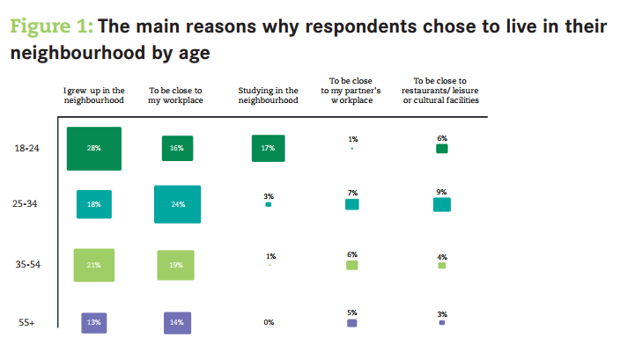
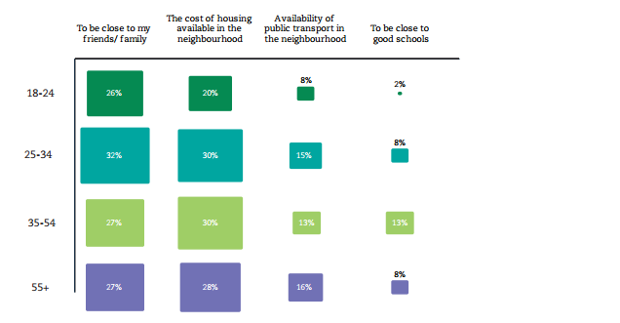
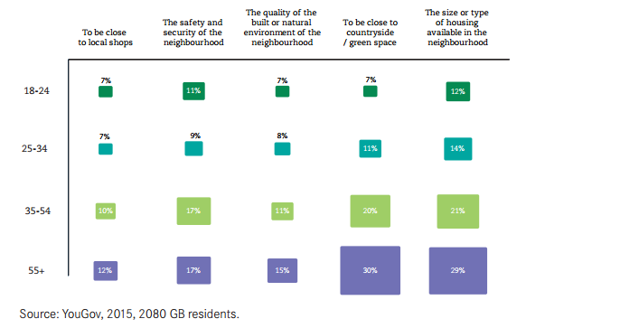
Not surprisingly, the key things that matter to people about the neighborhoods they live in include a mix of housing costs, being close to family, and proximity to where they work. More than a quarter (28 percent) of respondents cited housing costs and proximity to friends as key factors in the neighborhoods where they live, followed by the size and type of available housing (22 percent), and proximity to their workplace or their partner’s workplace (21 percent)…
Where people choose to live is largely determined by their stage of life. Young people aged between 25 and 34 prioritise proximity to the workplace, cost of housing, and access to leisure and cultural facilities when choosing where to live. Those aged between 35 and 55 tend to value access to good schools, and the size and type of their houses. And those aged over 55 prioritise access to countryside and green space.
These preferences help to explain the differing demographics seen across cities and their surrounding areas – different parts of cities are more able to offer amenities that are prioritised by people at different stages of their lives.
Overall, it sounds like two factors matter most even with the age differences: a favorable location in regards to social necessities (jobs and relationships) and good but affordable housing. Of course, obtaining these two goals may be quite difficult for many given that: families and friends don’t necessarily prioritize living near each other as opposed to living close to work or going where the jobs are, employers tend to be concentrated in certain locations, affordable and desirable housing can be very difficult to find in many popular areas, and consumers can’t exactly find housing that is everything that they want.
If age or life stage matters so much, should planners and others really go after lifestyle sorts of communities appealing to just one group or provide options for multiple groups within individual communities?
A couple of weeks ago, a really lovely historic home on a large lot in Lincoln Square listed. The house not only pre-dates the Great Chicago Fire, but it turns out that the house may actually be one of the oldest in Chicago. According to Crain’s, the original tax records show that a house on the property was built in 1849. It’s not exactly certain if the same house that hit the market two weeks ago is the same house, but either way, the home that does stand today was completed in the 1850s at the latest. However, out in the suburbs, there is one house that is also 166 years old and also on the market. The house at 2330 Coach Road in Long Grove, IL is one of the oldest houses in the Chicagoland area that is on the market. It’s also available to rent as well — for $2,200 per month. While its exterior certainly looks to be of very old construction, the interior has been completely renovated over the decades. While it may be common to find mid-19th century homes in cities on the East Coast, these houses in the Chicago area are about as old as they get out here.
This is about as old as it gets in the Chicago market. The northern parts of Illinois were not really settled until the 1830s. Illinois was declared a state in 1818 but a majority of the population lived in the central and southern parts as new residents came from the east via routes like the Ohio River. It wasn’t until the United States government got involved in planning and eventually constructing a canal in the northeastern part of the state to connect the Chicago River to the Des Plaines River (making a path from the Great Lakes to the Mississippi River) that settlers started arriving in larger numbers. Of course, once people started coming, things started changing: the Illinois & Michigan Canal opened in 1848, the first railroad in and out of Chicago opened in 1848, and Chicago started growing quickly (growing over 500% from 1840 to 1850, 274% from 1850 to 1860, and 167% from 1860 to 1870).
We first noticed a takeoff in suburban growth in 2013, following a stall-out in the Great Recession. This year research from Brookings confirms that peripheral communities — the newly minted suburbs of the 1990s and early 2000s — are growing more rapidly than denser, inner ring areas.
Peripheral, recent suburbs accounted for roughly 43% of all U.S. residences in 2010. Between July 2013 and July 2014, core urban communities lost a net 363,000 people overall, Brookings demographer Bill Frey reports, as migration increased to suburban and exurban counties. The biggest growth was in exurban areas, or the “suburbiest” places on the periphery…
Far from being doomed, exurbia is turning into something very different from the homogeneous and boring places portrayed in media accounts. For one thing exurbs are becoming increasingly ethnically diverse. In the decade that ended in 2010 the percentage of suburbanites living in “traditional” largely white suburbs fell from 51% to 39%. According to a 2014 University of Minnesota report, in the 50 largest U.S. metropolitan areas, 44% of residents live in racially and ethnically diverse suburbs, defined as between 20% and 60% non-white.
And how about the seniors, a group that pundits consistently claim to be heading back to the city? In reality, according to an analysis of Census data, as seniors age they’re increasingly unlikely to move, but if they do, they tend to move out of urban cores as they reach their 60s, and to less congested, often more affordable areas out in the periphery. Seniors are seven times more likely to buy a suburban house than move to a more urban location. A National Association of Realtors survey found that the vast majority of buyers over 65 looked in suburban areas, followed by rural locales.
This article throws out a lot of reasons why they might want to do this: wanting to own a single-family home, wanting more space (both in the home and in the community), feeling part of a smaller community, sending their kids to good schools, having communities with low crime, and accessing plenty of available jobs. Put another way, the exurbs have downsides but enough Americans consistently seem to want to live on the metropolitan fringe.
At the end, Kotkin suggests that planners and others need to own up to this reality: cities cannot provide these desirable traits. I wonder if that is the case; is the answer that it is either dense inner cities or sprawling exurbs? I think many cities and closer suburbs would want to be able to claim the positives cited above. And there are likely many pockets where this is possible even if not all residents of major cities have these advantages. But, instead of trying to suggest that all people should get used to dense city life or exurban life, why not look for more ways to enhance opportunities throughout an entire region? Perhaps it is a problem of government layers as every community looks out for their own interests first. Or perhaps this is still impossible in a country where race and social class matter tremendously for the kinds of places where people live. Rather than suggest Americans want to live in a certain kind of setting, we need solutions to issues in a variety of communities throughout metropolitan regions (and beyond).
I’m visiting Austin and heard about these McMansions. It’d be really cool to drive around and see some of these beasts. Which neighborhoods or streets are worth seeing?
The other thread participants then offer some good feedback for a city that recently instituted guidelines intended to reduce the number of new McMansions. But, if your city is known for its big houses, why not take advantage of this? Most cities would love to bring in more tourists who then spend money and demonstrate that the city is worth visiting. According to critics, McMansion owners want these homes in part because they want to impress others with the square footage and attention-grabbing architecture. Match this desire for visitors with the attention McMansion owners want (at least according to critics) and you could include such homes as important sights to see.
Of course, some cities might not want to highlight McMansions that are criticized for a variety of reasons. I’m guess Austin wants to be known for creativity and tech, not the poor architecture of overlarge homes. Similarly, I imagine many McMansion owners would not be thrilled if tour buses started regularly driving slowly past their homes giving tours.
At this point, I could only imagine regular McMansion tours being given by those who don’t like McMansions.
I recently saw my public library’s latest annual report with these figures on items borrowed:
While books are still the largest category, it isn’t much of a drop to the next category of DVDs. One interpretation of this data? The DVDs are nearly as important to the library’s patrons as DVDs. This makes the library one of the best video stores around with free prices and a decent selection.
It is the mission of the Warrenville Public Library District to collect, organize and make available the representative records of humanity’s actions, concerns and aspirations. It exists for the common good to support a literate and informed citizenry.
I know this trend has been underway for a while now as the DVDs might help keep people coming to the library and we certainly live in a visual culture. But, it would be interesting to think about how all those DVDs contribute to supporting a “literate and informed citizenry.” Of course, some could argue not all or even many books meet this guideline.
New Mexico State University’s distance education bachelor’s degree in sociology was ranked 10th in the nation for 2015-16 by TheBestSchools.org, an independent organization that focuses its ranking system on quality of programs, types of courses provided and faculty strength as well as school awards, rankings and reputation…
NMSU was listed on among the top 10 on TheBestSchools.org’s top 25 list for online sociology undergraduate programs behind schools such as Arizona State University, University of Colorado Denver and Oregon State University…
“Most of the faculty members are doing work on social issues that reflect life on the border or in the desert Southwest. So a student who lives in Toronto, Canada will take courses, not only on the basics of Sociology, such as social theory, methods, statistics, deviance, the family, etc., but they also will have an opportunity to take courses that reflect a part of the world that is so politically relevant. And they are taking these courses from faculty members who are living in that place of study. We are here.”
NMSU’s distance education bachelor’s program in sociology has grown since it began in 2003 and now serves approximately 120 majors.
See the full list of top sociology programs according to TheBestSchools.org here. There is an interesting mix of research schools (including several state system flagship schools) alongside other public and private options. The programs were selected according to these criteria:
We selected the degree programs based on the quality of the program, types of courses provided, and faculty strength, as well as school awards, rankings, and reputation.
Not surprisingly, there is not much overlap between this list and rankings of sociology programs according to sociologists and other academics. Yet, this second set of rankings is typically based on Ph.D. programs which is not going to be of use to many undergraduates. Is this list then that unusual if solely focused on sociology bachelor degrees?
Argos has painted new markings on the pavement outside its Liverpool store after research revealed almost half the nation found the slow pace of high streets to be their biggest shopping bugbear.
The new lane, being trialled this week in the Liverpool One shopping complex, hopes to help pick up the pace for those who are hurrying by bypassing the crowds.
New statistics show 31 per cent of people find pavement hoggers frustrating, while more than a quarter (27 per cent) get annoyed by dawdling pedestrians…
‘As the research demonstrates, a faster high street could vastly improve the overall shopping experience for British shoppers across the UK.
As a fast walker, I approve. However, I envision multiple problems arising:
The speed of fast walkers could vary quite a bit from each other. Various people could be moving faster than the general population but still not be moving fast enough for others in the fast track.
What happens when people inevitably wander into the fast track without knowing?
Where is the proper entrance and exit ramp on this track? This isn’t exactly like a moving walkway that has a clear beginning and end. Come to think of it, why not install more moving walkways that can help everyone move faster through a main corridor like this? (It does look like this is an outside setting so that’s an issue.)
How long can this experiment last? While there are a lot of pedestrians on many city streets, I’ve never seen fast lanes like this before.
“The basic idea is to have students use sociology to analyze the society of the wizardly world to be able to understand and compare and contrast between the Muggle world and the witching world,” Vandivier said.
About 30 students are taking the course, which Vandivier said is a large number for an online course, but she is glad for the active participation.
“Many of them are big Harry Potter fans. They get into arguments — not online, but when I’ve talked to some on campus — who’s the good guy and who’s the bad guy and who’s the Hufflepuff, and what that’s got to do with anything. It’s just so fun listening to them, and they are really emotionally invested in the different houses, in the different characters, in the different circumstances that happened and where they think things came from. Just all the ideology; it’s almost like a religion,” she said…
“If I were to teach a class on say, the cultures of India, I would first have to educate them on what the culture of India is. But in this situation, they already know, they already have it down,” she said. “And I’m just facilitating a compare and contrast, what’s the theme, what’s the difference, and what does that mean for each society? So that’s the great thing about Harry Potter.”
Why not use what students already know in order to demonstrate sociological concepts? And with the new Harry Potter play in the works, this might be a good time to capitalize on continued interest.
While the sociological study of pop culture may have been taboo decades ago, it is increasingly common today. The impact of such narratives are hard to deny, even as other traditional institutions (nations, families, race and class structures, education systems, etc.) draw ongoing attention.
Even Moses acknowledged that his methods were extreme. In fact, he had a term for it: The meat ax. New York, he argued, was already so dense and complex that you had to make cuts somewhere. Sure, other newly-planned metropolises could preserve history and make sure everyone was happy. But according to Moses, New York City needed drastic measures, as he argued in a quote from The Power Broker:
“You can draw any kind of pictures you like on a clean slate and indulge your every whim in the wilderness in laying out a New Delhi, Canberra and Brasilia, but when you operate in an overbuilt metropolis you have to hack your way with a meat ax.”
Imagine a bureaucrat saying that today! It was a time before preservation and urban advocacy existed in organised form. Preserving the grit of the city was a laughable idea — the city needed to be purged of its dirt, not protected…
This strange, antiseptic mindset can be traced alllllll the way back to Europe at the turn of the century, when academics and architects first started thinking about cities as living networks. The sociologist Georg Simmel, writing in 1903, was the first to really describe how cities affected the mental outlook of their inhabitants — city dwellers, Simmel reasoned, were blasé, even neurotic, because of the impersonal, overwhelming, and money-obsessed demands of the city.
But to the architects of 1920s and ’30s Europe, the city wasn’t just neurotic. It was actually sick. The thinking went that a city’s ills — crime, poverty, you name it — could be linked to its poor design its thoughtlessly narrow alleys and dirty streets, its crumbling tenements and poor plumbing. Le Corbusier described “the Cancer of Paris,” as Andrew Lees recounts in his book about the urbanism of the time.
If cities or neighborhoods are diseased, planners and others can justify all sorts of actions. Urban renewal in the mid 1900s operated on a similar premise: slums (often home to non-whites or immigrants) could not be redeemed and instead should be replaced with land use that would be much more valuable (and make a lot more money for developers and politicians). Why should older buildings or poorer residents stand in the way of progress for the city and region? Thus, many American cities moved forward with plans that did what Moses suggested: used a meat axe to chop away land from existing neighborhoods for highways, high-rises, and other land uses. While some of these projects have since been reversed (think the Embarcadero Freeway in San Francisco) or others never got off the ground (see freeway protests as detailed by historian Eric Avila), other projects continue to influence city life. In Chicago alone, think the major expressways in the city including the Eisenhower, the Dan Ryan, and the Kennedy as well as the University of Illinois at Chicago campus.
Bad stats are easy targets, though. Setting these aside, it’s much more difficult to wage a sustained critique of polling. Enter Robert Wuthnow, a Princeton professor whose new book, Inventing American Religion, takes on the entire industry with the kind of telegraphed crankiness only academics can achieve. He argues that even gold-standard contemporary polling relies on flawed methodologies and biased questions. Polls about religion claim to show what Americans believe as a society, but actually, Wuthnow says, they say very little…
Even polling that wasn’t bought by evangelical Christians tended to focus on white, evangelical Protestants, Wuthnow writes. This trend continues today, especially in poll questions that treat the public practice of religion as separate from private belief. As the University of North Carolina professor Molly Worthen wrote in a 2012 column for The New York Times, “The very idea that it is possible to cordon off personal religious beliefs from a secular town square depends on Protestant assumptions about what counts as ‘religion,’ even if we now mask these sectarian foundations with labels like ‘Judeo-Christian.’”…
These standards are largely what Wuthnow’s book is concerned with: specifically, declining rates of responses to almost all polls; the short amount of time pollsters spend administering questionnaires; the racial and denominational biases embedded in the way most religion polls are framed; and the inundation of polls and polling information in public life. To him, there’s a lot more depth to be drawn from qualitative interviews than quantitative studies. “Talking to people at length in their own words, we learn that [religion] is quite personal and quite variable and rooted in the narratives of personal experience,” he said in an interview…
In interviews, people rarely frame their own religious experiences in terms of statistics and how they compare to trends around the country, Wuthnow said. They speak “more about the demarcations in their own personal biographies. It was something they were raised with, or something that affected who they married, or something that’s affecting how they’re raising their children.”
I suspect such critiques could be leveled at much of survey research: the questions can be simplistic, the askers of the questions can have a variety of motives and skills in developing useful survey questions, and the data gets bandied about in the media and public. Can surveys alone adequately address race, cultural values, politics views and behaviors, and more? That said, I’m sure there are specific issues with surveys regarding religion that should be addressed.
I wonder, though , if another important issue here is whether the public and the media know what to do with survey results. This book review suggests people take survey findings as gospel. They don’t know about the nuances of surveys or how to look at multiple survey questions or surveys that get at similar topics. Media reports on this data are often simplistic and lead with a “shocking” piece of information or some important trend (even if the data suggests continuity). While more social science projects on religion could benefit from mixed methods or by incorporating data from the other side (whether quantitative or qualitative), the public knows even less about these options or how to compare data. In other words, surveys always have issues but people are generally innumerate in knowing what to do with the findings.


 Legally Sociable