Coming soon: more fully automated parking garages

Adding more automated parking garages could lead to more saved time and space:

Right now in the U.S., 22 garages already are using automated systems to store and retrieve vehicles, and it’s starting to scale up. Ground is breaking soon on a parking structure for a mixed-use development in Oakland, California, and it is claimed to be the newest such fully automated structure in the San Francisco Bay Area—and one of relatively few to allow public access (it will be visitor parking) and to be unmanned. The structure’s footprint is just 1600 square feet, the size required by seven surface-parking spots, yet it has 39 parking spaces over seven levels.

What it amounts to is virtually a dumbwaiter for cars. You drive the vehicle past a height sensor, then through a garage doorway and onto a platform—which itself is on what look like the tracks you’d find at an automatic carwash. Following instructions on a screen, you exit your vehicle, and visit a kiosk to get a ticket that you use to retrieve the vehicle upon your return. The system rotates the vehicle, loads it onto an elevator, and then stores it away on the appropriate shelf, potentially several stories up or down in a narrow-footprint building.

Retrieval, according to CityLift, the company behind the development, takes less than two minutes after inserting the ticket.

This summary is missing one key piece of information: how does this work financially? Putting more cars into less space should generate more revenue but this technology could be costly to purchase and maintain. In other words, how attractive would this option be to developers and owners of parking lots and garages?

I wonder how this might alter an experience I had in an underground garage in Chicago earlier this year. This particular garage was long and narrow with the lengthy side going away from the entrance. When we drove into the garage, it wasn’t much of a problem: we found the attendant and he had plenty of time to go find a spot further back in the garage. However, our return after a large sporting event concluded was more problematic. One side of the garage had cars stacked two deep, the other side had them stacked three deep, and the one attendant was running back and forth to bring cars up to the front of the garage. We were fortunate to be closer to the front of the line but I’m sure others behind us waited over an hour to have their car retrieved. Two minutes retrieval would be a significant help in this situation as would having fewer cars total in the garage (this helps with a rush of people coming in or out at the same time).
A sociologist goes to the Urban History Association meetings, Part Two

I posted several observations yesterday from my time at the Urban History Association meetings. I turn today to the three most interesting ideas or debates I heard when attending sessions and panels:

  1. On a session on public housing, the discussant made this observation: with all of these negative cases of big government involvement in public housing, perhaps we need to turn away from seeing this as the solution. The main issue is this: when the federal resources are earmarked for the poor and redevelopment, it always seems to end up in the hands of the wealthy and developers rather than with those who really need the assistance. (For another example of this that involves lots of government money but not public housing, see the book Crisis Cities about New York City after 9/11 and New Orleans after Hurricane Katrina.) He suggested then and in later conversation that doesn’t mean that government should be completely removed from public housing. However, more local efforts seem to allow more opportunity for success rather than a completely top-down approach.I’ve argued before that the private market can’t do much about affordable housing in the United States, let alone public housing. At the same time, I would agree that the record of the federal government regarding public housing is mediocre at best. Are there some middle-range solutions? (I’ll also acknowledge that sometimes it does seem to take the federal government to help local governments do the right thing. For example, the Chicago Housing Authority was a mess for decades and required some oversight.)
  1. On a panel on Jane Jacobs, one of the scholars highlighted her upbringing in Scranton, Pennsylvania as being particularly formative. While Jacobs is most associated with New York City and Toronto, she was shaped by this smaller big city, the third most populous Pennsylvania city at the time and a city that attracted a variety of residents to work in the coal mining industry. This made me think of two things: (1) Why don’t more scholars pay attention to smaller big cities that may not be as important on the global stage but still contain a large number of American residents and (2) how might Jacobs and fictional resident and booster Michael Scott of The Office get along?
  1. A later panel discussed the history of Silicon Valley. In a response to a question about the representativeness of Silicon Valley for understanding other places in the United States and around the world, at least one participant suggested the ideas, social life, and spatial dimensions of Silicon Valley were likely to spread elsewhere and become normal. Another participant pushed back, suggesting that many places have no interest in becoming like Silicon Valley or don’t have the knowledge or resources to follow such a path. Such a discussion highlights how a place devoted to creating things for the masses may be in its organization and daily life be very separate from the rest of the country.

A bonus nugget from a session: when the Illinois Tollways first opened, there were not enough customers/drivers. Thus, a marketing campaign kicked off and the commercials featured Mary MacToll. Enjoy.

A sociologist goes to the Urban History Association meetings, Part One

I attended and presented at the Urban History Association biennial meetings this weekend and I made some observations during my foray. Some thoughts:

  1. In the last five years or so, I’ve been to both specialist conferences – usually involving the sociology of religion – and general conferences – the American Sociological Association. They each have their perks. I particularly enjoyed two things about the specialty aspect of the UHA meetings: (1) it was nice to be with a group of scholars who shared a common set of readings and understandings of a particular social phenomena and (2) the smaller size seemed to allow for more conversations during and after sessions. Even though the conference drew attendees largely from R1 schools – and people from liberal arts colleges like myself were in short supply and tended to be from the Chicago area – it felt pretty inviting.
  2. Several quick observations on the discipline of history as I saw it practiced:
    -There was a tension between particular cases – micro history – and broad sweeping generalizations about social patterns. The micro history could be quite minute, perhaps focusing on a particular influential figure (or arguing why that figure should be viewed as influential) or brief time period while other papers and sessions focused on 50+ years or emphasized broader movements like modernism. Individual papers tended toward the micro while panels could think more broadly. I would guess that at least a few of the papers are part of larger works – dissertations, manuscripts – that touch on broader periods or forces.
    -There was an informal dress code for male attendees: dress shirt and jacket. Not everyone followed this but there were more sports coats and blazers than at the typical sociological gathering.
    -Race, class, and gender popped up now and then but this trinity of analysis wasn’t as present as at sociological meetings.
    -There were some interesting instances of trying to connect historical events to current events, particularly in a panel on Silicon Valley. But, often the papers stuck to their particular historical moment.
    -Almost every paper began with a story or anecdote from history. This is more acceptable with qualitative sociological work but rarer in sociology as a whole.
    -Every introduction I saw included a short bio of the scholar’s education and work. Sociologists rarely give this information. Does this suggest that pedigree is more important for the audience or do they benefit from having more information regarding the speaker?
  3. I realize that now eight years into my post-graduate school career, I feel much more comfortable at conferences. I had met only two of the conference attendees prior to the meetings but it was easier to introduce myself to others and participate when I had questions. During graduate school, I remember this being more difficult: who wants to talk to a lowly graduate student? My enjoyment of conferences has gone up as I feel like I have a leg to stand on (I have published works that people can read) and I feel like I can contribute (I’ve wrestled with a number of issues in my own work and in the classroom). These two factors work in another way: even as I do some urban history work, I likely would not have attended this meeting without receiving an invitation from the organizer of a session to submit a paper.

Tomorrow, I’ll present the three most intriguing ideas I heard at the conference from my one day of attending sessions.

GE moved to Boston to be near big ideas, disruption, competition

Big companies moving back to big cities is a trendy thing and here the CEO of General Electric describes their recent move back to Boston:

Immelt: You know, we wanted to get to a city. At the end of the day, I think for the company we wanted to get into a place where there was more of an every day where you could get up and be part of an academic setting. So I think it was important to get to a city...

I have to say it’s real. I thought it was a little bit of B.S. initially, I wasn’t sure. And when I looked out the window—when I was in Connecticut, it was beautiful, awesome, great office—but when I looked out my window, I saw nothing, there was nothing going on. I could watch cars go on the highway, things like that.

I’ve been Boston now six weeks and you just walk out the door. You’re in the middle of an ecosystem that quite honestly for a big company, it makes you afraid. You’re where the ideas are. You get more paranoid when you’re doing that and that’s a good thing. So I thought it was—

Isaacson: Only the paranoid survive!?

Immelt: No, no. It’s a good thing. When you’re a big company, it can get hidden but it’s important that you’re in touch with what the next idea is or what the next disruption is. And so I’m kind of a big believer that that’s the wave of the future.

The summary suggests this echoes Richard Florida’s approach to cities. Yet, when people talk about Florida, they often refer to his ideas about employees and the workforce: a talented, diverse, and tolerant workforce that is attracted to thriving cultural and entertainment scenes. Immelt is suggesting something else is also important: competition between ideas. In the suburbs, it is easy to become comfortable and become insulated from cutting edge thinking (and technologies?).

It seems like it wouldn’t be too hard to test this idea: cities produce more innovation and competition than suburban areas. Off the top of my head, it seems like Bell Labs did okay for decades in largely suburban office and R&D facilities. Are the various companies in Silicon Valley hampered by being in more suburban settings (or to put it another way, could they have been even more successful)? Is being in the metropolitan area enough to help spur innovation or does a physical location in an urban core (even opposed to being within city limits but not near thriving areas) near other firms and employees doing these things matter?

Photo illustrates two of the concerns about teardown McMansions

A news story about possible changes to Burbank’s guidelines for single-family homes includes a great depiction of a teardown McMansion:

burbankteardownmcmansion2013


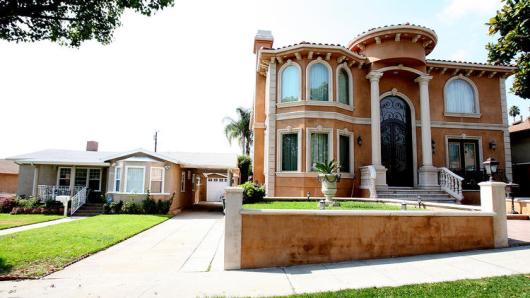
The image illustrates two common issues neighbors have with such new homes. First, the new home is significantly larger. Not just a little larger; a lot larger. Next to a postwar ranch home now sits a two story property that extends almost to the side property lines and partly due to its higher base now looms over the older, smaller home. Second, we don’t even have to go so far as to claim the architecture of the new home is garish; rather, it is significantly different from the next door ranch home. The small ranch home common to many suburban communities may not be much to look at (though they do have their own enthusiasts) but at least such homes are on blocks of other such homes. Once teardowns begin, the architectural continuity is lost and a hodge podge of homes emerges. A new owner of a teardown could attempt to do a lot to smooth over hard feelings among neighbors but the task is probably more difficult when such a disparity in size and architecture exists.

At the same time, pictures of teardowns can be taken in such a way that either highlight or downplay the differences between adjacent homes. However, I don’t think the picture above can be explained away by angles or camera lenses.


Once a home is labeled a McMansion, can it be redeemed?

McMansionHell recently examined a home in Flower Mound, Texas. A real estate insider asks what the listing agent is now supposed to do:

I post this not to be mean, because obviously this home has people who love it and it is someone’s home, no matter how much of a “mound” it is. There are some very pretty parts. I post it because I truly want your opinion: what would you do with a listing like this to make it more appealing?

A good question for either a real estate agent or a homeowner. With McMansion almost never serving as a positive term, I assume having a home labeled a McMansion is not going to (1) help with the selling price or (2) entice buyers. Even when such homes were really popular, I don’t think too many people would label the homes McMansions to help their cause.

Crazy idea: could you shame people and damage their lives by outing McMansion owners and agents who sell such homes? If you don’t like suburbs – and there are plenty of people who can’t stand them, including a number in academia – this could be an individual level strategy to discourage people from living there. Or perhaps some wealthy McMansion critic could buy up such homes and redevelop the property (presumably with structures they liked better or they could provide a memorial garden).

A better interpretation of crime statistics for Chicago suburbs

The Daily Herald looks at recent crime figures in Chicago area suburbs. How should we interpret such numbers?

Violent crimes increased last year in half of 80 suburbs, says a new report by the FBI we’ve been analyzing.

Property crimes increased in more than 40 percent of the suburbs.

The Uniform Crime Reporting Program’s 2015 report shows Rosemont had a 94 percent increase in violent crimes, from 18 in 2014 to 35 in 2015. Most are assaults, but the category also includes rape, homicide and robbery. The village had a 29 percent increase in property crimes, which include arson, burglary and vehicle theft.

Other more populous suburbs had larger numbers of violent crimes in 2015, including 650 in Aurora, 261 in Elgin and 128 in Naperville.

Violent crimes remained largely flat in Palatine, with 36; Des Plaines, with 50; and Arlington Heights, with 42; while some communities saw crimes decrease across the board. Buffalo Grove saw an 80 percent decrease in violent crimes, to 2, and an 18 percent decrease in property crimes, to 234, while Prospect Heights saw a 33 percent decrease in violent crimes, to 14, and a 29 percent decrease in property crimes, to 112.

What I would take away:

  1. Looking across communities, there was not much change as half of the suburbs did not experience a rise in violent crimes and property crimes increased in less than half of the suburbs.
  2. It is interesting to note larger jumps in crime in certain communities. However, these should be interpreted in light of #1 and it would be more helpful to look at crime rates in these larger suburbs rather than just relying on occurrences.
  3. The last paragraph notes some major changes in other suburbs. But, some of these suburbs are smaller and a large decrease (80% in Buffalo Groves means a drop from 10 to 2) or increase could be more a function of not many crimes overall rather than indicate a larger trend.
  4. There is little indication of crime figures or rates over time which would help put the 2015 figure in better perspective.

All together, the headline “40 suburbs see spike in violent crimes in 2015” is not the most accurate. It may catch the attention of readers but neither the headline or article sufficiently discuss the statistics.

Successful: reversing highway lanes to evacuate people ahead of a hurricane

As Hurricane Matthew approached, officials used all the lanes of highways:

Across swaths of Florida, South Carolina, Georgia, and North Carolina, half the highway lanes have reversed. Traffic engineers call this “contraflow,” the volte-face of normal traffic. Now, on both sides of these roads, vehicles only run one way—away from Hurricane Matthew

To select the exit routes months or even years before hurricane season, transportation planners turn to flood maps and atmospheric modeling. They predict hazards: wind, storm surge, freshwater flooding. They rely on traffic counts and experience to predict if and when residents will decide to finally leave their homes, and how…

The planners build computer simulations of their predictions, and tinker with the variables—down to specific intersections’ traffic signals—to speed up the process. With a few days notice, some regions choose to evacuate in waves, asking those living at low elevations to depart hours or even days before inland residents.

Rural regions often direct their residents toward one major highway, physically blocking off smaller roads. This undoubtedly results in jams, but some officials would rather have their populations—with their attendant gas, medical, and food needs—bunched together than spread throughout the hinterlands. Metropolitan areas are more likely to shut down an entire stretch of interstate, forcing cars onto side roads until they converge on bumper-to-bumper congestion miles from a flood zone.

It makes sense to use all available lanes going away from the hurricane, especially toward the end when few people would want to go the other direction. I would still be intrigued to see how many police such an effort requires and how drivers navigate on and off ramps going the opposite direction than normal. Even with all the lanes open one way, I imagine the traffic is not moving too fast.

If I remember correctly, reversing the lanes of highways was also on the table during the Cold War to quickly evacuate a major city. You can read a current-day guide to preparing for a nuclear blast here – there is no mention of highways. However, it does suggest more scenarios when people might be asked to evacuate:

Evacuations are more common than many people realize. Fires and floods cause evacuations most frequently across the U.S. and almost every year, people along coastlines evacuate as hurricanes approach. In addition, hundreds of times a year, transportation and industrial accidents release harmful substances, forcing many people to leave their homes.

While people may not think about evacuations much, I don’t think the highway lane reversals are common at all.

Sociology and totalitarian regimes

The discipline of sociology in Russia/the Soviet Union has faced problems over the decades:

Totalitarian regimes have a conflicted relationship with sociology. On the one hand, they have no elections or free media from which to learn about the public mood, so they need sociologists even more than democratic governments do. On the other hand, their fear of information is directly proportional to their need for it. They fear that sociologists, if allowed to work freely, will obtain knowledge about the vulnerabilities of the regime. An ideal totalitarian regime would find a way to obtain sociological data without the sociologists.

This push-pull relationship with sociology kept playing out throughout the Soviet period. For decades, sociology was effectively a banned discipline. Even Karl Marx, in official Soviet scholarship, was stripped of his sociological credentials, retaining the title only of “founder of scientific communism, teacher and leader of the international proletariat.” But starting in the 1950s, a little bit of sociology was allowed, under the auspices of philosophy — Marxist philosophy, of course…

The Levada Center retained its reputation as the most reliable source on Russian public opinion. Even federal ministries occasionally commissioned surveys from it. Sometimes the results of those differed little or not at all from those produced by the Kremlin-controlled pollsters.

But the Levada sociologists could not be controlled by the Kremlin, and that sealed their fate. In the end, the Kremlin’s fear of information became stronger than the desire to know, just as Mr. Gudkov knew it would.

This piece focus on one issue sociologists face within totalitarian regimes: dictators tend to want to control what information is available while sociologists generally want to make information available. Knowledge is power and those who try to subvert the official information stream are punished.

There is also at least one other issue regarding such information: what purpose should it serve? Do sociologists living in these conditions support or endorse the totalitarian actions? If so, are there justifiable reasons for doing so? Generally, sociology has thrived in places with more democratic governments and the discipline of sociology in the United States has shied away from ideas of fascism and totalitarianism, partly on the conservative end of the spectrum. (I’m sure there is work about this; the 1960s was an interesting point for sociology as prior to this, the discipline had some prominent conservative theorists.)

This could lead to an interesting question: is the practice of sociology generally limited to liberal democracies? In other words, it may only be possible under certain societal conditions and may not have emerged as it did without the changes to the nation-state and the start of the Scientific Revolution and the Enlightenment in Europe.

What can a political sociology class do? Perhaps change a highway name

Many highways and roads in the United States have local honorary names and one political sociology class wants to change who a nearby road honors:

University of Mary Washington students are all familiar with Jefferson Davis Highway, the road that leads to campus, Mary Washington Hospital and even Carl’s. Students walk over it to get to Giant, Eagle Landing and Home Team Grill but many students do not know the origin of its name. Students in the Political Sociology Class want to change that…

“The ultimate goal of our class project is to get the City Council of Fredericksburg’s approval to rename the Jefferson Davis Highway in the Fredericksburg area,” Greene said. “We are doing this project to show the public that we care about what our community represents, Jefferson Davis was a Confederate leader who owned approximately 100 slaves, why should we honor a leader who stood for inequality and the superiority of one race over another?”

Jefferson Davis was the owner of at least 113 slaves in his lifetime and was the president of the Confederate States of America from 1861 to 1865, and an embodiment of the values of the planter class. The United Daughters of the Confederacy decided to honor his memory by naming the highway after him…

For students who wish to get involved, Greene suggests showing support by “attending City Council meetings with our class, spreading the word amongst the campus and Fredericksburg community to help promote our mission by word of mouth and our Facebook page, and signing a petition that we plan to create in the near future. The more support we have from UMW, the more likely we are to make a change.”

I bet an analysis of all the honorary names in the United States would turn up a lot of figures who could be controversial. Take Chicago as an example: this helpful website helps makes sense of all of the honorary streets in the city. Given that roads and highways are built with taxpayer money, it makes some sense to have honorary figures who can appeal to everyone.

I like this class idea as a tangible goal for a political sociology course. Undergraduate students often ask how they can make an actual difference and this seems like an attainable goal. Along the way, the students will get opportunities to interact with local officials, the public, and other students and learn how to make such appeals.