Continuing to see Illinois highways as growth and job generators

The selection of a new executive director of the Illinois Tollway suggests the agency wants to continue to push growth:

Greg Bedalov, president and CEO of Choose DuPage, an economic development organization, will take over as executive director at the agency, officials said…

Rauner’s pick for Chairman Bob Schillerstrom told the Daily Herald that economic growth and job creation go hand-in-hand with the tollway.

It’s expected Bedalov will reflect that philosophy as the tollway heads into the third year of a massive $12 billion road building program…

In a 2012 op-ed piece for the Daily Herald, Bedalov talked about communities collaborating in the region instead of competing to create jobs.

“It is critical that local and county economic development agencies work collaboratively with state and federal agencies to uncover additional opportunities for economic wins,” he wrote.

This sounds like a growth machine approach to building tollways: providing increased capacity for vehicles will lead to new economic opportunities for businesses who want access to such transportation options, workers who can reach jobs more quickly, and developers who can develop and build nearby. The argument here is that this can be good for the entire region as the benefits of improved or new tollways would extend across communities.

Quickly, some possible objections:

1. It is really difficult to build new tollways in a region that is already largely developed. It is costly (acquiring land, environmental studies, increasing construction costs) and takes a lot of time.

2. Adding highway capacity just increases traffic: people see more available roads and drive on them. Why not put some of this transportation money into mass-transit and denser developments that could benefit from an economy of scale?

3. Who really benefits from such construction? The firms getting the contracts and the developers? How exactly do the benefits trickle down to the average resident?

The American rental market continues to get more expensive

A report shows the rental market continued to tighten in the United States in recent years:

And it’s probably getting rougher. “Rental markets tightened again in 2014 as the national vacancy rate fell by nearly a full percentage point to 7.6 percent—its lowest point in two decades,” Harvard’s researchers tell us. Meanwhile, rents rose at twice the rate of inflation, and faster than wages. However bad 2013 was when it comes to the country’s collective rent burden, it seems likely last year will look worse when the final numbers are in.

Rents are rising for the simple reason that, thanks to the never-ending hangover of the housing bust, a larger share of Americans are renting their living places now than they have in 20 years. And while developers have responded by building apartment buildings like mad—last year, there were the most multifamily housing starts for rent since 1987—it hasn’t quite been enough to keep up with demand. (Moreover, new construction is largely catering to wealthier buyers, while the families most burdened by rent tend to be lower-income.) Old, unwanted single-family homes from the boom days of the 1990s and early 2000s are relieving some of the pressure on the market, but not quite enough to keep prices from jumping.

Meanwhile, demand for rentals is probably going to keep rising. First, the Federal Reserve would really, really like to raise interest rates in the near future, which will make mortgages less affordable. But more importantly, millennials are getting older. Thus far, most of the growth in renting has been driven by middle-aged and older Americans. But even if young adults continue living with their parents at the same rate as today, there are simply so many twenty- and thirtysomethings that the rate of new household formation is bound to jump in the coming years, which is going to create much more appetite for rentals.

If expensive renting becomes the new normal, it would have widespread effects. Spending more money on rent means that people have less money to spend elsewhere, a problem in an economy driven by consumer spending. It could change how Americans view renters, which has negative connotations in a lot of wealthier suburban communities. Developers could continue to pursue different building options if they see a lot of money in multifamily housing. Lower-class residents may have a harder and harder time finding affordable housing, already a problem in many major housing markets. Denser development could shift ideas about homeownership and suburban life.

All that said, it remains to be seen whether this an economic stage or blip or whether the housing market will turn away from rental units and back toward single-family homes. Housing prices may be close to their 2006 peak but clearly fewer homes are being built and demand is down.


Use Airbnb to try a neighborhood before you buy a home

The neighborhood is an important part of purchasing a new home so I’m surprised it has taken so long to get to a solution like this: use Airbnb to try out the neighborhood before you buy.

Realtor.com and Airbnb have teamed up to show visitors to the realty website what Airbnb rentals are near properties listed for sale, so potential buyers can test-drive a neighborhood.

“This collaboration with Airbnb reinforces our commitment to giving consumers unparalleled insight to make informed real estate decisions,” Ryan O’Hara, chief executive officer of Realtor.com, said in a statement Wednesday. “Our relationship with Airbnb … allows us to reduce some of the unknown factors associated with relocating to a new community.”

I wonder how many people will take advantage of this. Even though Airbnb might make it easier to try the neighborhood yourself, it still requires the effort of signing up, actually staying, and then looking around and/or talking to people. And if you are going to go to the trouble to walk around and talk to people, do you actually need to stay the night? Remember, many neighborhood members may just be trying to avoid each other (examples here and here).

Perhaps the next step in all of this is to find a way for people to stay at the prospective home itself before they buy. Perhaps you could get two days and one night to stay there but have to put down a hefty fee. This may not work if the homeowners are still living there but it would offer an unparalleled look at a major purchase.

Applying Weber’s concept of disenchantment to Jurassic World

A journalist suggests Weber’s “disenchantment” could explain a world where scientists create new dinosaurs:

Yet the Indominus Rex’s business necessity is itself born of a spiritual void arguably endemic to capitalism itself. If “Jurassic Park” owes its ancestry to Mary Shelley’s Frankenstein, there’s a straight line between “Jurassic World” and Max Weber, the early 20th century German thinker whose celebrated 1917 lecture “Science As A Vocation” is one of the source texts for an important sociological concept known as “disenchantment.”

“Disenchantment” is the process through which empiricism replaces mysticism as an organising and motivating principle for both individuals and society at large. For Weber, the rise of capitalism meant that the rigors of daily existence started to find meaning through earthly and numerable concerns, rather than through one’s relation to an ineffable metaphysical power. In a sense, disenchantment is shorthand for the victory of the market over religion…

This is the movie about the moral, spiritual, and economic crisis of boredom at a dinosaur park. The crisis is not as far-fetched as it seems. We’re in the era where the Lourve, repository of the some of the world’s most sublime artistic accomplishments, isn’t immune from the selfie stick plague. There are now classes dedicated to taking Instagram photos of food. Look at all these people with their smart-phones out as Nationals pitching demigod Max Scherzer closed in on a (tragically blown) perfect game on June 20th. Layers of distraction and disenchantment separate people from even the rarest and most spectacular of events, even when they’re unfolding directly in front of them…

The movie is a kind of sly meta-joke about the traditional entertainment industry’s finely-honed ability to shovel as much brand identification and fan service down audiences’ throats as is humanly possible. The Indominus Rex — really just a larger, more violent version of “Jurassic Park’s” T-Rex — embodies the soul-deadening, almost self-destructive character of an industry whose primary commercial readout seems to be monstrous retreads. It’s a movie about the movies’ failure to impress audiences, and those audience’s enduring inability to be impressed by anything that’s genuinely new.

And that is why we continue to read and teach Max Weber in sociology courses from the introductory level to graduate school. If this was the subject of an end-of-the-semester research paper in a theory course, it could end up being pretty good. As noted here, Weber saw some of the benefits of capitalism and modernity but was pretty prescient regarding its consequences. Even critiques of the system – such as this film which highlights the downsides of science and progress – still have to play by the same rules, meaning that it has to sell to the mass public to be considered a “success.”

TV watching crushes all other leisure activities

Five Thirty Eight looks at the 2014 American Time Use Survey and finds TV still rules supreme:

Americans still spend more time watching TV than all other leisure activities combined:

Americans average 5.3 hours of leisure time per day (4.8 hours on weekdays and 6.5 hours on weekends and holidays) and over half that is spent in front of the television. Socializing and communicating is the next most popular activity and is the only one to nearly double on weekends (35 minutes on weekdays, 61 minutes on weekends).

libresco-datalab-timeuse

And an interesting parenting finding:

From 2010 to 2014, parents had deliberate conversations with their children for, on average, only 3 minutes a day, and they read to their kids for 2.4 minutes per day (about one picture book’s worth). Conversation with children helps spur language development, and several states run programs for low-income families, who may have less time at home, to help them engage their children and close the word gap.

That television still must provide something that other leisure activities just can’t compete with. Perhaps it is the compelling stories – something must be okay on those hundreds of channels. Perhaps it is just the plethora of options in HD on a big screen (improved TV technology goes a long ways, particularly for live events). Or maybe it is that TV doesn’t require much energy while many of the other leisure activities require more personal investment. For those who see this as a sign of civilization’s decline, at least Americans are persistent in their love for TV…

Linking longer commuting times to limited upward economic mobility

A recent study suggests that longer commute times are related to fewer people moving up the economic ladder:

Novara cites “recent research from Harvard University highlighting that commuting time has emerged as the strongest factor in determining whether a person escapes the cycles of poverty.”…

“These results are consistent with the view that the negative impacts of segregation may operate by making it more difficult to reach jobs or other resources that facilitate upward mobility. But any such spatial mismatch explanation must explain why the gradients emerge before children enter the labor market, as shown in Section V.E. A lack of access to nearby jobs cannot directly explain why children from low-income families are also more likely to have teenage births and less likely to attend college in cities with low levels of upward mobility. However, spatial mismatch could produce such patterns if it changes children’s behavior because they have fewer successful role models or reduces their perceived returns to education.”…

By Chetty’s numbers, commute time is up there with the fraction of single parents in terms of correlation. Family structure, is, of course, an age-old social concern; commuting time, not so much. All Chetty and his co-authors do is correlate, though they take a little stab at causation…

It’s not that commuting time is a magic bullet; no one factor Chetty studied is. But among the factors he did study—family structure, race and income segregation, school quality, social capital—it doesn’t get a lot of attention for its effects on social outcomes. And (as Yonah Freemark details) it’s something local governments can play a direct role in addressing.

“Spatial mismatch” is the idea that workers don’t live near the jobs they are likely to get. This happens often in metropolitan areas; cheaper housing is not necessarily near the jobs that those residents have or want to get. And I’m not sure cities and regions can do much about this; residential segregation tends to mean that higher-income and lower-income residents don’t often live near each other. The sort of white-collar jobs that could help people escape poverty may be located in suburban office parks, places that are not easily served by mass transit even if officials were willing to pour the money needed to get them up and running. If affordable housing and where businesses locate are simply left up to the market, they may have little incentive to locate near their workers.

“Touring the Deep Tunnel and Thornton Quarry,” one of the largest civil engineering projects in the world

Given the recent rain and flooding in the Chicago region, this seemed apropos: one journalist describes a recent tour of the Thornton Quarry and Deep Tunnel complex south of the city.

On Saturday, I joined the Southeast Environmental Task Force (SETF) on one of its tours of Chicago’s goliath infrastructure. The tour featured the future site of the Thornton Composite Reservoir, the largest such reservoir in the world, and a Deep Tunnel pumping station 350′ below ground at the Calumet Water Reclamation Plant. Both are part of the Metropolitan Water Reclamation District (MWRD)’s gargantuan Tunnel and Reservoir Plan, the multi-decade, multi-billion dollar project designed to protect the Chicago region from the flooding and pollution caused by overflowing sewer and stormwater infrastructure…

After this brief greeting, we drove to the former Thornton Quarry in the south suburban city of Thornton. The quarry, which is one of the largest aggregate quarries in the world, is still being actively mined nearby; however, the MWRD has acquired two significant portions of the area for the Deep Tunnel project. The resulting reservoir will hold 7.9 billion gallons of water, which MWRD Principal Civil Engineer Lou Storino estimated is the equivalent of 36 Soldier Fields. While on site, staff mentioned that we would be one of the last tours to descend to the base of the quarry, which will enter into operation shortly.

Tourists may find man-made sights like Hoover Dam impressive but Chicago area residents don’t have to go far to see similarly impressive projects. Not that the public could simply walk into the Deep Tunnel complex but you can glance at the quarry from the I-80/94 corridor. The Deep Tunnel project was quite costly and time-consuming but represents an effort to more effectively drain water away from Chicago, an on-going concern that even one of the largest civil engineering projects can’t solve on its own. This is what you get when you build a 9+ million metropolitan region centered on a swampy area near Lake Michigan…

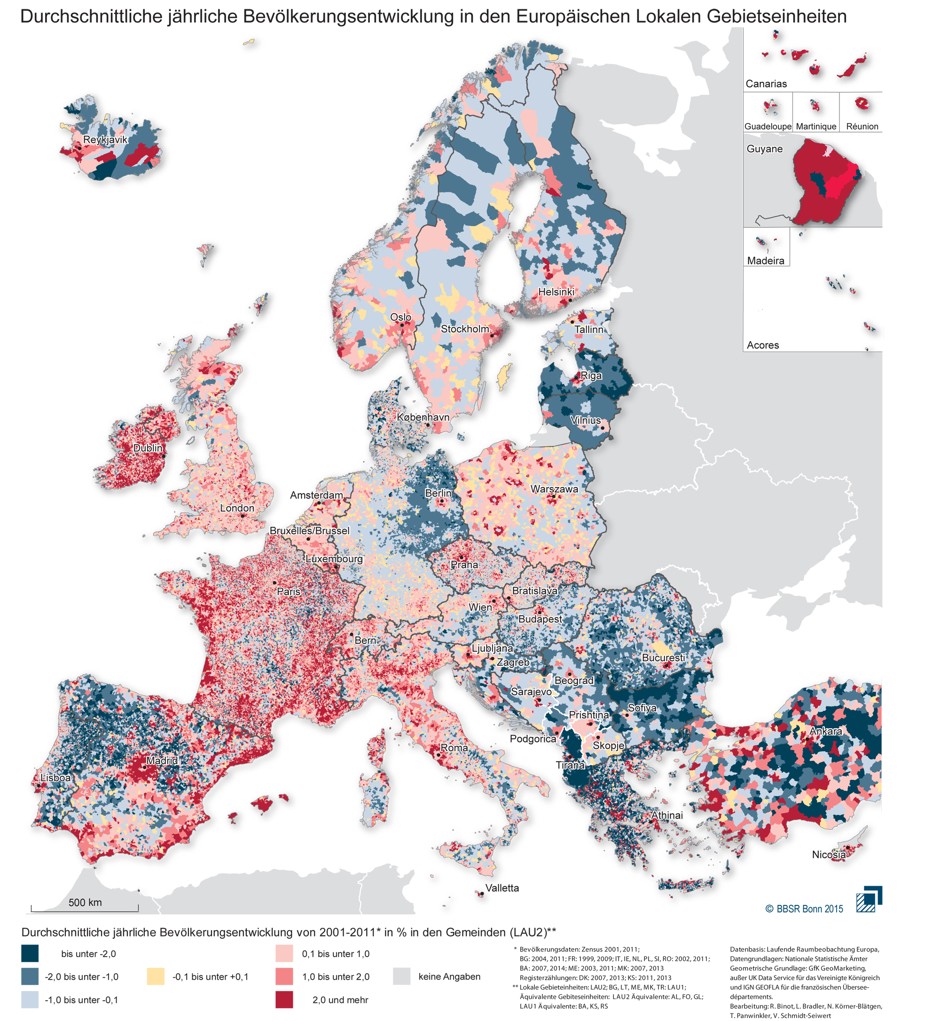
Detailed map of population changes in Europe, 2001-2011

A new map shows the population trends at work in Europe between 2001 and 2011:

Look at the Eastern section of the map and you’ll see that many cities, including Prague, Bucharest, and the Polish cities of Pozna? and Wroc?aw, are ringed with a deep red circle that shows a particularly high rise in average annual population of 2 percent or more. As this paper from Krakow’s Jagiellonian University’s Institute of Geography notes, Eastern cities began to spread out in the new millennium because it was their first chance to do so in decades…

We already know from other available data that Europe is experiencing a migration to the northwest, but the BBSR map adds complexity to this picture and reveals some interesting micro-trends. The dark blue coloring of the map’s Eastern section shows that the lean years for Eastern states are by no means over. Residents have continued to leave Albania, Bulgaria and Latvia in particular in search of jobs, while even relatively wealthy eastern Germany has been hollowed out almost everywhere except the Berlin region.

Population growth in the Northwest, meanwhile, is far from even. While large sections of Northern Scandinavia’s inland are losing people, there’s still modest growth on the Arctic coasts. And while the Scottish Highlands contain some the least peopled lands in all of Europe, Scotland’s Northeast shows remarkable population gains, a likely result of the North Sea oil industry concentrated in Aberdeen…

Spain’s trends look a little different from those of Europe as a whole. It’s actually in the country’s Northwest where the population has dropped most sharply, notably in the provinces of Galicia and León, which have long been known to produce many of Spain’s migrants.

But other previously impoverished regions, such as Southwestern Murcia, have grown, a trend continuing along the Mediterranean coast where population levels have risen sharply.

All of this may help explain reactions to migrants – population pressure is high in some places, particularly wealthier regions, while population loss is occurring in more economically depressed areas. It is also a helpful reminder of how relatively free people are to move between places. I don’t know how exactly this lines up with historic migration rates – particularly before the rise of nation-states which presumably allowed more of an ability to control population flows – but the industrialized world (and much of the rest of the world as well) is quite a mobile one.

“McAnger” over new big homes in New York City suburbs

Some new large homes in Westchester County have drawn some “McAnger”:

“This is really stupid,” wrote Laura Kerns. “No one needs this much house.”…”It’s sad, really,” David Raguso wrote. “This county just doesn’t care about the average person.”

Said Dana Doyle, “Bye bye, middle-class! The rich folk are taking over!”…

Like others, Daphne Philipson questioned the need for so much square footage. “The Gilded Age is back – and we know how well that went for everyone.”…

“Wretched excess,” he wrote. “There is nothing wrong with being financially successful, but why then not be reserved about it? How much house does a man need? Find meaning in meaningful things.”…Some were not so much annoyed but still critical of the new homes, critiquing the exterior appearance specifically as a hodgepodge of conflicting architectural styles. “Looks like it was thrown together at different times by different moods,” wrote Erika Kislaki-Bauer.

Eileen Healy Rehill lamented the addition of “more overly priced McMansions” in Westchester rather than “nice yet affordable housing for the middle class.” She was far from the only one, with housing for seniors and the disabled also mentioned.

Some familiar comments when McMansions are involved. Three quick thoughts, with the first two mentioned briefly in this summary of feedback:

1. Westchester County already is a wealthy county. It was known as the home to many wealthy estates as New York City was growing. A number of high-profile companies moved there post-World War II, including IBM. It is home to “Hipsterurbia.” In other words, McMansions are just symptomatic of a wealthy county where many communities would not welcome affordable housing and builders see ongoing opportunities for wealthy buyers.

2. These new homes are indeed large and luxurious. But, the conversation about “who needs this” can get sticky. How much do Westchester County residents consume? How many suburbanites buy a home that is too small for them? How many people don’t seek through the exterior of their home or the things inside to provide some markers of their social status? On one hand, Americans have historically tended to frown upon opulent wealth (hence, everyone wants to be middle class) yet consumption is rampant and the American middle class is very well off by American standards (though there may be a big gap between them and many Westchester County residents).

3. The critique of the architecture might seem class neutral. After all, people could build both big and small houses that match the local styles or are done in good taste. Yet, architectural styles and design are likely class-based tastes, a la Bourdieu.

Sociologists help Catholic Church understand itself but the data is not always welcome

Here is an interesting look at the reactions to the findings of the Center for Applied Research in the Apostolate:

Sociology wasn’t always viewed kindly when applied to church matters. Cardinal Roger Mahony (now retired) of Los Angeles once assessed as “nonsense” research done in the early 1990s by Richard Schoenherr of the University of Wisconsin predicting an impending priest shortage. Mahony said the work did the church a “disservice and “presumes that the only factors at work are sociology and statistical research. … We live by God’s grace, and our future is shaped by God’s design for his church — not by sociologists.” The predictions of the priest shortage, by the way, were remarkably accurate and decades ahead of the reality.

Not all church leaders feel that way, of course, and it was a prominent archbishop, Boston Cardinal Richard Cushing, who gathered other bishops and superiors of religious communities and donated $50,000 to start CARA…

Even the most convincing data can be upsetting when it gets in the way of a favorite narrative. Gaunt cautions that CARA’s inquiries can lead to rather pedestrian conclusions. For instance, he said, the center began to notice a drop in baptisms. The major theories being advanced in some quarters to explain the phenomenon blamed secularization and an anti-religious U.S. culture.

What didn’t fit, however, was CARA’s understanding that the decline was occurring in areas with lots of new Catholics. “This is in Dallas or Houston or Phoenix,” said Gaunt. “There are no parishes you can walk to. They all drive. And they’re overwhelmed. And this is where we’re beginning to find the drop in the number of baptisms. The data would suggest it’s not secularization — it’s parking. If you’re there with a baby, and you’re going to have to show up an hour early to try to get a parking spot and get in,” he said, that could cut into attendance and those early sacraments.

Some good discussion of how data can be used used by religious organizations: sometimes it goes well and sometimes the data is not welcome. I would think large organizations would want as much information as they could get but there are several issues when social scientists get involved. One, data doesn’t interpret itself – it simply provides more information that has to be acted upon. Second, interpretations of the data data can contradict folk theories and threaten those who hold such ideas.  Third, sociology can be viewed as antithetical to God’s work, either through its emphasis on society and humans or its tendencies toward liberal theories. Yet, hopefully good things can come from this marriage of sociological findings and church work.