The price to get your business on those blue highway amenities signs

It is a surprisingly complicated – and possibly costly – process to promote your business on a blue sign along the highway:

Roadside advertising programs are administered by individual states, though specific service signs like the one in the picture above tend to be farmed out to contractors. One of the biggest of these contractors is a company called Interstate Logos, which works with transportation agencies in 23 states to not only install the huge blue panels, but also to work with businesses to run the programs…

But even if your business meets all the requirements, and you’ve submitted your online application, there may be competition from other nearby businesses. As for which of those businesses get to be on the signs, that depends on the state’s policy. Colorado rotates the businesses at the end of each contract year, but other states like Michigan give preference to businesses nearer the highway, while still others like Washington use a first come-first serve (with waiting list) approach…

Typical mainline logo signs are about 48 inches by 36 inches, so based on WSDOT’s ballpark figures, it’s probably safe to figure about $300 to $500 per sign (this agrees with the Lexington Herald Leader’s claim of $1,253 for four logos)…

The sites says that in 2010, Kentucky Logos—contracted by the Kentucky DOT—paid the state $618,904.91. That’s great for the state, but according to the report, of the businesses on the 1,568 signs in the state, only 1 to 2 percent leave annually. So it seems the businesses are happy, too.

America: combining public services (highways) with business opportunities (advertising a select number of places for travelers to spend their money).

More thoughts on these signs:

  1. Why not include signs for big box stores? Places like Walmart or Target or Costco could provide most or all of these amenities in one stop.
  2. I don’t think the signs are as effective in denser areas where there a lot more options as you approach the exit. They can highlight a few options but you can already see a lot more signs in the distance.
  3. The lodging and camping signs seem outdated. How many people now drive down the highway and pick out a hotel at the side of the road? That sign space could be better used for other amenities.
  4. How effective are these advertisements compared to other forms? Does McDonald’s get a bigger return on the blue sign or a forty foot tall arch or a combination of both?
Losing sales and property tax revenue as stores close

The difficulties facing retail stores also have an effect on local governments who rely on sales tax and property tax revenue:

Nationwide, sales taxes comprise nearly one-third of the taxes that state governments collect and about 12 percent of what local governments collect, according to Lucy Dadayan, a senior researcher at the Nelson A. Rockefeller Institute of Government, a New York-based research group. “The epic closures of the brick-and-mortar stores is troubling news for state and local government sales-tax collections,” she said. They’re already feeling the hit: States’ tax revenues grew just 1.9 percent between 2014 and 2015, after growing 5.8 percent in the previous four quarters, according to the Rockefeller Institute. Local-government sales-tax collections grew just 1.7 percent, after growing 7.5 percent in the previous four quarters. In Ohio, state tax revenues grew just 0.1 percent, when adjusted for inflation, between 2015 and 2016, according to Dadayan. When revenues don’t continue to grow, governments have to slow down spending and can’t readily invest in long-term projects…

Clark County is not alone. In the southeastern part of Ohio, near the border with West Virginia, Belmont County gets $17 million of its $22 million budget from sales-tax revenues, Mark Thomas, a county supervisor, told me. The county has lost a bevy of retailers of late, including Elder-Beerman, Hhgregg, MC Sports, and Radio Shack. A Kmart in St. Clairsville is expected to close soon, according to the company. The decline in sales tax isn’t the only thing that hurts revenues—abandoned malls mean less revenue from commercial property taxes too. Local governments also see lower income taxes and, when retail workers are unemployed, they spend less, creating a vicious cycle of less and less revenue. “That trickle-down effect is huge,” Thomas said…

States that have seen manufacturing companies depart are bearing much of the brunt of the retail closures, according to Dadayan’s research. She tabulated where Macys, Kmart, and Sears have announced in the past year that they are planning to close stores, and found that Pennsylvania will have the most of those total store closings, at 16. Ohio and Michigan have the second-highest number, at 15 each, alongside Florida. Other states that have bigger populations have much lower combined closings. California, for example, only has eight.

The closures raise the question of what state and local governments will do if retail continues to evaporate. Already, many local governments are attempting to raise taxes to make up for budget shortfalls. Springfield asked voters to approve an income tax in November; the measure failed. The sales-tax rate at both the local and state levels has been creeping up in Ohio as governments try to raise taxes to make up for declines, according to Jon Honeck, the acting director of the Greater Ohio Policy Center, a local think tank. Ohio has also cut back on revenue-sharing between states and local governments since the election of Governor John Kasich in 2010, making it more difficult for local governments to make ends meet. “Some have just cut services, since the state is not going to help them out,” Honeck said.

Two quick thoughts:

  1. Communities have competed for decades over shopping malls and retail establishments. This competition could only increase though it may be less about the opening of new stories (everyone wants replacements for old establishments – for example, see the fate of Dominick’s grocery stores in the Chicago region) and more about retaining existing stores and asking companies to close stores elsewhere.
  2. It is interesting to see which areas are experiencing closures. Not all malls or stores are doing poorly but the successful ones are likely in wealthier areas that will do even better comparatively with the ongoing tax revenues. It is very difficult to convince businesses to locate in communities with less income.

NAR economist: “major housing shortage” in the US

The chief economist for the National Association of Realtors suggests there is a major housing shortage:

“A major housing shortage exists in this country,” Yun said in a statement. “It is therefore disappointing to witness in March the continued lackluster performance in new-home building, which was the second lowest activity over the past six months. Home prices have risen by 41 percent and rents have climbed 17 percent over the past five years at a time when the typical worker wage has grown by only 11 percent. To relieve housing costs, there simply needs to be more homes built.”

My first thought on this reading this: builders and developers are still skittish from the 2000s housing bubble. Instead of risking overextending themselves, compared to the past they are now focusing on more expensive homes or rental properties. Oddly though, I have seen little media coverage regarding builders and developers. They may be a secretive bunch generally but why isn’t there more scrutiny of their actions and motivations?

My second thought: if there is indeed a housing shortage, what does this say about the state of the economy? A booming construction sector is often related to a good economy. It doesn’t necessarily have to be this way in the future, particularly if there is a shift away from sprawl and homeownership of detached single-family homes, even if it was true in the post-World War II era.

Finally, who might be held responsible if there is indeed a housing shortage? It is hard to rally potential homebuyers into a cohesive group. Is there a way to prod politicians and business leaders to act and if so, could their actions even effect much change?

More on the reduced geographic mobility of Americans

A new book from economist Tyler Cowen discusses how the geographic mobility of Americans has declined:

Nowadays, moving from one state to another has dropped 51 percent from its average in the postwar years, and that number has been decreasing for more than 30 years. Black Americans, once especially adventurous, are now especially immobile. A survey of blacks born between 1952 and 1982 found that 69 percent had remained in the same county and 82 percent stayed in the same state where they were born…

One reason people don’t move where the jobs are is because of real-estate prices — which in turn are kept at high levels by regulatory restrictions and NIMBY-ism. In New York City in the 1950s a typical apartment rented for $60 a month, or $530 today if you adjust for inflation. Two researchers found that if you reduced regulations for building new homes in places like New York and San Francisco to the median level, the resulting expanded workforce would increase US GDP by $1.7 trillion. That won’t happen, though: More homes would diminish the property values of existing homeowners.

That locked-in syndrome is a factor in economic stagnation, too: A recent Wells Fargo survey found that white-collar office productivity growth was zero. As the economy was supposedly recovering from the financial crisis, from 2009 to 2014, American median wages fell 4 percent. Men’s median incomes today are actually below 1969 levels. Had we retained our pre-1973 rates of productivity growth, the typical household would earn about $30,000 a year more than it does.

Despite all the hype attached to a few tech companies, far fewer companies are being formed than in the 1980s, and fewer Americans are working for startups. Such new companies are linked with rapid job creation. We’re coming close, Cowen says, to realizing the 1950s cliche (not really true then) of everyone clinging to a job at a handful of huge, soul-crushing companies.

As I’ve seen a number of stories about declining mobility (see earlier posts here, here, and here), I wonder if the period between the early 1900s and 1960s was simply unusual. The American economy was doing well (except for the Great Depression and the World Wars) and other factors including legal segregation in the South drove mobility. What if more limited mobility is “normal” outside of unusual time periods? Should we expect that Americans should be willing to pick up and move just because there may be a job or an opportunity elsewhere? I would guess humans default toward less geographic mobility because moves limit the ability to develop communities. In fact, it has only been in recent centuries that more of the population has even had the opportunity to travel or move large distances from where they were born. Perhaps the real question here is to find out more of what would lead people (whether in the United States or elsewhere) to move significant distances.

Making money by betting on dying malls

Some are hoping to make a lot of money with the decline of shopping malls:

It’s no secret many mall complexes have been struggling for years as Americans do more of their shopping online. But now, they’re catching the eye of hedge-fund types who think some may soon buckle under their debts, much the way many homeowners did nearly a decade ago.

Like the run-up to the housing debacle, a small but growing group of firms are positioning to profit from a collapse that could spur a wave of defaults. Their target: securities backed not by subprime mortgages, but by loans taken out by beleaguered mall and shopping center operators. With bad news piling up for anchor chains like Macy’s and J.C. Penney, bearish bets against commercial mortgage-backed securities are growing…

Many of the malls are anchored by the same struggling tenants, like Sears, J.C. Penney and Macy’s, and large-scale closures could be “disastrous” for the mortgage-backed securities. In the worst-case scenario, the BBB- tranche could incur losses of as much as 50 percent, while the BB portion might lose 70 percent.

I’d love to see some analysis of whether this is a good development: it doesn’t sound like this will break the mortgage industry in the same way as the subprime mortgage crisis, clearly some investors have learned something from the past, yet the default of shopping malls can have a big effect on the local economy and community.

There is an interesting summary of the fate of the American shopping mall in the final paragraph of the article:

“When a mall starts to falter, the end result is typically binary in nature,” said Matt Tortorello, a senior analyst at Kroll Bond Rating Agency. “It’s either the mall is going to survive or it’s going take a substantial loss.”

This can’t be good in the short term, particularly if the retail money vanishes into the Internet ether. In the long run, it does hint at a very bifurcated retail experience in coming decades: wealthier places where shopping malls still thrive and are popular and other places where there is nothing but big box stores, the occasional strip mall, and online shopping.

Automated jobs could reduce tax revenues

I don’t know how accurate these figures are but it is an interesting argument: people might worry about losing jobs to automation but what about losing tax revenues?

The United States is in danger of losing more than one-third of its tax base thanks to increasing automation in both manufacturing and service sectors. Self-driving vehicles, self-serve kiosks, increases in manufacturing and energy production efficiency, and declining retail numbers all contribute to what is likely going to be a significant problem in the coming decades…

Conservative estimates put future job losses at 20 million with some estimates going up to as high as 70 million. When someone loses their job, they stop paying taxes, while their employers stop paying payroll and other types of taxes at the same time. Compounding the issue is the fact that many people who lose their jobs start to depend on the economic support of the government, along with their families…

A growing population and dwindling jobs will result in much higher levels of unemployment in working-age adults than we see now. To top it off, the number of people on either side of the working-age spectrum (under-18, over-67) are growing substantially. Something has to give at some point, whether that means the advent of a basic income system or substantial corporate/capital taxes, the transitional period we are currently in cannot last forever.

Something to keep an eye on. I could imagine this causing particular problems at the local level as less federal and state money is available at the same time that residents may have a harder time paying property taxes and other local fees.

Bad predictions: actively managed equity funds

An article about diversity in ETFs includes this figure about the prediction abilities of those who pick stocks:

A study by S&P Dow Jones Indices found that from 2006 to mid-2016, 87 percent of all actively managed U.S. equity funds underperformed the market.

In other words: not good. This is plenty of other evidence about this; see the work of Phillip Tetlock. Hence, the rise of ETFs.

One thing that this article on ETF does not address: if more business has moved to different financial instruments, what has happened to all of those stock pickers and hedge fund managers?

A college degree leads to more geographic mobility

Americans with a college degree are more likely to leave where they grew up and end up in metropolitan regions:

Today, people with a college degree are more likely than they used to be to move to metropolitan regions with good jobs and other people like them, and this means both that those regions do better over time and that the return on that education is even greater. Almost half of college graduates move out of their birth states by age 30, according to Moretti. Only 27 percent of high school graduates do. As booming cities draw in new college-educated workers, employers seeking these workers follow, and cities continue to gain strength like magnets. This improves the prospects of everyone in the region, including those without college degrees. The working-class strongholds that once prospered without college-educated workers, on the other hand, are doing worse and worse, as computers and robots replace the workers whose jobs haven’t been sent overseas, and, as a result, an oversupply of labor brings down wages for everyone still there.

It’s not just that a college degree leads to higher earnings or more opportunities; it is also that people with college degrees tend to cluster in certain locations. Even in a world where technology could theoretically allow workers to be far away from their workplaces, the clustering in desirable cities of employers, cultural scenes, and places to live with a high quality of life is linked to education levels.

Another side effect of this clustering is that cities tend to have diverse and vibrant economies while smaller communities simply can’t access multiple options. Thus, even if a smaller community has a single thriving industry, this may not work well:

Focusing on one type of industry could be a successful strategy; Warsaw, Indiana, a relatively small town in the northern part of the state, is the orthopedic capital of America, with dozens of orthopedic device companies small and large located there and a bustling economy as a result. Elkhart, Indiana is the epicenter of the recreational vehicle industry, and manufacturers and suppliers are located there, creating good jobs when the economy is doing well. Cities and towns may be able to convince a cluster of a certain type of companies to locate there, and reverse their decline. “Every place has to look at its comparative advantage, and find a niche,” Ross DeVol, the chief research officer at the Milken Institute, told me.

Having lived near Elkhart during the financial crisis, such a strategy can look good in boom times but be disastrous in down times.

Looking toward the future, are there any particular industries or sectors that would be willing to spread out geographically in order to build stronger American communities? This might limit their profits or make it difficult to attract certain employees but could it be worthwhile to invest in smaller communities in the long run (either for the communities or also for a competitive advantage)? Even sectors like health care are finding it difficult to maintain facilities in small towns because of the advantages that consolidation and economies of scale offer.

Are we already to the point where people live in rural areas because (1) they are “stuck” there or (2) because they are already well-off and have the resources or option to live there?

Trying to split Naperville’s downtown streetscape improvement costs

Downtowns need regular upkeep and maintenance but paying for streetscape improvements can be a tricky matter:

In an estimated $15 million project that’s expected to take six years once it begins, the city plans to upgrade sidewalks, install new benches and street furniture and enhance street corners throughout its commercial core…

City staff members are proposing the work be paid for over 15 years, with the city contributing half and downtown property owners the other half.

They say it’s a fair cost distribution because a strong downtown improves the city as a whole…

Problem is, those same downtown property owners who could be asked to foot the bill for sidewalks and benches also are still paying off the Van Buren Avenue parking garage — and will be until 2021, 20 years after it was constructed. They’re also paying for ongoing downtown maintenance and marketing through a separate special tax that’s renewed every five years.

As is suggested in the article by local leaders, perhaps this is simply the price of doing business in a popular suburban downtown: you chip in to help make the downtown better. This sort of public-private partnership can work well when there is a vibrant business scene. But, I could also imagine that these added costs make it more difficult for certain kinds of businesses to participate.

It would also be interesting to know how these streetscape improvements compare with efforts of others – whether municipalities or shopping centers – to improve their appearance and amenities. One way to view retail competition is as an arms race: who can create and foster the most vibrant scene? Who has the mix of stores, restaurants, recreational opportunities, parking, weather, and events that would lead consumers to go there rather than somewhere else? Not making such proactive improvements, even though they may be costly, could lead to falling behind.

Can you plan suburban growth around an Amazon distribution center?

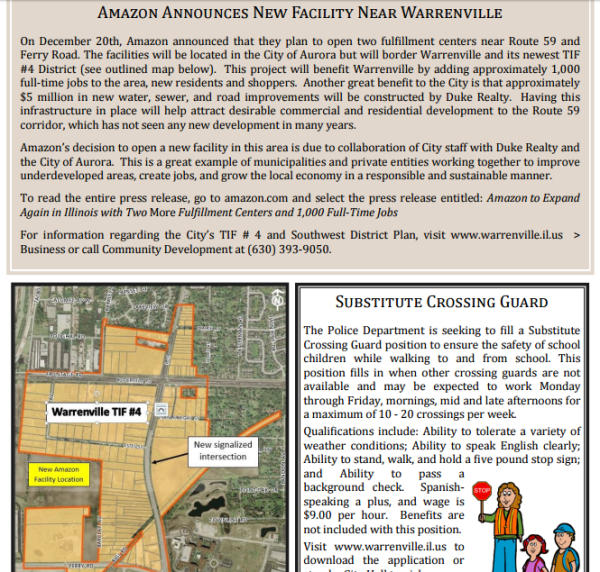
Thanks to state tax breaks, Amazon will soon begin construction on a new distribution center in northeast Aurora. The new facility is said to bring 1,000+ jobs. The latest newsletter from the City of Warrenville discusses the new facility. The facility is located near the border with Warrenville and the city thinks this will be a good for Warrenville:

warrenvilletifamazon

Can an Amazon facility be an economic boon for a suburb, particularly in a portion of the community that is underdeveloped? At the least, the 1,000+ workers will have to live somewhere. Could there be certain facilities that pop up to serve the workers – fast food places? Gas stations? Dry cleaners? Tattoo parlors (wait, Warrenville has enough of those)? Adding students to the school system?

I’m sure the city is either working on estimates of this and it would be worth sharing with the public. Connecting the dots between a warehouse/distribution facility and other community amenities is not obvious and what is Warrenville willing to do to capitalize on this opportunity?