Photo essay demonstrating LA’s mansionization

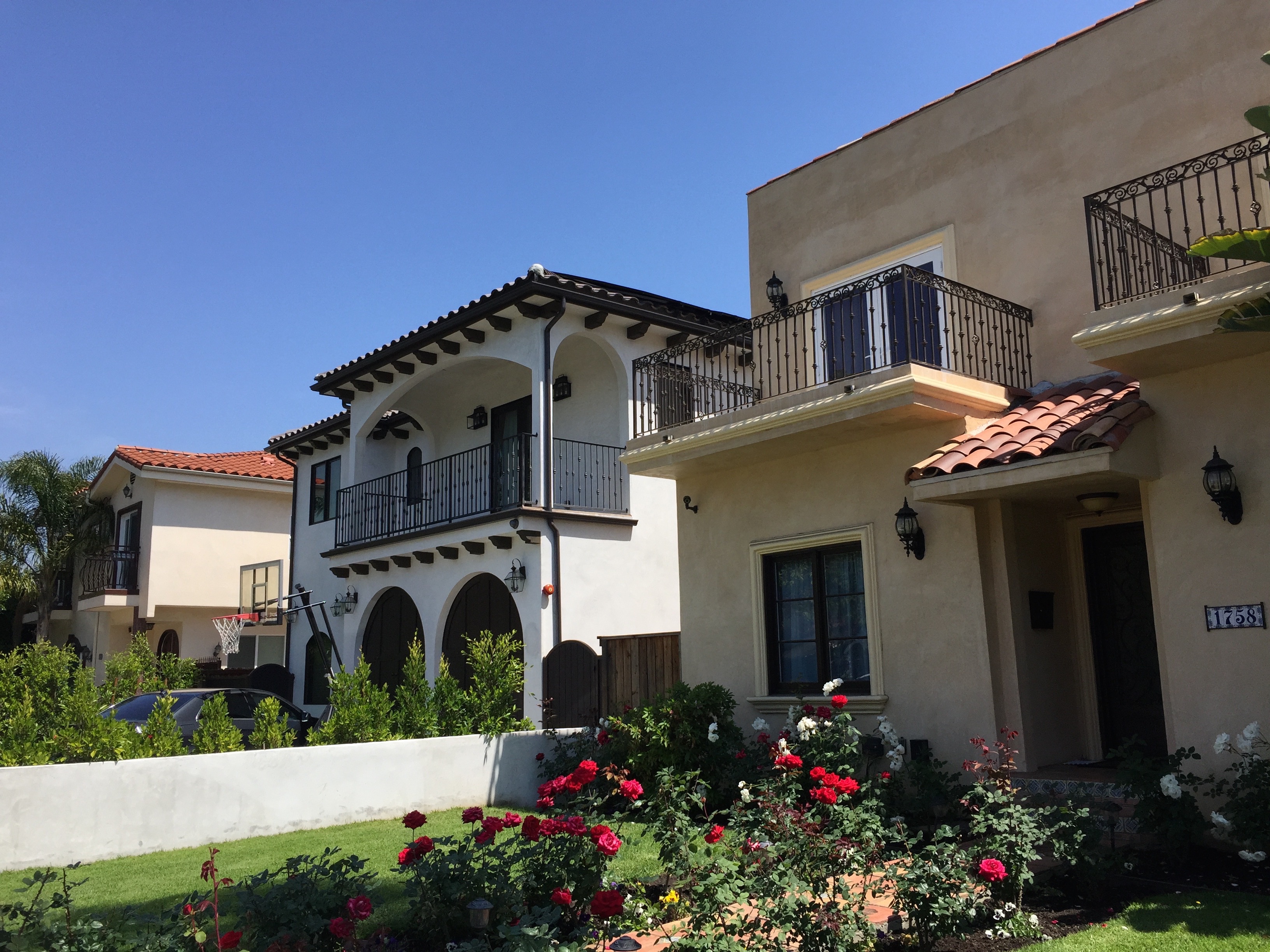
Here is a photo essay that shows the incongruity of a number of teardown McMansions in Los Angeles:

A developer wants to make as much money as he can as quickly as he can, where the only people whose feelings or quality of life he cares about are himself and whoever buys his newly-built mansion. A normal, thinking, feeling person could find many reasons why she would not want to rob her neighbor of privacy or sunlight by building a looming addition onto her house, with perhaps the most powerful reason being that her neighbors would hate her for it. A developer who will never live in a house he has built doesn’t have any relationships with neighbors to preserve. He actually stands to benefit from being indifferent/contemptuous to neighbors’ concerns, especially if it means he is able to build a bigger, more expensive, more obtrusive structure without the impediment of a guilty conscience. And don’t forget the long, noisy, messy, utterly unpleasant experience of living near a house under construction…

And that’s perhaps the biggest danger of mansionization. Regardless of what you think about mansionization and how it should or shouldn’t be regulated, there’s something about it that I’ve found to be consistently true.

When the first mansion goes up on a block of more modestly-sized homes, it sticks out like a garish eyesore. But if a second mansion is built on the same block, that first mansion suddenly doesn’t look nearly as big and out of place as it did before…

2015-07-01-1435742962-2381680-3inaRowGOOD.jpg
Three of a kindAnd at that point, the entire block might as well be mansionized — and chances are it will be. Having one mansion next to you is bad enough, but if the house on the other side of you gets mansionized, blocking sun and privacy from two sides, who would want to stay? Better to take what you can get and sell, leaving the house to a developer or new buyer who would inevitably go big — and another reminder of the now “old” neighborhood will be gone.
The critique of these new homes focuses on three areas:

1. It is often developers, and not neighbors, who go forward with the oversized homes. Neighbors might be more sensitive to the needs of others but developers are simply trying to maximize the property for profit. This may be true though there are plenty of cases where people buy properties with smaller homes and then make the decision to build a huge home. Developers aren’t the only ones to blame here.

2. The architecture and design of these new large homes are lacking. The homes are unnecessarily large and depart from traditional Southern California styles (stucco, clay tile roofs, etc.). These new homes clash with the older, smaller homes.

3. McMansions spread like a contagion: once a neighborhood or block has one, newer ones are soon to follow. The hint is that the teardowns need to be stopped at the start. A number of LA neighborhoods have been pushing for housing restrictions. But, it may be that one of these homes has to be built before neighbors really rally around the cause.

Beijing nearly doubles in population, environmental impact increases 4x

Rapid population growth in Beijing has led to a much larger environmental impact:

Researchers from NASA and Stanford University recently estimated that the area directly affected by Beijing’s urbanization has quadrupled in size from 2000 to 2009. So while the area we call Beijing has remained roughly the same size, its environmental influence has grown far larger. These findings, published this week in the Journal of Geophysical Research: Atmospheres, draw on new computer models and data from NASA’s QuikScat satellite.

From 2000 to 2014, Beijing’s population grew from around 11 million to 21 million—today packing as many people into one city as there are in all of Australia (or North Korea or Syria). Strangely, the study didn’t measure the effect of more greenhouse gas emissions released by these additional residents and their vehicles. Instead, it only measured the growth of physical infrastructure—for instance, new roads and buildings.

The changes in the city’s physical infrastructure had massive, compounding effects on its weather and climate. New roads, for instance, reduce the ground’s albedo, its ability to reflect light and heat away from the city, and buildings prevented air from circulating freely. Those effects have resulted in higher temperatures and lower wind speeds. Researchers found that winter temperatures had increased in the city by 5 to 7 degrees Fahrenheit, while wind speeds were reduced by about 2 to 7 miles per hour, making the city air even more stagnant, according to the American Geophysical Union.

Some have argued that larger cities may be better for the environment in the long run because they use less land (and Beijing did not increase in land mass during this period) and there are economies of scale. Yet, this may primarily apply to (a) cities in the wealthiest countries and/or (b) cities with slower rates of growth. Simply adding ten million people in 14 years probably isn’t good for the environment as even the most advanced cities of today would have a difficult time absorbing that many people in housing, let alone dealing with the environmental impact. For a comparison, see the major infrastructure efforts in the Chicago region to mitigate flooding: the region has grown but this happened over a century and the Chicago region still has 10+ million fewer people than Beijing. And still it is very difficult to get a handle on stormwater and flooding during major storms, let alone in a city adding 10 million people in 14 years.

Chicago Epic marketing cut due to state budget

Chicago rolled out an “Epic” campaign this spring to attract tourists but it is now no more due to a lack of state funding:

Chicago’s latest tourism campaign, Epic, is about to end two months early thanks to epic budget cuts at the state level.

Choose Chicago, the city’s tourism program, is losing 40 percent of its operating budget in the latest set of state budget cuts, according to Crain’s. That means Epic, the (perhaps unimaginative) summer tourism campaign launched in April with a TV ad encouraging viewers to “be part of something epic,” would end July 1 rather than run through the summer. Unless they are talking about an epically rainy June, the campaign ending this early wouldn’t leave much sizzle in the summer tourism industry.

Choose Chicago CEO Don Welsh said in statement that the program will lose most of its funding, from the state hotel tax, unless there is a last-minute approval of the state’s 2016 fiscal budget—increasingly unlikely as the week progresses…

The loss of Epic could deal a blow to Mayor Rahm Emanuel’s vow to boost tourism to 55 million visitors by 2020. Crain’s says Rauner, who was once the chairman of Choose Chicago, believes tourism is a boon to the local economy.

Two quick thoughts:

1. If you go with a catch term like “epic,” it is bound to be used sarcastically if something goes wrong (like the campaign ends early). Not exactly epic…

2. How do we – the public – know that such marketing campaigns work? Even though the Epic campaign is ending early, did it have any influence? Did the slogan catch on? What does this mean for future Chicago marketing campaigns? Just because a big campaign was out there doesn’t mean that it did much in this media and advertising saturated world.

Explaining why four Chicago neighborhoods haven’t had a murder in 3.5 years

Given Chicago’s reputation for violence, why have four Chicago neighborhoods – Mount Greenwood, Edison Park, Forest Glen, and North Park – not had a murder in recent years?

According to census data, 15,228 “law enforcement workers” live in Chicago, including about 12,100 police officers. Mount Greenwood, Edison Park and Forest Glen have some of the highest percentages of residents in the city working in law enforcement.

Crime in general is also low in these communities. For instance, between 2012 and 2014, not a single person was shot in Edison Park, which also reported only one criminal sexual assault. Forest Glen reported two sexual assaults. North Park had just 13 burglaries — which police Supt. Garry McCarthy calls a bellwether crime.

The city’s safest communities also have a high percentage of home ownership…

Another factor that stands out about some of the safest communities is wealth…

People in low-income neighborhoods tend to have a strong sense of community — with families living there for generations and looking out for one another, Papachristos says. But many young men have gravitated over the years toward gangs in those same neighborhoods, he says.

This article reads like a list of reasons for why crime happens in the first place (though at least broken windows theory is not invoked) and social scientists have found a range of reasons that might work in some situations and not others. However, we would suspect that areas that are wealthier have less crime as more people are living comfortably in the formal economy. This doesn’t mean these neighborhoods have no crime; there may be less violent crime but there are still some property crimes and likely crimes that are not caught including drug offenses and white collar crime (these might be even harder to uncover in wealthier areas).

If we follow the logic of this article, we would want to move high-crime areas toward the experiences of wealthier, higher quality of life neighborhoods that do exist in Chicago. Who is willing to take the steps to help this happen?

Obama bypasses Congress and talks to mayors about economic policies

President Obama talked to big city mayors yesterday in efforts to work outside of Congress:

White House aides say the U.S. Conference of Mayors meeting was an ideal opportunity to press the president’s agenda with a more sympathetic audience. White House spokesman Eric Schultz told reporters before the speech that it was a chance to move “forward on priorities helping the middle class despite inaction in Congress.”

The president urged mayors to raise the minimum wage, guarantee paid sick leave, and expand childcare and pre-kindergarten education — all issues with little traction among congressional Republicans…

Since Obama called for an increase to the minimum wage in 2013, 17 states and the District of Columbia have passed raises. Large retailers, including Wal-Mart Stores Inc, IKEA, and Gap Inc. have also pledged to increase the lowest hourly wage for their employees.

This could be viewed as a political ploy to shame Congress or subvert the typical process by which Washington works. In contrast, Obama’s strategy works with one of the standard lines about big-city mayors: they can’t be as partisan as legislators or those in the executive branch because they have to attend to more practical details on a regular basis. In other words, they have to make sure their cities work and can’t afford to get bogged down in ideological standoffs. (Interestingly, I heard this again recently at a conference in Chicago and there was some open laughter.)

That said, economic issues would certainly matter to many mayors as they need jobs for citizens as well as the economic benefits that come with jobs and economic growth (increased population, more tax revenues, increased prestige, etc.). Of course, there is disagreement about how to best do this. Chicago mayor Rahm Emanuel presents some of these contrasts. Is he pro-Walmart? He certainly seems to like attracting big corporations and tech start-ups. Is he truly interested in economic development in poorer neighborhoods? How much influence do wealthy businesspeople have in Chicago? He was behind raising the minimum wage in Chicago. Can he be considered non-partisan?

Whether Congress acts or not, cities and metropolitan regions are large economic engines and their leaders do have some latitude in policies that could encourage or discourage economic growth.

Naperville appoints first mayor emeritus

A new Pradel-less era is underway in Naperville – or not, considering he was just named mayor emeritus

All city council members said they agreed with the sentiment of recognizing Pradel and giving him a title from which to continue volunteering to represent the city at ceremonial events, as he has done so frequently for the past two decades…

The resolution creates the honorary position of “mayor emeritus” specifically for Pradel and only for as long as Steve Chirico, who proposed the position, is mayor. As mayor rmeritus, Pradel, 77, is envisioned to act as a “goodwill ambassador” for the city at ceremonial functions, and to do so without a salary or a budget…

But council member Becky Anderson said she thinks Pradel’s is a special case. He’s the city’s longest-serving mayor who also worked nearly 30 years as a police officer and became known as “Officer Friendly.” Anderson called Pradel Naperville’s “favored son.”

An interesting move that allows Pradel to do what many said was the thing he did best: be a cheerleader for Naperville. Yet, this raises two additional issues for me:

1. This could be viewed either as trying to maintain some continuity with the past (not necessarily a bad thing in a community that has been pretty successful in recent decades) or an inability to move on from the past and seize the new era.

2. Why don’t more local governments have such cheerleader/figurehead positions? This may be written into the jobs for certain people – say, mayors in certain forms of government who don’t have much power or economic development directors – but not everyone has the skills to do this. If countries have these sorts of positions – a president or prime minister who shows the public face but the real work is done elsewhere by other people – why not local governments? My first guess would be that they wouldn’t want another salary to pay.

Getting used to living next to Chicago’s L

WBEZ summarizes how several Chicago residents who live right next to the L tracks have adapted:

Maybe most surprising of all, everyone we spoke to says they’ve adapted to the noise and the shaking the train brings. And there’s a kicker. One expert tells us residents (neighbors to the tracks or not) should expect the CTA train lines to eventually get quieter, as the agency updates to newer train models and lines are revamped with noise mitigation in mind.

I’m not surprised. It is something you notice immediately if you are not used to it but it eventually fades away. I spent 10+ years growing up in a house within 500 feet of a major railroad line. There were 70+ trains, freight and passenger, per day and the noise and vibrations were quite noticeable. Yet, outside of having to turn the TV and radio up or down depending on whether a train was nearby, it just became part of normal life.

Perhaps the more interesting question here is whether these properties have reduced values. If so, and given the ability of many nearby residents to adjust, perhaps these properties are hidden gems?

Reflecting on McKinney, TX as Money’s Best Place to Live

Following the pool incident McKinney, Texas, one former resident thinks through how the event matches Money‘s claim that it is the Best Place to Live in the United States:

Before this month, the last time McKinney made major news was in the fall, when it was named the best place to live in America by Money magazine. It’s among the fastest-growing cities in the country, and lately big companies have infused the region with thousands of jobs in fields such as energy and aviation. Starting this year, Money wrote, every high-school freshman in McKinney would be issued a Macbook Air to aid in his or her studies.

“Underlying McKinney’s homey Southern charm is a thoroughly modern city,” the Money story gushed…

But the events of recent weeks suggest that even as McKinney has boomed and prospered, some of the more repressive aspects of small-town thinking persist. Perhaps now that so many have come to McKinney to claim what they feel is theirs—a better job, a bigger house, a more private swimming pool—people feel more entitled than ever to push away anyone unlike themselves. Perhaps some cops believe they have an even bigger mandate to crack down on those who pester the well-heeled. Adults at the pool were reportedly telling the black children to “go back to Section 8” housing, and in the aftermath of the incident, local homeowners defended the police. “I feel absolutely horrible for the police and what’s going on… they were completely outnumbered and they were just doing the right thing when these kids were fleeing and using profanity and threatening security guards,” one anonymous woman told Fox 4 in Dallas…

McKinney, more modern than ever, isn’t always recognizable as its former, sleepy southern self. (The Money article speaks of its art galleries, boutiques, and, oddly, shoe-repair shops.) But becoming a “thoroughly modern city” doesn’t just mean a job at Raytheon and access to craft beer. It implies compromise and integration. It requires an understanding of the fact that, in order for a newly rich town to keep growing, it needs a diverse environment in which every person feels at home. When McKinney tops the rankings as the best place to live, it’s worth considering for whom, exactly, that’s actually true.

A few thoughts:

1. Even the best places to live have ugly incidents. This reminds me of Naperville, Illinois which was ranked several times in the top 5 places to live by Money but which has some high profile crimes in recent years. Granted, the crimes were rare. But, Naperville has also dropped to #33 in the rankings.

2. Rapid population growth always comes with adjustments to the character of a community, particularly for suburbs. As late as 1990, McKinney had a population of just over 21,000. There will be rifts between old-timers and new-comers, people who remember when they could know everyone and those who are used to anonymity, those who resent new developments and others who like the new housing options. New populations will arrive – McKinney is over 10% black and over 18% Latino. The suburb will wonder how they can have a single community – and maybe this isn’t possible any longer.

3. Quality of life issues are huge in suburbs. Protecting private property through homeowners associations (and their private pools and security guards) and expensive housing (often leading to separate parts of town based on housing values) is common. Of course, there are places within suburbs where people across these divides do come together. But, the emphasis is often on private lives and avoiding open conflict with other suburban residents.

Chicago still leading the way for corruption

A new report finds Chicago is still at the top of American cities in corruption:

According to new research released today by University of Illinois at Chicago political science professor Dick Simpson, there were 45 convictions for public corruption in 2013 (the latest year available) in the U.S. court district that covers the Chicago area. That’s way, way above the 19 convictions in Los Angeles and 13 in the Southern District of New York (Manhattan). But Houston had far and away the most pols convicted on federal corruption charges in 2013, with 83.

Since the U.S. Department of Justice began to collect data in 1976, Chicago’s Northern District of Illinois, which includes Chicago, Cook County and 17 other counties, has had 1,642 convictions, according to Simpson. That compares with 1,316 in LA and 1,260 in the New York district, which includes Manhattan, the Bronx and six other counties…

If it makes you feel better, Simpson notes that on a per capita basis, Illinois is in seventh place. The District of Columbia, Louisiana, Mississippi, Alaska, and North and South Dakota rank higher than Illinois.

In this case, I don’t know if the quantification helps at all. When scholars or activists produce such figures, they are often trying to draw attention to a particular cause by pointing out the large numbers. This is how social problems are made. On the other hand, Chicago has had a reputation for corruption for decades. Do these numbers mean anything if residents of the region already expect this? Perhaps the comparison of numbers with other cities and regions can help. Yet, it doesn’t look like knowing these figures changes very much.

And what is going with Houston – is the oil money flowing a little too freely?

Naperville ranked as the 186th most diverse city out of 230 biggest cities

Naperville may be the safest big city but it doesn’t have much diversity according to new rankings from WalletHub:

As the culmination to our series on diversity studies, this final installment combines our previous reports on economic class diversity, ethno-racial and linguistic diversity, and diversified economies with household diversity to paint the clearest image of America’s cities today. Recognizing that economic opportunity follows diversity, where in the U.S. would you rather live? Better yet, where would your unique background be most valuable to society?

To help you answer those questions, WalletHub once again examined the demographic profiles of the 230 most populated U.S. cities. In order to construct our final rankings, we tallied each city’s scores in the four major diversity categories we analyzed in this series.

Los Angeles leads the way at #1 and Chicago is at #32 overall. For the record, Naperville ranks 125 in income diversity, 336 in educational diversity, 265 in racial & ethnic diversity, 170 in language diversity, 149 in region of birth, and 183 in industry diversity. Naperville is also listed as one of the five lowest in marital status diversity as well as in household type diversity.

The commentary on the rankings suggests that economic opportunity is linked to higher levels of diversity. This may be the case but it doesn’t necessarily mean that the economic opportunities are equitably spread across cities. Perhaps having opportunities nearby is better than no opportunities at all – though I’m reminded of some of the earliest American sociological neighborhood studies like The Gold Coast and the Slum that noted how closely the rich and poor could live near each other with no interaction. Even if Naperville is not diverse in many of these areas, that doesn’t mean that it can’t be wealthier or that it won’t be viewed as a desirable place to live (ask Money or other magazines). Indeed, some might see the lack of diversity as highly desirable for both defensible (wanting a higher quality of life – isn’t that what the suburbs are supposed to be about?) and indefensible (trying to avoid members of a different racial/ethnic groups or certain social classes).